WIRELESS DOOR LOCK CONTROL SYSTEM, Diagnostic DTC:B1242

| DTC Code | DTC Name |
|---|---|
| B1242 | Wireless Door Lock Tuner Circuit Malfunction |
DESCRIPTION
The door control receiver is used to receive radio waves relating to the entry functions of the electrical key transmitter sub-assembly. The certification ECU (smart key ECU assembly) decodes the requested electrical key transmitter sub-assembly by identifying a key code based on the radio waves received via the door control receiver. The door control receiver receives a signal from the electrical key transmitter sub-assembly and sends signals to the main body ECU (multiplex network body ECU) through the certification ECU (smart key ECU assembly). The certification ECU (smart key ECU assembly) then sends a command, according to the requested operation, to each ECU (ex. if door lock operation is requested, the certification ECU (smart key ECU assembly) sends a door lock command to the main body ECU (multiplex network body ECU)).
| DTC No. | DTC Detection Condition | Trouble Area |
|---|---|---|
| B1242 |
|
|
WIRING DIAGRAM
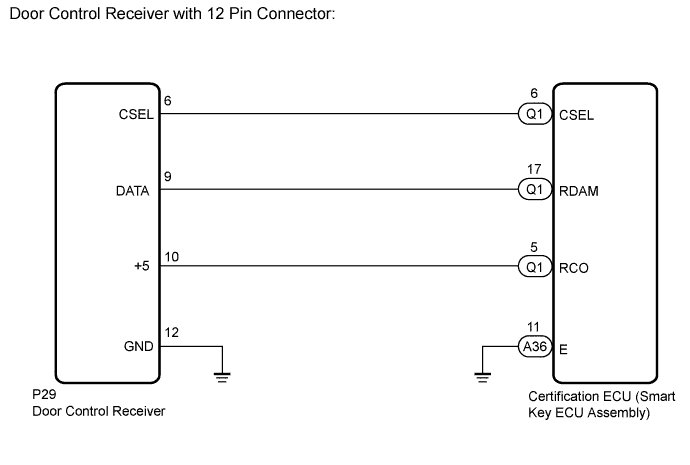
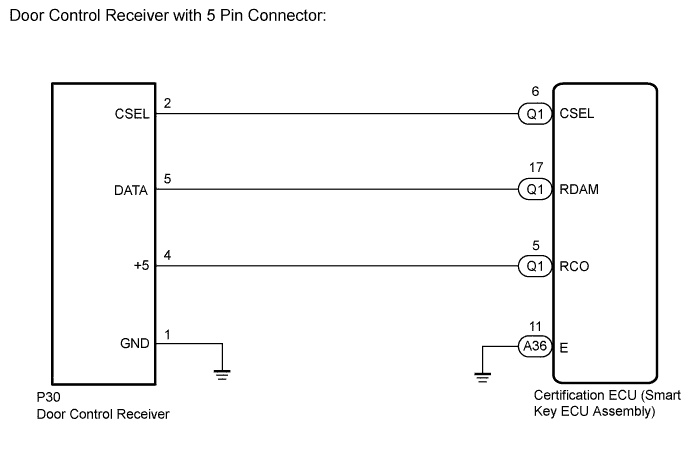
INSPECTION PROCEDURE
Note
-
When replacing or inspecting the door control receiver and wire harness, do not change the position or length of the wire harness. If the wire harness is too close to the door control receiver, smart and wireless function performance may be affected.
-
Before performing the inspection, check that there are no problems related to the CAN communication system Click here.
-
When replacing the door control receiver, read the transmitter IDs (tire pressure warning system) stored in the old ECU using the GTS and write them down before removal Click here.*
-
It is necessary to perform initialization Click here after registration Click here of the transmitter IDs into the door control receiver if the door control receiver has been replaced.*
-
This DTC is not detected within 10 seconds after the engine switch turned to off from on (IG).
-
*: for China and Taiwan
PROCEDURE
-
CHECK CERTIFICATION ECU (SMART KEY ECU ASSEMBLY)
-
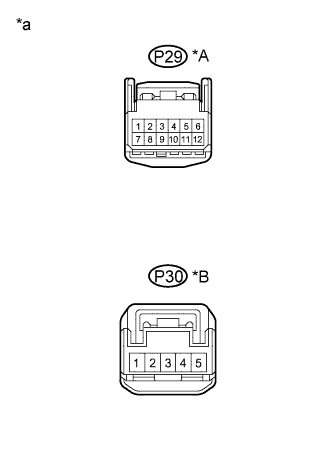
Text in Illustration *A Door Control Receiver with 12 Pin Connector *B Door Control Receiver with 5 Pin Connector *a Front view of wire harness connector
(Door control receiver)
Disconnect the P29*1 or P30*2 door control receiver connector.
-
*1: for 12 Pin Connector
-
*2: for 5 Pin Connector
-
-
Measure the resistance and voltage according to the value(s) in the table below.
Standard Voltage Door Control Receiver with 12 Pin Connector Tester Connection Condition Specified Condition P29-10 (+5) - P29-12 (GND) Engine switch off, all doors closed and electrical key transmitter sub-assembly switch not pressed → electrical key transmitter sub-assembly switch pressed Below 1 V → 4.5 to 5.5 V P29-9 (DATA) - P29-12 (GND) Engine switch off, all doors closed and electrical key transmitter sub-assembly switch not pressed → electrical key transmitter sub-assembly switch pressed → electrical key transmitter sub-assembly switch released Below 1 V → 10 to 16 V → Below 1 V Standard Resistance Door Control Receiver with 12 Pin Connector Tester Connection Condition Specified Condition P29-12 (GND) - Body ground Always Below 1 Ω Standard Voltage Door Control Receiver with 5 Pin Connector Tester Connection Condition Specified Condition P30-4 (+5) - P30-1 (GND) Engine switch off, all doors closed and electrical key transmitter sub-assembly switch not pressed → electrical key transmitter sub-assembly switch pressed Below 1 V → 4.5 to 5.5 V P30-5 (DATA) - P30-1 (GND) Engine switch off, all doors closed and electrical key transmitter sub-assembly switch not pressed → electrical key transmitter sub-assembly switch pressed → electrical key transmitter sub-assembly switch released Below 1 V → 10 to 16 V → Below 1 V Standard Resistance Door Control Receiver with 5 Pin Connector Tester Connection Condition Specified Condition P30-1 (GND) - Body ground Always Below 1 Ω Result Result Proceed to NG A OK (Door Control Receiver with 12 Pin Connector) B OK (for 5 Pin Connector and except Brazil, Aruba, Costa Rica, Panama or Nicaragua) C OK (for 5 Pin Connector and for Brazil, Aruba, Costa Rica, Panama or Nicaragua) D
B 
REPLACE DOOR CONTROL AND TIRE PRESSURE MONITORING SYSTEM RECEIVER ASSEMBLY Click here
C
REPLACE DOOR CONTROL RECEIVER (for Rear) Click here
D
REPLACE DOOR CONTROL RECEIVER (for Quarter) Click here
A 
-
-
CHECK HARNESS AND CONNECTOR (DOOR CONTROL RECEIVER - CERTIFICATION ECU (SMART KEY ECU ASSEMBLY))
-
Disconnect the A36 and Q1 certification ECU (smart key ECU assembly) connectors.
-
Measure the resistance according to the value(s) in the table below.
Standard Resistance Door Control Receiver with 12 Pin Connector Tester Connection Condition Specified Condition Q1-6 (CSEL) - P29-6 (CSEL) Always Below 1 Ω Q1-17 (RDAM) - P29-9 (DATA) Always Below 1 Ω Q1-5 (RCO) - P29-10 (+5) Always Below 1 Ω A36-11 (E) - Body ground Always Below 1 Ω P29-12 (GND) - Body ground Always Below 1 Ω Q1-6 (CSEL) or P29-6 (CSEL) - Body ground Always 10 kΩ or higher Q1-17 (RDAM) or P29-9 (DATA) - Body ground Always 10 kΩ or higher Q1-5 (RCO) or P29-10 (+5) - Body ground Always 10 kΩ or higher Standard Resistance Door Control Receiver with 5 Pin Connector Tester Connection Condition Specified Condition Q1-6 (CSEL) - P30-2 (CSEL) Always Below 1 Ω Q1-17 (RDAM) - P30-5 (DATA) Always Below 1 Ω Q1-5 (RCO) - P30-4 (+5) Always Below 1 Ω A36-11 (E) - Body ground Always Below 1 Ω P30-1 (GND) - Body ground Always Below 1 Ω Q1-6 (CSEL) or P30-2 (CSEL) - Body ground Always 10 kΩ or higher Q1-17 (RDAM) or P30-5 (DATA) - Body ground Always 10 kΩ or higher Q1-5 (RCO) or P30-4 (+5) - Body ground Always 10 kΩ or higher
NG
REPAIR OR REPLACE HARNESS OR CONNECTOR
OK 
REPLACE CERTIFICATION ECU (SMART KEY ECU ASSEMBLY)
-