PRE-CRASH SAFETY SYSTEM SYSTEM DESCRIPTION
-
PRE-CRASH SAFETY SYSTEM DESCRIPTION
-
The pre-crash safety system uses the pre-crash alarm control, pre-crash brake assist control and pre-crash brake control to help avoid a collision or reduce the impact if it determines that the possibility of a collision is high or a collision is unavoidable based on the position and relative speed of a preceding vehicle.
-
The operation of this system can be disabled by using the pre-crash safety system cancel switch assembly.
Tech Tips
When the pre-crash safety system operation is disabled, the PCS OFF warning light on the combination meter will be illuminated.
-
-
PRE-CRASH SAFETY SYSTEM SENSOR DESCRIPTION
-
The millimeter wave radar sensor assembly and forward recognition camera detect the position and relative speed of preceding vehicles and pedestrians*. This information is sent to the driving support ECU to determine if the possibility of a collision is high or a collision is unavoidable.
Tech Tips
*: Depending on the vehicle destination and specifications, the pedestrian detection function may not be available.
-
-
FUNCTION OF MAIN COMPONENTS
Item Outline Millimeter Wave Radar Sensor Assembly
-
Radiates millimeter radar waves forward and uses reflected waves to detect the distance to, direction of, and relative speed of objects in front of the vehicle.
-
Sends information (the distance to, direction of, and relative speed of detected objects) to the driving support ECU assembly.
Driving Support ECU Assembly
-
Determines if the possibility of a collision is high or a collision is unavoidable based on the signals from each sensor and sends brake request signals to the skid control ECU.
-
Sends request signals to illuminate the warning lights, display related information on the multi-information display in the combination meter assembly and sound a buzzer.
Forward Recognition Camera Captures images of the area in front of the vehicle and processes them to detect preceding vehicles or pedestrians and sends information to the driving support ECU assembly. Airbag Sensor Assembly (Yaw Rate and Acceleration Sensor) Detects the yaw rate and acceleration of the vehicle and sends signals to the driving support ECU assembly. Steering Angle Sensor Detects the steering angle and direction and sends signals to the driving support ECU assembly. Vehicle Speed Sensor Detects the wheel speed and sends signals to the skid control ECU. Stop Light Switch Assembly Detects the depression of the brake pedal and sends signals to the skid control ECU. Engine Room Junction Block Assembly (Integration Relay) Illuminates the stop lights based on the pre-crash brake control operation signal from the skid control ECU. Steering Pad Switch Assembly
-
Used to turn the pre-crash safety system on and off.
-
Can be used to change the warning timing of the pre-crash safety system between "Far", "Mid", "Near".
VSC OFF Switch Disables the pre-crash brake assist control and pre-crash brake control if pressed and held. Brake Booster with Master Cylinder Assembly (Skid Control ECU)
-
Performs pre-crash brake control based on brake request signals from the driving support ECU assembly.
-
Sends wheel speed signals to the driving support ECU assembly.
-
Detects the brake request signal and sends a signal to the engine room junction block assembly (integration relay).
Combination Meter Assembly
-
Displays "BRAKE!" on the multi-information display and sounds a buzzer to inform the driver when the pre-crash alarm control is being performed operated.
-
Illuminates the PCS OFF warning light when the pre-crash safety system is off.
-
Warns the driver of a pre-crash safety system malfunction by displaying a message on the multi-information display, illuminating the master warning light and blinking the PCS OFF warning light.
-
Warns the driver when the pre-crash safety system is temporarily unavailable when the area of the windshield in front of the camera is dirty or fogged up by illuminating the PCS OFF warning light. Warns the driver when the pre-crash safety system is temporarily unavailable when the area of the windshield in front of the camera is not dirty or fogged up by blinking the PCS OFF warning light.
Skid Control Buzzer Assembly Sounds to warn the driver when the pre-crash alarm control is operated. Main Body ECU (Multiplex Network Body ECU) Sends vehicle destination country information to the driving support ECU assembly. -
-
OUTLINE OF PRE-CRASH SAFETY SYSTEM
-
OUTLINE OF PRE-CRASH ALARM:
-
When the driving support ECU assembly determines that the possibility of a frontal collision is high, a warning message is displayed on the multi-information display and a buzzer sounds to warn the driver to take evasive action to avoid a collision.
-
-
OUTLINE OF PRE-CRASH BRAKE ASSIST CONTROL:
-
When the driving support ECU assembly determines that the possibility of a frontal collision is high, the pre-crash brake assist control enters standby mode. When the driver depresses the brake pedal, the pre-crash brake assist control increases the brake fluid pressure to improve the fluid pressure response and rate of deceleration.
-
-
OUTLINE OF PRE-CRASH BRAKE CONTROL:
-
When the driving support ECU determines that a collision is high, the brakes are automatically operated in order to reduce the vehicle speed to help avoid the collision or reduce impact of the collision. At the same time the brakes are operated, the stop lights are illuminated to inform drivers in following vehicles that the vehicle is slowing down.
Tech Tips
If the vehicle is stopped by the pre-crash brake control before a collision occurs, the control will continue for up to 2 seconds unless the driver depresses the accelerator pedal or brake pedal.
-
Pre-crash brake control operation will be canceled if any of the following conditions are detected:
-
The accelerator pedal is fully depressed.
-
The steering wheel is turned greatly or abruptly to avoid a collision.
Control Operation Control Operating Condition Transmitting ECU Receiving ECU Part Operated Pre-crash alarm Possibility of a collision is high Driving Support ECU Assembly Combination Meter Assembly
-
Combination Meter Assembly (warning message)
-
Skid Control Buzzer Assembly (warning buzzer)
Pre-crash brake assist
-
Possibility of a collision is high
-
The brake pedal is depressed
Driving Support ECU Assembly
-
Combination Meter Assembly
-
Brake Actuator Assembly (Skid Control ECU)
-
Combination Meter Assembly (warning message)
-
Skid Control Buzzer Assembly (warning buzzer)
-
Brake Actuator Assembly (Skid Control ECU)
Pre-crash brake Possibility of a collision is very high Driving Support ECU Assembly
-
Combination Meter Assembly
-
Brake Actuator Assembly (Skid Control ECU)
-
Combination Meter Assembly (warning message)
-
Skid Control Buzzer Assembly (warning buzzer)
-
Brake Actuator Assembly (Skid Control ECU)
-
-
-
-
PRE-CRASH SAFETY SYSTEM OPERATION CONDITIONS
CAUTION:
Always observe the legal speed limit when driving on public roads.
CONTROL OPERATION CONDITIONS FOR EACH SPECIFICATION Specification Pre-crash Alarm Pre-crash Brake Assist (PBA) Pre-crash Brake (PB) 1
-
The pre-crash safety system is ON.
-
Vehicle speed is between approximately 10 and 180 km/h (7 and 110 mph).
-
The relative speed to a preceding vehicle is approximately 10 km/h (7 mph) or more.
-
For detecting a pedestrian, vehicle speed is between approximately 10 and 80 km/h (7 and 50 mph).
-
The pre-crash safety system is ON.
-
The VSC is enabled.
-
Vehicle speed is between approximately 30 and 180 km/h (20 and 110 mph).
-
The relative speed to a preceding vehicle is approximately 30 km/h (20 mph) or more.
-
For detecting a pedestrian, vehicle speed is between approximately 30 and 80 km/h (20 and 50 mph).
-
The pre-crash safety system is ON.
-
The VSC is enabled.
-
Vehicle speed is between approximately 10 and 180 km/h (7 and 110 mph).
-
The relative speed to a preceding vehicle is approximately 10 km/h (7 mph) or more.
-
For detecting a pedestrian, vehicle speed is between approximately 10 and 80 km/h (7 and 50 mph).
2
-
The pre-crash safety system is ON.
-
Vehicle speed is between approximately 15 and 180 km/h (10 and 110 mph).
-
The relative speed to a preceding vehicle is approximately 10 km/h (7 mph) or more.
-
The pre-crash safety system is ON.
-
The VSC is enabled.
-
Vehicle speed is between approximately 30 and 180 km/h (20 and 110 mph).
-
The relative speed to a preceding vehicle is approximately 30 km/h (20 mph) or more.
-
The pre-crash safety system is ON.
-
The VSC is enabled.
-
Vehicle speed is between approximately 15 and 180 km/h (10 and 110 mph).
-
The relative speed to a preceding vehicle is approximately 10 km/h (7 mph) or more.
3
-
The pre-crash safety system is ON.
-
Vehicle speed is between approximately 15 and 180 km/h (10 and 110 mph).
-
The relative speed to a preceding vehicle is approximately 10 km/h (7 mph) or more.
-
The pre-crash safety system is ON.
-
The VSC is enabled.
-
Vehicle speed is between approximately 30 and 180 km/h (20 and 110 mph).
-
The relative speed to a preceding vehicle is approximately 30 km/h (20 mph) or more.
-
The pre-crash safety system is ON.
-
The VSC is enabled.
-
Vehicle speed is between approximately 15 and 180 km/h (10 and 110 mph).
-
The relative speed to a preceding vehicle is approximately 10 km/h (7 mph) or more.
CONTROLS AVAILABLE FOR EACH SPECIFICATION (REFERENCE) Specification Pre-crash Alarm Pre-crash Brake Assist (PBA) Pre-crash Brake (PB) Pedestrian Detection Function 1 ○ ○ ○ ○ 2 ○ ○ ○ X 3 ○ ○ ○ X ○: Available
X: Not Available
-
-
CASES IN WHICH PRE-CRASH SAFETY SYSTEM WILL NOT OPERATE
-
In the following situations, a vehicle may not be detected and the pre-crash safety system may not operate or operation will be delayed.
-
When the vehicle is approaching the side of a parked vehicle.
-
Preceding vehicles with a small, low or irregularly shaped rear end, such as a low platform trailer or motorcycle.
-
Flatbed trucks which are not carrying a load.
-
Vehicles with a load protruding from the rear.
-
Vehicles with extremely high ground clearance.
-
When intensely bright light, such as sunlight, is reflecting off a preceding vehicle.
-
When a vehicle, motorcycle or bicycle cuts in front of the vehicle or emerges from beside another vehicle, etc.
-
When a preceding vehicle suddenly turns sharply or decelerates.
-
When the vehicle has cut immediately behind a preceding vehicle.
-
When driving in inclement weather (heavy rain or snow, dense fog, sandstorm, etc.)
-
When the vehicle is hit with water, snow or dust from a preceding or oncoming vehicle.
-
Passing through an area which contains heavy fog or smoke.
-
When the vehicle is being driven where a sudden change in brightness occurs, such as at the entrance or exit of a tunnel or in the shade.
-
When an intensely bright light, such as the sun or high beams of an oncoming vehicle shine directly into the forward recognition camera.
-
When the surrounding area is dim, such as at dawn or dusk, or while at night or when in a tunnel.
-
If a certain amount of time has not elapsed since the engine was started.
-
The vehicle has not been driven for a certain amount of time after turning to the left or right.
-
When driving on a sharp curve.
-
If the vehicle is skidding.
-
When driving on a rough or uneven road.
-
When the vehicle is overloaded.
-
When the suspension of the vehicle has been modified.
-
When the wheels are misaligned.
-
When the windshield glass is covered with water drops, snow, ice, dirt, frost, dust, oil, etc.
-
When the windshield glass is fogged-up.
-
If a wiper blade blocks the forward recognition camera.
-
When the windshield glass around the forward recognition camera is damaged.
-
When the forward recognition camera is obstructed by a load on the roof of the vehicle.
-
When the headlights have been modified.
-
When the front of the vehicle has been modified and is longer than usual.
-
When the forward recognition camera is misaligned due to a strong impact having been applied to it or its surrounding area.
-
The vehicle is drifting within a lane.
-
The vehicle is being driven at extremely high speeds.
-
The vehicle is being driven in reverse.
-
When driving on a steep hill.
-
-
In the following situations, sufficient braking force may not be obtained.
-
When the brakes are overheated and do not operate properly, such as after driving down a long grade or mountain.
-
When the brakes are wet and do not operate properly, such as after driving through standing water or after being washed.
-
If the vehicle is not properly maintained (excessive brake wear or tire wear, incorrect tire pressure, etc.).
-
When the vehicle is being driven on a slippery surface.
-
-
In the following situations, a pedestrian may not be detected by the forward recognition camera, preventing the pre-crash safety system from operating properly.
-
When a A pedestrian is shorter than 1m (3.28 ft.) or taller than 2 m (6.56 ft.).
-
When the silhouette of a pedestrian is obscured by a raincoat, long skirt, etc.
-
When a pedestrian is partially hidden behind large baggage or an umbrella.
-
A pedestrian is bent forward, sitting, lying or standing still.
-
When a pedestrian is pushing a stroller, bicycle or wheelchair.
-
When pedestrians are in a close group.
-
When a pedestrian is wearing white clothes that reflect sunlight.
-
When a pedestrian is in the dark, such as in a tunnel or at night.
-
When a pedestrian appears to be the same brightness as their surroundings.
-
When a pedestrian is near a wall, fence, guardrail or other large object.
-
When a pedestrian is walking on a metal object on the road.
-
When a pedestrian is moving at high speed.
-
When a pedestrian is abruptly changing speed when walking.
-
When a pedestrian runs out in the front of the vehicle from behind another vehicle, etc.
-
When a pedestrian collides with front corner or the side of the vehicle.
-
-
When the PCS OFF warning light is blinking or illuminated and a warning message is displayed on the multi-information display, the pre-crash safety system may be temporarily disabled or is malfunctioning.
Tech Tips
For details on the operation of the PCS OFF warning light and displayed warning messages, refer to Diagnosis System Click here.
-
In the following situations, the PCS OFF warning light will blink or illuminate and a warning message will be displayed. When normal operating conditions return, the PCS OFF warning light and the warning message will turn off and the pre-crash safety system will be able to operate.
-
When the temperature of the forward recognition camera is extremely high.
-
When the temperature of the forward recognition camera is extremely low.
-
When the millimeter wave radar sensor assembly or radiator grille (or front panel) emblem is covered with snow or dirt.
-
When the forward recognition camera is obstructed, such as when the hood is open or a sticker is attached to the windshield glass near the forward recognition camera.
-
-
-
If the VSC system is disabled, the following will occur.
-
The pre-crash brake assist control and pre-crash brake control will be disabled.
-
The PCS OFF warning light will turn on and the "VSC Turned Off Pre-crash safety System Unavailable" warning message will be displayed on the multi-information display.
-
-
-
CASES WHICH PRE-CRASH SAFETY SYSTEM MAY OPERATE UNNECESSARILY
-
In the following situations, the pre-crash safety system may determine that the possibility of collision is high and operate each control, even though a collision is not likely.
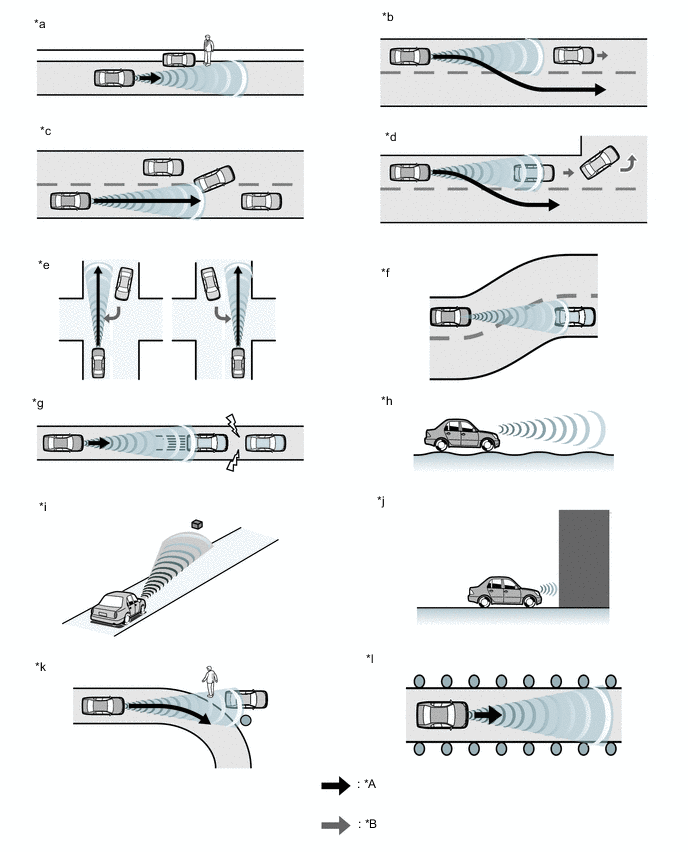
Text in Illustration *A Movement of the vehicle *B Movement of other vehicle or a pedestrian *a When passing extremely close to a vehicle or pedestrian. *b When overtaking a preceding vehicle. *c When overtaking a preceding vehicle that is changing lanes. *d When passing extremely close to a vehicle or obstruction. *e When passing an oncoming vehicle which is about to turn left or right. *f When driving on a road where relative location to preceding vehicles in an adjacent lane may change, such as on a winding road. *g When a preceding vehicle suddenly decelerates. *h When the posture of the vehicle is constantly changing due to driving on a winding or rough road. *i Axis misalignment of forward recognition camera (reinstallation, applied impact, etc.). *j Parking with the front of the vehicle extremely close to an obstacle (wall, vehicle, etc.). *k When there is a vehicle, pedestrian or object by the roadside at the entrance of a curve. *l When driving on a narrow road surrounded by objects on the roadside. 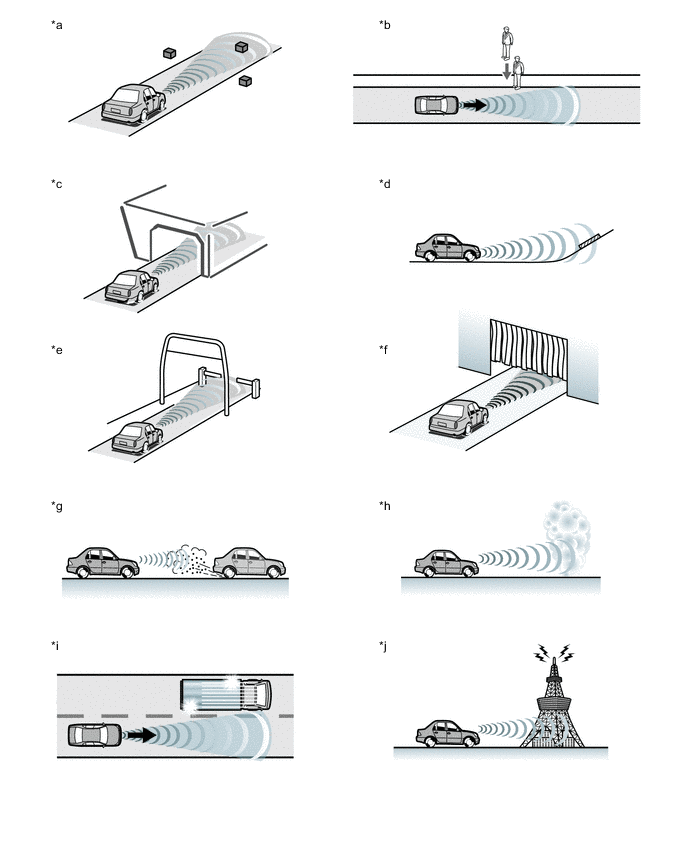
Text in Illustration *a When there is a metal object, ramp or protrusion on the road or roadside. *b When a crossing pedestrian stops extremely close to the vehicle. *c When driving in a tunnel or multistory parking lot. *d When approaching a hill with a metal object on the surface of the road. *e When approaching an electronic toll collection gate or barrier. *f Passing through an area which contains an obstacle that covers the vehicle (such as a hanging curtain). *g When the vehicle is hit with water, snow or dust from a preceding or oncoming vehicle. *h Passing through an area which contains heavy fog or smoke. *i When passing a reflective object such as a large truck or guardrail. *j When driving near a telecommunication tower or other emitter of radio waves.
-