СИСТЕМА ECD, Diagnostic DTC:P0030
| DTC Code | DTC Name |
|---|---|
| P0030 | HO2S Heater Control Circuit Bank 1 Sensor 1 |
DESCRIPTION
The air fuel ratio sensor is a broadband air fuel ratio sensor. The broadband air fuel ratio sensor measures the remaining oxygen in the exhaust gas. Fluctuations in the value of the remaining oxygen is sent to the ECM as a voltage signal.
The air fuel ratio sensor is used as both a control sensor and monitoring sensor in diesel engines. The lambda air fuel ratio sensor is necessary to ensure the value of the exhaust gas is within compliance. The air fuel ratio sensor is necessary for calculating the average amount value for the injectors. The lambda air fuel ratio sensor measures the air fuel ratio. If there is a deviation, the ECM changes the exhaust gas recirculation rate to optimize the air fuel ratio. Adjusting the average amount value is not a control operation which is performed. air fuel ratio sensor deviation is "learned" to the characteristic map and stored temporarily by the ECM.
The sensor system of the broadband air fuel ratio sensor is composed of several thin layers of zirconium dioxide ceramic. The heating element within the laminate ensures the required operating temperature of at least 760°C. The broadband air fuel ratio sensor includes two cells, a measurement cell and a reference cell. These two cells are coated in electrodes made of platinum.
Tech Tips
Although the DTC titles say HO2S heater, these DTCs relate to the air fuel ratio sensor heater.
| DTC No. | DTC Detection Condition | Trouble Area |
|---|---|---|
| P0030 | Ground short in air fuel ratio sensor heater circuit for 2 seconds or more (3 trip detection logic) |
|
WIRING DIAGRAM
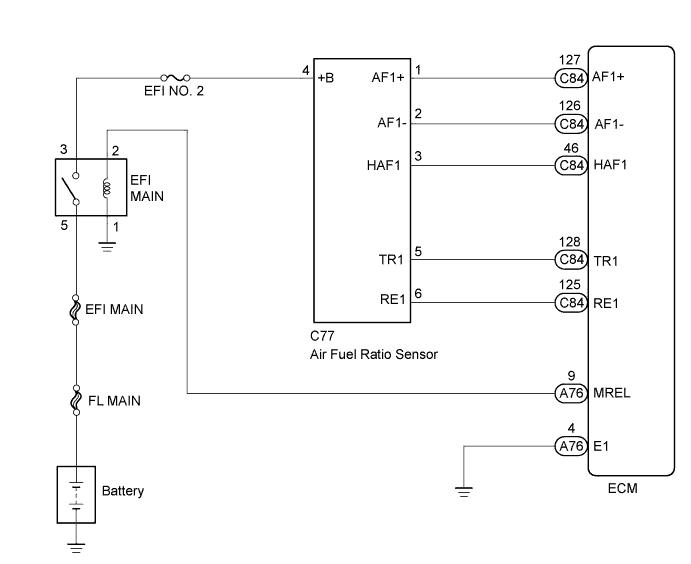
INSPECTION PROCEDURE
Note
-
When replacing the ECM and/or air fuel ratio sensor, the ECM needs Registration and Initialization Click here.
-
Inspect the fuses for circuits related to this system before performing the following inspection procedure.
Tech Tips
-
When the ECM must be replaced, before replacing the ECM, perform the "Learning Values Save" function using the GTS. Then after installing the new ECM, perform all of the initialization/registrations for the "Learning Values Write" function by following the instructions shown on the GTS display.
-
Read freeze frame data using the GTS. Freeze frame data records the engine condition when malfunctions are detected. When troubleshooting, freeze frame data can help determine if the vehicle was moving or stationary, if the engine was warmed up or not, and other data from the time the malfunction occurred.
PROCEDURE
-
INSPECT AIR FUEL RATIO SENSOR (HEATER RESISTANCE)
-
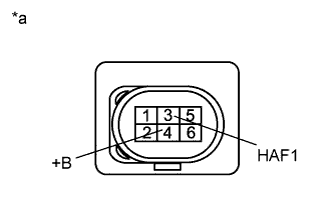
Text in Illustration *a Component without harness connected
(Air Fuel Ratio Sensor)
Disconnect the air fuel ratio sensor connector.
-
Measure the resistance according to the value(s) in the table below.
Standard Resistance Tester Connection Condition Specified Condition 4 (+B) - 3 (HAF1) 20°C (68°F) 2.0 to 3.2 Ω
NG 
REPLACE AIR FUEL RATIO SENSOR Click here
OK 
-
-
CHECK HARNESS AND CONNECTOR (AIR FUEL RATIO SENSOR - ECM)
-
Disconnect the air fuel ratio sensor connector.
-
Disconnect the ECM connector.
-
Measure the resistance according to the value(s) in the table below.
Standard Resistance Tester Connection Condition Specified Condition C77-1 (AF1+) - C84-127 (AF1+) Always Below 1 Ω C77-2 (AF1-) - C84-126 (AF1-) Always Below 1 Ω C77-3 (HAF1) - C84-46 (HAF1) Always Below 1 Ω C77-5 (TR1) - C84-128 (TR1) Always Below 1 Ω C77-6 (RE1) - C84-125 (RE1) Always Below 1 Ω C77-1 (AF1+) or C84-127 (AF1+) - Body ground Always 10 kΩ or higher C77-2 (AF1-) or C84-126 (AF1-) - Body ground Always 10 kΩ or higher C77-3 (HAF1) or C84-46 (HAF1) - Body ground Always 10 kΩ or higher C77-5 (TR1) or C84-128 (TR1) - Body ground Always 10 kΩ or higher C77-6 (RE1) or C84-125 (RE1) - Body ground Always 10 kΩ or higher
NG
REPAIR OR REPLACE HARNESS OR CONNECTOR Click here
OK
-
-
CHECK HARNESS AND CONNECTOR (POWER SOURCE)
-
Disconnect the air fuel ratio sensor connector.
-
Measure the voltage according to the value(s) in the table below.
Standard Voltage Tester Connection Switch Condition Specified Condition C77-4 (+B) - Body ground Ignition switch ON 11 to 14 V
NG
CHECK HARNESS AND CONNECTOR (AIR FUEL RATIO SENSOR - EFI MAIN RELAY) Click here
OK
-
-
REPLACE ECM
-
Replace the ECM Click here.
NEXT
CONFIRM WHETHER MALFUNCTION HAS BEEN SUCCESSFULLY REPAIRED Click here
-
-
REPLACE AIR FUEL RATIO SENSOR
-
Replace the air fuel ratio sensor Click here.
-
Perform the O2 sensor learning value reset Click here.
NEXT
CONFIRM WHETHER MALFUNCTION HAS BEEN SUCCESSFULLY REPAIRED Click here
-
-
CHECK HARNESS AND CONNECTOR (AIR FUEL RATIO SENSOR - EFI MAIN RELAY)
-
Disconnect the air fuel ratio sensor connector.
-
Remove the EFI MAIN relay from the engine room No. 1 relay block.
-
Measure the resistance according to the value(s) in the table below.
Standard Resistance Tester Connection Condition Specified Condition C77-4 (+B) - 3 (EFI MAIN relay holder) Always Below 1 Ω C77-4 (+B) or 3 (EFI MAIN relay holder) - Body ground Always 10 kΩ or higher
NG
REPAIR OR REPLACE HARNESS OR CONNECTOR Click here
OK
-
-
CHECK ECM POWER SOURCE CIRCUIT
-
Check the ECM power source circuit Click here.
NEXT
CONFIRM WHETHER MALFUNCTION HAS BEEN SUCCESSFULLY REPAIRED Click here
-
-
REPAIR OR REPLACE HARNESS OR CONNECTOR
-
Repair or replace the harness or connector.
NEXT
-
-
CONFIRM WHETHER MALFUNCTION HAS BEEN SUCCESSFULLY REPAIRED
-
Connect the GTS to the DLC3.
-
Turn the ignition switch to ON and turn the GTS on.
-
Clear the DTCs Click here.
-
Turn the ignition switch off and wait for 60 seconds or more [A].
-
Perform road test [B].
-
Repeat [A] and [B] for the number of trips detected.
-
Enter the following menus: Engine and ECT / Trouble Codes.
-
Confirm that the DTC is not output again.
NEXT 
END
-