HYBRID CONTROL SYSTEM, Diagnostic DTC:P0A7A-324
| DTC Code | DTC Name |
|---|---|
| P0A7A-324 | Generator Inverter Performance |
DESCRIPTION
For a description of the inverter Click here.
If the generator inverter overheats, has a circuit malfunction or has an internal short, the inverter transmits this information to the MG ECU via the generator inverter fail signal line.
| DTC No. | INF Code | DTC Detection Condition | Trouble Area |
|---|---|---|---|
| P0A7A | 324 | Generator inverter fail signal detection (circuit malfunction) |
|
WIRING DIAGRAM
Refer to the wiring diagram for DTC P0A1A-200 Click here.
Refer to the wiring diagram for DTC P0AA6-526 Click here.
Refer to the wiring diagram for DTC P324E-788 Click here.
Refer to the wiring diagram for DTC U0110-159 Click here.
CAUTION / NOTICE / HINT
CAUTION:
-
Before inspecting the high-voltage system or disconnecting the low voltage connector of the inverter with converter assembly, take safety precautions such as wearing insulated gloves and removing the service plug grip to prevent electrical shocks. After removing the service plug grip, put it in your pocket to prevent other technicians from accidentally reconnecting it while you are working on the high-voltage system.
-
After removing the service plug grip, wait for at least 10 minutes before touching any of the high-voltage connectors or terminals. After waiting for 10 minutes, check the voltage at the terminals in the inspection point in the inverter with converter assembly. The voltage should be 0 V before beginning work Click here.
Tech Tips
Waiting for at least 10 minutes is required to discharge the high-voltage capacitor inside the inverter with converter assembly.
Note
-
After turning the power switch off, waiting time may be required before disconnecting the cable from the negative (-) auxiliary battery terminal. Therefore, make sure to read the disconnecting the cable from the negative (-) auxiliary battery terminal notices before proceeding with work Click here.
-
After troubleshooting and repairing all output DTCs, be sure to replace the inverter with converter assembly. (Because the inverter with converter assembly may have broken or damage due to circuit malfunction.)
PROCEDURE
-
CHECK DTC OUTPUT (HYBRID CONTROL)
-
Connect the GTS to the DLC3.
-
Turn the power switch on (IG).
-
Enter the following menus: Powertrain / Hybrid Control / Trouble Codes.
-
Check for DTCs.
Result Result Proceed to P0A7A-203 is not output. A P0A7A-203 is also output. B Note
-
If P0A7A-203 is output, troubleshoot it first. After completing the troubleshooting for P0A7A-203, return to perform troubleshooting for this DTC.
-
Parts repaired or replaced during troubleshooting for P0A7A-203 do not need to be re-inspected in this diagnosis procedure.
-
-
Turn the power switch off.
B 
GO TO DTC CHART (P0A7A-203) Click here
A 
-
-
CHECK DTC OUTPUT (HYBRID CONTROL)
-
Connect the GTS to the DLC3.
-
Turn the power switch on (IG).
-
Enter the following menus: Powertrain / Hybrid Control / Trouble Codes.
-
Check for DTCs.
Tech Tips
-
If P0A7A-203 was not output in step 1 of this diagnosis procedure, check Table 1 below.
-
If P0A7A-203 was output in step 1 of this diagnosis procedure, repair that DTC first, then check Table 2 below.
Result Result Proceed to P0A7A-324 only is output, or DTCs except the ones in the table below are also output. A Any of the following DTCs are also output. B Table 1 DTC No. Relevant Diagnosis P0A1A (all INF codes)*1 Generator Control Module P0A1B (all INF codes)*1 Drive Motor "A" Control Module P0A1D (all INF codes)*1 Hybrid Powertrain Control Module P0A3F-243 Drive Motor "A" Position Sensor Circuit P0A40-500 Drive Motor "A" Position Sensor Circuit Range/Performance P0A41-245 Drive Motor "A" Position Sensor Circuit Low P0A4B-253 Generator Position Sensor Circuit P0A4C-513 Generator Position Sensor Circuit Range/Performance P0A4D-255 Generator Position Sensor Circuit Low P0A60 (all INF codes)*1 Drive Motor "A" Phase V Current P0A63 (all INF codes)*1 Drive Motor "A" Phase W Current P0A72 (all INF codes)*1 Generator Phase V Current P0A75 (all INF codes)*1 Generator Phase W Current P0A78-113, 128, 266, 267, 279, 284, 287, 306, 503, 504, 505, 506, 586, 806, 807, 808 Drive Motor "A" Inverter Performance P0A7A-122, 130, 322, 325, 344, 517, 518, 809, 810, 811 Generator Inverter Performance P0A90-509 Drive Motor "A" Performance P0A92-521 Hybrid Generator Performance P0A94-442, 547, 548, 549, 554, 555, 556, 585, 587, 589, 590 DC/DC Converter Performance P0C73-776 Motor Electronics Coolant Pump "A" Control Performance P0C76-523 Hybrid Battery System Discharge Time Too Long P314A-828 Inverter Coolant Pump Speed Signal Table 2 DTC No. Relevant Diagnosis P0A1A (all INF codes)*1 Generator Control Module P0A1B (all INF codes)*1 Drive Motor "A" Control Module P0A1D (all INF codes)*1 Hybrid Powertrain Control Module P0A3F-243 Drive Motor "A" Position Sensor Circuit P0A40-500 Drive Motor "A" Position Sensor Circuit Range/Performance P0A41-245 Drive Motor "A" Position Sensor Circuit Low P0A4B-253 Generator Position Sensor Circuit P0A4C-513 Generator Position Sensor Circuit Range/Performance P0A4D-255 Generator Position Sensor Circuit Low P0A60 (all INF codes)*1 Drive Motor "A" Phase V Current P0A63 (all INF codes)*1 Drive Motor "A" Phase W Current P0A72-333 Generator Phase V Current P0A75-341 Generator Phase W Current P0A78-113, 128, 266, 267, 279, 284, 287, 306, 503, 504, 505, 506, 586, 806, 807, 808 Drive Motor "A" Inverter Performance P0A7A-122, 130, 322, 325, 517, 518, 809, 810, 811 Generator Inverter Performance P0A90-509 Drive Motor "A" Performance P0A94-442, 547, 548, 549, 554, 555, 556, 585, 587, 589, 590 DC/DC Converter Performance P0C73-776 Motor Electronics Coolant Pump "A" Control Performance P0C76-523 Hybrid Battery System Discharge Time Too Long P314A-828 Inverter Coolant Pump Speed Signal Tech Tips
-
*1: If any INF codes are output for this DTC, refer to the corresponding diagnostic procedure.
-
P0A7A-324 may be stored due to a malfunction which also causes DTCs in the preceding table to be stored. In this case, first troubleshoot the output DTCs in the preceding table. After troubleshooting and repairing all output DTCs, be sure to replace the inverter with converter assembly.
-
-
Turn the power switch off.
B
GO TO DTC CHART (HYBRID CONTROL SYSTEM) Click here
A
-
-
CHECK CONNECTOR CONNECTION CONDITION (INVERTER WITH CONVERTER ASSEMBLY CONNECTOR)
CAUTION:
Be sure to wear insulated gloves.
-
Check that the service plug grip is not installed.
Note
After removing the service plug grip, do not turn the power switch on (READY), unless instructed by the repair manual because this may cause a malfunction.
-
Check the connector connections and contact pressure of the low voltage connectors of the inverter with converter assembly Click here.
Note
Before disconnecting the connector, confirm that it is properly connected by checking that the locking claws are engaged and that the connector does not pull out.
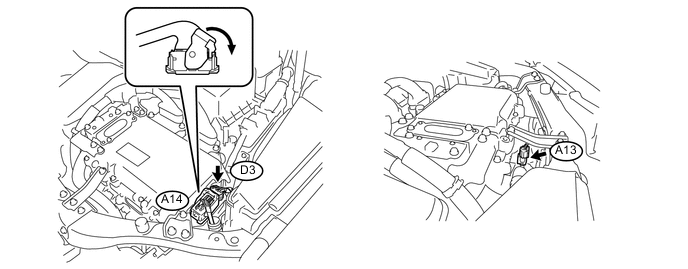
OK The connectors are connected securely and there are no contact pressure problems. Tech Tips
When connecting the connector, insert it with the locking lever in the raised position. Rotate the lever downward and make sure that the connector is pulled into its socket. When the locking lever is in its fully closed position, a click will be heard as its locking claws engage. After the click is heard, pull up on the connector to confirm that it is properly connected.
NG
CONNECT SECURELY
OK
-
-
CHECK QUANTITY OF HV COOLANT
-
Check the HV coolant level in the inverter reserve tank.
-
Check for HV coolant leaks.
Result Result Proceed to No leaks are found and coolant level in the inverter reserve tank assembly is above the low line. A No leaks are found and coolant level in the inverter reserve tank assembly is below the low line. B HV coolant leaks are evident. C Tech Tips
After repairing the HV coolant leaks and adding coolant, perform the "Activate the Water Pump" Active Test (HV Active Test item) and the "Control the Electric Cooling Fan" Active Test (Engine Active Test item) and make sure that there are no malfunctions.
B
ADD HV COOLANT
C
INSPECT FOR HV COOLANT LEAK AND ADD COOLANT
A
-
-
CHECK COOLANT HOSE
-
Check if the hoses of the cooling system are kinked or clogged.
NG
CORRECT THE PROBLEM
OK
-
-
PERFORM ACTIVE TEST USING GTS (CONTROL THE ELECTRIC COOLING FAN)
-
Connect the GTS to the DLC3.
-
Turn the power switch on (IG).
-
Enter the following menus: Powertrain / Engine and ECT / Active Test / Control the Electric Cooling Fan.
-
Perform the "Control the Electric Cooling Fan" Active Test.
OK The cooling fan rotates. -
Turn the power switch off.
NG
CHECK COOLING FAN SYSTEM Click here
OK
-
-
CHECK HV COOLANT (CHECK FOR CONDITIONS THAT MAY HAVE CAUSED FREEZING)
-
Connect the GTS to the DLC3.
-
Turn the power switch on (IG).
-
Enter the following menus: Powertrain / Hybrid Control / Trouble Codes.
-
Read the freeze frame data Ambient Temperature using the GTS.
-
Check if the freeze frame data Ambient Temperature is below freezing.
Result Result Proceed to Ambient Temperature value is above freezing temperature of the HV coolant. A Ambient Temperature value is below freezing temperature of the HV coolant. B Tech Tips
-
HV coolant (SLLC) with a 30% concentration freezes at -15 °C (5°F) and HV coolant (SLLC) with a 50% concentration freezes at -35°C (-31°F).
-
If the HV coolant freezes in the HV radiator or HV water pump, the coolant temperature in the inverter with converter assembly rises because the HV coolant cannot circulate. As a result, a DTC may be stored.
-
A DTC is stored when the water pump impeller cannot rotate due to freezing of the HV coolant.
-
If a DTC is stored due to freezing of HV coolant, the problem cannot be reproduced. Judge whether freezing of HV coolant occurred according to the freeze point of the HV coolant, HV coolant change history and ambient temperature when the DTC was stored.
-
-
Turn the power switch off.
B 
REPLACE HV COOLANT Click here
A
-
-
CHECK HARNESS AND CONNECTOR (INVERTER WITH CONVERTER ASSEMBLY - GENERATOR RESOLVER)
CAUTION:
Be sure to wear insulated gloves.
-
Check that the service plug grip is not installed.
Note
After removing the service plug grip, do not turn the power switch on (READY), unless instructed by the repair manual because this may cause a malfunction.
-
Disconnect the D3 inverter with converter assembly connector.
-
Connect the cable to the negative (-) auxiliary battery terminal.
-
Turn the power switch on (IG).
-
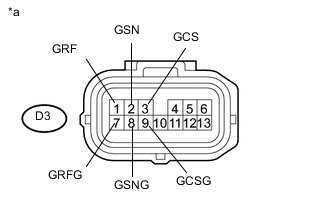
Text in Illustration *a Front view of wire harness connector
(to Inverter with Converter Assembly)
Measure the voltage according to the value(s) in the table below.
Standard Voltage Tester Connection Condition Specified Condition D3-1 (GRF) - Body ground Power switch on (IG) Below 1 V D3-7 (GRFG) - Body ground Power switch on (IG) Below 1 V D3-2 (GSN) - Body ground Power switch on (IG) Below 1 V D3-8 (GSNG) - Body ground Power switch on (IG) Below 1 V D3-3 (GCS) - Body ground Power switch on (IG) Below 1 V D3-9 (GCSG) - Body ground Power switch on (IG) Below 1 V Note
Turning the power switch on (IG) with the low voltage connector of the inverter with converter assembly disconnected causes other DTCs to be stored. Clear the DTCs after performing this inspection.
-
Turn the power switch off.
-
Disconnect the cable from the negative (-) auxiliary battery terminal.
-
Reconnect the D3 inverter with converter assembly connector.
NG
REPAIR OR REPLACE HARNESS OR CONNECTOR
OK
-
-
CHECK GENERATOR RESOLVER
CAUTION:
Be sure to wear insulated gloves.
-
Check that the service plug grip is not installed.
Note
After removing the service plug grip, do not turn the power switch on (READY), unless instructed by the repair manual because this may cause a malfunction.
-
Disconnect the D3 inverter with converter assembly connector.
-
Text in Illustration *a Front view of wire harness connector
(to Inverter with Converter Assembly)
Measure the resistance according to the value(s) in the table below.
Standard Resistance Tester Connection Condition Specified Condition D3-1 (GRF) - D3-7 (GRFG) Power switch off 4.2 to 12.5 Ω D3-2 (GSN) - D3-8 (GSNG) Power switch off 9.8 to 20.1 Ω D3-3 (GCS) - D3-9 (GCSG) Power switch off 9.8 to 20.1 Ω Tech Tips
To correct the variation of the measured resistance due to temperature, use the following formula to calculate the resistance at 20°C (68°F).
R20 = Rt / {1 + 0.00393 X (T - 20)}
The calculation is based on the following:
R20: Resistance at 20°C (68°F) (mΩ)
Rt: Measured resistance (mΩ)
T: Temperature when the resistance is measured (°C (°F).)
Standard Resistance (Check for Short) Tester Connection Condition Specified Condition D3-1 (GRF) or D3-7 (GRFG) - Body ground and other terminals Power switch off 1 MΩ or higher D3-2 (GSN) or D3-8 (GSNG) - Body ground and other terminals Power switch off 1 MΩ or higher D3-3 (GCS) or D3-9 (GCSG) - Body ground and other terminals Power switch off 1 MΩ or higher -
Reconnect the D3 inverter with converter assembly connector.
NG
CHECK CONNECTOR CONNECTION CONDITION (GENERATOR RESOLVER CONNECTOR) Click here
OK
-
-
CHECK HARNESS AND CONNECTOR (INVERTER WITH CONVERTER ASSEMBLY - MOTOR RESOLVER)
CAUTION:
Be sure to wear insulated gloves.
-
Check that the service plug grip is not installed.
Note
After removing the service plug grip, do not turn the power switch on (READY), unless instructed by the repair manual because this may cause a malfunction.
-
Disconnect the D3 inverter with converter assembly connector.
-
Connect the cable to the negative (-) auxiliary battery terminal.
-
Turn the power switch on (IG).
-
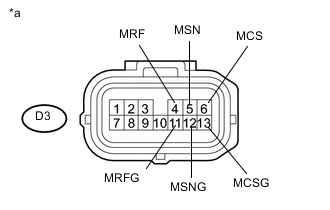
Text in Illustration *a Front view of wire harness connector
(to Inverter with Converter Assembly)
Measure the voltage according to the value(s) in the table below.
Standard Voltage Tester Connection Condition Specified Condition D3-4 (MRF) - Body ground Power switch on (IG) Below 1 V D3-11 (MRFG) - Body ground Power switch on (IG) Below 1 V D3-5 (MSN) - Body ground Power switch on (IG) Below 1 V D3-12 (MSNG) - Body ground Power switch on (IG) Below 1 V D3-6 (MCS) - Body ground Power switch on (IG) Below 1 V D3-13 (MCSG) - Body ground Power switch on (IG) Below 1 V Note
Turning the power switch on (IG) with the low voltage connector of the inverter with converter assembly disconnected causes other DTCs to be stored. Clear the DTCs after performing this inspection.
-
Turn the power switch off.
-
Disconnect the cable from the negative (-) auxiliary battery terminal.
-
Reconnect the D3 inverter with converter assembly connector.
NG
REPAIR OR REPLACE HARNESS OR CONNECTOR
OK
-
-
CHECK MOTOR RESOLVER
CAUTION:
Be sure to wear insulated gloves.
-
Check that the service plug grip is not installed.
Note
After removing the service plug grip, do not turn the power switch on (READY), unless instructed by the repair manual because this may cause a malfunction.
-
Disconnect the D3 inverter with converter assembly connector.
-
Text in Illustration *a Front view of wire harness connector
(to Inverter with Converter Assembly)
Measure the resistance according to the value(s) in the table below.
Standard Resistance Tester Connection Condition Specified Condition D3-4 (MRF) - D3-11 (MRFG) Power switch off 4.2 to 12.5 Ω D3-5 (MSN) - D3-12 (MSNG) Power switch off 9.8 to 20.1 Ω D3-6 (MCS) - D3-13 (MCSG) Power switch off 9.8 to 20.1 Ω Tech Tips
To correct the variation of the measured resistance due to temperature, use the following formula to calculate the resistance at 20°C (68°F).
R20 = Rt / {1 + 0.00393 X (T - 20)}
The calculation is based on the following:
R20: Resistance at 20°C (68°F) (mΩ)
Rt: Measured resistance (mΩ)
T: Temperature when the resistance is measured (°C (°F).)
Standard Resistance (Check for Short) Tester Connection Condition Specified Condition D3-4 (MRF) or D3-11 (MRFG) - Body ground and other terminals Power switch off 1 MΩ or higher D3-5 (MSN) or D3-12 (MSNG) - Body ground and other terminals Power switch off 1 MΩ or higher D3-6 (MCS) or D3-13 (MCSG) - Body ground and other terminals Power switch off 1 MΩ or higher -
Reconnect the D3 inverter with converter assembly connector.
NG
CHECK CONNECTOR CONNECTION CONDITION (MOTOR RESOLVER CONNECTOR) Click here
OK
-
-
CHECK INVERTER WITH CONVERTER ASSEMBLY (GENERATOR CABLE CONNECTION CONDITION)
CAUTION:
Be sure to wear insulated gloves.
-
Check that the service plug grip is not installed.
Note
After removing the service plug grip, do not turn the power switch on (READY), unless instructed by the repair manual because this may cause a malfunction.
-
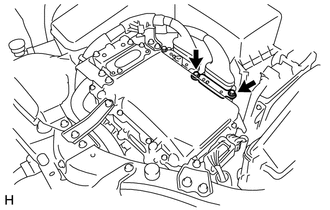
Remove the upper inverter cover (generator cable side) from the inverter with converter assembly.
-
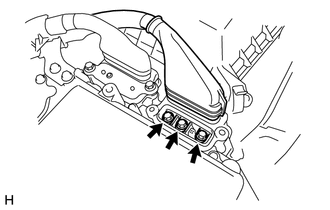
Check that the bolts for the generator cable are tightened to the specified torque, the generator cable is connected securely, and there are no contact problems.
Specified Condition T=8.0 N*m (82 kgf*cm, 71 in.*lbf) Note
Make sure that the tightening torque of the bolt is between 6.4 and 9.6 N*m (65 and 98 kgf*cm, 57 and 85 in.*lbf).
-
Disconnect the generator cable from the inverter with converter assembly.
-
Check for arc marks at the terminals for the generator cable.
Result Result Proceed to The terminals are connected securely and there are no contact problems. There are no arc marks. A The terminals are not connected securely and there is a contact problem. There are arc marks. B The terminals are not connected securely and there is a contact problem. There are no arc marks. C The terminals are connected securely and there are no contact problems. There are arc marks. B -
Connect the generator cable to the inverter with converter assembly.
-
Install the upper inverter cover (generator cable side).
B
REPLACE MALFUNCTIONING PARTS
C
CONNECT SECURELY
A
-
-
CHECK INVERTER WITH CONVERTER ASSEMBLY (MOTOR CABLE CONNECTION CONDITION)
CAUTION:
Be sure to wear insulated gloves.
-
Check that the service plug grip is not installed.
Note
After removing the service plug grip, do not turn the power switch on (READY), unless instructed by the repair manual because this may cause a malfunction.
-
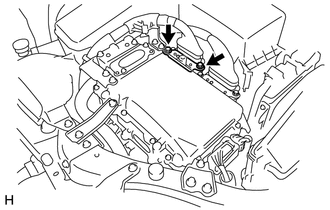
Remove the upper inverter cover (motor cable side) from the inverter with converter assembly.
-
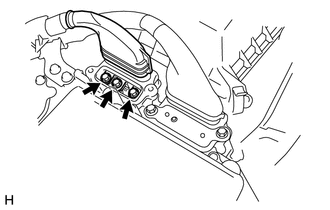
Check that the bolts for the motor cable are tightened to the specified torque, the motor cable is connected securely, and there are no contact problems.
Specified Condition T=8.0 N*m (82 kgf*cm, 71 in.*lbf) Note
Make sure that the tightening torque of the bolt is between 6.4 and 9.6 N*m (65 and 98 kgf*cm, 57 and 85 in.*lbf).
-
Disconnect the motor cable from the inverter with converter assembly.
-
Check for arc marks at the terminals for the motor cable.
Result Result Proceed to The terminals are connected securely and there are no contact problems. There are no arc marks. A The terminals are not connected securely and there is a contact problem. There are arc marks. B The terminals are not connected securely and there is a contact problem. There are no arc marks. C The terminals are connected securely and there are no contact problems. There are arc marks. B -
Connect the motor cable to the inverter with converter assembly.
-
Install the upper inverter cover (motor cable side).
B
REPLACE MALFUNCTIONING PARTS
C
CONNECT SECURELY
A
-
-
CHECK HYBRID VEHICLE TRANSAXLE ASSEMBLY (MG1)
CAUTION:
Be sure to wear insulated gloves.
-
Check that the service plug grip is not installed.
Note
After removing the service plug grip, do not turn the power switch on (READY), unless instructed by the repair manual because this may cause a malfunction.
-
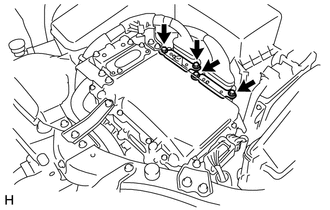
Remove the upper inverter cover (generator cable side) and upper inverter cover (motor cable side) from the inverter with converter assembly.
-
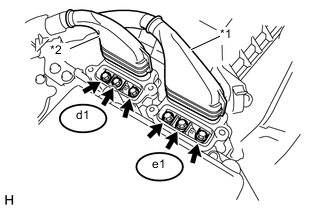
Text in Illustration *1 Generator Cable *2 Motor Cable Disconnect the generator cable and motor cable from the inverter with converter assembly.
-
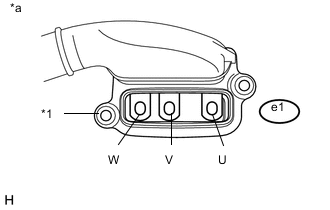
Text in Illustration *1 Shield Ground *a Generator Cable
(Inverter with Converter Assembly Side)
Check MG1 for an interphase short using a milliohmmeter.
-
Using a milliohmmeter, measure the resistance according to the value(s) in the table below.
Tech Tips
If the MG1 temperature is high, the resistance will vary greatly from the specification. Therefore, measure the resistance at least 8 hours after the vehicle is stopped.
Standard Resistance Tester Connection Condition Specified Condition e1-1 (W) - e1-3 (U) Power switch off 59.1 to 67.5 mΩ e1-2 (V) - e1-1 (W) Power switch off 59.1 to 67.5 mΩ e1-3 (U) - e1-2 (V) Power switch off 62.1 to 70.5 mΩ Tech Tips
To correct the variation of the measured resistance due to temperature, use the following formula to calculate the resistance at 20°C (68° F).
-
R20 = Rt / {1 + 0.00393 X (T - 20)}
The calculation is based on the following:
-
R20: Resistance at 20°C (68° F) (mΩ)
-
Rt: Measured resistance (mΩ)
-
T: Temperature when the resistance is measured (°C)
-
-
-
Using a megohmmeter set to 500 V, measure the resistance according to the value(s) in the table below.
Note
Be sure to set the megohmmeter to 500 V when performing this test. Using a setting higher than 500 V can result in damage to the component being inspected.
Standard Resistance Tester Connection Condition Specified Condition e1-1 (W) - Body ground and shield ground Power switch off 100 MΩ or higher e1-2 (V) - Body ground and shield ground Power switch off 100 MΩ or higher e1-3 (U) - Body ground and shield ground Power switch off 100 MΩ or higher -
Connect the generator cable and motor cable.
-
Install the upper inverter cover (generator cable side) and upper inverter cover (motor cable side).
NG
REPLACE HYBRID VEHICLE TRANSAXLE ASSEMBLY Click here
OK
-
-
CHECK HYBRID VEHICLE TRANSAXLE ASSEMBLY (MG2)
CAUTION:
Be sure to wear insulated gloves.
-
Check that the service plug grip is not installed.
Note
After removing the service plug grip, do not turn the power switch on (READY), unless instructed by the repair manual because this may cause a malfunction.
-
Remove the upper inverter cover (generator cable side) and upper inverter cover (motor cable side) from the inverter with converter assembly.
-
Text in Illustration *1 Generator Cable *2 Motor Cable Disconnect the generator cable and motor cable from the inverter with converter assembly.
-
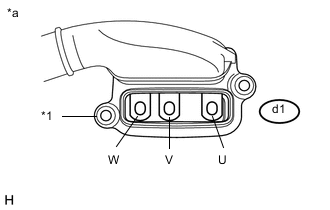
Text in Illustration *1 Shield Ground *a Motor Cable
(Inverter with Converter Assembly Side)
Check MG2 for an interphase short using a milliohmmeter.
-
Using a milliohmmeter, measure the resistance according to the value(s) in the table below.
Tech Tips
If the MG2 temperature is high, the resistance will vary greatly from the specification. Therefore, measure the resistance at least 8 hours after the vehicle is stopped.
Standard Resistance Tester Connection Condition Specified Condition d1-1 (W) - d1-3 (U) Power switch off 71.4 to 81.0 mΩ d1-2 (V) - d1-1 (W) Power switch off 71.4 to 81.0 mΩ d1-3 (U) - d1-2 (V) Power switch off 74.4 to 84.1 mΩ Tech Tips
To correct the variation of the measured resistance due to temperature, use the following formula to calculate the resistance at 20°C (68° F).
-
R20 = Rt / {1 + 0.00393 X (T - 20)}
The calculation is based on the following:
-
R20: Resistance at 20°C (68° F) (mΩ)
-
Rt: Measured resistance (mΩ)
-
T: Temperature when the resistance is measured (°C)
-
-
-
Using a megohmmeter set to 500 V, measure the resistance according to the value(s) in the table below.
Note
Be sure to set the megohmmeter to 500 V when performing this test. Using a setting higher than 500 V can result in damage to the component being inspected.
Standard Resistance Tester Connection Condition Specified Condition d1-1 (W) - Body ground and shield ground Power switch off 100 MΩ or higher d1-2 (V) - Body ground and shield ground Power switch off 100 MΩ or higher d1-3 (U) - Body ground and shield ground Power switch off 100 MΩ or higher -
Connect the generator cable and motor cable.
-
Install the upper inverter cover (generator cable side) and upper inverter cover (motor cable side).
NG
REPLACE HYBRID VEHICLE TRANSAXLE ASSEMBLY Click here
OK
-
-
CHECK FUSE (INV)
-
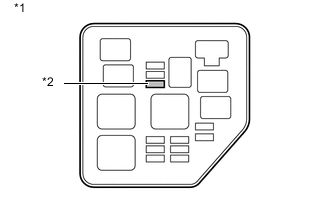
Text in Illustration *1 No. 2 Engine Room Relay Block *2 INV fuse Remove the INV fuse from the No. 2 engine room relay block.
-
Measure the resistance according to the value(s) in the table below.
Standard Resistance Tester Connection Condition Specified Condition INV fuse terminal Always Below 1Ω -
Install the INV fuse.
NG
CHECK HARNESS AND CONNECTOR (INVERTER WITH CONVERTER ASSEMBLY - INV FUSE) Click here
OK
-
-
CHECK HARNESS AND CONNECTOR (INVERTER WITH CONVERTER ASSEMBLY POWER SOURCE CIRCUIT)
CAUTION:
Be sure to wear insulated gloves.
-
Check that the service plug grip is not installed.
Note
After removing the service plug grip, do not turn the power switch on (READY), unless instructed by the repair manual because this may cause a malfunction.
-
Disconnect the A14 inverter with converter assembly connector.
-
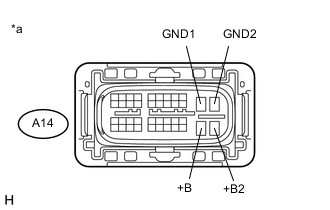
Text in Illustration *a Front view of wire harness connector
(to Inverter with Converter Assembly)
Measure the resistance according to the value(s) in the table below.
Standard Resistance Tester Connection Condition Specified Condition A14-10 (GND1) - Body ground Power switch off Below 1 Ω A14-11 (GND2) - Body ground Power switch off Below 1 Ω -
Connect the cable to the negative (-) auxiliary battery terminal.
-
Turn the power switch on (IG).
-
Measure the voltage according to the value(s) in the table below.
Standard Voltage Tester Connection Condition Specified Condition A14-30 (+B) - Body ground Power switch on (IG) 11 to 14 V A14-31 (+B2) - Body ground Power switch on (IG) 11 to 14 V Note
Turning the power switch on (IG) with the inverter with converter assembly connector disconnected causes other DTCs to be stored. Clear the DTCs after performing this inspection.
-
Turn the power switch off.
-
Disconnect the cable from the negative (-) auxiliary battery terminal.
-
Reconnect the A14 inverter with converter assembly connector.
NG
REPAIR OR REPLACE POWER SOURCE CIRCUIT
OK
-
-
CHECK HARNESS AND CONNECTOR (POWER MANAGEMENT CONTROL ECU - INVERTER WITH CONVERTER ASSEMBLY)
CAUTION:
Be sure to wear insulated gloves.
-
Check that the service plug grip is not installed.
Note
After removing the service plug grip, do not turn the power switch on (READY), unless instructed by the repair manual because this may cause a malfunction.
-
Disconnect the A33 power management control ECU connector.
-
Disconnect the A14 inverter with converter assembly connector.
-
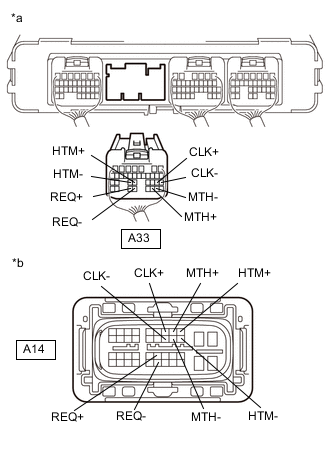
Text in Illustration *a Rear view of wire harness connector
(to Power Management Control ECU)
*b Front view of wire harness connector
(to Inverter with Converter Assembly)
Measure the resistance according to the value(s) in the table below.
Standard Resistance (Check for Open) Tester Connection Condition Specified Condition A33-24 (HTM+) - A14-9 (HTM+) Power switch off Below 1 Ω A33-25 (HTM-) - A14-20 (HTM-) Power switch off Below 1 Ω A33-30 (MTH+) - A14-8 (MTH+) Power switch off Below 1 Ω A33-29 (MTH-) - A14-19 (MTH-) Power switch off Below 1 Ω A33-33 (REQ+) - A14-26 (REQ+) Power switch off Below 1 Ω A33-32 (REQ-) - A14-37 (REQ-) Power switch off Below 1 Ω A33-21 (CLK+) - A14-7 (CLK+) Power switch off Below 1 Ω A33-20 (CLK-) - A14-18 (CLK-) Power switch off Below 1 Ω Standard Resistance (Check for Short) Tester Connection Condition Specified Condition A33-24 (HTM+) or A14-9 (HTM+) - Body ground and other terminals Power switch off 10 kΩ or higher A33-25 (HTM-) or A14-20 (HTM-) - Body ground and other terminals Power switch off 10 kΩ or higher A33-30 (MTH+) or A14-8 (MTH+) - Body ground and other terminals Power switch off 10 kΩ or higher A33-29 (MTH-) or A14-19 (MTH-) - Body ground and other terminals Power switch off 10 kΩ or higher A33-33 (REQ+) or A14-26 (REQ+) - Body ground and other terminals Power switch off 10 kΩ or higher A33-32 (REQ-) or A14-37 (REQ-) - Body ground and other terminals Power switch off 10 kΩ or higher A33-21 (CLK+) or A14-7 (CLK+) - Body ground and other terminals Power switch off 10 kΩ or higher A33-20 (CLK-) or A14-18 (CLK-) - Body ground and other terminals Power switch off 10 kΩ or higher -
Connect the cable to the negative (-) auxiliary battery terminal.
-
Turn the power switch on (IG).
-
Measure the voltage according to the value(s) in the table below.
Standard Voltage Tester Connection Condition Specified Condition A33-24 (HTM+) or A14-9 (HTM+) - Body ground Power switch on (IG) Below 1 V A33-25 (HTM-) or A14-20 (HTM-) - Body ground Power switch on (IG) Below 1 V A33-30 (MTH+) or A14-8 (MTH+) - Body ground Power switch on (IG) Below 1 V A33-29 (MTH-) or A14-19 (MTH-) - Body ground Power switch on (IG) Below 1 V A33-33 (REQ+) or A14-26 (REQ+) - Body ground Power switch on (IG) Below 1 V A33-32 (REQ-) or A14-37 (REQ-) - Body ground Power switch on (IG) Below 1 V A33-21 (CLK+) or A14-7 (CLK+) - Body ground Power switch on (IG) Below 1 V A33-20 (CLK-) or A14-18 (CLK-) - Body ground Power switch on (IG) Below 1 V Note
Turning the power switch on (IG) with the power management control ECU and inverter with converter assembly connector disconnected causes other DTCs to be stored. Clear the DTCs after performing this inspection.
-
Turn the power switch off.
-
Disconnect the cable from the negative (-) auxiliary battery terminal.
-
Reconnect the A14 inverter with converter assembly connector.
-
Reconnect the A33 power management control ECU connector.
NG
REPAIR OR REPLACE HARNESS OR CONNECTOR
OK
-
-
CHECK POWER MANAGEMENT CONTROL ECU
-
Disconnect the A33 power management control ECU connector.
-
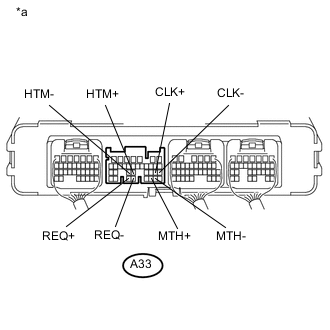
Text in Illustration *a Component without harness connected
(Power Management Control ECU)
Measure the resistance according to the value(s) in the table below.
Standard Resistance Tester Connection Condition Specified Condition A33-24 (HTM+) - A33-25 (HTM-) Power switch off 80 to 170 Ω A33-30 (MTH+) - A33-29 (MTH-) Power switch off 80 to 170 Ω A33-33 (REQ+) - A33-32 (REQ-) Power switch off 80 to 170 Ω A33-21 (CLK+) - A33-20 (CLK-) Power switch off 80 to 170 Ω -
Reconnect the A33 power management control ECU connector.
NG
REPLACE POWER MANAGEMENT CONTROL ECU Click here
OK
-
-
CHECK CONNECTOR CONNECTION CONDITION (GENERATOR RESOLVER CONNECTOR)
-
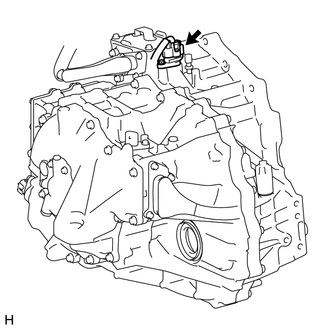
Check the connection of the generator resolver connector.
OK The connector is connected securely and there are no contact problems.
NG
CONNECT SECURELY
OK
-
-
CHECK CONNECTOR CONNECTION CONDITION (MOTOR RESOLVER CONNECTOR)
-
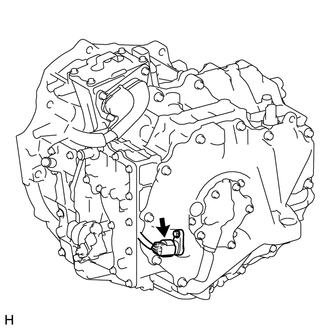
Check the connection of the motor resolver connector.
OK The connector is connected securely and there are no contact problems.
OK
REPLACE INVERTER WITH CONVERTER ASSEMBLY Click here
NG
CONNECT SECURELY
-
-
CHECK CONNECTOR CONNECTION CONDITION (GENERATOR RESOLVER CONNECTOR)
-
Check the connection of the generator resolver connector.
OK The connector is connected securely and there are no contact problems.
NG
CONNECT SECURELY
OK
-
-
INSPECT HYBRID VEHICLE TRANSAXLE ASSEMBLY (GENERATOR RESOLVER)
-
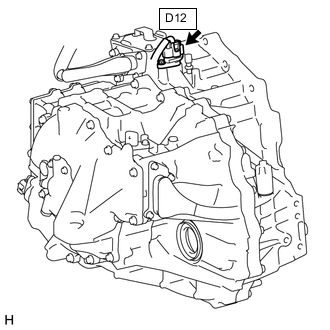
Disconnect the D12 generator resolver connector.
-
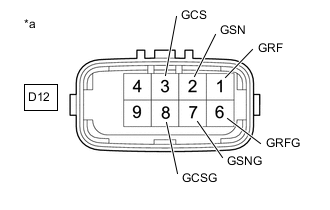
*a Component without harness connected
(Generator Resolver (Hybrid Vehicle Transaxle Assembly))
Measure the resistance according to the value(s) in the table below.
Standard Resistance Tester Connection Condition Specified Condition D12-1 (GRF) - D12-6 (GRFG) Power switch off 5.8 to 11.8 Ω D12-2 (GSN) - D12-7 (GSNG) Power switch off 11.7 to 17.7 Ω D12-3 (GCS) - D12-8 (GCSG) Power switch off 11.7 to 17.7 Ω Tech Tips
To correct the variation of the measured resistance due to temperature, use the following formula to calculate the resistance at 20°C (68°F).
R20 = Rt / {1 + 0.00393 X (T - 20)}
The calculation is based on the following:
R20: Resistance at 20°C (68°F) (mΩ)
Rt: Measured resistance (mΩ)
T: Temperature when the resistance is measured (°C (°F).)
Standard Resistance (Check for Short) Tester Connection Condition Specified Condition D12-1 (GRF) - Body ground and other terminals (except 6 (GRFG)) Power switch off 1 MΩ or higher D12-6 (GRFG) - Body ground and other terminals (except 1 (GRF)) Power switch off 1 MΩ or higher D12-2 (GSN) - Body ground and other terminals (except 7 (GSNG)) Power switch off 1 MΩ or higher D12-7 (GSNG) - Body ground and other terminals (except 2 (GSN)) Power switch off 1 MΩ or higher D12-3 (GCS) - Body ground and other terminals (except 8 (GCSG)) Power switch off 1 MΩ or higher D12-8 (GCSG) - Body ground and other terminals (except 3 (GCS)) Power switch off 1 MΩ or higher Tech Tips
The generator resolver is not available as a supply part. If it requires replacement, replace the hybrid vehicle transaxle assembly.
-
Reconnect the D12 generator resolver connector.
OK
REPAIR OR REPLACE HARNESS OR CONNECTOR
NG
REPLACE HYBRID VEHICLE TRANSAXLE ASSEMBLY Click here
-
-
CHECK CONNECTOR CONNECTION CONDITION (MOTOR RESOLVER CONNECTOR)
-
Check the connection of the motor resolver connector.
OK The connector is connected securely and there are no contact problems.
NG
CONNECT SECURELY
OK
-
-
INSPECT HYBRID VEHICLE TRANSAXLE ASSEMBLY (MOTOR RESOLVER)
-
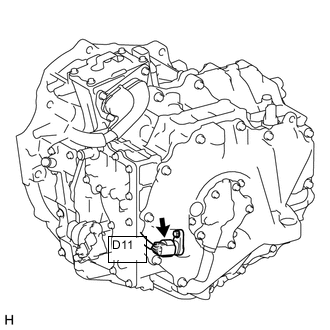
Disconnect the D11 motor resolver connector.
-
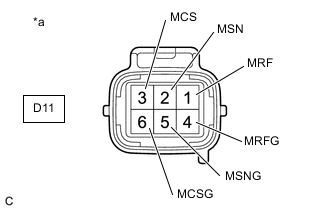
*a Component without harness connected
(Motor Resolver (Hybrid Vehicle Transaxle Assembly))
Measure the resistance according to the value(s) in the table below.
Standard Resistance Tester Connection Condition Specified Condition D11-1 (MRF) - D11-4 (MRFG) Power switch off 5.8 to 11.8 Ω D11-2 (MSN) - D11-5 (MSNG) Power switch off 11.7 to 17.7 Ω D11-3 (MCS) - D11-6 (MCSG) Power switch off 11.7 to 17.7 Ω Tech Tips
To correct the variation of the measured resistance due to temperature, use the following formula to calculate the resistance at 20°C (68°F).
R20 = Rt / {1 + 0.00393 X (T - 20)}
The calculation is based on the following:
R20: Resistance at 20°C (68°F) (mΩ)
Rt: Measured resistance (mΩ)
T: Temperature when the resistance is measured (°C (°F).)
Standard Resistance (Check for Short) Tester Connection Condition Specified Condition D11-1 (MRF) - Body ground and other terminals (except 4 (MRFG)) Power switch off 1 MΩ or higher D11-4 (MRFG) - Body ground and other terminals (except 1 (MRF)) Power switch off 1 MΩ or higher D11-2 (MSN) - Body ground and other terminals (except 5 (MSNG)) Power switch off 1 MΩ or higher D11-5 (MSNG) - Body ground and other terminals (except 2 (MSN)) Power switch off 1 MΩ or higher D11-3 (MCS) - Body ground and other terminals (except 6 (MCSG)) Power switch off 1 MΩ or higher D11-6 (MCSG) - Body ground and other terminals (except 3 (MCS)) Power switch off 1 MΩ or higher Tech Tips
The motor resolver is not available as a supply part. If it requires replacement, replace the hybrid vehicle transaxle assembly.
-
Reconnect the D11 motor resolver connector.
OK
REPAIR OR REPLACE HARNESS OR CONNECTOR
NG
REPLACE HYBRID VEHICLE TRANSAXLE ASSEMBLY Click here
-
-
CHECK HARNESS AND CONNECTOR (INVERTER WITH CONVERTER ASSEMBLY - INV FUSE)
CAUTION:
Be sure to wear insulated gloves.
-
Check that the service plug grip is not installed.
Note
After removing the service plug grip, do not turn the power switch on (READY), unless instructed by the repair manual because this may cause a malfunction.
-
Disconnect the A14 inverter with converter assembly connector.
-
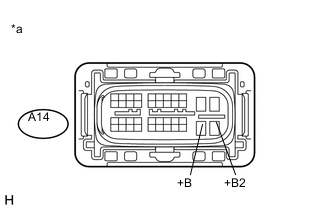
Text in Illustration *a Front view of wire harness connector
(to Inverter with Converter Assembly)
Measure the resistance according to the value(s) in the table below.
Standard Resistance Tester Connection Condition Specified Condition A14-30 (+B) - Body ground Power switch off 10 kΩ or higher A14-31 (+B2) - Body ground Power switch off 10 kΩ or higher -
Reconnect the A14 inverter with converter assembly connector.
NG
REPAIR OR REPLACE HARNESS OR CONNECTOR Click here
OK
-
-
REPLACE INVERTER WITH CONVERTER ASSEMBLY
NEXT
REPLACE FUSE (INV)
-
REPAIR OR REPLACE HARNESS OR CONNECTOR
NEXT
REPLACE FUSE (INV)
-
REPLACE HV COOLANT
-
Replace the HV coolant with coolant having an appropriate concentration (appropriate freeze point) for the vehicle usage conditions Click here.
NEXT
COMPLETED
-