FUEL SYSTEM ON-VEHICLE INSPECTION

CAUTION / NOTICE / HINT
CAUTION:
-
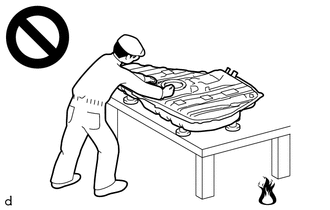
Never perform work on fuel system components near any possible ignition sources.
-
Vaporized fuel could ignite, resulting in a serious accident.
-
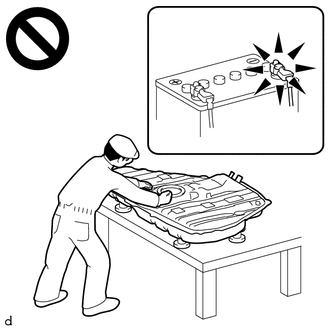
Do not perform work on fuel system components without first disconnecting the cable from the negative (-) battery terminal.
-
Sparks could cause vaporized fuel to ignite, resulting in a serious accident.
PROCEDURE
-
PRECAUTION
Note
-
Keep fuel away from rubber or leather parts.
-
If a malfunction such as pump lock occurs and the fuel pump is damaged, excessive current may be continuously applied to the fuel pump control ECU, damaging its internal parts. Make sure to replace the fuel pump control ECU at the same time when replacing the fuel pump.
-
After turning the ignition switch off, waiting time may be required before disconnecting the cable from the battery terminal. Therefore, make sure to read the disconnecting the cable from the battery terminal notice before proceeding with work.
-
-
CHECK FUEL PUMP OPERATION AND INSPECT FOR FUEL LEAK
-
Check fuel pump operation.
-
Connect the GTS to the DLC3.
-
Turn the ignition switch to ON.
Note
Do not start the engine.
-
Turn the GTS on.
-
Enter the following menus: Powertrain / Engine / Active Test / Activate the Circuit Relay.
Powertrain > Engine > Active TestTester Display Activate the Circuit Relay -
Check for pressure in the fuel tube sub-assembly from the fuel line. Check that sounds of fuel flowing from the fuel tank assembly can be heard. If no sounds can be heard, check the relay, fuel pump, ECM and wiring connectors.
-
-
Inspect for fuel leaks.
-
Check that there are no fuel leaks from the fuel system after doing any maintenance or repairs. If there is a fuel leak, repair or replace parts as necessary.
-
-
Turn the ignition switch off.
-
Disconnect the GTS from the DLC3.
-
-
CHECK FUEL PRESSURE
-
Discharge fuel system pressure.
-
Measure the battery voltage.
Standard Voltage 11 to 14 V -
Disconnect the cable from the negative (-) battery terminal.
Note
When disconnecting the cable, some systems need to be initialized after the cable is reconnected.
-
Remove the windshield wiper motor and link assembly.
-
Remove the No. 1 heater air duct splash shield seal.
-
Remove the water guard plate LH.
-
Remove the cowl body mounting reinforcement LH.
-
Remove the cowl body mounting reinforcement RH.
-
Remove the outer cowl top panel sub-assembly (for LHD).
-
Remove the outer cowl top panel sub-assembly (for RHD).
-
Remove the radiator cover.
-
Remove the No. 1 air cleaner inlet.
-
Remove the air cleaner cap with air cleaner hose.
-
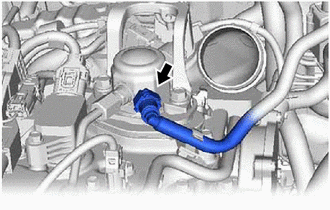
Disconnect the fuel tube sub-assembly.
-
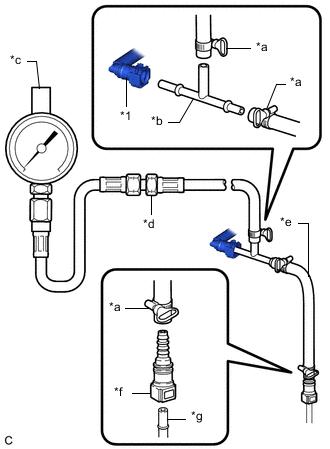
*1 Fuel Tube Sub-assembly (Vehicle Side) *a SST (Hose Band) *b SST (T-joint) *c SST (Gauge) *d SST (Hose Joint) *e SST (Hose) *f SST (Fuel Tube Connector) *g Fuel Pipe (Vehicle Side) Install SST (EFI fuel pressure gauge) as shown in the illustration.
- SST
- 09268-45101 ( 09268-41250, 09268-41260, 09268-41280, 09268-41500, 09268-41700, 95336-08070 )
-
Wipe up any spilled fuel.
-
Connect the cable to the negative (-) battery terminal.
Note
When disconnecting the cable, some systems need to be initialized after the cable is reconnected.
-
Connect the GTS to the DLC3.
-
Turn the ignition switch to ON.
Note
Do not start the engine.
-
Turn the GTS on.
-
Enter the following menus: Powertrain / Engine / Active Test / Activate the Circuit Relay.
Powertrain > Engine > Active TestTester Display Activate the Circuit Relay -
Measure the fuel pressure.
Standard Fuel Pressure 196 to 588 kPa (2.0 to 6.0 kgf/cm2, 28 to 85 psi)
-
If the fuel pressure is less than the standard, check the fuel hoses and their connections, fuel pump, fuel filter and fuel pressure regulator assembly.
-
If the result is not as specified, replace the fuel pressure regulator assembly.
-
-
Disconnect the GTS from the DLC3.
-
Start the engine.
-
Measure the fuel pressure at idle.
Standard Fuel Pressure 196 to 588 kPa (2.0 to 6.0 kgf/cm2, 28 to 85 psi) -
Stop the engine.
-
Check that the fuel pressure remains as specified for 5 minutes.
Standard Fuel Pressure 147 kPa (1.5 kgf/cm2, 21 psi) or more If the result is not as specified, check the fuel pump, fuel pressure regulator assembly and/or fuel injector assemblies.
-
After checking the fuel pressure, disconnect the cable from the negative (-) battery terminal and carefully remove SST to prevent fuel from spraying.
Note
When disconnecting the cable, some systems need to be initialized after the cable is reconnected.
-
Connect the fuel tube sub-assembly.
-
Install the air cleaner cap with air cleaner hose.
-
Install the No. 1 air cleaner inlet.
-
Install the radiator cover.
-
Install the outer cowl top panel sub-assembly (for LHD).
-
Install the outer cowl top panel sub-assembly (for RHD).
-
Install the cowl body mounting reinforcement RH.
-
Install the cowl body mounting reinforcement LH.
-
Install the water guard plate LH.
-
Install theNo. 1 heater air duct splash shield seal.
-
Install the windshield wiper motor assembly.
-
Inspect for fuel leaks.
-
-
CHECK FUEL PRESSURE (for High Pressure)
-
Connect the GTS to the DLC3.
-
Turn the ignition switch to ON.
-
Turn the GTS on.
-
Start and warm up the engine.
-
Enter the following menus: Powertrain / Engine / Data List / Fuel Pressure (High).
Powertrain > Engine > Data ListTester Display Fuel Pressure (High) -
Check the high pressure side fuel pressure.
Standard Fuel Pressure 4000 to 18000 kPa (40.8 to 183.5 kgf/cm2, 580 to 2610 psi) If the result is not as specified, check the fuel pump, fuel pump assembly, fuel pressure sensor and wire harnesses.
-
Stop the engine.
-