CHARGE LID OPENER SYSTEM Charge Lid Unlock Function does not Operate
DESCRIPTION
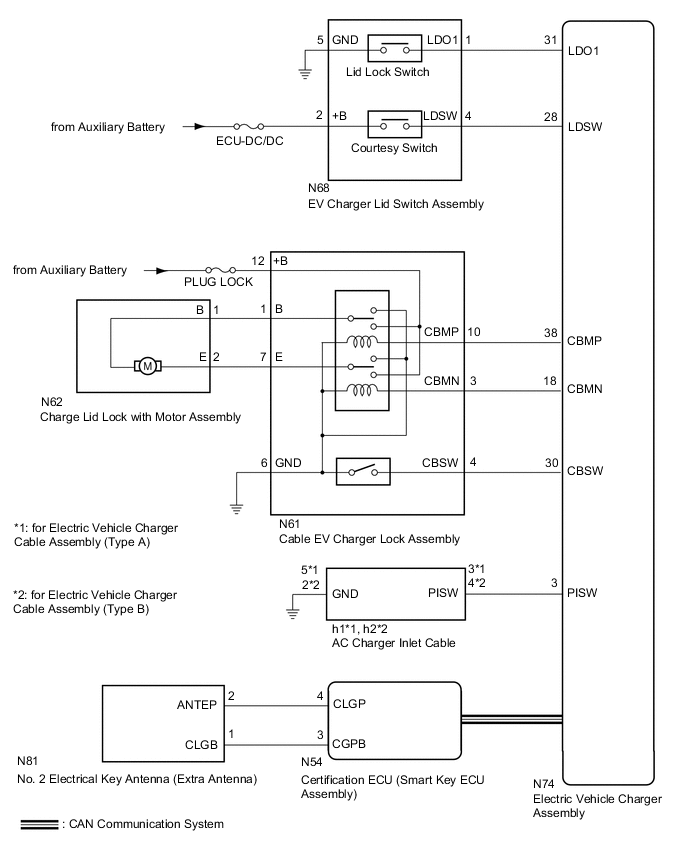
If the unlock function of the charging port lid lock does not operate, the EV charger lid switch assembly, cable EV charger lock assembly, AC charger inlet cable, charge lid lock with motor assembly, No. 2 electrical key antenna (extra antenna), electrical key transmitter sub-assembly or the signal circuit between electric vehicle charger assembly and certification ECU (smart key ECU assembly) may be malfunctioning or the vehicle may be being affected by wave interference.
WIRING DIAGRAM
CAUTION / NOTICE / HINT
CAUTION:
-
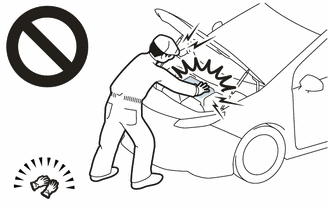
Before the following operations are conducted, take precautions to prevent electric shock by turning the power switch off, wearing insulated gloves, and removing the service plug grip from HV battery.
-
Inspecting the high-voltage system
-
Disconnecting the low voltage connector of the inverter with converter assembly
-
Disconnecting the low voltage connector of the HV battery
-
Disconnecting the low voltage connector of the electric vehicle charger assembly.
-
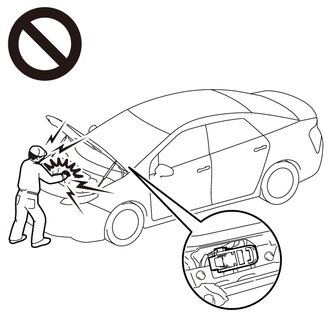
To prevent electric shock, make sure to remove the service plug grip to cut off the high voltage circuit before servicing the vehicle.
-
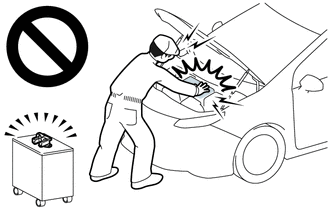
After removing the service plug grip from the HV battery, put it in your pocket to prevent other technicians from accidentally reconnecting it while you are working on the high-voltage system.
-
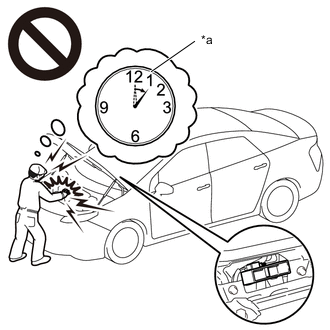
*a Without waiting for 10 minutes After removing the service plug grip, wait for at least 10 minutes before touching any of the high-voltage connectors or terminals. After waiting for 10 minutes, check the voltage at the terminals in the inspection point in the inverter with converter assembly. The voltage should be 0 V before beginning work.
Tech Tips
Waiting for at least 10 minutes is required to discharge the high-voltage capacitor inside the inverter with converter assembly and the electric vehicle charger assembly.
Note
-
After turning the power switch off, waiting time may be required before disconnecting the cable from the negative (-) auxiliary battery terminal. Therefore, make sure to read the disconnecting the cable from the negative (-) auxiliary battery terminal notices before proceeding with work.
-
The charge lid opener system uses the CAN communication system. Inspect the communication function by following How to Proceed with Troubleshooting. Troubleshoot the charge lid opener system after confirming that the communication system is functioning properly.
-
The charge lid opener system uses the entry and start system (for entry function).
If the entry and start system (for entry function) is malfunctioning, the charging port lid may not be able to be locked/unlocked.
In this case, make sure to inspect the entry and start system (for entry function) first.
-
Check that there are no electrical key transmitter sub-assemblies in the vehicle.
-
Inspect the fuses for circuits related to this system before performing the following procedure.
-
If the customize setting "Auto Entry Cancel SW" is set to "ON", operation of the charging port lid lock will be prohibited. In this case, perform either of the following operations to operate the charging port lid lock.
-
Unlock charging port lid lock: With any door unlocked, push the charging port lid by hand and open the charging port lid (extend the push lifter of the EV charger lid switch assembly (charging lid courtesy switch)).
-
Lock charging port lid lock: With all of the doors locked, push the charging port lid by hand to close the charging port lid (push in the push lifter of the EV charger lid switch assembly (charging lid courtesy switch)).
-
To protect the charging port lid lock motor, if the charging port lid lock/unlock is operated repeatedly, operation of the unlock will be prohibited. Wait for 3 minutes or more to allow the motor to cool and then resume the inspection.
-
To protect the charging port lid lock motor, if the charging port lid lock/unlock is operated repeatedly in quick succession, operation of the unlock will be prohibited for a certain amount of time. Wait for 3 seconds or more after operation was prohibited and then resume the inspection.
-
If the charging port lid lock pin is dirty or frozen, or if foreign matter is caught between the charging port lid lock pin and charging port lid, the charging port lid lock pin may not be able to be locked/unlocked. Clean the charging port lid lock pin before performing the inspection.
PROCEDURE
-
CHECK DTC OUTPUT (HEALTH CHECK)
-
Connect the GTS to the DLC3.
-
Turn the power switch on (IG).
-
Turn the GTS on.
-
Enter the following menus: Health Check.
-
Check DTCs.
Result Result Proceed to No DTCs are output. A DTCs are output. B
B 
GO TO DTC CHART
A 
-
-
CHECK ENTRY AND START SYSTEM (for Entry Function) OPERATION
-
Check that all doors can be locked and unlocked by the entry and start system (for Entry Function).
Result Result Proceed to Entry function operates (doors can be locked/unlocked using entry function) A Entry function does not operate (doors cannot be locked/unlocked using entry function) B
B
GO TO ENTRY AND START SYSTEM (for Entry Function) Click here
A
-
-
CHECK ENTRY AND START SYSTEM (for CHARGING PORT LID)
-
Close all of the doors.
-
Lock all of the doors.
-
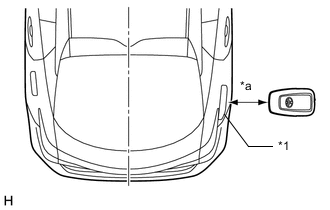
*1 Charging Port Lid *a Approximately 0.7 m (2.3 ft.) Hold the electrical key transmitter sub-assembly at the same height as the charging port lid and approximately 0.7 m (2.3 ft.) from the vehicle as shown in the illustration and check that the LED of the electrical key transmitter sub-assembly blinks.
Tech Tips
-
The charging port lid is located on the rear right side of the vehicle.
-
Make sure to perform this inspection with all of the doors locked. (The entry function and charging port lid verification function cannot be operated if any of the doors are unlocked.)
-
-
Hold the electrical key transmitter sub-assembly at the same height as the No. 2 electrical key antenna (extra antenna) and approximately 0.3 m (1.0 ft.) from the vehicle and check that the LED of the electrical key transmitter sub-assembly blinks.
Tech Tips
-
The No. 2 electrical key antenna (Extra Antenna) is located on the rear right side of the vehicle under the charging port lid.
-
When the electrical key transmitter sub-assembly is brought near the No. 2 electrical key antenna (Extra Antenna), the possibility of wave interference decreases, and it can be determined if wave interference is causing the problem symptom.
-
If the inspection result is that the problem only occurs in certain locations or at certain times of day, the possibility of wave interference is high. Also, added vehicle components may cause wave interference. If installed, remove them and perform the operation check.
-
There may be wave interference if the vehicle is near broadcasting antennas, large video displays, wireless garage door opener systems, wireless security cameras, home security systems, etc. In this case, move the vehicle to a different location and check if there is any improvement.
-
Communication may not be possible if the electrical key transmitter sub-assembly is within 0.2 m (0.656 ft.) of the charging port lid.
-
-
Check that the LED of the electrical key transmitter sub-assembly blinks.
Result Result Proceed to LED of electrical key transmitter sub-assembly does not blink
(charging port lid verification function does not operate)
A When electrical key transmitter sub-assembly brought near charging port lid, LED blinks
(charging port lid verification function operates)
B When electrical key transmitter sub-assembly brought near No. 2 electrical key antenna (Extra Antenna), LED blinks.
(charging port lid verification function operates)
C
A
GO TO ENTRY AND START SYSTEM (for Entry Function) Click here
C
AFFECTED BY WAVE INTERFERENCE
B
-
-
CHECK ELECTRIC VEHICLE CHARGER ASSEMBLY (CHARGING PORT LID CLOSED AND CHARGING PORT LID LOCK LOCKED)
CAUTION:
Be sure to wear insulated gloves.
-
Disconnect the cable to the negative (-) auxiliary battery terminal.
-
Remove the service plug grip.
Note
After removing the service plug grip, do not turn the power switch on (READY), unless instructed by the repair manual because this may cause a malfunction.
-
Connect the cable to the negative (-) auxiliary battery terminal.
-
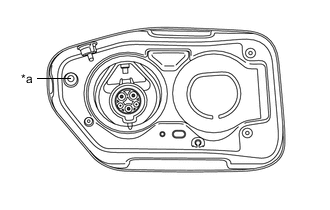
*a Push Lifter Close the charging port lid (push in the push lifter).
-
Lock all of the doors.
-
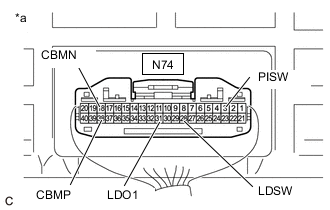
*a Component with harness connected
(Electric Vehicle Charger Assembly)
Measure the voltage according to the value(s) in the table below.
Note
Make sure that the charging port lid is closed (the push lifter is pushed in) when measuring the voltage.
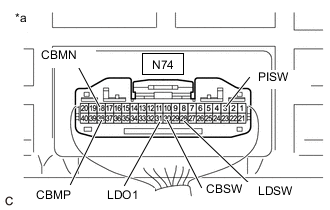
Standard Voltage Tester Connection Condition Specified Condition N74-38 (CBMP) - Body ground Power switch on (IG) 0 to 1.5 V N74-18 (CBMN) - Body ground Power switch on (IG) 0 to 1.5 V N74-28 (LDSW) - Body ground Power switch on (IG) 0 to 1.5 V N74-31 (LDO1) - Body ground Power switch on (IG) 11 to 14 V N74-3 (PISW) - Body ground Power switch on (IG) 3.572 to 4.730 V*1
4.50 to 5.00*2
-
*1: for Electric Vehicle Charger Cable Assembly (Type A)
-
*2: for Electric Vehicle Charger Cable Assembly (Type B)
-
-
Connect the GTS to the DLC3.
-
Turn the GTS on.
-
Enter the following menus: Powertrain / Plug-in Control / Data List / Charging Lid Switch Status, Charging Lid Lock Pin Request Status, Charging Connector Connect Status Voltage, Charging Connector Lock Pin Status, Charging Connector Lock Motor Unlock Direction Revolution Request Current, Charging Connector Lock Motor Lock Direction Revolution Request Current.
Tech Tips
-
The state of each terminal can be checked on the Data List.
-
As the values in the Data List and the measured values might vary due to slight differences in factors such as the environment, vehicle age, etc., make sure to only use the results as a reference.
Powertrain > Plug-in Control > Data ListTester Display Measurement Item Normal Condition Charging Lid Switch Status Charging lid switch status OFF: Charging port lid close (push lifter of EV charger lid switch assembly (charging lid courtesy switch) pushed in) Charging Lid Lock Pin Request Status Charging port lid lock unlock request signal Lock: Charging port lid locked (charging port lid lock pin extended) Charging Connector Connect Status Voltage PISW terminal voltage used for checking electric vehicle charger cable assembly connection condition 3.57 to 4.75 V: Electric vehicle charger cable assembly not inserted*1
4.50 to 5.00 V: Electric vehicle charger cable assembly not inserted*2
Charging Connector Lock Pin Status Charging connector lock pin status Lock: Charging connector lock pin extended Charging Connector Lock Motor Unlock Direction Revolution Request Current Output of current to operate charging connector lock motor or charging port lid lock motor in reverse OFF: Charging connector lock motor or charging port lid lock motor not operated Charging Connector Lock Motor Lock Direction Revolution Request Current Output of current to operate charging connector lock motor or charging port lid lock motor forward OFF: Charging connector lock motor or charging port lid lock motor not operated
-
*1: for Electric Vehicle Charger Cable Assembly (Type A)
-
*2: for Electric Vehicle Charger Cable Assembly (Type B)
Powertrain > Plug-in Control > Data ListTester Display Charging Lid Switch Status Charging Lid Lock Pin Request Status Charging Connector Connect Status Voltage Charging Connector Lock Pin Status Charging Connector Lock Motor Unlock Direction Revolution Request Current Charging Connector Lock Motor Lock Direction Revolution Request Current Result Result Proceed to OK A NG (CBMP terminal) B NG (CBMN terminal) C NG (LDSW terminal) D NG (LDO1 terminal) E NG (PISW terminal) F -
B 
GO TO STEP 13 Click here
C
GO TO STEP 16 Click here
D
GO TO STEP 19 Click here
E
GO TO STEP 22 Click here
F
GO TO STEP 25 Click here
A
-
-
CHECK ELECTRIC VEHICLE CHARGER ASSEMBLY (CHARGING PORT LID CLOSED AND CHARGING PORT LID LOCK UNLOCKED)
CAUTION:
Be sure to wear insulated gloves.
-
Lock all of the doors.
-
*a Push Lifter While carrying the electrical key transmitter sub-assembly, close the charging port lid then fully push it in by hand (fully push in the push lifter).
-
*a Component with harness connected
(Electric Vehicle Charger Assembly)
Measure the voltage according to the value(s) in the table below.
Note
Make sure that the push lifter is fully pushed in when measuring the voltage.
Standard Voltage Tester Connection Condition Specified Condition N74-30 (CBSW) - Body ground Power switch on (IG) 4.5 to 5.5 V N74-38 (CBMP) - Body ground Power switch on (IG) 0 to 1.5 V N74-18 (CBMN) - Body ground Power switch on (IG) 0 to 1.5 V N74-28 (LDSW) - Body ground Power switch on (IG) 0 to 1.5 V N74-31 (LDO1) - Body ground Power switch on (IG) 0 to 1.5 V N74-3 (PISW) - Body ground Power switch on (IG) 3.572 to 4.730 V*1
4.50 to 5.00*2
-
*1: for Electric Vehicle Charger Cable Assembly (Type A)
-
*2: for Electric Vehicle Charger Cable Assembly (Type B)
-
-
Enter the following menus: Powertrain / Plug-in Control / Data List / Charging Lid Switch Status, Charging Lid Lock Pin Request Status, Charging Connector Connect Status Voltage, Charging Connector Lock Pin Status, Charging Connector Lock Motor Unlock Direction Revolution Request Current, Charging Connector Lock Motor Lock Direction Revolution Request Current.
Tech Tips
-
The state of each terminal can be checked on the Data List.
-
As the values in the Data List and the measured values might vary due to slight differences in factors such as the environment, vehicle age, etc., make sure to only use the results as a reference.
Powertrain > Plug-in Control > Data ListTester Display Measurement Item Normal Condition Charging Lid Switch Status Charging lid switch status OFF: Charging port lid close (push lifter of EV charger lid switch assembly (charging lid courtesy switch) pushed in) Charging Lid Lock Pin Request Status Charging port lid lock unlock request signal Unlock: Charging port lid unlocked (charging port lid lock pin not extended) Charging Connector Connect Status Voltage PISW terminal voltage used for checking electric vehicle charger cable assembly connection condition 3.57 to 4.75 V: Electric vehicle charger cable assembly not inserted*1
4.50 to 5.00 V: Electric vehicle charger cable assembly not inserted*2
Charging Connector Lock Pin Status Charging connector lock pin status Unlock: Charging connector lock pin not extended Charging Connector Lock Motor Unlock Direction Revolution Request Current Output of current to operate charging connector lock motor or charging port lid lock motor in reverse OFF: Charging connector lock motor or charging port lid lock motor not operated Charging Connector Lock Motor Lock Direction Revolution Request Current Output of current to operate charging connector lock motor or charging port lid lock motor forward OFF: Charging connector lock motor or charging port lid lock motor not operated
-
*1: for Electric Vehicle Charger Cable Assembly (Type A)
-
*2: for Electric Vehicle Charger Cable Assembly (Type B)
Powertrain > Plug-in Control > Data ListTester Display Charging Lid Switch Status Charging Lid Lock Pin Request Status Charging Connector Connect Status Voltage Charging Connector Lock Pin Status Charging Connector Lock Motor Unlock Direction Revolution Request Current Charging Connector Lock Motor Lock Direction Revolution Request Current Result Result Proceed to OK A NG (CBSW terminal) B NG (CBMP terminal) C NG (CBMN terminal) D NG (LDSW terminal) E NG (LDO1 terminal) F NG (PISW terminal) G -
B
GO TO STEP 10 Click here
C
GO TO STEP 13 Click here
D
GO TO STEP 16 Click here
E
GO TO STEP 19 Click here
F
GO TO STEP 22 Click here
G
GO TO STEP 25 Click here
A
-
-
CHECK ELECTRIC VEHICLE CHARGER ASSEMBLY (CHARGING PORT LID OPEN AND CHARGING PORT LID LOCK UNLOCKED)
CAUTION:
Be sure to wear insulated gloves.
-
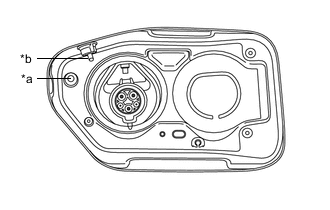
*a Push Lifter *b Lock Pin While carrying the electrical key transmitter sub-assembly, open the charging port lid (extend the push lifter).
Note
If the lock pin is extended (the charging port lid lock is locked), unlock it using the charging port lid lock emergency release lever.
-
Connect the charge connector.
-
*a Component with harness connected
(Electric Vehicle Charger Assembly)
Measure the voltage according to the value(s) in the table below.
Note
Make sure that the charging port lid is open (the push lifter is extended) when measuring the voltage.
Standard Voltage Tester Connection Condition Specified Condition N74-30 (CBSW) - Body ground Power switch on (IG) 0 to 1.5 V N74-38 (CBMP) - Body ground Power switch on (IG) 0 to 1.5 V N74-18 (CBMN) - Body ground Power switch on (IG) 0 to 1.5 V N74-28 (LDSW) - Body ground Power switch on (IG) 11 to 14 V N74-31 (LDO1) - Body ground Power switch on (IG) 11 to 14 V N74-3 (PISW) - Body ground Power switch on (IG) 0.35 to 3.572 V*1
0.35 to 4.50*2
-
*1: for Electric Vehicle Charger Cable Assembly (Type A)
-
*2: for Electric Vehicle Charger Cable Assembly (Type B)
-
-
Enter the following menus: Powertrain / Plug-in Control / Data List / Charging Lid Switch Status, Charging Lid Lock Pin Request Status, Charging Connector Connect Status Voltage, Charging Connector Lock Pin Status, Charging Connector Lock Motor Unlock Direction Revolution Request Current, Charging Connector Lock Motor Lock Direction Revolution Request Current.
Tech Tips
-
The state of each terminal can be checked on the Data List.
-
As the values in the Data List and the measured values might vary due to slight differences in factors such as the environment, vehicle age, etc., make sure to only use the results as a reference.
Powertrain > Plug-in Control > Data ListTester Display Measurement Item Normal Condition Charging Lid Switch Status Charging lid switch status ON: Charging port lid open (push lifter of EV charger lid switch assembly (charging lid courtesy switch) extended) Charging Lid Lock Pin Request Status Charging port lid lock unlock request signal Unlock: Charging port lid unlocked (charging port lid lock pin not extended) Charging Connector Connect Status Voltage PISW terminal voltage used for checking electric vehicle charger cable assembly connection condition 0.35 to 3.57 V: Electric vehicle charger cable assembly inserted*1
0.35 to 4.50 V: Electric vehicle charger cable assembly inserted*2
Charging Connector Lock Pin Status Charging connector lock pin status Unlock: Charging connector lock pin not extended Charging Connector Lock Motor Unlock Direction Revolution Request Current Output of current to operate charging connector lock motor or charging port lid lock motor in reverse OFF: Charging connector lock motor or charging port lid lock motor not operated Charging Connector Lock Motor Lock Direction Revolution Request Current Output of current to operate charging connector lock motor or charging port lid lock motor forward OFF: Charging connector lock motor or charging port lid lock motor not operated
-
*1: for Electric Vehicle Charger Cable Assembly (Type A)
-
*2: for Electric Vehicle Charger Cable Assembly (Type B)
Powertrain > Plug-in Control > Data ListTester Display Charging Lid Switch Status Charging Lid Lock Pin Request Status Charging Connector Connect Status Voltage Charging Connector Lock Pin Status Charging Connector Lock Motor Unlock Direction Revolution Request Current Charging Connector Lock Motor Lock Direction Revolution Request Current Result Result Proceed to OK A NG (CBSW terminal) B NG (CBMP terminal) C NG (CBMN terminal) D NG (LDSW terminal) E NG (LDO1 terminal) F NG (PISW terminal) G -
B
CHECK ELECTRIC VEHICLE CHARGER ASSEMBLY (CBSW TERMINAL VOLTAGE) Click here
C
CHECK ELECTRIC VEHICLE CHARGER ASSEMBLY (CBMP TERMINAL VOLTAGE) Click here
D
CHECK ELECTRIC VEHICLE CHARGER ASSEMBLY (CBMN TERMINAL VOLTAGE) Click here
E
CHECK ELECTRIC VEHICLE CHARGER ASSEMBLY (LDSW TERMINAL VOLTAGE) Click here
F
CHECK ELECTRIC VEHICLE CHARGER ASSEMBLY (LDO1 TERMINAL VOLTAGE) Click here
G
CHECK ELECTRIC VEHICLE CHARGER ASSEMBLY (PISW TERMINAL VOLTAGE) Click here
A
-
-
INSPECT CABLE EV CHARGER LOCK ASSEMBLY (CBSW TERMINAL)
-
Remove the cable EV charger lock assembly.
-
Inspect the cable EV charger lock assembly.
Result Proceed to OK NG
NG
REPLACE CABLE EV CHARGER LOCK ASSEMBLY Click here
OK
-
-
INSPECT CHARGE LID LOCK WITH MOTOR ASSEMBLY
-
Remove the charge lid lock with motor assembly.
-
Inspect the charge lid lock with motor assembly.
Result Proceed to OK NG
NG
REPLACE CHARGE LID LOCK WITH MOTOR ASSEMBLY Click here
OK
-
-
CAUSE ANALYSIS (ENVIRONMENT/USER RELATED CAUSE)
-
Perform cause analysis in the order of "Environment" and "User" categories as specified in the following tables.
Environment Possible Cause Action to be Taken Charging port lid lock motor temperature high Explain to the customer that, due to the temperature of the charging port lid lock motor becoming high, to protect the charging port lid lock motor, charging port lid unlock operation was prohibited.
(Wait 3 minutes or more after lock/unlock operation is prohibited, then resume inspection.)
Charging port lid lock motor cannot operate due to foreign matter, ice, etc. Explain to the customer that the charging port lid cannot be locked/unlocked if foreign matter, ice, etc. are stuck on the lock pin or charging port lid. User Possible Cause Action to be Taken Push lifter of the EV charger lid switch assembly (charging lid courtesy switch) is push in (charging port lid is close) Explain to the customer that the charging port lid lock may not operate if the push lifter of the EV charger lid switch assembly (charging lid courtesy switch) is pushed in (the charging port lid is judged as closed).
Explain to the customer that the push lifter of the EV charger lid switch assembly (charging lid courtesy switch) should not be pushed in when the charging port lid is open.
Entry function of entry and start system (for start system) start disabled Explain to the customer that as the entry function was disabled, the charging port lid unlock did not operate.
Tech Tips
Operating the charging port lid unlock when the entry function is disabled:
-
With any door unlocked, push the charging port lid by hand and open the charging port lid (extend the push lifter of the EV charger lid switch assembly (charging lid courtesy switch)).
Charging port lid lock or unlock was operated repeatedly Explain to the customer that to protect the charging port lid lock motor, if the charging port lid lock was operated repeatedly, operation may be temporarily prohibited. Charging port lid unlock operation was attempted after auxiliary battery was replaced or cable disconnected and connected Explain to the customer that charging port lid unlock operation may be prohibited after the auxiliary battery has been replaced or the cable has been disconnected and reconnected to the negative (-) auxiliary battery terminal.
(Operate the charging port lid lock again.)
-
-
Take appropriate action in accordance with the result of the cause analysis.
Result Proceed to NEXT
NEXT
END
-
-
CHECK ELECTRIC VEHICLE CHARGER ASSEMBLY (CBSW TERMINAL VOLTAGE)
CAUTION:
Be sure to wear insulated gloves.
-
Disconnect the N74 electric vehicle charger assembly connector.
-
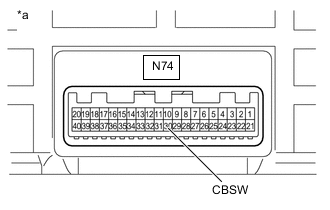
*a Component without harness connected
(Electric Vehicle Charger Assembly)
Measure the voltage according to the value(s) in the table below.
Standard Voltage Tester Connection Condition Specified Condition N74-30 (CBSW) - Body ground Power switch off 4.5 to 5.5 V Result Proceed to OK NG
NG
REPLACE ELECTRIC VEHICLE CHARGER ASSEMBLY Click here
OK
-
-
INSPECT CABLE EV CHARGER LOCK ASSEMBLY (CBSW TERMINAL)
-
Remove the cable EV charger lock assembly.
-
Inspect the cable EV charger lock assembly.
Result Proceed to OK NG
NG
REPLACE CABLE EV CHARGER LOCK ASSEMBLY Click here
OK
-
-
CHECK HARNESS AND CONNECTOR (ELECTRIC VEHICLE CHARGER ASSEMBLY - CABLE EV CHARGER LOCK ASSEMBLY (CBSW))
CAUTION:
Be sure to wear insulated gloves.
-
Measure the resistance according to the value(s) in the table below.
Standard Resistance Tester Connection Condition Specified Condition N74-30 (CBSW) - N61-4 (CBSW) Power switch off Below 1 Ω N74-30 (CBSW) or N61-4 (CBSW) - Body ground Power switch off 10 kΩ or higher Result Proceed to OK NG
OK
GO TO STEP 9 Click here
NG
REPAIR OR REPLACE HARNESS OR CONNECTOR
-
-
CHECK ELECTRIC VEHICLE CHARGER ASSEMBLY (CBMP TERMINAL VOLTAGE)
CAUTION:
Be sure to wear insulated gloves.
-
Disconnect the N74 electric vehicle charger assembly connector.
-
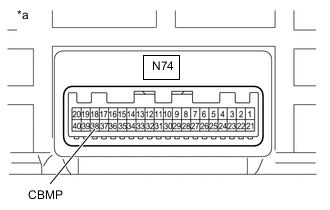
*a Component without harness connected
(Electric Vehicle Charger Assembly)
Measure the voltage according to the value(s) in the table below.
Standard Voltage Tester Connection Condition Specified Condition N74-38 (CBMP) - Body ground Power switch off 0 to 1.5 V Result Proceed to OK NG
NG
REPLACE ELECTRIC VEHICLE CHARGER ASSEMBLY Click here
OK
-
-
INSPECT CABLE EV CHARGER LOCK ASSEMBLY (CBMP TERMINAL)
-
Remove the cable EV charger lock assembly.
-
Inspect the cable EV charger lock assembly.
Result Proceed to OK NG
NG
REPLACE CABLE EV CHARGER LOCK ASSEMBLY Click here
OK
-
-
CHECK HARNESS AND CONNECTOR (ELECTRIC VEHICLE CHARGER ASSEMBLY - CABLE EV CHARGER LOCK ASSEMBLY (CBMP))
CAUTION:
Be sure to wear insulated gloves.
-
Measure the resistance according to the value(s) in the table below.
Standard Resistance Tester Connection Condition Specified Condition N74-38 (CBMP) - N61-10 (CBMP) Power switch off Below 1 Ω N74-38 (CBMP) or N61-10 (CBMP) - Body ground Power switch off 10 kΩ or higher Result Proceed to OK NG
OK
GO TO STEP 9 Click here
NG
REPAIR OR REPLACE HARNESS OR CONNECTOR
-
-
CHECK ELECTRIC VEHICLE CHARGER ASSEMBLY (CBMN TERMINAL VOLTAGE)
CAUTION:
Be sure to wear insulated gloves.
-
Disconnect the N74 electric vehicle charger assembly connector.
-
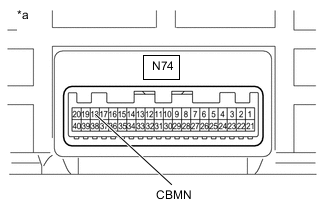
*a Component without harness connected
(Electric Vehicle Charger Assembly)
Measure the voltage according to the value(s) in the table below.
Standard Voltage Tester Connection Condition Specified Condition N74-18 (CBMN) - Body ground Power switch off 0 to 1.5 V Result Proceed to OK NG
NG
REPLACE ELECTRIC VEHICLE CHARGER ASSEMBLY Click here
OK
-
-
INSPECT CABLE EV CHARGER LOCK ASSEMBLY (CBMN TERMINAL)
-
Remove the cable EV charger lock assembly.
-
Inspect the cable EV charger lock assembly.
Result Proceed to OK NG
NG
REPLACE CABLE EV CHARGER LOCK ASSEMBLY Click here
OK
-
-
CHECK HARNESS AND CONNECTOR (ELECTRIC VEHICLE CHARGER ASSEMBLY - CABLE EV CHARGER LOCK ASSEMBLY (CBMN))
CAUTION:
Be sure to wear insulated gloves.
-
Measure the resistance according to the value(s) in the table below.
Standard Resistance Tester Connection Condition Specified Condition N74-18 (CBMN) - N61-3 (CBMN) Power switch off Below 1 Ω N74-18 (CBMN) or N61-3 (CBMN) - Body ground Power switch off 10 kΩ or higher Result Proceed to OK NG
OK
GO TO STEP 9 Click here
NG
REPAIR OR REPLACE HARNESS OR CONNECTOR
-
-
CHECK ELECTRIC VEHICLE CHARGER ASSEMBLY (LDSW TERMINAL VOLTAGE)
CAUTION:
Be sure to wear insulated gloves.
-
Disconnect the N74 electric vehicle charger assembly connector.
-
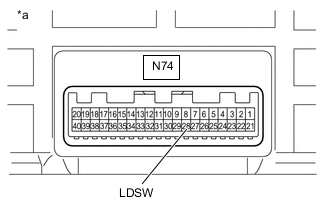
*a Component without harness connected
(Electric Vehicle Charger Assembly)
Measure the voltage according to the value(s) in the table below.
Standard Voltage Tester Connection Condition Specified Condition N74-28 (LDSW) - Body ground Power switch off 0 to 1.5 V Result Proceed to OK NG
NG
REPLACE ELECTRIC VEHICLE CHARGER ASSEMBLY Click here
OK
-
-
INSPECT EV CHARGER LID SWITCH ASSEMBLY (LDSW TERMINAL)
-
Remove the EV charger lid switch assembly.
-
Inspect the EV charger lid switch assembly.
Result Proceed to OK NG
NG
REPLACE EV CHARGER LID SWITCH ASSEMBLY Click here
OK
-
-
CHECK HARNESS AND CONNECTOR (ELECTRIC VEHICLE CHARGER ASSEMBLY - EV CHARGER LID SWITCH ASSEMBLY (LDSW))
CAUTION:
Be sure to wear insulated gloves.
-
Measure the resistance according to the value(s) in the table below.
Standard Resistance Tester Connection Condition Specified Condition N74-28 (LDSW) - N68-4 (LDSW) Power switch off Below 1 Ω N74-28 (LDSW) or N68-4 (LDSW) - Body ground Power switch off 10 kΩ or higher Result Proceed to OK NG
OK
GO TO STEP 9 Click here
NG
REPAIR OR REPLACE HARNESS OR CONNECTOR
-
-
CHECK ELECTRIC VEHICLE CHARGER ASSEMBLY (LDO1 TERMINAL VOLTAGE)
CAUTION:
Be sure to wear insulated gloves.
-
Disconnect the N74 electric vehicle charger assembly connector.
-
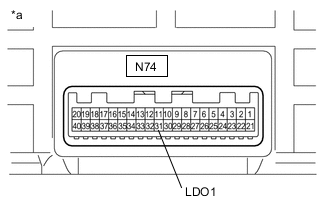
*a Component without harness connected
(Electric Vehicle Charger Assembly)
Measure the voltage according to the value(s) in the table below.
Standard Voltage Tester Connection Condition Specified Condition N74-31 (LDO1) - Body ground Power switch off 11 to 14 V Result Proceed to OK NG
NG
REPLACE ELECTRIC VEHICLE CHARGER ASSEMBLY Click here
OK
-
-
INSPECT EV CHARGER LID SWITCH ASSEMBLY (LDO1 TERMINAL)
-
Remove the EV charger lid switch assembly.
-
Inspect the cable EV charger lid switch assembly.
Result Proceed to OK NG
NG
REPLACE EV CHARGER LID SWITCH ASSEMBLY Click here
OK
-
-
CHECK HARNESS AND CONNECTOR (ELECTRIC VEHICLE CHARGER ASSEMBLY - EV CHARGER LID SWITCH ASSEMBLY (LDO1))
CAUTION:
Be sure to wear insulated gloves.
-
Measure the resistance according to the value(s) in the table below.
Standard Resistance Tester Connection Condition Specified Condition N74-31 (LDO1) - N68-1 (LDO1) Power switch off Below 1 Ω N74-31 (LDO1) or N68-1 (LDO1) - Body ground Power switch off 10 kΩ or higher Result Proceed to OK NG
OK
GO TO STEP 9 Click here
NG
REPAIR OR REPLACE HARNESS OR CONNECTOR
-
-
CHECK ELECTRIC VEHICLE CHARGER ASSEMBLY (PISW TERMINAL VOLTAGE)
CAUTION:
Be sure to wear insulated gloves.
-
Disconnect the N74 electric vehicle charger assembly connector.
-
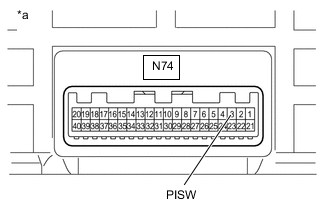
*a Component without harness connected
(Electric Vehicle Charger Assembly)
Measure the voltage according to the value(s) in the table below.
Standard Voltage Tester Connection Condition Specified Condition N74-3 (PISW) - Body ground Power switch off 3.572 to 4.730 V*1
4.50 to 5.00*2
-
*1: for Electric Vehicle Charger Cable Assembly (Type A)
-
*2: for Electric Vehicle Charger Cable Assembly (Type B)
Result Proceed to OK NG -
NG
REPLACE ELECTRIC VEHICLE CHARGER ASSEMBLY Click here
OK
-
-
INSPECT AC CHARGER INLET CABLE (PISW TERMINAL)
-
Remove the AC charger inlet cable.
-
Inspect the AC charger inlet cable.
Result Proceed to OK NG
NG
REPLACE AC CHARGER INLET CABLE Click here
OK
-
-
CHECK HARNESS AND CONNECTOR (ELECTRIC VEHICLE CHARGER ASSEMBLY - AC CHARGER INLET CABLE (PISW))
CAUTION:
Be sure to wear insulated gloves.
-
Measure the resistance according to the value(s) in the table below.
Standard Resistance Tester Connection Condition Specified Condition N74-3 (PISW) - h1-3 (PISW)*1 Power switch off Below 1 Ω N74-3 (PISW) - h2-4 (PISW)*2 Power switch off Below 1 Ω N74-3 (PISW) or h1-3 (PISW) - Body ground*1 Power switch off 10 kΩ or higher N74-3 (PISW) or h2-4 (PISW) - Body ground*2 Power switch off 10 kΩ or higher
-
*1: for Electric Vehicle Charger Cable Assembly (Type A)
-
*2: for Electric Vehicle Charger Cable Assembly (Type B)
Result Proceed to OK NG -
OK
GO TO STEP 9 Click here
NG
REPAIR OR REPLACE HARNESS OR CONNECTOR
-