SOLAR CHARGING SYSTEM PRECAUTION
-
SOLAR CHARGING SYSTEM PRECAUTION
CAUTION:
-
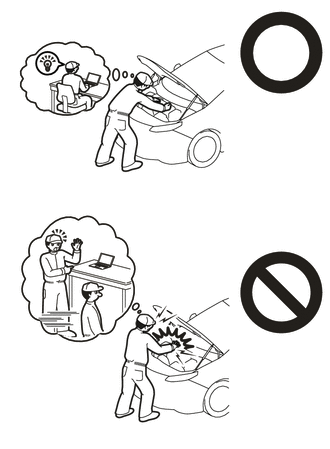
Orange wire harnesses and connectors indicate high-voltage circuits. To prevent electric shock, always follow the procedure described in the repair manual.
-
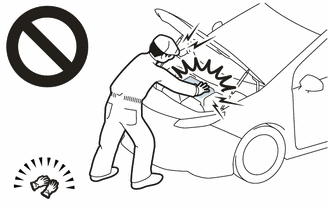
To prevent electric shock, wear insulated gloves when working on wire harnesses and components of the high voltage system.
-
-
PRECAUTIONS FOR INSPECTING SOLAR CHARGING SYSTEM
-
The solar charging system may operate when the vehicle is parked or being serviced. Therefore, when replacing any solar charging system related components, make sure to turn the power switch on (IG) and then off, then disconnect the cable from the negative (-) auxiliary battery terminal within 2 to 4 minutes after turning the power switch off. After that, remove the service plug grip and disconnect the low voltage connector of the solar energy control unit to disable the solar charging system before performing service.
Note
After turning the power switch off, waiting time may be required before disconnecting the cable from the negative (-) auxiliary battery terminal. Therefore, make sure to read the disconnecting the cable from the negative (-) auxiliary battery terminal notices before proceeding with work.
-
Wait at least 5 seconds after disconnecting the cable from the negative (-) auxiliary battery terminal before touching any of the connectors or terminals of the solar energy control unit.
Tech Tips
Waiting for at least 5 seconds is required to discharge the high-voltage capacitor inside the solar energy control unit.
-
Due to the properties of the No. 1 roof window glass sub-assembly, if the No. 1 roof window glass sub-assembly is malfunctioning or there is an open in the wire harness between the No. 1 roof window glass sub-assembly and solar energy control unit, the solar energy control unit may not be able to detect the malfunction as it is unable to determine if electricity is not being generated due to a malfunction or the absence of sufficient sunlight. Therefore, even if a malfunction is not detected, there may still be a malfunction.
-
No. 1 Roof Window Glass Sub-assembly Precautions
-
Before disconnecting or connecting the No. 1 roof window glass sub-assembly connector, make sure to cover the No. 1 roof window glass sub-assembly with a thick cloth to prevent it from generating electricity.
Note
As the No. 1 roof window glass sub-assembly is constantly generating electricity, according to the amount of solar radiation that strikes it (maximum open-circuit voltage of approximately 51.3 V), take care when disconnecting or reconnecting the connector to reduce the risk of electrical shock or a short.
-
-
-
DISPOSING OF A SOLAR BATTERY
-
When disposing of a solar battery, make sure to return it through an authorized collection agent who is capable of handling it safely. If the solar battery is returned via the manufacturer specified route, it will be returned properly and in a safe manner by an authorized collection agent.
CAUTION:
-
Accidents such as electric shock may result if the solar battery is disposed of improperly or abandoned. Therefore, make sure to return all solar batteries through an authorized collection agent.
-
After removing the solar battery, keep it away from water. Exposure to water may cause the solar battery to produce heat, resulting in a fire.
-
-
-
INITIALIZATION
Note
When disconnecting the cable from the negative (-) auxiliary battery terminal, initialize the following system(s) after the cable is reconnected.
System Name See Procedure Lane departure alert system (w/ Steering Control) Intelligent clearance sonar system Parking assist monitor system Simple intelligent parking assist system Power door lock control system Pre-crash safety system Adaptive High Beam system