SFI SYSTEM(w/ Canister Pump Module) DATA LIST / ACTIVE TEST
-
DATA LIST
Tech Tips
Using the GTS to read the Data List allows the values or states of switches, sensors, actuators and other items to be read without removing any parts. This non-intrusive inspection can be very useful because intermittent conditions or signals may be discovered before parts or wiring is disturbed. Reading the Data List information early in troubleshooting is one way to save diagnostic time.
Note
In the table below, the values listed under "Normal Condition" are reference values. Do not depend solely on these reference values when deciding whether a part is faulty or not.
-
Connect the GTS to the DLC3.
-
Turn the power switch on (IG).
-
Turn the GTS on.
-
Put the engine in Inspection Mode (Maintenance Mode).
Powertrain > Hybrid Control > UtilityTester Display Inspection Mode -
Start the engine.
-
Warm up the engine.
-
Turn the A/C switch off.
-
Turn the power switch off.
-
Turn the power switch on (IG).
-
Turn the GTS on.
-
Enter the following menus: Powertrain / Engine / Data List.
Tech Tips
-
To display the list box, press the pull down menu button next to Primary. Then select a measurement group.
-
When you select a measurement group, the ECU data belonging to that group is displayed.
-
Measurement Group List / Description
-
All Data / All data
-
Primary / -
-
Engine Control / Engine control system related data
-
Ptrl General / -
-
Ptrl AF Control / Air fuel ratio control system related data
-
Ptrl AF O2 Sensor / Air fuel ratio sensor and heated oxygen sensor related data
-
Ptrl Throttle / Gasoline throttle system related data
-
Ptrl Intake Control / Intake control system related data
-
Ptrl Valve Control / Valve control system related data
-
Ptrl Misfire / "Misfire" related data
-
Ptrl Starting / "Difficult to start" related data
-
Ptrl Rough Idle / "Rough idle" related data
-
Ptrl Evaporative / Evaporative system related data
-
Ptrl CAT Converter / Catalyst converter related data
-
Check Mode / Check mode related data
-
Monitor Status / Monitor status related data
-
Ignition / Ignition system related data
-
Charging Control / Charging control system related data
-
Compression / Data used during "Check the Cylinder Compression" Active Test
-
AT / Automatic transaxle system related data
-
Vehicle Information / Vehicle information
-
-
Read the Data List according to the display on the GTS.
Tech Tips
The title used for each group of Data List items in this repair manual does not appear on the GTS. However, the name in parentheses after the title, which is a Measurement Group, does appear on the GTS. When the name shown in parentheses is selected on the GTS, all of the Data List items listed for that group will be displayed.
-
-
Various Vehicle Conditions 1 (All Data)
Powertrain > Engine > Data ListTester Display Measurement Item Range Normal Condition Diagnostic Note Vehicle Speed Vehicle speed Min.: 0 km/h (0 mph), Max.: 255 km/h (158 mph) Actual vehicle speed This is the current vehicle speed. Engine Speed Engine speed Min.: 0 rpm, Max.: 16383 rpm 950 to 1050 rpm: Idling with warmed up engine (inspection mode [maintenance mode], not charge control, Park (P) selected) When the crankshaft position sensor is malfunctioning, "Engine Speed" is approximately 0 rpm or varies greatly from the actual engine speed. Calculate Load Load calculated by ECM Min.: 0%, Max.: 100%
-
20 to 40%: Idling with warmed up engine (inspection mode [maintenance mode], not charge control)
-
15 to 35%: Warmed up engine, 2500 rpm (inspection mode [maintenance mode])
-
This is the engine load calculated based on the actual intake manifold pressure.
-
Calculate Load = Actual intake manifold pressure / maximum intake manifold pressure x 100 (%)
(For example, when the actual intake manifold pressure is the same as atmospheric pressure, Calculate Load is 100%.)
Vehicle Load Vehicle load Min.: 0%, Max.: 25700% Actual vehicle load
-
This is the engine intake air charging efficiency.
-
Vehicle Load = Current intake airflow (g/rev.) / maximum intake airflow x 100 (%)
Maximum intake airflow = Displacement (L) / 2 x 1.2 (g/rev.)
Tech Tips
Due to individual engine differences, intake air temperature, etc., the value may exceed 100%.
Intake airflow (g/rev.) = Intake airflow (gm/sec) x 60 / Engine speed (rpm)
(Intake airflow (gm/sec) is value of Mass Air Flow Sensor)
Mass Air Flow Sensor Airflow rate from mass air flow meter sub-assembly Min.: 0 gm/sec, Max.: 655.35 gm/sec
-
1.0 to 3.0 gm/sec: Idling with warmed up engine (inspection mode [maintenance mode], not charge control)
-
4.5 to 8.5 gm/sec: Warmed up engine, 2500 rpm (inspection mode [maintenance mode])
This is the intake air amount measured by the mass air flow meter sub-assembly. Atmospheric Pressure Atmospheric pressure Min.: 0 kPa (0 psi), Max.: 255 kPa (37 psi) Equivalent to atmospheric pressure
-
This value is calculated based on the atmospheric pressure sensor.
-
Standard atmospheric pressure: 101 kPa(abs) [15 psi(abs)]
-
For every 100 m (328 ft) increase in altitude, pressure drops by 1 kPa (0.1 psi). This varies depending on the weather.
Intake Manifold Absolute Pressure Intake manifold absolute pressure Min.: 0 kPa (0 psi), Max.: 2047.96 kPa (296.95 psi)
-
80 to 110 kPa (11.6 to 15.95 psi): Power switch on (IG)
-
20 to 40 kPa (2.9 to 5.8 psi): Idling with warmed up engine (inspection mode [maintenance mode], not charge control)
-
This is the intake manifold pressure.
-
This item is the pressure detected by the manifold absolute pressure sensor and is used for air fuel ratio control and EGR valve control.
Tech Tips
When the power switch is on (IG), the manifold absolute pressure and atmospheric pressure are approximately the same (standard atmospheric pressure = 101 kPa(abs) [15 psi(abs)]).
Coolant Temperature Engine coolant temperature Min.: -40°C (-40°F), Max.: 140°C (284°F) 75 to 100°C (167 to 212°F): After warming up This is the engine coolant temperature.
Tech Tips
-
After warming up the engine, the engine coolant temperature will be 75 to 100°C (167 to 212°F).
-
After a long soak, the engine coolant temperature, intake air temperature and ambient air temperature will be approximately equal.
-
If the value is -40°C (-40°F), or higher than 135°C (275°F), the sensor circuit is open or shorted.
-
Check if the engine overheats if the value indicated is higher than 135°C (275°F).
Intake Air Temperature Intake air temperature Min.: -40°C (-40°F), Max.: 140°C (284°F) Equivalent to temperature at location of mass air flow meter sub-assembly This is the engine intake air temperature.
Tech Tips
-
After a long soak, the engine coolant temperature, intake air temperature and ambient air temperature will be approximately equal.
-
If the value is -40°C (-40°F), or higher than 128°C (262°F), the sensor circuit is open or shorted.
Ambient Temperature Ambient temperature Min.: -40°C (-40°F), Max.: 215°C (419°F) Actual ambient temperature This is the ambient temperature.
Tech Tips
If the vehicle has been left as is for a long time after the power switch was turned off, coolant temperature, intake air temperature, ambient temperature and radiator coolant temperature will be almost the same.
Engine Run Time Engine run time Min.: 0 sec, Max.: 65535 sec Time after engine start
-
This is the time elapsed since the engine is first started with the power switch on (READY).
-
With the power switch on (READY), time measurement will not stop even after the engine stops.
Radiator Coolant Temperature Radiator coolant temperature Min.: -40°C (-40°F), Max.: 215°C (419°F) - This is the radiator coolant temperature.
Tech Tips
If the vehicle has been left as is for a long time after the power switch was turned off, coolant temperature, intake air temperature, ambient temperature and radiator coolant temperature will be almost the same.
IG-ON Coolant Temperature Engine coolant temperature when the power switch is turned on (IG) Min.: -40°C (-40°F), Max.: 119.3°C (246.7°F) - This is the engine coolant temperature stored when the power switch is turned on (IG). Initial Engine Coolant Temperature Engine coolant temperature when the power switch is turned on (READY) Min.: -40°C (-40°F), Max.: 119.3°C (246.7°F) - This is the engine coolant temperature stored when the power switch is turned on (READY). IG-ON Intake Air Temperature Intake air temperature when the power switch is turned on (IG) Min.: -40°C (-40°F), Max.: 119.3°C (246.7°F) - This is the intake air temperature stored when the power switch is turned on (IG). Initial Engine Intake Air Temperature Intake air temperature when the power switch is turned on (READY) Min.: -40°C (-40°F), Max.: 119.3°C (246.7°F) - This is the intake air temperature stored when the power switch is turned on (READY). Battery Voltage Auxiliary battery voltage Min.: 0 V, Max.: 65.5 V 11 to 16 V: Power switch on (IG) If 11 V or less, characteristics of some electrical components may change. BATT Voltage Auxiliary battery voltage Min.: 0 V, Max.: 79.998 V 11 to 16 V: Power switch on (IG) If 11 V or less, characteristics of some electrical components may change. -
-
Throttle Control (All Data)
Powertrain > Engine > Data ListTester Display Measurement Item Range Normal Condition Diagnostic Note Throttle Position Sensor No.1 Voltage % Absolute No. 1 throttle position sensor Min.: 0%, Max.: 100% 10 to 22%: Power switch on (IG), accelerator pedal fully released The No. 1 throttle position sensor output is converted using 5 V = 100%.
Tech Tips
If there are no throttle position sensor DTCs stored, it is possible to conclude that the throttle position sensor system is normal.
Throttle Position Sensor No.2 Voltage % Absolute No. 2 throttle position sensor Min.: 0%, Max.: 100% 42 to 62%: Power switch on (IG), accelerator pedal fully released The No. 2 throttle position sensor output is converted using 5 V = 100%. System Guard System guard ON or OFF ON: Idling or throttle actuator operating
-
When there is a difference between the target and actual throttle valve opening angle, this item changes to OFF and the electronic throttle control system operation is disabled.
-
OFF: Electronic throttle control is stopped.
Open Side Malfunction Open malfunction ON or OFF OFF This item indicates a malfunction in the electronic throttle when the throttle valve is open. Throttle Request Position Required throttle position Min.: 0 V, Max.: 4.98 V 0.6 to 1.1 V: Idling with warmed up engine (inspection mode [maintenance mode]), Park (P) selected The value of this item is calculated by the ECM and shows the voltage for the target throttle valve position. Throttle Sensor Position Throttle sensor position Min.: 0%, Max.: 100% - - Throttle Position Sensor No.1 Voltage No. 1 throttle position sensor output voltage Min.: 0 V, Max.: 4.98 V
-
0.6 to 1.1 V: Power switch on (IG), accelerator pedal fully released
-
0.6 to 1.4 V: Fail-safe operating
This is the No. 1 throttle position sensor output voltage. Throttle Position Sensor No.2 Voltage No. 2 throttle position sensor output voltage Min.: 0 V, Max.: 4.98 V
-
2.1 to 3.1 V: Power switch on (IG), accelerator pedal fully released
-
2.1 to 3.1 V: Fail-safe operating
This is the No. 2 throttle position sensor output voltage. Throttle Position Command Throttle position command value Min.: 0 V, Max.: 4.98 V 0.6 to 1.1 V: Idling with warmed up engine (inspection mode [maintenance mode]), Park (P) selected The value displayed for this item is the same as Throttle Request Position. Throttle Position Sensor Open Position No.1 No. 1 throttle position sensor Min.: 0 V, Max.: 4.98 V 0.6 to 1.4 V This is the No. 1 throttle position sensor output voltage when there is no current supplied to the electronic throttle actuator. If the accelerator pedal is released, the throttle valve is kept open by the throttle valve opener when the power switch is on (IG). Throttle Position Sensor Open Position No.2 No. 2 throttle position sensor Min.: 0 V, Max.: 4.98 V 1.7 to 2.5 V This is the No. 2 throttle position sensor output voltage when there is no current supplied to the electronic throttle actuator. If the accelerator pedal is released, the throttle valve is kept open by the throttle valve opener when the power switch is on (IG). Throttle Motor Current Throttle actuator current Min.: 0 A, Max.: 19.9 A 0 to 3.0 A: Idling with warmed up engine (inspection mode [maintenance mode]), A/C off and Park (P) selected When the value of this item is large but the actual opening angle (Throttle Position Sensor No.1 Voltage) does not reach the target opening angle (Throttle Request Position), there is an "unable to open" malfunction. Throttle Motor Duty Ratio Throttle actuator Min.: 0%, Max.: 100% 10 to 22%: Idling with warmed up engine (inspection mode [maintenance mode]), A/C off and Park (P) selected This is the output duty ratio of the throttle actuator drive circuit. Throttle Motor Duty Ratio (Open) Throttle actuator duty ratio (open) Min.: 0%, Max.: 255% 0 to 40%: Idling with warmed up engine (inspection mode [maintenance mode]), A/C off and Park (P) selected This is the duty ratio used to drive the throttle actuator and open the throttle valve. It is an ECM command signal. Throttle Motor Duty Ratio (Close) Throttle actuator duty ratio (close) Min.: 0%, Max.: 255% 0 to 40%: Idling with warmed up engine (inspection mode [maintenance mode]) This is the duty ratio used to drive the throttle actuator and close the throttle valve. It is an ECM command signal.
Tech Tips
During idle, the throttle valve opening angle is usually controlled using a duty ratio drive signal which closes the throttle valve. However, if carbon deposits have built up, it may be necessary to open the throttle valve more than the throttle valve opener does. In that case, the opening angle is controlled using the Throttle Motor Duty Ratio (Open) signal.
Throttle Position Sensor Fully Closed Learn Value Throttle valve fully closed position (learned value) Min.: 0 V, Max.: 4.98 V 0.4 to 1.0 V: Power switch on (IG), accelerator pedal fully released
-
The ECM uses this learned value to determine the fully closed (and fully open) position of the throttle valve. The ECM calculates the learned value based on the position of the throttle valve when the accelerator pedal is released and the throttle valve motor is not operating.
-
Learning is performed immediately after the power switch is turned on (IG).
+BM Voltage +BM voltage Min.: 0 V, Max.: 79.998 V 11 to 16 V: Power switch on (IG) This is the power supply for the electronic throttle actuator. When the power supply is interrupted for approximately 1 second, DTCs P065714 (open circuit) and P06579E (short circuit, ECU malfunction) are stored and the electronic throttle control system enters fail-safe mode (normal operation is not restored until the power switch is turned off). Actuator Power Supply Actuator power supply ON or OFF ON: Engine running or throttle actuator operating - Throttle Air Flow Learn Value (Area 1) Throttle air flow learning value of area 1 Min.: 0, Max.: 1.99 - - Throttle Air Flow Learn Value (Area 2) Throttle air flow learning value of area 2 Min.: 0, Max.: 1.99 - - Throttle Air Flow Learn Value (Area 3) Throttle air flow learning value of area 3 Min.: 0, Max.: 1.99 - - Throttle Air Flow Learn Value (Calculated Value) Throttle air flow learning value (calculated value) Min.: 0, Max.: 1.99 - - Throttle Air Flow Learn Value (Atmosphere Pressure Offset Value) Throttle air flow learning value (atmosphere pressure offset value) Min.: 0, Max.: 2.55 - - -
-
Idle Speed Control (Ptrl Rough Idle)
Powertrain > Engine > Data ListTester Display Measurement Item Range Normal Condition Diagnostic Note Low Revolution Control Low engine speed control operation state ON or OFF OFF This item indicates whether the engine speed dropped immediately after starting due to poor combustion, etc. Engine Stall Control F/B Flow ISC torque lower limit value to prevent engine stall Min.: -1024 Nm, Max.: 1023.96 Nm -
-
The intake air amount and ignition timing are adjusted when there is a large decrease in engine speed (for example, a decrease to 550 rpm or less) in order to prevent the engine from stalling.
-
For use when the starting problems or rough idle is present.
-
-
EVAP System 1 (All Data)
Powertrain > Engine > Data ListTester Display Measurement Item Range Normal Condition Diagnostic Note VSV for Vent Valve Key-off EVAP system vent valve status ON or OFF - Active Test item [Activate the VSV for Vent Valve] support data. Vacuum Pump Key-off EVAP system leak detection pump status ON or OFF - Active Test item [Activate the VSV for Vacuum Pump] support data. *: Click here
-
Fuel System (All Data)
Powertrain > Engine > Data ListTester Display Measurement Item Range Normal Condition Diagnostic Note Injector Cylinder #1 (Port) Injection period of the No. 1 cylinder Min.: 0 μs, Max.: 65535 μs 1000 to 3000 μs: Idling with warmed up engine (inspection mode [maintenance mode], not charge control) This is the injection period of the No. 1 cylinder (the command value from the ECM). Injection Volume Cylinder #1 Injection volume (cylinder 1) Min.: 0 ml, Max.: 2 ml 0.03 to 0.13 ml: Idling with warmed up engine (inspection mode [maintenance mode], not charge control) This is the fuel injection volume for 10 injections. Injection Volume Fuel injection volume Min.: -25%, Max.: 24.8% - Active Test item [Control the Injection Volume] or [Control the Injection Volume for A/F Sensor] support data. Fuel Pump/Speed Status Fuel pump status ON or OFF ON: Engine running - Current Fuel Type Current fuel type - Gasoline/petrol - -
EVAP System 2 (Ptrl Evaporative)
Powertrain > Engine > Data ListTester Display Measurement Item Range Normal Condition Diagnostic Note EVAP (Purge) VSV Purge VSV control duty Min.: 0%, Max.: 100% 10 to 70%: Idling with warmed up engine (inspection mode [maintenance mode])
-
This is a command signal from the ECM.
-
This is the purge VSV control duty ratio. When EVAP (Purge) VSV is any value except 0%, EVAP purge* is being performed.
*: Gasoline vapor from the fuel tank is being introduced into the intake system via the purge VSV.
-
When the engine is cold or immediately after the engine is started, EVAP (Purge) VSV will be 0%.
EVAP Purge Flow Purge flow Min.: 0%, Max.: 399.9% - This is the percentage of total engine airflow contributed by EVAP purge operation.
(Evap Purge Flow = Purge flow / Engine airflow x 100 (%))
EVAP Purge Density Learn Value Purge density learned value Min.: -200, Max.: 199.993 -
-
This is the proportion of the decrease in injection volume (based on the change in the air fuel ratio feedback compensation value) related to a 1% purge flow rate.
-
When the value of this item is a large negative value, the purge effect is large.
-
The purge density is determined from the change in the air fuel ratio feedback compensation value when purge flow is introduced.
-
Purge density learning is performed so that the feedback compensation value is 0 +/-2%.
Tech Tips
-
Usually, the value is approximately +/-1.
-
1: The concentration of HC in the purge gas is relatively low.
-
0: The concentration of HC in the purge gas is approximately equal to the stoichiometric air fuel ratio.
-
A large negative value indicates that the concentration of HC in the purge gas is relatively high.
Vapor Pressure Fuel Tank Sensor Fuel tank pressure Min.: -25.6 kPa (-3.712 psi), Max.: 25.599 kPa (3.712 psi) Atmospheric pressure: Fuel tank cap assembly removed Pressure inside fuel tank monitored by fuel tank pressure sensor. Vapor Pressure Pump Vapor pressure Min.: 0 kPa (0 psi), Max.: 1441.77 kPa (209.057 psi) Approximately 100 kPa(abs) [15 psi(abs)]: Power switch on (IG) This is the EVAP system pressure monitored by the canister pressure sensor.
Tech Tips
-
Except for when the monitor is running, this value should be approximately the same as atmospheric pressure.
-
As Vapor Pressure Pump is almost the same as atmospheric pressure when the engine is stopped, this item can be used to help determine if the canister pressure sensor characteristics are abnormal, if there is noise, or if the sensor output is stuck at a certain value.
EVAP Vapor Pressure (Wide) Fuel tank pressure (wide range) Min.: -32.768 kPa (-4.751 psi), Max.: 32.767 kPa (4.751 psi) Atmospheric pressure: Fuel tank cap assembly removed - Vapor Pressure (Calculated) Calculated EVAP system pressure Min.: -720.896 kPa (-104.53 psi), Max.: 720.874 kPa (104.527 psi) Approximately 100 kPa(abs) [15 psi(abs)]: Power switch on (IG) - Fuel Filler Opener Fuel lid lock with motor assembly status ON or OFF -
-
Active Test [Activate the Fuel Filler Opener] support data.
-
ON: Fuel lid lock with motor assembly operating
-
OFF: Fuel lid lock with motor assembly not operating
Fuel Vapor-Containment Valve Fuel vapor-containment valve status Open or Close Open: Fuel vapor-containment valve open - Fuel Lid SW Fuel lid courtesy switch status Open or Close
-
Open: Fuel lid opener switch pushed
-
Close: Fuel lid opener switch not pushed
- Fuel Lid Sensor SW Fuel lid opener switch status Open or Close
-
Open: Fuel lid open
-
Close: Fuel lid closed
- EVAP Purge VSV VSV status for EVAP control ON or OFF - This item is ON when EVAP (Purge) VSV is approximately 30% or higher, and is OFF when the VSV duty ratio is less than 30%. Purge Cut VSV Duty Purge VSV duty Min.: 0%, Max.: 399.9% - - -
-
Air Fuel Ratio Control 1 (All Data)
Powertrain > Engine > Data ListTester Display Measurement Item Range Normal Condition Diagnostic Note Target Air-Fuel Ratio Target air fuel ratio Min.: 0, Max.: 2 0.8 to 1.2: Idling with warmed up engine (inspection mode [maintenance mode])
-
This is the target air fuel ratio used by the ECM.
-
1.0 is the stoichiometric air fuel ratio. Values that are more than 1.0 indicate the system attempting to make the air fuel ratio leaner. Values that are less than 1.0 indicate the system attempting to make the air fuel ratio richer.
-
Target Air-Fuel Ratio and A/F (O2) Lambda Sensor B1S1 are related.
-
-
Air Fuel Ratio Control 2 (Ptrl AF O2 Sensor)
Powertrain > Engine > Data ListTester Display Measurement Item Range Normal Condition Diagnostic Note A/F (O2) Lambda Sensor B1S1 Output air fuel ratio associated Min.: 0, Max.: 1.99
-
Value less than 1 (0.000 to 0.999) = Rich
-
1 = Stoichiometric air fuel ratio
-
Value more than 1 (1.001 to 1.999) = Lean
This is the actual air fuel ratio calculated based on the air fuel ratio sensor output. A/F (O2) Sensor Voltage B1S1 Air fuel ratio sensor output voltage Min.: 0 V, Max.: 7.99 V 2.6 to 3.8 V: Idling with warmed up engine (inspection mode [maintenance mode])
-
This is the output voltage of the air fuel ratio sensor (the voltage cannot be measured at the terminals of the sensor). This value is calculated by the ECM based on the current output of the air fuel ratio sensor (refer to A/F (O2) Sensor Current below for the actual sensor output).
-
Performing the "Control the Injection Volume or Control the Injection Volume for A/F Sensor" Active Test enables the technician to check the output voltage of the sensor.
A/F (O2) Sensor Current B1S1 Air fuel ratio sensor output current Min.: -128 mA, Max.: 127.99 mA -0.5 to 0.5 mA: Idling with warmed up engine (inspection mode [maintenance mode])
-
With a stoichiometric air fuel ratio (for example, during idling after the engine is warmed up), the air fuel ratio sensor current output is approximately -0.5 to 0.5 mA.
-
When the value is outside the range of 0.7 to 2.2 mA when the fuel-cut is being performed, there is a malfunction in the air fuel ratio sensor or sensor circuit.
A/F (O2) Sensor Heater Duty Ratio B1S1 Air fuel ratio sensor heater duty ratio Min.: 0%, Max.: 399.9% 0 to 100% When the value of this item is more than 0%, current is being supplied to the heater. O2 Sensor Voltage B1S2 Heated oxygen sensor output voltage Min.: 0 V, Max.: 1.275 V 0 to 1.0 V
-
This is the output voltage of the heated oxygen sensor.
-
Values close to 0 V indicate an air fuel ratio leaner than the stoichiometric ratio.
-
Values close to 1 V indicate an air fuel ratio richer than the stoichiometric ratio.
-
During air fuel ratio feedback control, the value moves back and forth between 0 and 1 V.
-
Performing the "Control the Injection Volume" or "Control the Injection Volume for A/F Sensor" Active Test enables the technician to check output voltage of the sensor.
O2 Sensor Impedance B1S2 Heated oxygen sensor impedance Min.: 0 ohm, Max.: 21247.67 ohm 5 to 15000 ohm - O2 Sensor Heater B1S2 Heated oxygen sensor heater Active or Not Act Active: Heater on - O2 Sensor Heater Current Value B1S2 Heated oxygen sensor current Min.: 0 A, Max.: 4.999 A - When the value of this item is more than 0 A, current is being supplied to the heater. Short FT Bank 1 Short-term fuel trim Min.: -100%, Max.: 99.21% -20 to 20% This item is the "short-term fuel injection volume compensation ratio" used to maintain the air fuel ratio at the stoichiometric ratio using the air fuel ratio sensor for feedback. Long FT Bank 1 Long-term fuel trim Min.: -100%, Max.: 99.21% -20 to 20%
-
The ECM will learn the Long FT Bank 1 values based on Short FT Bank 1. The goal is to keep Short FT Bank 1 at 0% to keep the air fuel ratio mixture at the stoichiometric ratio.
-
This item is used to determine whether the system related to air fuel ratio control is malfunctioning.
-
The condition of the system is determined based on the sum of Short FT Bank 1 and Long FT Bank 1 (excluding times when the system is in transition).
-
20% or higher: The air fuel ratio may be lean.
-
-20 to 20%: The air fuel ratio can be determined to be normal.
-
-20% or less: The air fuel ratio may be rich.
-
Air fuel ratio feedback learning is divided up according to the engine operating range (engine speed x load), and a separate value is stored for each operating range. "Long FT Bank 1" indicates the learned value for the current operating range.
[A/F Learn Value Idle Bank 1], [A/F Learn Value Low Bank 1], [A/F Learn Value Mid No.1 Bank 1], [A/F Learn Value Mid No.2 Bank 1] and [A/F Learn Value High Bank 1] indicate the learned values for the different operating ranges. The learned value that is the same as "Long FT Bank 1" indicates the current engine operating range.
Total FT Bank 1 Total fuel trim Min.: -0.5, Max.: 0.496 -0.28 to 0.2: Idling with warmed up engine (inspection mode [maintenance mode]) Total FT Bank 1 = Short FT Bank 1 + Long FT Bank 1 Fuel System Status Bank 1 Fuel system status (bank 1) Unused, OL, CL, OLDrive, OLFault or CLFault CL: Idling with warmed up engine (inspection mode [maintenance mode])
-
OL (Open Loop): Has not yet satisfied conditions to go to closed loop.
-
CL (Closed Loop): Feedback for fuel control.
-
OLDrive: Open loop due to driving conditions (fuel enrichment).
-
OLFault: Open loop due to a detected system fault.
-
CLFault: Closed loop but the air fuel ratio sensor, which is used for fuel control, is malfunctioning.
Tech Tips
CL (Closed Loop): During air fuel ratio feedback control, A/F (O2) Lambda Sensor B1S1 is approximately 1.0 and A/F (O2) Sensor Voltage B1S1 is approximately 3.3 V.
A/F Learn Value Idle Bank 1 Air fuel ratio learn value of idle area Min.: -50%, Max.: 49.6% -20 to 20% Learning is performed when idling with the engine warmed up (engine coolant temperature is 80°C [176°F] or higher). A/F Learn Value Low Bank 1 Air fuel ratio learn value of low load area Min.: -50%, Max.: 49.6% -20 to 20% Learning is performed when driving with the engine warmed up (engine coolant temperature is 80°C [176°F] or higher) and operating in the low load range (when the range of engine loads is divided into four parts). A/F Learn Value Mid No.1 Bank 1 Air fuel ratio learn value of middle 1 load area Min.: -50%, Max.: 49.6% -20 to 20% Learning is performed when driving with the engine warmed up (engine coolant temperature is 80°C [176°F] or higher) and operating in the middle load range closer to the low load range (when the range of engine loads is divided into four parts). A/F Learn Value Mid No.2 Bank 1 Air fuel ratio learn value of middle 2 load area Min.: -50%, Max.: 49.6% -20 to 20% Learning is performed when driving with the engine warmed up (engine coolant temperature is 80°C [176°F] or higher) and operating in the middle load range closer to the high load range (when the range of engine loads is divided into four parts). A/F Learn Value High Bank 1 Air fuel ratio learn value of high load area Min.: -50%, Max.: 49.6% -20 to 20% Learning is performed when driving with the engine warmed up (engine coolant temperature is 80°C [176°F] or higher) and operating in the high load range (when the range of engine loads is divided into four parts). -
-
Ignition System (Ignition)
Powertrain > Engine > Data ListTester Display Measurement Item Range Normal Condition Diagnostic Note Ignition Timing Cylinder #1 Ignition timing advance for No. 1 cylinder Min.: -64 deg, Max.: 63.5 deg 8 to 24 deg: Idling with warmed up engine (inspection mode [maintenance mode], not charge control), Park (P) selected - Knock F/B Value Knocking feedback value Min.: -1024 deg(CA), Max.: 1023.9 deg(CA) -20 to 0 deg(CA): Driving at 70 km/h (43 mph) (Engine running) This is the ignition timing retard compensation amount determined by the presence or absence of knocking.
Ignition timing = Most retarded timing value*1 + Knock Correct Learn Value*2 + Knock F/B Value*3 + each compensation amount
Example: 21 deg(CA) = 10 deg(CA) + 14 deg(CA) - 3 deg(CA)
*1: The most retarded timing value is a constant determined by the engine speed and engine load.
*2: The knock correction learned value is calculated as shown below in order to keep Knock F/B Value as close to -3 deg(CA) as possible.
When Knock F/B Value is less than -4 deg(CA), Knock Correct Learn Value is slowly decreased.
When Knock F/B Value is higher than -2 deg(CA), Knock Correct Learn Value is slowly increased.
*3: The base value is -3 deg(CA) and is adjusted based on the presence or absence of knocking. When there is no knocking, the value is increased, and when knocking is present, the value is decreased.
Tech Tips
If Knock F/B Value does not change around the time when knocking occurs even though knocking continues (for example, stays at -3 deg(CA)), it can be determined that knocking is not being detected.
-
There is a problem with the knock control sensor sensitivity.
-
The knock control sensor is improperly installed.
-
There is a problem with a wire harness.
Possible Causes:
Knock Correct Learn Value Knocking correction learned value Min.: -1024 deg(CA), Max.: 1023.9 deg(CA) 0 to 22 deg(CA): Driving at 70 km/h (43 mph) (Engine running)
-
Refer to "Knock F/B Value".
-
When there is knocking or a lack of power, compare the values of following items to another vehicle of the same model.
-
Engine Speed
-
Calculate Load
-
Ignition Timing Cylinder #1
-
Knock F/B Value
-
Knock Correct Learn Value
-
Knock Correct Learn Value is large: There is no knocking and the ignition timing is advanced.
-
Knock Correct Learn Value is small: Knocking is present and the ignition timing is being retarded.
Tech Tips
When knocking continues even though Knock Correct Learn Value is less than that of the vehicle being used for comparison (in other words, the ignition timing is being retarded but the knocking does not stop), there may be a buildup of deposits or other such problems due to deterioration over time (oil entering the cylinders, poor quality fuel, etc.).
Idle Spark Advance Control Cylinder #1 Individual cylinder timing advance compensation amount (No. 1) Min.: 0 deg(CA), Max.: 15.93 deg(CA) -
-
This is the ignition timing advance compensation amount used to stabilize idling (each cylinder has a separate value). When the speed for a certain cylinder drops, the system advances the timing for that particular cylinder in an attempt to restore the speed and stabilize idling.
-
It may be possible to use this item to help determine specific cylinders which are not operating normally.
Idle Spark Advance Control Cylinder #2 Individual cylinder timing advance compensation amount (No. 2) Min.: 0 deg(CA), Max.: 15.93 deg(CA) -
-
This is the ignition timing advance compensation amount used to stabilize idling (each cylinder has a separate value). When the speed for a certain cylinder drops, the system advances the timing for that particular cylinder in an attempt to restore the speed and stabilize idling.
-
It may be possible to use this item to help determine specific cylinders which are not operating normally.
Idle Spark Advance Control Cylinder #3 Individual cylinder timing advance compensation amount (No. 3) Min.: 0 deg(CA), Max.: 15.93 deg(CA) -
-
This is the ignition timing advance compensation amount used to stabilize idling (each cylinder has a separate value). When the speed for a certain cylinder drops, the system advances the timing for that particular cylinder in an attempt to restore the speed and stabilize idling.
-
It may be possible to use this item to help determine specific cylinders which are not operating normally.
Idle Spark Advance Control Cylinder #4 Individual cylinder timing advance compensation amount (No. 4) Min.: 0 deg(CA), Max.: 15.93 deg(CA) -
-
This is the ignition timing advance compensation amount used to stabilize idling (each cylinder has a separate value). When the speed for a certain cylinder drops, the system advances the timing for that particular cylinder in an attempt to restore the speed and stabilize idling.
-
It may be possible to use this item to help determine specific cylinders which are not operating normally.
-
-
Mass Air Flow Meter (All Data)
Powertrain > Engine > Data ListTester Display Measurement Item Range Normal Condition Diagnostic Note Mass Air Flow Circuit Status of the mass air flow meter sub-assembly circuit Normal or Abnormal Normal - -
EGR System (All Data)
Powertrain > Engine > Data ListTester Display Measurement Item Range Normal Condition Diagnostic Note Target EGR Valve Position No.1 EGR valve target opening amount Min.: 0%, Max.: 100% 0%: Idling with warmed up engine (inspection mode [maintenance mode])
-
When the engine is cold or idling, at engine start, etc., the value is 0%.
-
When the valve is fully closed, the value is 0%.
-
When the valve is fully open, the value is 100%.
EGR Step Position EGR step position Min.: 0 step, Max.: 255 step -
-
Active Test item [Control the EGR Step Position] support data.
-
When the valve is fully closed, the value is 0 step.
-
When the valve is fully open, the value is 110 step.
Clogged EGR Port Imbalance Ratio EGR valve on (open)/off (fully closed) time imbalance ratio Min.: 0, Max.: 2.55 0 to 0.9
-
If the value becomes 1.0 or more, DTC P10AA00 will be stored.
-
The highest recorded value will be displayed continuously until the DTCs are cleared or the cable is disconnected from the negative (-) auxiliary battery terminal.
-
-
VVT Control (Ptrl Valve Control)
Powertrain > Engine > Data ListTester Display Measurement Item Range Normal Condition Diagnostic Note VVT Advance Fail VVT control failure status ON or OFF OFF: Idling ON: There is an intake VVT timing advance malfunction. Intake VVT Hold Learn Value Bank 1 Intake VVT hold correct learned value Min.: 0%, Max.: 399.9% - - Intake VVT Change Angle Bank 1 Intake VVT displacement angle Min.: 0 DegFR, Max.: 639.9 DegFR - This is the intake VVT displacement angle. Intake VVT OCV Control Duty Ratio Bank 1 Camshaft timing oil control valve operation duty ratio Min.: 0%, Max.: 399.9% - - Intake VVT Target Angle Bank 1 Intake VVT target angle Min.: 0 DegFR, Max.: 639.9 DegFR 10 DegFR: Idling with warmed up engine (inspection mode [maintenance mode], not charge control) - -
Catalyst (Ptrl CAT Converter)
Powertrain > Engine > Data ListTester Display Measurement Item Range Normal Condition Diagnostic Note Catalyst Temperature B1S1 Front catalyst temperature Min.: -40°C (-40°F), Max.: 6513.5°C (11756.3°F) -
-
This is the temperature of the front catalyst estimated by the ECM.
-
This item is included in the conditions used to detect catalyst deterioration (DTC P042000), etc., and should therefore be used as a reference when recreating malfunction conditions.
Catalyst Temperature B1S2 Rear catalyst temperature Min.: -40°C (-40°F), Max.: 6513.5°C (11756.3°F) - This is the temperature of the rear catalyst estimated by the ECM. -
-
Check Mode (Check Mode)
Powertrain > Engine > Data ListTester Display Measurement Item Range Normal Condition Diagnostic Note Misfire Test Result Check mode result for misfire monitor Compl or Incmpl - - O2 Sensor B1S2 Test Result Check mode result for heated oxygen sensor Compl or Incmpl - - A/F (O2) Sensor B1S1 Test Results Check mode result for air fuel ratio sensor Compl or Incmpl - - -
Test Result (Monitor Status)
Powertrain > Engine > Data ListTester Display Measurement Item Range Normal Condition Diagnostic Note Complete Parts Monitor Comprehensive component monitor Not Avl or Avail -
-
*1
Fuel System Monitor Fuel system monitor Not Avl or Avail -
-
*1
Misfire Monitor Misfire monitor Not Avl or Avail -
-
*1
EGR/VVT Monitor EGR/VVT monitor Not Avl or Avail -
-
*1
EGR/VVT Monitor Result EGR/VVT monitor Compl or Incmpl -
-
*1
A/F (O2) Sensor Heater Monitor A/F (O2) sensor heater monitor Not Avl or Avail -
-
*1
A/F (O2) Sensor Heater Monitor Result A/F (O2) sensor heater monitor Compl or Incmpl -
-
*1
A/F (O2) Sensor Monitor A/F (O2) sensor monitor Not Avl or Avail -
-
*1
A/F (O2) Sensor Monitor Result A/F (O2) sensor monitor Compl or Incmpl -
-
*1
EVAP Monitor EVAP monitor Not Avl or Avail -
-
*1
EVAP Monitor Result EVAP monitor Compl or Incmpl -
-
*1
Catalyst Monitor Catalyst monitor Not Avl or Avail -
-
*1
Catalyst Monitor Result Catalyst monitor Compl or Incmpl -
-
*1
Component Monitor ENA (Current) Comprehensive component monitor Unable or Enable -
-
*2
Component Monitor Result (Current) Comprehensive component monitor Compl or Incmpl -
-
*2
Fuel System Monitor ENA (Current) Fuel system monitor Unable or Enable -
-
*2
Fuel System Monitor Result (Current) Fuel system monitor Compl or Incmpl -
-
*2
Misfire Monitor ENA (Current) Misfire monitor Unable or Enable -
-
*2
Misfire Monitor Result (Current) Misfire monitor Compl or Incmpl -
-
*2
EGR/VVT Monitor ENA (Current) EGR/VVT monitor Unable or Enable -
-
*2
EGR/VVT Monitor Result (Current) EGR/VVT monitor Compl or Incmpl -
-
*2
O2 Sensor Heater ENA (Current) O2 sensor heater monitor Unable or Enable -
-
*2
O2 Sensor Heater Monitor Result (Current) O2 sensor heater monitor Compl or Incmpl -
-
*2
A/F (O2) Sensor Monitor ENA (Current) A/F (O2) sensor monitor Unable or Enable -
-
*2
A/F (O2) Sensor Monitor Result (Current) A/F (O2) sensor monitor Compl or Incmpl -
-
*2
EVAP Monitor ENA (Current) EVAP monitor Unable or Enable -
-
*2
EVAP Monitor Result (Current) EVAP monitor Compl or Incmpl -
-
*2
Catalyst Monitor ENA (Current) Catalyst monitor Unable or Enable -
-
*2
Catalyst Monitor Result (Current) Catalyst monitor Compl or Incmpl -
-
*2
*1:
Avail: The monitor is available on this vehicle.
Not Avl: The monitor is not available on this vehicle.
Incmpl / Compl: The item changes from Incmpl to Compl if the monitor was completed at least once at some time in the past. This item does not change when the power switch is turned off. However, the item changes back to Incmpl when DTCs are cleared or cable is disconnected from the negative (-) auxiliary battery terminal.
*2:
Enable: The monitor is available on the vehicle.
Unable: The monitor is not available on the vehicle.
Incmpl / Compl: The item changes from Incmpl to Compl if the monitor was completed during the current trip. The item changes back to Incmpl when the power switch is turned off.
-
-
Various Vehicle Conditions 2 (All Data)
Powertrain > Engine > Data ListTester Display Measurement Item Range Normal Condition Diagnostic Note TC Terminal TC terminal status ON or OFF - Active Test item [Activate the TC Terminal] support data. MIL MIL status ON or OFF OFF - MIL ON Run Distance Distance driven with MIL on Min.: 0 Km (0 mile), Max.: 65535 Km (40723 mile) - This is the distance driven since the MIL was illuminated. Running Time from MIL ON Running time from MIL on Min.: 0 min, Max.: 65535 min Running time after MIL turned on - Time after DTC Cleared Time after DTCs cleared Min.: 0 min, Max.: 65535 min Time after DTCs cleared - Distance from DTC Cleared Distance driven after DTCs cleared Min.: 0 km (0 mile), Max.: 65535 km (40723 mile) Distance driven after DTCs cleared This is the distance driven since DTCs were cleared (or since the vehicle left the factory). Warmup Cycle Cleared DTC Warmup cycles after DTCs cleared Min.: 0, Max.: 255 - This is the number of warmup cycles after the DTCs were cleared. Distance Traveled from Last Battery Cable Disconnect Distance driven after auxiliary battery cable disconnected Min.: 0 Km (0 mile), Max.: 65535 Km (40723 mile) Total distance vehicle driven after auxiliary battery cable disconnected - IG OFF Elapsed Time Time after power switch off Min.: 0 min, Max.: 655350 min Cumulative time after power switch off - OBD Requirements OBD requirement - OBD II (California ARB) - Number of Emission DTC Emissions-related DTCs Min.: 0, Max.: 127 - This is the number of emissions-related DTCs stored. Total Distance Traveled Total distance traveled Min.: 0 km (0 mile), Max.: 16777215 km (10425361 mile) - - -
Misfire (Ptrl Misfire)
Powertrain > Engine > Data ListTester Display Measurement Item Range Normal Condition Diagnostic Note Ignition Trigger Count Ignition counter Min.: 0, Max.: 65535 0 to 400
-
This is the cumulative number of ignitions.
-
This counter is increased by one for each ignition (this stops when misfire monitoring stops). This value is cleared every 200 revolutions.
-
The misfire rate for each cylinder is calculated by dividing the misfire count for each cylinder by the value of this item.
-
The misfire rate for each cylinder = Misfire Count Cylinder #1 to #4 / Ignition Trigger Count
Tech Tips
-
For 4-cylinder engines, the values range from 0 to 400.
-
For 6-cylinder engines, the values range from 0 to 600.
-
For 8-cylinder engines, the values range from 0 to 800.
Misfire Count Cylinder #1 Misfire count of No. 1 cylinder Min.: 0, Max.: 255 0
-
This is the misfire count for No. 1 cylinder.
-
This counter is increased by one for each misfire and is cleared every 200 revolutions.
-
Check this item to help determine the malfunctioning cylinder.
Misfire Count Cylinder #2 Misfire count of No. 2 cylinder Min.: 0, Max.: 255 0
-
This is the misfire count for No. 2 cylinder.
-
This counter is increased by one for each misfire and is cleared every 200 revolutions.
-
Check this item to help determine the malfunctioning cylinder.
Misfire Count Cylinder #3 Misfire count of No. 3 cylinder Min.: 0, Max.: 255 0
-
This is the misfire count for No. 3 cylinder.
-
This counter is increased by one for each misfire and is cleared every 200 revolutions.
-
Check this item to help determine the malfunctioning cylinder.
Misfire Count Cylinder #4 Misfire count of No. 4 cylinder Min.: 0, Max.: 255 0
-
This is the misfire count for No. 4 cylinder.
-
This counter is increased by one for each misfire and is cleared every 200 revolutions.
-
Check this item to help determine the malfunctioning cylinder.
All Cylinders Misfire Count Misfire count of all cylinders Min.: 0, Max.: 255 0
-
This is the total misfire count of all cylinders.
-
This counter is increased by one for each misfire, has a maximum value of 255 and is cleared every 1000 revolutions.
Misfire RPM Engine speed for first misfire range Min.: 0 rpm, Max.: 6375 rpm 0 rpm: 0 misfires
-
This is the average engine speed recorded when misfiring occurs.
-
The value of this item is closer to the actual conditions of the vehicle at the time misfire occurred than the values of Engine Speed and Calculate Load stored in the freeze frame data. When reproducing malfunction conditions, use this value as a reference.
Misfire Load Engine load for first misfire range Min.: 0%., Max.: 510% 0%: 0 misfires
-
This is the average engine load recorded when misfiring occurs.
-
The value of this item is closer to the actual conditions of the vehicle at the time misfire occurred than the values of Engine Speed and Calculate Load stored in the freeze frame data. When reproducing malfunction conditions, use this value as a reference.
Misfire Margin Misfire monitoring Min.: -128%, Max.: 127% 0 to 127%: Idling with warmed up engine (inspection mode [maintenance mode])
-
This is the misfire detection margin.
-
Misfire Margin = (Misfire detection threshold - maximum engine speed variation) / misfire detection threshold x 100%
-
When the variation in the engine speed is large and exceeds the misfire detection threshold, the misfire count starts. This item is a measure of how much the engine speed variation can increase with respect to the threshold before the engine is determined to be misfiring.
-
A large value means there is a large margin for the engine speed to vary before the engine is determined to be misfiring.
-
Example:
When the engine is determined to be misfiring, Misfire Margin = -128 to 0%.
Catalyst OT Misfire Fuel Cut Fuel cut to prevent catalyst from overheating during misfire Not Avl or Avail Not Avl
-
When a high frequency of misfires is concentrated in a certain cylinder, this function stops fuel injection for that cylinder.
-
For vehicles which support this function, stop this fuel cut using the Active Test and confirm the misfire counts to determine the malfunctioning cylinder.
-
Avail: "Fuel cut to prevent catalyst from overheating during misfire" available
-
Not Avl: "Fuel cut to prevent catalyst from overheating during misfire" not available
Catalyst OT Misfire Fuel Cut History History of fuel cut to prevent catalyst from overheating during misfire ON or OFF OFF This can be used to tell whether there was a large amount of misfires occurred at a certain cylinder. Catalyst OT Misfire Fuel Cut Cylinder #1 Fuel cut operation of No. 1 cylinder (if certain level of misfire malfunction is detected) ON or OFF OFF - Catalyst OT Misfire Fuel Cut Cylinder #2 Fuel cut operation of No. 2 cylinder (if certain level of misfire malfunction is detected) ON or OFF OFF - Catalyst OT Misfire Fuel Cut Cylinder #3 Fuel cut operation of No. 3 cylinder (if certain level of misfire malfunction is detected) ON or OFF OFF - Catalyst OT Misfire Fuel Cut Cylinder #4 Fuel cut operation of No. 4 cylinder (if certain level of misfire malfunction is detected) ON or OFF OFF - -
-
Various Vehicle Conditions 3 (All Data)
Powertrain > Engine > Data ListTester Display Measurement Item Range Normal Condition Diagnostic Note Engine Start Hesitation History of hesitation during engine start ON or OFF - This item changes to ON when the engine speed does not reach 500 rpm during cranking. Low Revolution for Engine Start History of low engine speed after engine start ON or OFF - This item changes to ON when the engine speed drops to 200 rpm or less within approximately 2 seconds of the engine was starting. Cooling Fan Duty Ratio Electric cooling fan request duty ratio Min.: 0%, Max.: 127.5% - Active Test item [Control the Engine Cooling Fan Duty Ratio] support data. Electric Water Pump Electric water pump speed status Min.: 0 rpm, Max.: 10200 rpm - - -
Compression (Compression)
Powertrain > Engine > Data ListTester Display Measurement Item Range Normal Condition Diagnostic Note Engine Speed Cylinder #1 Engine speed for No. 1 cylinder Min.: 0 rpm, Max.: 51199 rpm -
-
Values for this item are only displayed when the Active Test "Check the Cylinder Compression" is performed.
-
This is the engine speed of No. 1 cylinder measured during fuel-cut with the engine cranking.
-
When there is compression loss, the engine speed of the malfunctioning cylinder increases.
Tech Tips
When multiple cylinders have compression loss, the engine speeds for multiple cylinders increase and it is not possible to determine which cylinders have compression loss. At this time, it is necessary to actually perform a compression measurement.
Engine Speed Cylinder #2 Engine speed for No. 2 cylinder Min.: 0 rpm, Max.: 51199 rpm -
-
Values for this item are only displayed when the Active Test "Check the Cylinder Compression" is performed.
-
This is the engine speed of No. 2 cylinder measured during fuel-cut with the engine cranking.
-
When there is compression loss, the engine speed of the malfunctioning cylinder increases.
Tech Tips
When multiple cylinders have compression loss, the engine speeds for multiple cylinders increase and it is not possible to determine which cylinders have compression loss. At this time, it is necessary to actually perform a compression measurement.
Engine Speed Cylinder #3 Engine speed for No. 3 cylinder Min.: 0 rpm, Max.: 51199 rpm -
-
Values for this item are only displayed when the Active Test "Check the Cylinder Compression" is performed.
-
This is the engine speed of No. 3 cylinder measured during fuel-cut with the engine cranking.
-
When there is compression loss, the engine speed of the malfunctioning cylinder increases.
Tech Tips
When multiple cylinders have compression loss, the engine speeds for multiple cylinders increase and it is not possible to determine which cylinders have compression loss. At this time, it is necessary to actually perform a compression measurement.
Engine Speed Cylinder #4 Engine speed for No. 4 cylinder Min.: 0 rpm, Max.: 51199 rpm -
-
Values for this item are only displayed when the Active Test "Check the Cylinder Compression" is performed.
-
This is the engine speed of No. 4 cylinder measured during fuel-cut with the engine cranking.
-
When there is compression loss, the engine speed of the malfunctioning cylinder increases.
Tech Tips
When multiple cylinders have compression loss, the engine speeds for multiple cylinders increase and it is not possible to determine which cylinders have compression loss. At this time, it is necessary to actually perform a compression measurement.
Average Engine Speed of All Cylinder Average engine speed for all cylinders Min.: 0 rpm, Max.: 51199 rpm - Values for this item are only displayed when the Active Test "Check the Cylinder Compression" is performed. -
-
Air Fuel Ratio Cylinder Imbalance (Ptrl AF O2 Sensor)
Powertrain > Engine > Data ListTester Display Measurement Item Range Normal Condition Diagnostic Note A/F Sensor Determination (Worst Value) Bank 1 Worst judgment value of air fuel ratio sensor output Min.: 0, Max.: 2.55 0.00
-
The worst value detected during monitoring is displayed.
-
The value is reset when DTCs are cleared.
Engine Speed Fluctuation Average (Worst Value) Cylinder #1 Worst value of average engine speed fluctuation (cylinder 1) Min.: 0, Max.: 2.55 0.00
-
The worst value detected during monitoring is displayed.
-
The value is reset when DTCs are cleared.
Engine Speed Fluctuation Average (Worst Value) Cylinder #2 Worst value of average engine speed fluctuation (cylinder 2) Min.: 0, Max.: 2.55 0.00
-
The worst value detected during monitoring is displayed.
-
The value is reset when DTCs are cleared.
Engine Speed Fluctuation Average (Worst Value) Cylinder #3 Worst value of average engine speed fluctuation (cylinder 3) Min.: 0, Max.: 2.55 0.00
-
The worst value detected during monitoring is displayed.
-
The value is reset when DTCs are cleared.
Engine Speed Fluctuation Average (Worst Value) Cylinder #4 Worst value of average engine speed fluctuation (cylinder 4) Min.: 0, Max.: 2.55 0.00
-
The worst value detected during monitoring is displayed.
-
The value is reset when DTCs are cleared.
-
-
Various Vehicle Conditions 4 (All Data)
Powertrain > Engine > Data ListTester Display Measurement Item Range Normal Condition Diagnostic Note Requested Engine Torque Requested engine torque Min.: 0 kW, Max.: 16383.75 kW 0 to 73 kW - HV Target Engine Speed HV target engine speed Min.: 0 rpm, Max.: 6375 rpm 0 to 5200 rpm - Actual Engine Torque Actual engine torque Min.: -32768 Nm, Max.: 32767 Nm 0 Nm: Idling (inspection mode [maintenance mode], not charge control) - Engine Driving Time Engine driving time Min.: 0 sec, Max.: 255 sec 0 to 255 sec - Request Engine Run Time Request engine run time Min.: 0 sec, Max.: 25.5 sec 0 to 25.5 sec - Judge Time Engine Ignition Judgment time for complete explosion of ignition Min.: 0 sec, Max.: 25.5 sec 0 to 25.5 sec - Judge Time Engine Output Judgment time for time until engine output Min.: 0 sec, Max.: 25.5 sec 0 to 25.5 sec - Fuel Level Fuel level Empty or Not Emp Not Emp - ISC Learning Value ISC learning value Min.: -1024 Nm, Max.: 1023.96 Nm -5 to 10 Nm: Idling with warmed up engine (inspection mode [maintenance mode]) - ISC Learning ISC learning Compl or Incmpl
-
Compl: ISC learned value complete
-
Incmpl: ISC learned value incomplete
- F/C for Engine Stop Req Fuel cut for engine stop request ON or OFF ON → OFF:
Engine stopped → Engine start
- Engine Independent Engine independent operation Not Opr or Operate
-
Operate: Idling with warmed up engine (inspection mode [maintenance mode], not charge control)
-
Not Opr: Idling with warmed up engine (inspection mode [maintenance mode]), accelerator pedal depressed
"Not Opr" is displayed during charge control. Racing Operation Racing operation Not Opr or Operate
-
Operate: Idling with warmed up engine (inspection mode [maintenance mode]), accelerator pedal depressed
-
Not Opr: Idling with warmed up engine (inspection mode [maintenance mode], not charge control)
- Request Warm-up Request engine warm up Not Req or Request - - Engine Independent Control Engine independent control operation Not Opr or Operate - - Electric Water Pump Target Speed Engine water pump assembly target speed Min.: 0 rpm, Max.: 6375 rpm - Target motor speed of the engine water pump. Electric Water Pump Speed Engine water pump assembly speed Min.: 0 rpm, Max.: 6375 rpm - Actual motor speed of the engine water pump. -
-
ACTIVE TEST
Tech Tips
Using the GTS to perform Active Tests allows relays, VSVs, actuators and other items to be operated without removing any parts. This non-intrusive functional inspection can be very useful because intermittent operation may be discovered before parts or wiring is disturbed. Performing Active Tests early in troubleshooting is one way to save diagnostic time. Data List information can be displayed while performing Active Tests.
-
Connect the GTS to the DLC3.
-
Turn the power switch on (IG).
-
Turn the GTS on.
-
Put the engine in Inspection Mode (Maintenance Mode).
Powertrain > Hybrid Control > UtilityTester Display Inspection Mode -
Start the engine.
-
Warm up the engine.
-
Turn the power switch off.
-
Turn the power switch on (IG).
-
Turn the GTS on.
-
Enter the following menus: Powertrain / Engine / Active Test.
-
According to the display on the GTS, perform the Active Test.
Powertrain > Engine > Active TestTester Display Measurement Item Control Range Diagnostic Note Control the Injection Volume Control the injection volume Between -12.5% and 24.8%
-
All fuel injector assemblies are tested at the same time.
-
Injection volume can be changed in fine gradations within the control range.
-
This Active Test enables the checking and graphing of the air fuel ratio sensor and heated oxygen sensor voltage outputs.
-
To perform this Active Test, enter the following menus: Powertrain / Engine / Active Test / Control the Injection Volume / Data List / A/F (O2) Sensor Voltage B1S1 and O2 Sensor Voltage B1S2.
-
While performing the Active Test, air fuel ratio feedback control and feedback learning are stopped.
-
This Active Test should be performed with the engine in Inspection Mode (Maintenance Mode).
Control the Injection Volume for A/F Sensor Change injection volume -12.5%/0%/12.5%
-
All fuel injector assemblies are tested at the same time.
-
This Active Test enables the checking and graphing of the air fuel ratio sensor and heated oxygen sensor voltage outputs.
-
To perform this Active Test, enter the following menus: Powertrain / Engine / Active Test / Control the Injection Volume for A/F Sensor / Data List / A/F (O2) Sensor Voltage B1S1 and O2 Sensor Voltage B1S2.
-
While performing the Active Test, air fuel ratio feedback control and feedback learning are stopped.
-
This Active Test should be performed with the engine in Inspection Mode (Maintenance Mode).
-
See waveform *3.
Activate the EVAP Purge VSV Activate purge VSV control ON/OFF
-
Confirm that the vehicle is stopped.
-
The purge VSV is opened with approximately 50% duty ratio.
-
See waveform *5.
Activate the Circuit Relay Activate fuel pump ON/OFF Perform this test when the following conditions are met:
-
Power switch is on (IG).
-
Engine is stopped.
-
Park (P) has been selected.
Activate the TC Terminal Turn on and off TC and TE1 (CG) connection ON/OFF
-
Confirm that the vehicle is stopped.
-
ON: TC and TE1 (CG) are connected.
-
OFF: TC and TE1 (CG) are disconnected.
Prohibit the Idle Fuel Cut Prohibit idling fuel cut control Start/Stop Perform this test when the following conditions are met:
-
Power switch is on (IG).
-
Park (P) has been selected.
Prohibit the Catalyst OT Misfire Prevent Fuel Cut Prohibit catalyst overheat protection fuel cut Start/Stop
Start: Fuel cut prohibited
Perform this test when the engine speed is 3000 rpm or less. Control the ETCS Open/Close Slow Speed Throttle actuator
-
Close/Open
-
Start/Stop
Open: Throttle valve opens slowly
Perform this test when the following conditions are met:
-
Power switch is on (IG).
-
Engine is stopped.
-
Accelerator pedal is fully depressed (accelerator pedal position: 58 degrees or more).
-
Park (P) has been selected.
Control the ETCS Open/Close Fast Speed Throttle actuator
-
Close/Open
-
Start/Stop
Open: Throttle valve opens quickly
-
Same as above.
-
See waveform *4.
Control the Intake VVT OCV Duty Ratio Bank 1 Control camshaft timing oil control valve assembly -100 to 100% (This value added to present camshaft timing oil control valve assembly control duty)
100%: Maximum advance
-100%: Maximum retard
-
Engine stalls or idles roughly when the camshaft timing oil control valve assembly is set to 100%.
-
Perform this test when the following conditions are met:
-
Engine is idling.
-
DTCs related to the VVT system may be stored due to Active Test operation, but this does not indicate a malfunction.
-
This Active Test should be performed with the engine in Inspection Mode (Maintenance Mode).
-
See waveform *7.
Control the EGR Step Position Control EGR valve assembly From 0 to 110 step
-
The EGR valve is fully closed at step position 0, and fully open at step position 110.
-
The amount of EGR gas flowing into the intake manifold varies in accordance with the EGR valve opening angle.
-
Perform this test when the following conditions are met:
-
Engine is running.
-
Park (P) has been selected.
-
Do not leave the EGR valve open for 10 seconds or more while performing the Active Test.
-
Be sure to return the EGR valve to step 0 when the Active Test is completed.
-
Do not open the EGR valve 30 steps or more while performing the Active Test.
-
This Active Test should be performed with the engine in Inspection Mode (Maintenance Mode).
-
See waveform *6.
Activate the Vacuum Pump Activate leak detection pump (built into canister pump module) ON/OFF Perform this test when the following conditions are met:
-
Fuel tank pressure is 3 kPa(gauge) [0.4 psi(gauge)] or less.
-
Fuel-vapor containment valve is closed.
*1
Activate the VSV for Vent Valve Activate vent valve (built into canister pump module) ON/OFF Perform this test when the following conditions are met:
-
Fuel tank pressure is 3 kPa(gauge) [0.4 psi(gauge)] or less.
-
Fuel-vapor containment valve is closed.
*1
Activate the Fuel Filler Opener Activate fuel lid opener motor ON/OFF Perform this test when the following conditions are met:
-
Power switch on (IG).
-
Engine is stopped.
-
Park (P) has been selected.
Activate the Fuel Vapor-Containment Valve Activate fuel vapor-containment valve Open/Close Perform this test when the following conditions are met:
-
Power switch on (IG).
-
Engine is stopped.
-
Park (P) has been selected.
*1
Control the Select Cylinder Fuel Cut Selected cylinder (cylinder #1 to #4) injector fuel cut
-
#1/#2/#3/#4
-
Start/Stop
-
Perform this test when the following conditions are met:
-
Engine is idling.
-
Park (P) has been selected.
-
This Active Test should be performed with the engine in Inspection Mode (Maintenance Mode).
Control the All Cylinders Fuel Cut Fuel cut for all cylinders Start/Stop
-
Perform this test when the following conditions are met:
-
Engine is idling.
-
Park (P) has been selected.
-
This Active Test should be performed with the engine in Inspection Mode (Maintenance Mode).
Check the Cylinder Compression Check the cylinder compression pressure Start/Stop
-
Fuel injection and ignition stop of all cylinders.
-
This Active Test should be performed with the engine in Inspection Mode (Maintenance Mode).
*2
Control the Engine Cooling Fan Duty Ratio Control the electric cooling fan motor 0 to 100% Confirm that the vehicle is stopped. Activate the Electric Water Pump Engine water pump assembly speed control 0 rpm/3000 rpm Perform this test when engine coolant temperature less than 100°C (212°F). *1: Refer to EVAP System.
-
- *2: Check the Cylinder Compression
Note
Use a fully-charged HV battery.
Tech Tips
While the Check the Cylinder Compression Active Test is being performed, if the speed of one cylinder is more than the other cylinders, it can be determined that the compression pressure of that cylinder is lower than the other cylinders.
-
Connect the GTS to the DLC3.
-
Turn the power switch on (IG).
-
Turn the GTS on.
-
Put the engine in Inspection Mode (Maintenance Mode).
-
Start the engine and warm it up.
-
Turn the power switch off.
-
Turn the power switch on (IG).
-
Turn the GTS on.
-
Put the engine in Inspection Mode (Maintenance Mode).
Tech Tips
Do not start the engine.
-
Enter the following menus: Powertrain / Engine / Active Test / Check the Cylinder Compression.
Tech Tips
To display the entire Data List, press the pull down menu button next to Primary. Then select Compression.
-
Push the snapshot button to turn the snapshot function on.
Tech Tips
Using the snapshot function, data can be recorded while performing the Active Test.
-
While the engine is not running, press the Active Test button to change Check the Cylinder Compression to "Start".
Tech Tips
After performing the above procedure, Check the Cylinder Compression will start. Fuel injection for all cylinders is prohibited and each cylinder engine speed measurement enters standby mode.
-
Crank the engine.
Tech Tips
Continue to crank the engine until the values change from the default value (51199 rpm).
-
Monitor the engine speed (Engine Speed Cylinder #1 to #4) displayed on the GTS.
Note
-
If the Check the Cylinder Compression Active Test needs to be performed after it is changed to "Start" and performed once, press the Exit button to return to the Active Test menu screen. Then perform the Check the Cylinder Compression Active Test again.
-
As soon as the measurements are obtained, stop the Active Test.
Tech Tips
-
At first, the GTS display will show each cylinder's engine speed measurement to be extremely high. After the engine has started, each cylinder's engine speed measurement will change to the actual engine speed.
-
If the cylinder engine speed values (Engine Speed Cylinder #1 to #4) displayed in the Data List do not change from an extremely high value, return to the Active Test menu screen, change "Check the Cylinder Compression" to "Start" and crank the engine again within 1 second.
-
-
Stop the engine and change the Active Test "Check the Cylinder Compression" to "Stop" after the engine stops.
Note
-
When performing the Active Test, DTC P160400 (startability malfunction) may be stored.
-
After performing the Active Test, make sure to check and clear the DTCs.
-
-
Push the snapshot button to turn the snapshot function off.
-
Select "Stored Data" on the GTS screen, select the recorded data and display the data as a graph.
Tech Tips
If the data is not displayed as a graph, the change of the values cannot be observed.
-
Check the change in engine speed values.
-
- Reference Waveforms for Active Test
-
*3: Control the Injection Volume for A/F Sensor (Engine warmed up and idling, inspection mode [maintenance mode], not charge control)
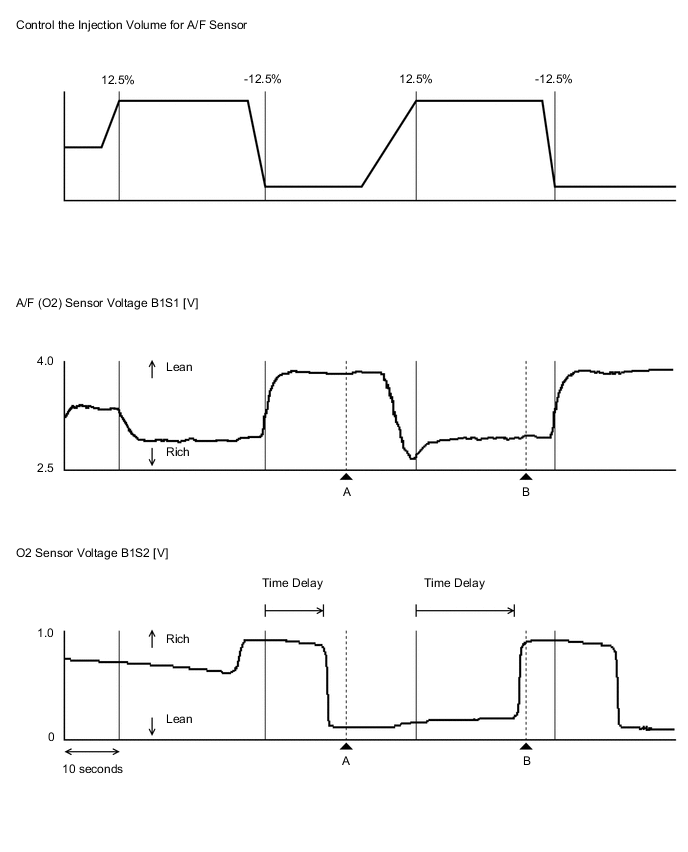
GTS Display Measurement Item/Operation Normal Condition Control the Injection Volume for A/F Sensor - ▲A ▲B Active Test operation -12.5% 12.5% A/F (O2) Sensor Voltage B1S1 3.724 V 2.397 V O2 Sensor Voltage B1S2 0.055 V 0.955 V Tech Tips
-
While performing the Active Test, air fuel ratio feedback control and feedback learning are stopped.
-
Usually, the value of A/F (O2) Sensor Voltage B1S1 drops below 3.1 V when the control value for Control the Injection Volume for A/F Sensor is changed to 12.5%.
-
Usually, the value of A/F (O2) Sensor Voltage B1S1 changes to 3.4 V or higher when the control value for Control the Injection Volume for A/F Sensor is changed to -12.5%.
-
Usually, the value of O2 Sensor Voltage B1S2 changes to 0.55 V or higher when the control value for Control the Injection Volume for A/F Sensor is changed to 12.5%.
-
Usually, the value of O2 Sensor Voltage B1S2 drops below 0.4 V when the control value for Control the Injection Volume for A/F Sensor is changed to -12.5%.
-
The air fuel ratio sensor has an output delay of a few seconds and the heated oxygen sensor has a maximum output delay of approximately 20 seconds.
-
If the sensor output voltage does not change (almost no reaction) while performing the Active Test, the sensor may be malfunctioning.
-
-
*4: Control the ETCS Open/Close Fast Speed [Active Test for electrical throttle control system] (Power switch on (IG), Accelerator pedal fully depressed)
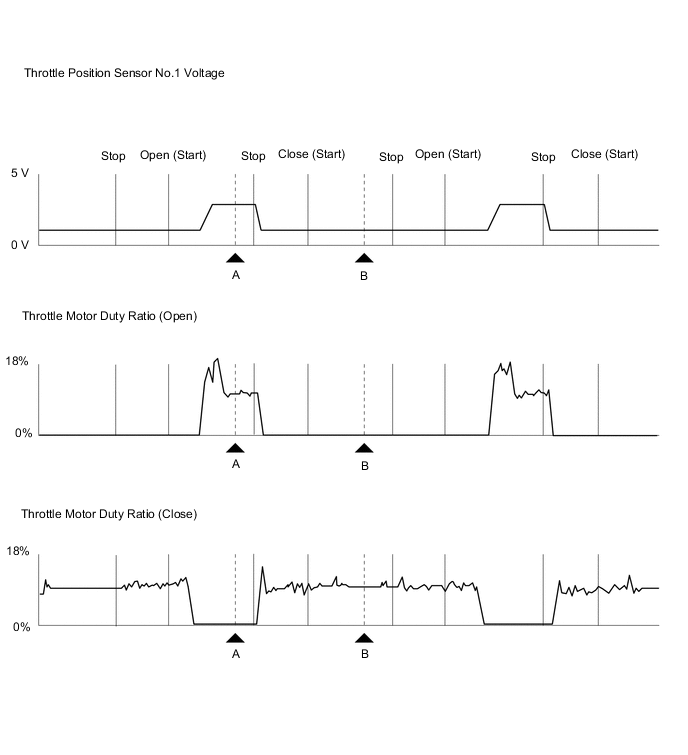
GTS Display Measurement Item/Operation Normal Condition Control the ETCS Open/Close Fast Speed - ▲A ▲B Active Test operation Open Close Throttle Position Sensor No.1 Voltage 2.597 V 0.742 V Throttle Motor Duty Ratio (Open) 13.0% 0.0% Throttle Motor Duty Ratio (Close) 0.0% 13.0% Tech Tips
If any DTCs related to the Electronic Throttle Control System (ETCS) are stored, this Active Test cannot be performed.
-
*5: Activate the EVAP Purge VSV (Engine warmed up and idling, inspection mode [maintenance mode], not charge control)
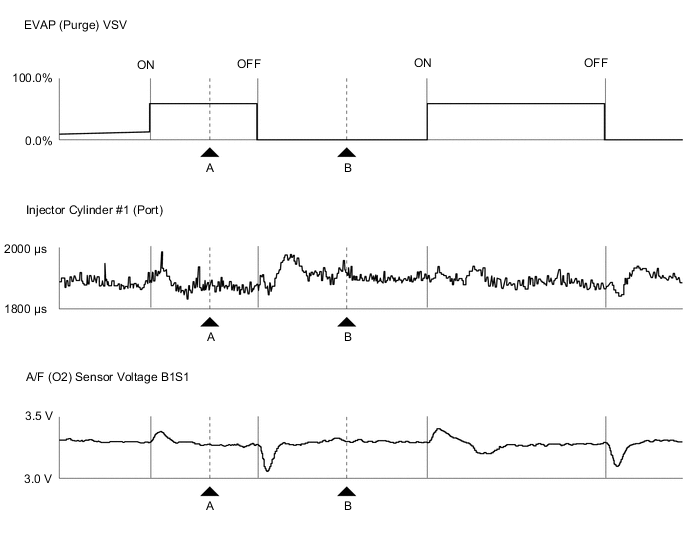
GTS Display Measurement Item/Operation Normal Condition Activate the EVAP Purge VSV - ▲A ▲B Active Test operation ON OFF EVAP (Purge) VSV 49.8% 0.0% Injector Cylinder #1 (Port) 1859 μs 1894 μs A/F (O2) Sensor Voltage B1S1 3.296 V 3.301 V Tech Tips
-
The graphs and values above are for reference only because the fuel injection volume (compensation volume) varies depending on the HC density of the purge air from the canister.
-
Even when the Active Test is performed (the purge VSV is opened approximately 50%), the ECM performs air fuel ratio feedback to maintain the air fuel ratio at the stoichiometric ratio. Therefore, by observing the change in the Data List item "Injector Cylinder #1 (Port)", it is possible to determine whether the purge VSV is actually open.
-
-
*6: Control the EGR Step Position (Engine warmed up and idling, inspection mode [maintenance mode], not charge control)
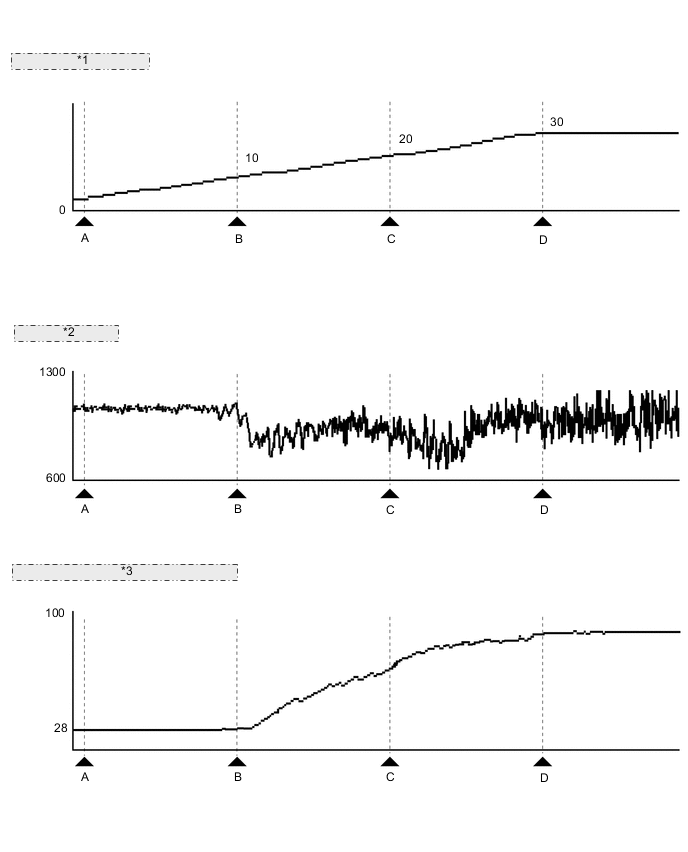
*1 EGR Step Position [step] *2 Engine Speed [rpm] *3 Intake Manifold Absolute Pressure [kPa] GTS Display Measurement Item Normal Condition Control the EGR Step Position - ▲A ▲B ▲C ▲D EGR Step Position 0 step 10 step 20 step 30 step Intake Manifold Absolute Pressure 28 kPa (4.06 psi) 28 kPa (4.06 psi) 67 kPa (9.72 psi) 88 kPa (12.76 psi) Note
-
Make sure that the value of Data List item Engine Independent is "Operate" while performing the Active Test.
-
Do not leave the EGR valve open for 10 seconds or more while performing Active Test.
-
Be sure to return the EGR valve to step 0 when the Active Test is completed.
-
Do not open the EGR valve 30 steps or more during the Active Test.
Tech Tips
-
When the value of Control the EGR Step Position is "0 step", the value of Intake Manifold Absolute Pressure should be between 20 and 40 kPa (2.9 to 5.8 psi).
-
When the EGR system is normal and the value of Control the EGR Step Position is changed from "0 step" to "30 step", the value of Intake Manifold Absolute Pressure will increase to a value at least 10 kPa (1.45 psi) higher than the value of Intake Manifold Absolute Pressure when the value of Control the EGR Step Position was "0 step".
-
If the value of Data List item Engine Independent is "Not Opr" when the engine is idling, charge control is being performed. Perform the Active Test after charge control is complete ("Operate" is displayed).
-
-
*7: Control the Intake VVT OCV Duty Ratio Bank 1 (Idling, inspection mode [maintenance mode], not charge control)
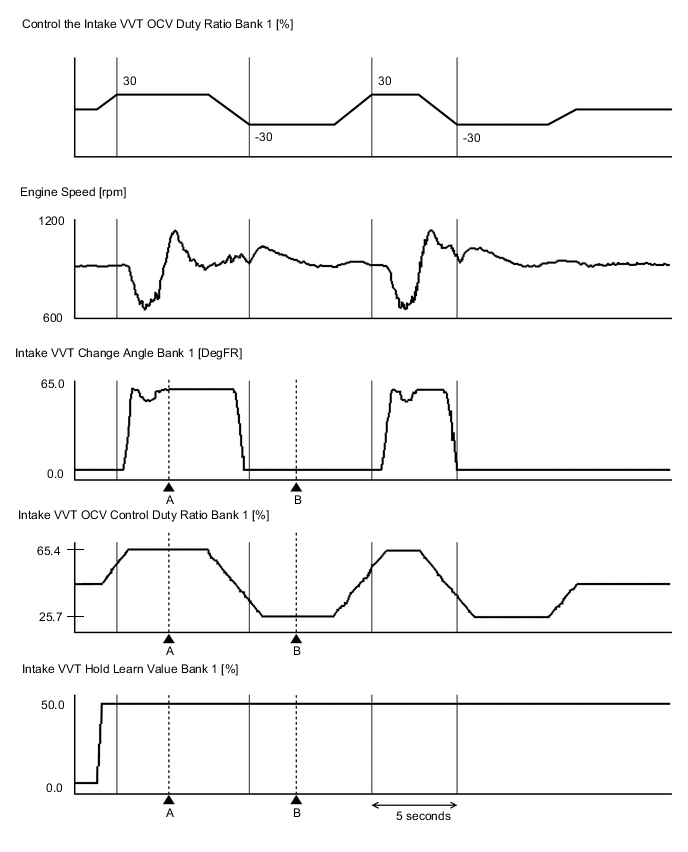
GTS Display Measurement Item/Operation Normal Condition Control the Intake VVT OCV Duty Ratio Bank 1 - ▲A ▲B Active Test operation* 30% -30% Intake VVT Change Angle Bank 1 62.5 DegFR 0.0 DegFR Intake VVT OCV Control Duty Ratio Bank 1 65.4% 25.7% Intake VVT Hold Learn Value Bank 1 50.0% 50.0% Tech Tips
-
*: Change the control value for Control the Intake VVT OCV Duty Ratio Bank 1 to 30% or -30%.
-
Test not possible with park (P) selected during charge control. Select neutral (N) to perform test.
-
-
-
-
SYSTEM CHECK
-
EVAPORATIVE SYSTEM CHECK
Tech Tips
Performing a System Check enables the system, which consists of multiple actuators, to be operated without removing any parts. In addition, it can output any stored DTCs, and can detect potential malfunctions in the system. The System Check can be performed with the GTS.
-
Connect the GTS to the DLC3.
-
Turn the power switch on (IG).
-
Turn the GTS on.
-
Enter the following menus: Powertrain / Engine / Utility / Evaporative System Check.
Powertrain > Engine > UtilityTester Display Evaporative System Check -
Perform the System Check by referring to the table below.
GTS Display Test Part Condition Diagnostic Note Evaporative System Check
(Automatic Mode)
Perform 9 steps in order to operate EVAP key-off monitor automatically Fuel temperature is less than 35°C (95°F), etc.
-
If no pending DTCs are output after performing this test, the system is functioning normally.
-
Refer to EVAP System Inspection Procedure.
Evaporative System Check
(Manual Mode)
Perform 9 steps in order to operate EVAP key-off monitor manually Fuel temperature is less than 35°C (95°F), etc.
-
Used to detect malfunctioning parts.
-
Refer to EVAP System Inspection Procedure.
-
-
-