AIR CONDITIONING SYSTEM Ambient Temperature Display System
DESCRIPTION
The thermistor assembly is installed in front of the cooler condenser assembly to detect the ambient temperature which is used to control the air conditioning system AUTO mode. This sensor is connected to the air conditioning amplifier assembly and detects fluctuations in the ambient temperature. This data is used for controlling the cabin temperature. The sensor sends a signal to the air conditioning amplifier assembly. The resistance of the thermistor assembly changes in accordance with the ambient temperature. As the temperature decreases, the resistance increases. Conversely, as the temperature increases, the resistance decreases.
The air conditioning amplifier assembly applies a voltage (5 V) to the thermistor assembly and reads voltage changes due to changes in the resistance of the thermistor assembly.
Note
The thermistor assembly is installed on the front of the cooler condenser assembly in the motor compartment room and detects the ambient temperature around the installation area (the ambient temperature detected is the temperature detected around the thermistor assembly and not the ambient temperature of the air surrounding the vehicle). Therefore, the ambient temperature around the thermistor assembly changes depending on the radiated heat from the motor compartment room and the ambient temperature display value is affected by vehicle speed. In the following cases, the ambient temperature of the air surrounding the vehicle and the displayed value are different and the speed at which the displayed value updates is delayed. However, this is not a malfunction.
The ambient temperature around the thermistor assembly installation area drastically changes due to a cause other than the radiated heat (vehicle garage, entering or exiting a tunnel, etc.).
WIRING DIAGRAM
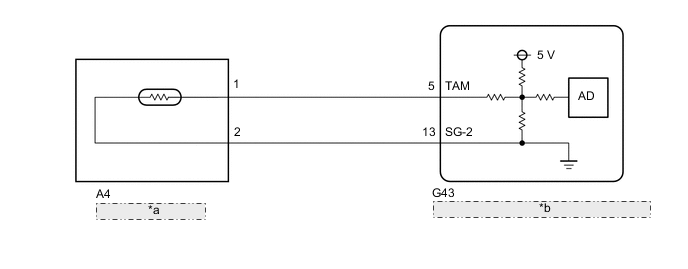
| *a | Thermistor Assembly |
| *b | Air Conditioning Amplifier Assembly |
CAUTION / NOTICE / HINT
Note
-
After turning the power switch off, waiting time may be required before disconnecting the cable from the negative (-) auxiliary battery terminal. Therefore, make sure to read the disconnecting the cable from the negative (-) auxiliary battery terminal notices before proceeding with work.
-
Before starting the inspection, it is necessary to release the residual heat from the motor compartment room (coolant hoses, etc.) after stopping the electric motor (when the vehicle is parked after being driven). Therefore, move and park the vehicle in the following type of temperature measurement location.
-
A location within the vehicle service area which has a relatively low amount of environmental temperature changes in the area surrounding the vehicle.
-
A location with a level surface made of a material such as concrete which transmits a relatively low amount of heat from the ground, such as concrete.
-
A location with no heat influences around the vehicle to be inspected such as other vehicles with a running engine and electric motors, exhaust gas ducts installed on the exhaust pipes, stoves, etc.
-
The air conditioning system uses the CAN communication system. Inspect the communication function by following How to Proceed with Troubleshooting. Troubleshoot the air conditioning system after confirming that the communication system is functioning properly.
for LHD: Click here
for RHD: Click here
-
Power switch operation during parked vehicle inspection:
Turn the power switch on (IG). (Do not start the electric motor.)
PROCEDURE
-
CHECK FOR DTC
-
Clear the DTC.
Body Electrical > Air Conditioner > Clear DTCs -
Check for DTCs when the following conditions are met.
Body Electrical > Air Conditioner > Trouble CodesNote
During the parked vehicle inspection, perform the inspection with the power switch on (IG) (do not start the electric motor).
Result Result Proceed to DTC B1412/12 is not output A DTC B1412/12 is output B
B 
GO TO DTC B1412/12 Click here
A 
-
-
INSPECT THERMISTOR ASSEMBLY (AMBIENT TEMPERATURE SENSOR)
Note
During the parked vehicle inspection, perform the inspection with the power switch off (do not start the electric motor).
-
Disconnect the thermistor assembly connector.
-
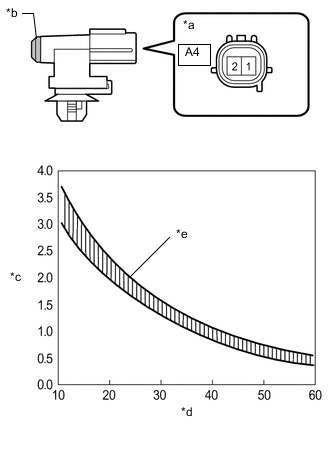
*a Component without harness connected
(Thermistor Assembly)
*b Sensing Portion *c Resistance (kΩ) *d Temperature (°C (°F)) *e Allowable Range Measure the resistance according to the value(s) in the table below.
Standard Resistance Tester Connection Condition Specified Condition A4-1 - A4-2 10°C (50°F) 3.00 to 3.73 kΩ 15°C (59°F) 2.45 to 2.88 kΩ 20°C (68°F) 1.95 to 2.30 kΩ 25°C (77°F) 1.60 to 1.80 kΩ 30°C (86°F) 1.28 to 1.47 kΩ 35°C (95°F) 1.00 to 1.22 kΩ 40°C (104°F) 0.80 to 1.00 kΩ 45°C (113°F) 0.65 to 0.85 kΩ 50°C (122°F) 0.50 to 0.70 kΩ 55°C (131°F) 0.44 to 0.60 kΩ 60°C (140°F) 0.36 to 0.50 kΩ Note
-
Hold the sensor only by its connector. Touching the sensing portion may change the resistance value.
-
When measuring, the sensor temperature must be the same as the ambient temperature.
-
Use a thermometer to detect the ambient temperature of the installation area around the thermistor assembly.
Tech Tips
As the temperature increases, the resistance decreases (see the graph).
Result Proceed to OK NG -
NG
REPLACE THERMISTOR ASSEMBLY Click here
OK
-
-
CHECK HARNESS AND CONNECTOR (THERMISTOR ASSEMBLY - AIR CONDITIONING AMPLIFIER ASSEMBLY)
Note
During the parked vehicle inspection, perform the inspection with the power switch off (do not start the electric motor).
-
Disconnect the A4 thermistor assembly connector.
-
Disconnect the G43 air conditioning amplifier assembly connector.
-
Measure the resistance according to the value(s) in the table below.
Standard Resistance Tester Connection Condition Specified Condition A4-1 - G43-5 (TAM) Always Below 1 Ω A4-2 - G43-13 (SG-2) Always Below 1 Ω A4-1 - A4-2 Always 10 kΩ or higher A4-1 or G43-5 (TAM) - Body ground Always 10 kΩ or higher A4-2 or G43-13 (SG-2) - Body ground Always 10 kΩ or higher Result Proceed to OK NG
NG
REPAIR OR REPLACE HARNESS OR CONNECTOR
OK
-
-
CHECK AMBIENT TEMPERATURE COMPARISON
-
Disconnect the cable from the negative (-) auxiliary battery terminal.
Note
Make sure the wire harness(es) and connector(s) for the vehicle being inspected are connected. After the power switch is turned off, the navigation system stores the various memory and settings within approximately 6 minutes. Therefore, make sure to disconnect the cable from the negative (-) auxiliary battery terminal after confirming that 6 minutes or more have elapsed since turning the power switch off.
-
Disconnect the cable from the negative (-) auxiliary battery terminal and wait 90 seconds or more.
Tech Tips
The air conditioning amplifier assembly reads and memorizes the thermistor assembly detection value from before the power switch was turned off for 1 hour after turning the power switch off. Therefore, it is necessary to switch off the air conditioning amplifier assembly internal power source and clear the stored values from before the power switch was turned off.
-
Connect the cable to the negative (-) auxiliary battery terminal.
-
Using a thermometer, measure the ambient temperature of the installation area around the thermistor assembly and record it.
Note
-
During the parked vehicle inspection, perform the inspection with the power switch on (IG) (do not start the electric motor).
-
Set the thermometer so that the measuring tip is at approximately the same height and lateral position as the thermistor assembly (ambient temperature sensor) installed behind the front grille and approximately 5 cm from the surface of the front grille, and then maintain the thermometer in that position.
-
After the power switch is turned on (IG), the ambient temperature, detected signal value and sensing portion temperature of the thermistor assembly (ambient temperature sensor) and the measuring tip of the thermometer will equalize. Therefore, make sure to wait approximately 6 minutes before measuring.
-
If the temperature sensing portion of the thermistor assembly is touched, the body temperature of the technician may cause an incorrect temperature measurement. Therefore, do not touch the temperature sensor when measuring the ambient temperature of the installation area around the thermistor assembly (ambient temperature sensor).
-
Do not move the thermometer from the maintained position, touch the measuring tip or allow it to contact the front grille.
-
-
Record the ambient temperature value displayed on the multi-information display of the combination meter assembly.
-
Compare the ambient temperature of the installation area around the thermistor assembly with the ambient temperature value displayed on the multi-information display of the combination meter assembly.
Standard The ambient temperature of the installation area around the thermistor assembly is approximately the same as the ambient temperature value displayed on the multi-information display of the combination meter assembly. Result Proceed to OK NG
OK
END
NG
REPLACE AIR CONDITIONING AMPLIFIER ASSEMBLY Click here
-