REAR BRAKE INSPECTION
PROCEDURE
-
INSPECT BRAKE CYLINDER AND PISTON
-
Check the rear disc brake cylinder assembly bore and rear disc brake piston for rust and scoring.
If necessary, replace the rear disc brake cylinder assembly or disc brake piston.
-
-
INSPECT PAD LINING THICKNESS
-
Using a ruler, measure the rear disc brake pad lining thickness.
Standard Thickness 10.0 mm (0.394 in.) Minimum Thickness 1.0 mm (0.0394 in.) Tech Tips
Be sure to check the rear disc thickness when replacing the rear disc brake pads with new ones.
If a rear disc brake pad lining thickness is less than the minimum thickness, replace the rear disc brake pads.
-
-
INSPECT REAR DISC BRAKE PAD SUPPORT PLATE
-
Clean the rear No. 1 disc brake pad support plate and rear No. 2 disc brake pad support plate with brake cleaner, and check that the No. 1 disc brake pad support plate and rear No. 2 disc brake pad support plate has no deformation, cracks, rust, or difficult to remove foreign matter.
-
When installing the rear No. 1 disc brake pad support plate and rear No. 2 disc brake pad support plate, use brake cleaner to clean the surface of the rear disc brake cylinder mounting that contacts the rear No. 1 disc brake pad support plate and rear No. 2 disc brake pad support plate, and with the rear No. 1 disc brake pad support plate and rear No. 2 disc brake pad support plate installed to the rear disc brake cylinder mounting, check that there is no looseness or deformation.
-
When installing the rear disc brake pad, check that the rear disc brake pad support plate has spring force, and that the rear disc brake pad does not easily fall off.
-
-
INSPECT DISC THICKNESS
-
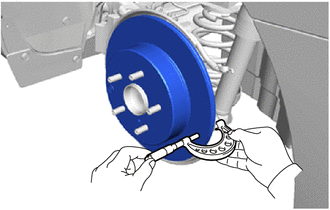
Using a micrometer, measure the rear disc thickness.
Standard Thickness 12.0 mm (0.472 in.) Minimum Thickness 10.5 mm (0.413 in.) If the rear disc thickness is less than the minimum thickness, replace the rear disc.
-
-
INSPECT DISC RUNOUT
-
Inspect the rear axle hub bearing looseness and rear axle hub runout.
-
Align the matchmarks on the rear disc and rear axle hub and bearing assembly, and install the rear disc with the 5 hub nuts.
- Torque:
- 103 N*m { 1050 kgf*cm, 76 ft.*lbf }
-
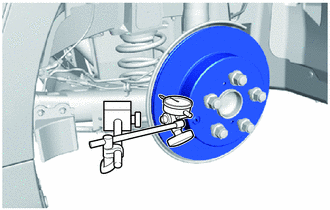
Using a dial indicator, measure the rear disc runout 10 mm (0.394 in.) from the outer edge of the rear disc.
Maximum Disc Runout 0.15 mm (0.00591 in.) Note
-
Keep the magnet of the dial indicator away from the rear axle hub and bearing assembly and rear speed sensor.
-
If the runout exceeds the specified limit, adjust the phase of the rear disc and the rear axle hub to minimize the runout, and reinstall them. If the runout still exceeds the specified limit, grind the rear disc. If grinding the rear disc results in a rear disc thickness that is less than the specified minimum, replace the rear disc with a new one.
-
-
Remove the 5 hub nuts and rear disc.
-