FC CONTROL SYSTEM, Diagnostic DTC:P1E40-450, P1E41-450
| DTC Code | DTC Name |
|---|---|
| P1E40-450 | Hydrogen Leak (Motor Room Side) |
| P1E41-450 | Hydrogen Leak (Tank Side) |
DESCRIPTION
The hydrogen detector is provided in an area where hydrogen may accumulate, so that it can detect hydrogen in case of leaks. The hydrogen detector monitors for leaks independently from the FC system control.
If hydrogen concentrations more than a specified amount is detected by the hydrogen detector, this DTC will be set.
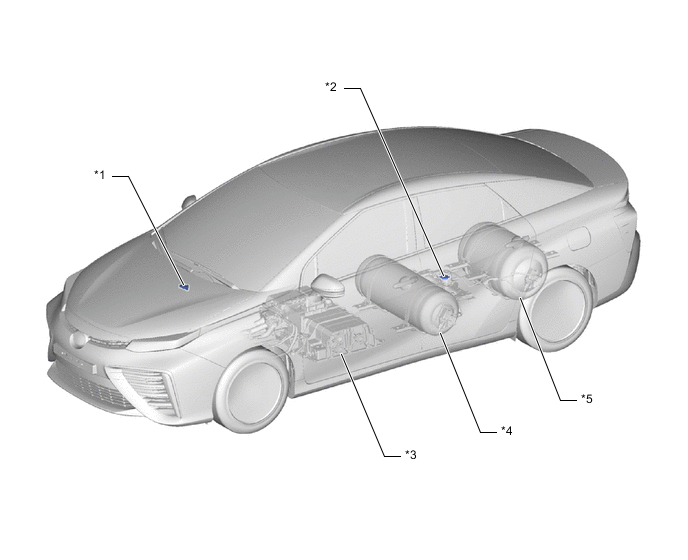
| *1 | Hydrogen Detector (for Motor Room Side) | *2 | Hydrogen Detector (for Hydrogen Tank Side) |
| *3 | FC Stack Assembly | *4 | No. 1 Hydrogen Tank Assembly |
| *5 | No. 2 Hydrogen Tank Assembly | - | - |
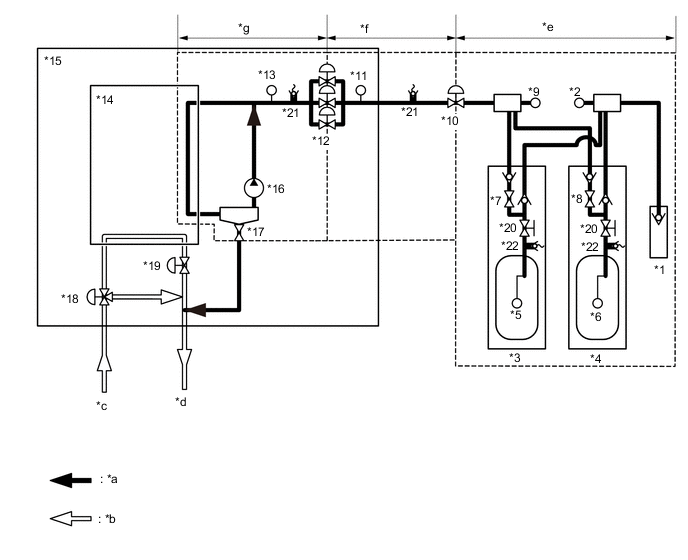
| *1 | Hydrogen Inlet Receptacle Assembly | *2 | Hydrogen Tank Pressure Sensor (for Inlet Side) |
| *3 | No. 1 Hydrogen Tank Assembly | *4 | No. 2 Hydrogen Tank Assembly |
| *5 | Hydrogen Tank Temperature Sensor 1 | *6 | Hydrogen Tank Temperature Sensor 2 |
| *7 | Tank Shut Valve 1 | *8 | Tank Shut Valve 2 |
| *9 | Hydrogen Tank Pressure Sensor (for Outlet Side) | *10 | Hydrogen Supply Regulator Assembly |
| *11 | Medium-range Hydrogen Pressure Sensor | *12 | Hydrogen Injector |
| *13 | Low-range Hydrogen Pressure Sensor | *14 | FC Stack |
| *15 | FC Stack Assembly | *16 | Hydrogen Pump |
| *17 | Exhaust Drainage Valve | *18 | Air Shunt Valve |
| *19 | Air Pressure Regulating Valve | *20 | Manual Valve |
| *21 | Pressure Relief Valve | *22 | Pressure Relief Device |
| *a | Hydrogen System | *b | Air System |
| *c | From the FC Air Compressor with Motor Assembly | *d | To the Exhaust Drainage Pipe |
| *e | High-range pressure area | *f | Medium-range pressure area |
| *g | Low-range pressure area | - | - |
| DTC No. | Detection Item | DTC Detection Condition | Trouble Area | Warning Indicate |
|---|---|---|---|---|
| P1E40-450 | Hydrogen Leak (Motor Room Side) | Power switch is turned on (READY) after the hydrogen detector is completely warmed up (within 10 seconds of turning on the power switch (IG)), the FC Mode is in a mode other than FC Shutdown, and any one of the following conditions is met:
(1 trip detection logic) |
|
|
| P1E41-450 | Hydrogen Leak (Tank Side) | Power switch is turned on (READY) after the hydrogen detector is completely warmed up (within 10 seconds of turning on the power switch (IG)), the FC Mode is in a mode other than FC Shutdown, and any one of the following conditions is met:
(1 trip detection logic) |
|
|
Tech Tips
-
DTC P1E40-450 indicates hydrogen leaks somewhere in the motor compartment, and P1E41-450 indicates hydrogen leaks somewhere near the hydrogen tank.
-
Troubleshoot hydrogen leaks from the high-range pressure area first.
| Vehicle Condition | FC shutdown (power switch on (IG)) |
FC startup process | FC intermittent operation | FC is generating power (vehicle is in stationary) |
FC is generating power (vehicle is traveling) |
FC shutdown process |
|---|---|---|---|---|---|---|
| Data List "FC Mode" |
FC Shutdown | FC Startup Process | FC Working | FC Shutdown Process | ||
| Data List "FC Intermittent Operation" |
OFF | ON | OFF | OFF | ||
| DTC Detection | - | ○ | ○ | ○ | ○ | ○ |
| DTC No. | Data List |
|---|---|
| P1E40-450 |
|
| P1E41-450 |
|
Refer to the following items stored in the freeze frame data.
-
"Motor Room Side Hydrogen Detector Density", "Tank Side Hydrogen Detector Density":
Amount of detected leakage is displayed in percentage.
-
"Smoothed Value of High-range Hydrogen Pressure":
The value is normally in a range of 1000 to 87500 kPa(abs) with the power switch on (READY). If it is below 1000 kPa(abs), a situation is identified as lack of hydrogen, and the FC system will be brought to a halt.
-
"Smoothed Value of Medium-range Hydrogen Pressure":
The value is normally in a range of 1000 to 1600 kPa(abs) with the power switch on (READY).
-
"Smoothed Value of Low-range Hydrogen Pressure":
The value is normally "an atmospheric pressure plus 10 kPa" to "280 kPa(abs)" with the power switch on (READY), and is regulated to stay at the "Target Low-range Hydrogen Pressure" value.
The following items can be helpful when performing repairs:
-
Vehicle Speed
-
Shift Sensor Shift Position
-
Accelerator Degree
-
Ready
-
FC Mode
-
FC Intermittent Operation
-
FC Voltage before Boosting
-
FC Current
-
Target Hydrogen Pump Revolution
-
Hydrogen Pump Revolution
-
Target FC Stack Air Pressure (FC Stack Inlet)
-
Smoothed Value of FC Stack Air Pressure (FC Stack Inlet)
-
Target Mass Air Flow Value
-
Mass Air Flow Value
-
Target Air Compressor Revolution
-
Air Compressor Revolution
-
Target FC Stack Coolant Temperature (FC Stack Outlet)
-
Smoothed Value of FC Stack Coolant Temperature (FC Stack Outlet)
-
Exhaust Drainage Valve Driving Request
Common Data List items for FC inspection
CAUTION / NOTICE / HINT
CAUTION:
-
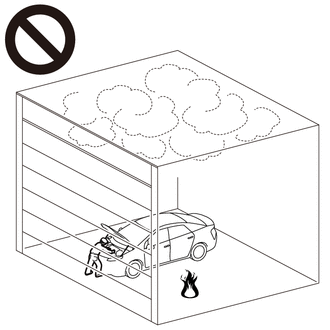
Work procedures must be performed in an area with good ventilation (airflow) where hydrogen gas will not accumulate, and flames or other things that could act as ignition sources must not be present.
-
Accumulated hydrogen gas could ignite, resulting in a serious accident.
Note
-
After completion of repair, using a hydrogen gas detector and soapy water, check that no hydrogen leaks from the hydrogen pipes.
-
When the vehicle is parked with the power switch off, if the FC control ECU judges that the FC stack temperature will go below 0°C (32°F), it activates the FC air compressor, hydrogen pump and FC cooling water pump for a maximum of 180 seconds and drains water from the FC stack assembly. When performing inspection or repairs with the power switch off (not on (IG) or on (READY)), disconnect the cable from the negative (-) auxiliary battery terminal before performing work (If the auxiliary battery voltage is needed to conduct inspection, warm up the FC system beforehand).
Tech Tips
-
Forcing the SOC of the EV battery to decrease by applying electrical loads such as turning on the air conditioning (HOT MAX, maximum airflow), or depressing the accelerator pedal with the shift lever in P, the "FC Intermittent Operation" of the Data List is easily to enter OFF (power generation mode).
After the repair, clear the DTCs and perform the following procedure to check that DTCs are not output.
-
Activate the FC system (If it cannot be activated, check the DTCs that are present at the time).
-
If the "Motor Room Side Hydrogen Detector Density" or "Tank Side Hydrogen Detector Density" value in the Data List is more than 2%, a DTC will be output. Also, if pressure leaks have occurred in the hydrogen system, the following DTCs listed below will be set. If no pressure leaks have occurred, the "Smoothed Value of High-range Hydrogen Pressure" and "Smoothed Value of Medium-range Hydrogen Pressure" in the Data List are stable at values other than 0 (zero) with the power switch on (READY).
-
P1E42-450 (Hydrogen Pressure Leak (Excessive Hydrogen Flow))
-
P1E43-450 (Hydrogen Pressure Leak (High/Medium Pressure Area))
-
P1E44-450 (Hydrogen Pressure Leak (Low Pressure Area))
PROCEDURE
-
CHECK DTC OUTPUT
Note
The freeze frame data is cleared when DTCs are cleared. Be sure to make a note of necessary data in advance.
-
Connect the GTS to the DLC3.
-
Turn the power switch on (IG).
-
Turn the GTS on.
-
Enter the following menus: Powertrain / FC / Trouble Codes.
-
Check for DTCs.
Powertrain > FC > Trouble CodesResult Result Proceed to P1E40-450 or P1E41-450 only is output, or DTCs except the ones in the table below are also output. A Any of the following DTCs are also output. B Malfunction Content Relevant DTC System Malfunction P1E42-450 Hydrogen Pressure Leak (Excessive Hydrogen Flow) P1E43-450 Hydrogen Pressure Leak (High/Medium Pressure Area) P1E44-450 Hydrogen Pressure Leak (Low Pressure Area) P1DC1-450 Low-range Hydrogen Pressure Too High P1DC3-450 Medium-range Hydrogen Pressure Too High Tech Tips
-
DTC P1E40-450 or P1E41-450 may be set due to problems that cause the DTCs shown above to be output. If such happens, troubleshoot the suspected area(s) corresponding to the output DTC(s) in order starting with the listed DTCs shown in the table above.
-
If no pressure leaks have occurred in the high-range or medium-range hydrogen pressure system, the "Smoothed Value of High-range Hydrogen Pressure" and "Smoothed Value of Medium-range Hydrogen Pressure" in the Data List are stable at values other than 0 (zero) with the power switch on (READY).
-
-
Turn the power switch off.
B 
GO TO DTC CHART Click here
A 
-
-
CLEAR DTC
-
Connect the GTS to the DLC3.
-
Turn the power switch on (IG).
-
Turn the GTS on.
-
Enter the following menus: Powertrain / FC / Trouble Codes.
-
Clear the DTCs.
Powertrain > FC > Clear DTCs -
Turn the power switch off and wait for 3 minutes or more.
Result Proceed to NEXT
NEXT
-
-
CHECK HYDROGEN GAS LEAKAGE POINT
CAUTION:
-
Work procedures must be performed in an area with good ventilation (airflow) where hydrogen gas will not accumulate, and flames or other things that could act as ignition sources must not be present.
-
Accumulated hydrogen gas could ignite, resulting in a serious accident.
-
Open the hood with the power switch off, check for hydrogen leaks around the underbody and in the motor compartment with a hydrogen gas detector. If leakage is found, pay extra attention to fire safety in the following operations.
Tech Tips
For procedures to check for leaks from hydrogen pipes and components (high-range pressure and medium-range pressure), refer to Click here.
-
Turn the power switch off.
-
Remove the under cover.
-
Check that the hydrogen tank and hydrogen pipes are not damaged.
-
Check for a gas leaking sound, and then check if there are hydrogen leaks in the hydrogen pipes and components with a hydrogen gas detector.
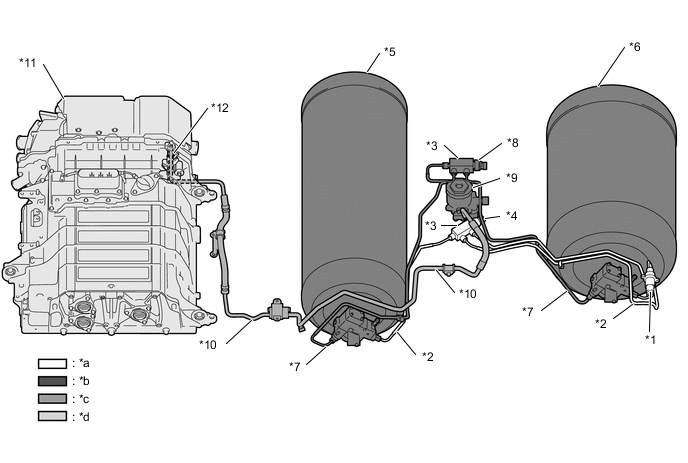
*1 Hydrogen Inlet Receptacle Assembly *2 High-range Hydrogen Pressure Pipe (for filling) *3 Hydrogen Tank Tube Joint *4 Hydrogen Tank Pressure Sensor (for Inlet Side) *5 No. 1 Hydrogen Tank Assembly *6 No. 2 Hydrogen Tank Assembly *7 High-range Hydrogen Pressure Pipe (for feeding) *8 Hydrogen Tank Pressure Sensor (for Outlet Side) *9 Hydrogen Supply Regulator Assembly *10 Medium-range Hydrogen Pressure Pipe *11 FC Stack Assembly *12 Hydrogen Injector *a High-range Pressure Area (when filling)
(Hydrogen Inlet Receptacle Assembly → Hydrogen Tank Assembly )
*b High-range Pressure Area
(Hydrogen Tank Assembly → Hydrogen Supply Regulator Assembly)
*c Medium-range Pressure Area
(Hydrogen Supply Regulator Assembly → Hydrogen Injector)
*d Low-range Pressure Area
(Hydrogen Injector → FC Stack)
Standard value 300 ppm or less. (Hydrogen gas detector) Result Proceed to OK NG -
Install the under cover.
NG 
CHECK HYDROGEN GAS LEAK Click here
OK
-
-
CHECK HYDROGEN GAS LEAKAGE POINT
CAUTION:
-
Work procedures must be performed in an area with good ventilation (airflow) where hydrogen gas will not accumulate, and flames or other things that could act as ignition sources must not be present.
-
Accumulated hydrogen gas could ignite, resulting in a serious accident.
-
Open the hood with the power switch off, check for hydrogen leaks around the underbody and in the motor compartment with a hydrogen gas detector. If leakage is found, pay extra attention to fire safety in the following operations.
Note
Turning the power switch on (READY) causes the tank shut valve to open, and this pressurizes hydrogen in the hydrogen pipes. At this time, locate leaking areas of the hydrogen pipe. If there are leaks, the hydrogen pressure in the pipe decreases gradually, so perform checks quickly.
Tech Tips
For procedures to check for leaks from hydrogen pipes and components (high-range pressure and medium-range pressure), refer to Click here.
-
Remove the under cover.
-
Connect the GTS to the DLC3.
-
Turn the power switch on (IG).
-
Turn the GTS on.
-
Enter the following menus: Powertrain / FC / Data List / FC Mode, FC Intermittent Operation
Powertrain > FC > Data ListTester Display FC Mode FC Intermittent Operation -
Turn the power switch on (READY) with the shift lever in P, and check the Data List that "FC Mode" is FC Working and "FC Intermittent Operation" is OFF.
Tech Tips
If there are no leaks, the high-range and medium-range hydrogen systems will be pressurized full in virtually a few seconds after the power switch is turned on (READY)(the tank shut valves open). For the low-range hydrogen system, after the power switch is turned on (READY), when the "FC Mode" in the Data List enters FC Working and Intermittent Operation turns OFF, the hydrogen injector is caused to open so that hydrogen can be supplied.
-
Turn the power switch off.
-
Check for a gas leaking sound, and then check if there are hydrogen leaks in the hydrogen pipes and components with a hydrogen gas detector.
*1 Hydrogen Inlet Receptacle Assembly *2 High-range Hydrogen Pressure Pipe (for filling) *3 Hydrogen Tank Tube Joint *4 Hydrogen Tank Pressure Sensor (for Inlet Side) *5 No. 1 Hydrogen Tank Assembly *6 No. 2 Hydrogen Tank Assembly *7 High-range Hydrogen Pressure Pipe (for feeding) *8 Hydrogen Tank Pressure Sensor (for Outlet Side) *9 Hydrogen Supply Regulator Assembly *10 Medium-range Hydrogen Pressure Pipe *11 FC Stack Assembly *12 Hydrogen Injector *a High-range Pressure Area (when filling)
(Hydrogen Inlet Receptacle Assembly → Hydrogen Tank Assembly )
*b High-range Pressure Area
(Hydrogen Tank Assembly → Hydrogen Supply Regulator Assembly)
*c Medium-range Pressure Area
(Hydrogen Supply Regulator Assembly → Hydrogen Injector)
*d Low-range Pressure Area
(Hydrogen Injector → FC Stack)
Standard value 300 ppm or less. (Hydrogen gas detector) Result Proceed to OK NG -
Install the under cover.
NG
CHECK HYDROGEN GAS LEAK Click here
OK
-
-
READ VALUE USING GTS (SMOOTHED VALUE OF HIGH-RANGE HYDROGEN PRESSURE)
Tech Tips
This troubleshooting procedure is to check if the No. 1 hydrogen tank assembly is empty or its internal pressure is lower than that of the No. 2 hydrogen tank assembly, due to leakage of the No. 1 hydrogen tank.
-
Connect the GTS to the DLC3.
-
Turn the power switch on (IG).
-
Turn the GTS on.
-
Enter the following menus: Powertrain / FC / Trouble Codes.
-
Clear the DTCs.
Powertrain > FC > Clear DTCs -
Enter the following menus: Powertrain / FC / Data List / FC Mode, Smoothed Value of High-range Hydrogen Pressure
Powertrain > FC > Data ListTester Display FC Mode Smoothed Value of High-range Hydrogen Pressure -
Turn the power switch on (READY) with the shift lever in P, and check the Data List that "FC Mode" is FC Working.
-
Record the "Smoothed Value of High-range Hydrogen Pressure" of the Data List. (1)
-
Turn the power switch off and wait for 3 minutes or more.
Tech Tips
After the power switch is turned off, the "Smoothed Valve of High-range Hydrogen Pressure" is reduced to depressurized by 5000 to 10000 kPa due to system shutdown control.
-
Remove the under cover.
-
Remove the 3 bolts to separate the FC exhaust pipe.
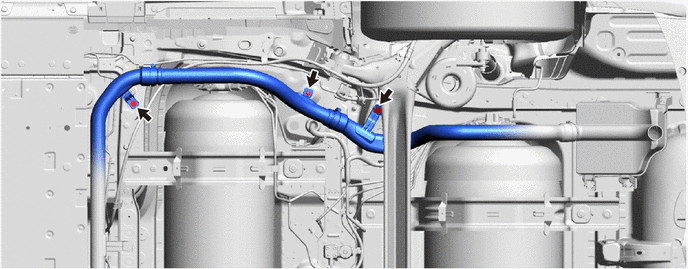
-
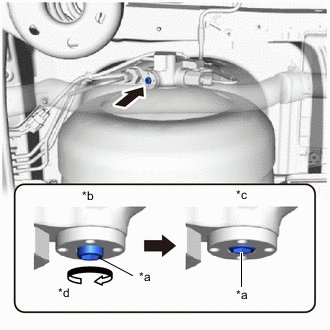
*a Adjustment Bolt *b Manual Valve Open *c Manual Valve Closed *d Clockwise Using an 8 mm hexagon socket wrench, rotate the adjustment bolt clockwise to close the manual valve of the No. 2 hydrogen tank assembly.
Torque 20 N*m (204 kgf*cm, 15 ft.*lbf) Note
-
The manual valve is the component that shuts off the pressure from the hydrogen tank assembly, so be careful not to damage the hexagonal portion.
-
If the hexagonal portion has been damaged, the No. 2 hydrogen tank assembly must be replaced.
-
-
Turn the power switch on (IG).
-
Turn the GTS on.
-
Enter the following menus: Powertrain / FC / Data List / FC Mode, Smoothed Value of High-range Hydrogen Pressure
Powertrain > FC > Data ListTester Display FC Mode Smoothed Value of High-range Hydrogen Pressure -
Turn the power switch on (READY).
Note
-
Perform operations (2) and (3) instructed below within 5 seconds of turning the power switch on (READY).
-
If the manual valve of the No. 2 hydrogen tank assembly is forced to close when the No. 1 hydrogen tank assembly has run out of hydrogen due to leaks, the hydrogen supply to the hydrogen supply line will be blocked even when the power switch is on (READY). At this time, "Hydrogen Empty Low Level" may be stored in the vehicle control history, so check the vehicle control history after completion of repair, and delete it before returning the vehicle to the customer if it is recorded.
Tech Tips
If the No. 1 hydrogen tank assembly has run out of hydrogen due to leaks, the hydrogen supply to the FC stack will stop due to closure of the manual valve of the No. 2 hydrogen tank assembly, and as a result, the FC system will be disabled ("FC Mode" of the Data List will not enter the FC Working).
-
-
Read the "Smoothed Value of High-range Hydrogen Pressure" of the Data List. (2)
Result Result Proceed to "Smoothed Value of High-range Hydrogen Pressure" has increased up to the value recorded in operation (1). A Other than above B -
Turn the power switch off. (3)
-
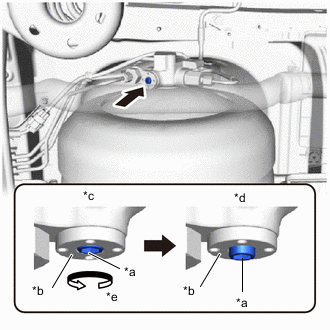
*a Adjustment Bolt *b Plug *c Manual Valve Closed *d Manual Valve Open *e Counterclockwise Using an 8 mm socket hexagon wrench, rotate the adjustment bolt counterclockwise until it contacts the plug, and open the No. 2 hydrogen tank assembly manual valve.
Note
-
The manual valve is the component that shuts off the pressure from the hydrogen tank assembly, so be careful not to damage the hexagonal portion.
-
If the hexagonal portion has been damaged, the No. 2 hydrogen tank assembly must be replaced.
-
-
Install the FC exhaust pipe to the vehicle body with the bolt.
-
Install the under cover.
B
REPLACE NO. 1 HYDROGEN TANK ASSEMBLY Click here
A
-
-
READ VALUE USING GTS (SMOOTHED VALUE OF HIGH-RANGE HYDROGEN PRESSURE)
Tech Tips
This troubleshooting procedure is to check if the No. 2 hydrogen tank assembly is empty or its internal pressure is lower than that of the No. 1 hydrogen tank assembly, due to leakage of the No. 2 hydrogen tank.
-
Connect the GTS to the DLC3.
-
Turn the power switch on (IG).
-
Turn the GTS on.
-
Enter the following menus: Powertrain / FC / Trouble Codes.
-
Clear the DTCs.
Powertrain > FC > Clear DTCs -
Enter the following menus: Powertrain / FC / Data List / FC Mode, Smoothed Value of High-range Hydrogen Pressure
Powertrain > FC > Data ListTester Display FC Mode Smoothed Value of High-range Hydrogen Pressure -
Turn the power switch on (READY) with the shift lever in P, and check the Data List that "FC Mode" is FC Working.
-
Record the "Smoothed Value of High-range Hydrogen Pressure" of the Data List. (1)
-
Turn the power switch off and wait for 3 minutes or more.
Tech Tips
After the power switch is turned off, the "Smoothed Valve of High-range Hydrogen Pressure" is reduced to depressurized by 5000 to 10000 kPa due to system shutdown control.
-
Remove the under cover.
-
Remove the 3 bolts to separate the FC exhaust pipe.
-
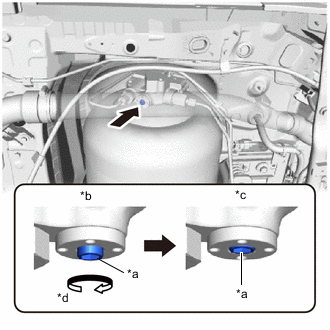
*a Adjustment Bolt *b Manual Valve Open *c Manual Valve Closed *d Clockwise Using an 8 mm hexagon socket wrench, rotate the adjustment bolt clockwise to close the manual valve of the No. 1 hydrogen tank assembly.
Torque 20 N*m (204 kgf*cm, 15 ft.*lbf) Note
-
The manual valve is the component that shuts off the pressure from the hydrogen tank assembly, so be careful not to damage the hexagonal portion.
-
If the hexagonal portion has been damaged, the No. 1 hydrogen tank assembly must be replaced.
-
-
Turn the power switch on (IG).
-
Turn the GTS on.
-
Enter the following menus: Powertrain / FC / Data List / FC Mode, Smoothed Value of High-range Hydrogen Pressure
Powertrain > FC > Data ListTester Display FC Mode Smoothed Value of High-range Hydrogen Pressure -
Turn the power switch on (READY).
Note
-
Perform operations (2) and (3) instructed below within 5 seconds of turning the power switch on (READY).
-
If the manual valve of the No. 1 hydrogen tank assembly is forced to close when the No. 2 hydrogen tank assembly has run out of hydrogen due to leaks, the hydrogen supply to the hydrogen supply line will be blocked even when the power switch is on (READY). At this time, "Hydrogen Empty Low Level" may be stored in the vehicle control history, so check the vehicle control history after completion of repair, and delete it before returning the vehicle to the customer if it is recorded.
Tech Tips
If the No. 2 hydrogen tank assembly has run out of hydrogen due to leaks, the hydrogen supply to the FC stack will stop due to closure of the manual valve of the No. 1 hydrogen tank assembly, and as a result, the FC system will be disabled ("FC Mode" of the Data List will not enter the FC Working).
-
-
Read the "Smoothed Value of High-range Hydrogen Pressure" of the Data List. (2)
Result Result Proceed to "Smoothed Value of High-range Hydrogen Pressure" has increased up to the value recorded in operation (1). A Other than above B -
Turn the power switch off. (3)
-
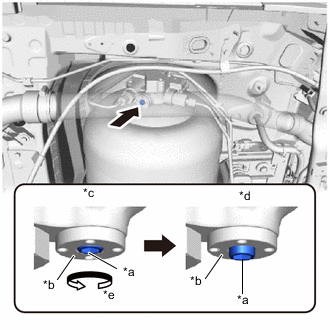
*a Adjustment Bolt *b Plug *c Manual Valve Closed *d Manual Valve Open *e Counterclockwise Using an 8 mm socket hexagon wrench, rotate the adjustment bolt counterclockwise until it contacts the plug, and open the No. 1 hydrogen tank assembly manual valve.
Note
-
The manual valve is the component that shuts off the pressure from the hydrogen tank assembly, so be careful not to damage the hexagonal portion.
-
If the hexagonal portion has been damaged, the No. 1 hydrogen tank assembly must be replaced.
-
-
Install the FC exhaust pipe to the vehicle body with the bolt.
-
Install the under cover.
B
REPLACE HYDROGEN TANK ASSEMBLY NO.2 Click here
A
-
-
CHECK EXHAUST HYDROGEN GAS
CAUTION:
-
Work procedures must be performed in an area with good ventilation (airflow) where hydrogen gas will not accumulate, and flames or other things that could act as ignition sources must not be present.
-
Accumulated hydrogen gas could ignite, resulting in a serious accident.
-
Ensure the safety of the areas in front and at the back of the vehicle.
-
Put wheel chocks and securely apply the parking brake.
-
Connect the GTS to the DLC3.
-
Turn the power switch on (IG).
-
Turn the GTS on.
-
Enter the following menus: Powertrain / FC / Data List / FC Mode, FC Intermittent Operation, Exhaust Drainage Valve Driving Request
Powertrain > FC > Data ListTester Display FC Mode FC Intermittent Operation Exhaust Drainage Valve Driving Request -
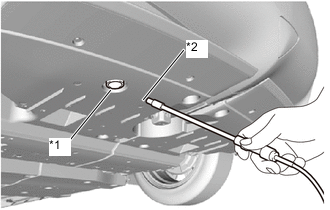
*1 Tailpipe *2 Hydrogen gas detector probe Using a hydrogen gas detector, measure the hydrogen concentration in the gas emitted from the tail pipe.
Note
-
Perform this measurement in an environment where there is no wind.
-
Position the hydrogen gas detector probe in an area 100 mm (3.94 in.) away from the tailpipe opening. (Avoid locations underneath the tailpipe opening)
-
Position the hydrogen gas detector probe so that it is free from dropping water that comes from the tailpipe opening.
-
-
Measure the hydrogen concentration for 1 minute with the shift lever in P, the power switch on (READY), the Data List "FC Mode" showing FC Working and "FC Intermittent Operation" showing OFF. Watch for changes in the concentration when the "Exhaust Drainage Valve Driving Request" is ON and OFF in the Data List.
Note
Perform measurement immediately after the power switch is turned on (READY).
-
Turn the power switch off.
Result Result Proceed to Hydrogen concentration increases when the "Exhaust Drainage Valve Driving Request" is ON but does not increase when it is OFF. A Other than above* B
-
*: The exhaust drainage valve is malfunctioning
-
Exhaust drainage valve is stuck closed:
-
Regardless of the "Exhaust Drainage Valve Driving Request" being ON or OFF, the concentration shown on the hydrogen gas detector has remained low.
-
Exhaust drainage valve is stuck open:
-
Regardless of the "Exhaust Drainage Valve Driving Request" being ON or OFF, the concentration shown on the hydrogen gas detector has remained high when the power switch is on (READY).
-
B
REPLACE FC STACK ASSEMBLY Click here
A
-
-
CHECK HYDROGEN DETECTOR
-
Perform on-vehicle inspection for the hydrogen detector.
If DTC P1E40-450 is stored: Click here
If DTC P1E41-450 is stored: Click here
Result Proceed to OK NG
OK
CHECK FOR INTERMITTENT PROBLEMS Click here
NG
REPLACE HYDROGEN DETECTOR Hydrogen detector (for motor room side) Click here Hydrogen detector (for hydrogen tank side) Click here
-
-
CHECK HYDROGEN GAS LEAK
CAUTION:
-
Work procedures must be performed in an area with good ventilation (airflow) where hydrogen gas will not accumulate, and flames or other things that could act as ignition sources must not be present.
-
Accumulated hydrogen gas could ignite, resulting in a serious accident.
-
Connect the GTS to the DLC3.
-
Turn the power switch on (IG).
-
Turn the GTS on.
-
Enter the following menus: Powertrain / FC / Data List / FC Mode, FC Intermittent Operation
Powertrain > FC > Data ListTester Display FC Mode FC Intermittent Operation -
Turn the power switch on (READY) with the shift lever in P, and check the Data List that "FC Mode" is FC Working and "FC Intermittent Operation" is OFF.
Tech Tips
If there are no leaks, the high-range and medium-range hydrogen systems will be pressurized full in virtually a few seconds after the power switch is turned on (READY)(the tank shut valves open). For the low-range hydrogen system, after the power switch is turned on (READY), when the "FC Mode" in the Data List enters FC Working and Intermittent Operation turns OFF, the hydrogen injector is caused to open so that hydrogen can be supplied.
-
Turn the power switch off.
-
Apply soapy water to locate hydrogen leaking areas.
Note
Do not apply soapy water to the FC stack assembly. If a hydrogen gas detector identifies gas leaks from the FC stack assembly, replace the FC stack assembly with new one.
Result Proceed to NEXT
NEXT
REPLACE MALFUNCTIONING PARTS
-
-
CHECK HYDROGEN GAS LEAK
CAUTION:
-
Work procedures must be performed in an area with good ventilation (airflow) where hydrogen gas will not accumulate, and flames or other things that could act as ignition sources must not be present.
-
Accumulated hydrogen gas could ignite, resulting in a serious accident.
-
Apply soapy water to locate hydrogen leaking areas.
Note
Do not apply soapy water to the FC stack assembly. If a hydrogen gas detector identifies gas leaks from the FC stack assembly, replace the FC stack assembly with new one.
Result Proceed to NEXT
NEXT
REPLACE MALFUNCTIONING PARTS
-