FC CONTROL SYSTEM, Diagnostic DTC:P1DB2-450, P1DB3-450
| DTC Code | DTC Name |
|---|---|
| P1DB2-450 | High-range Hydrogen Pressure Sensor Circuit Low |
| P1DB3-450 | High-range Hydrogen Pressure Sensor Circuit High |
DESCRIPTION
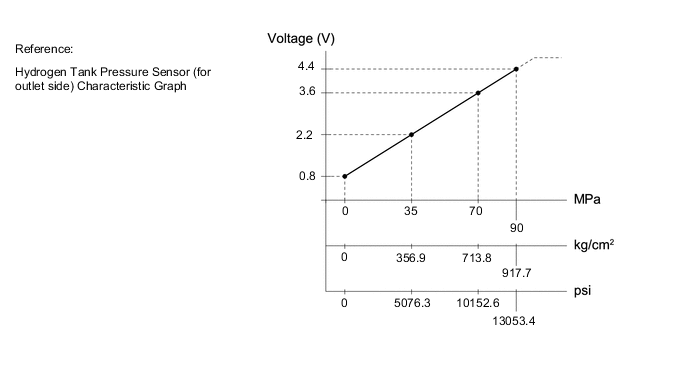
The hydrogen tank pressure sensor (for outlet side) is provided on the hydrogen tank tube joint (for outlet side), and it detects and converts pressure of the hydrogen supply system (high-range pressure area) into a voltage values.
The FC control ECU checks for leaks in the hydrogen supply system (high-range pressure area) when the FC system is activated, and monitors pressure in the hydrogen supply system while the FC is in operation, though use of hydrogen tank pressure sensor (for outlet side) values.
| DTC No. | Detection Item | DTC Detection Condition | Trouble Area | Warning Indicate |
|---|---|---|---|---|
| P1DB2-450 | High-range Hydrogen Pressure Sensor Circuit Low | If the +B voltage is not low when the power switch is turned on (IG), High-range Hydrogen Pressure Sensor Voltage remains at less than 0.55 V for more than 3 seconds. (1 trip detection logic) |
|
Master Warning Light: Comes on |
| P1DB3-450 | High-range Hydrogen Pressure Sensor Circuit High | If the +B voltage is not low when the power switch is turned on (IG), High-range Hydrogen Pressure Sensor Voltage remains at more than 4.65 V for more than 3 seconds. (1 trip detection logic) |
|
Master Warning Light: Comes on |
| Vehicle Condition | FC shutdown (power switch on (IG)) |
FC startup process | FC intermittent operation | FC is generating power (vehicle is in stationary) |
FC is generating power (vehicle is traveling) |
FC shutdown process |
|---|---|---|---|---|---|---|
| Data List "FC Mode" |
FC Shutdown | FC Startup Process | FC Working | FC Shutdown Process | ||
| Data List "FC Intermittent Operation" |
OFF | ON | OFF | OFF | ||
| DTC Detection | ○ | ○ | ○ | ○ | ○ | - |
| DTC No. | Data List |
|---|---|
| P1DB2-450 | High-range Hydrogen Pressure Sensor Voltage |
| P1DB3-450 |
The following items can be helpful when performing repairs:
-
Smoothed Value of High-range Hydrogen Pressure
Data List
Tech Tips
If DTCs are found, read the "High-range Hydrogen Pressure Sensor Voltage" in the Data List on a GTS.
| High-range Hydrogen Pressure Sensor Voltage | Malfunction |
|---|---|
| Less than 0.55 V |
|
| Higher than 4.65 V |
|
Tech Tips
It is suspected that malfunctions, or open/short circuits have occurred in the Hydrogen tank pressure sensor (for outlet side).
WIRING DIAGRAM
CAUTION / NOTICE / HINT
Note
When the vehicle is parked with the power switch off, if the FC control ECU judges that the FC stack temperature will go below 0°C (32°F), it activates the FC air compressor, hydrogen pump and FC cooling water pump for a maximum of 180 seconds and drains water from the FC stack assembly. When performing inspection or repairs with the power switch off (not on (IG) or on (READY)), disconnect the cable from the negative (-) auxiliary battery terminal before performing work (If the auxiliary battery voltage is needed to conduct inspection, warm up the FC system beforehand).
Tech Tips
After the repair, clear the DTCs and perform the following procedure to check that DTCs are not output.
-
Turn the power switch on (IG) and wait for 3 seconds or more.
PROCEDURE
-
CHECK TERMINAL VOLTAGE (POWER SOURCE OF HYDROGEN TANK PRESSURE SENSOR (FOR OUTLET SIDE))
-
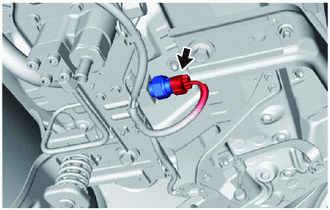
Disconnect the hydrogen tank pressure sensor (for outlet side) connector.
-
Turn the power switch on (IG).
-
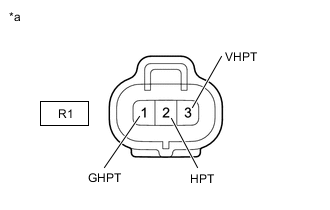
*a Front view of wire harness connector
(to Hydrogen Tank Pressure Sensor (for Outlet Side))
Measure the voltage according to the value(s) in the table below.
Standard Voltage Tester Connection Condition Specified Condition R1-3 (VHPT) - R1-1 (GHPT) Power switch on (IG) 4.75 to 5.25 V R1-2 (HPT) - R1-1 (GHPT) Power switch on (IG) 4.935 to 5.065 V -
Turn the power switch off.
-
Reconnect the hydrogen tank pressure sensor (for outlet side) connector.
Result Proceed to OK NG
NG 
CHECK HARNESS AND CONNECTOR (POWER SOURCE OF HYDROGEN TANK PRESSURE SENSOR (FOR OUTLET SIDE)) Click here
OK 
-
-
REPLACE HYDROGEN TANK PRESSURE SENSOR (FOR OUTLET SIDE)
Result Proceed to NEXT
NEXT
-
CLEAR DTC
-
Connect the GTS to the DLC3.
-
Turn the power switch on (IG).
-
Turn the GTS on.
-
Enter the following menus: Powertrain / FC / Trouble Codes.
-
Clear the DTCs.
Powertrain > FC > Clear DTCs -
Turn the power switch off and wait for 3 minutes or more.
Result Proceed to NEXT
NEXT
-
-
CHECK DTC OUTPUT
-
Connect the GTS to the DLC3.
-
Turn the power switch on (IG) and wait for 3 seconds or more.
-
Turn the GTS on.
-
Enter the following menus: Powertrain / FC / Trouble Codes.
-
Check for DTCs.
Powertrain > FC > Trouble CodesResult Result Proceed to DTC P1DB2-450 or P1DB3-450 are output A DTCs are not output B -
Turn the power switch off.
A 
REPLACE FC CONTROL ECU Click here
B
END
-
-
CHECK HARNESS AND CONNECTOR (POWER SOURCE OF HYDROGEN TANK PRESSURE SENSOR (FOR OUTLET SIDE))
CAUTION:
Be sure to wear insulated gloves.
-
Check that the service plug grip is not installed to FC stack assembly and EV battery.
Note
After removing the service plug grip, do not turn the power switch on (READY), unless instructed by the repair manual because this may cause a malfunction.
-
Disconnect the hydrogen tank pressure sensor (for outlet side) connector.
-
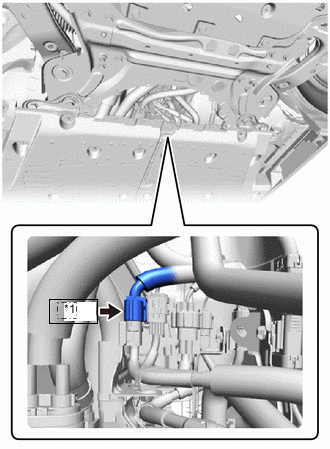
*1 Aq3 Disconnect the FC stack assembly (low-range hydrogen pressure sensor, medium-range hydrogen pressure sensor) connector.
-
Connect the cable to the negative (-) auxiliary battery terminal.
-
Turn the power switch on (IG).
-
*a Front view of wire harness connector
(to Hydrogen Tank Pressure Sensor (for Outlet Side))
Measure the voltage according to the value(s) in the table below.
Standard Voltage Tester Connection Condition Specified Condition R1-3 (VHPT) - R1-1 (GHPT) Power switch on (IG) 4.75 to 5.25 V R1-2 (HPT) - R1-1 (GHPT) Power switch on (IG) 4.935 to 5.065 V -
Turn the power switch off.
-
Disconnect the cable from the negative (-) auxiliary battery terminal.
-
Reconnect the FC stack assembly (low-range hydrogen pressure sensor, medium-range hydrogen pressure sensor) connector.
-
Reconnect the hydrogen tank pressure sensor (for outlet side) connector.
Result Proceed to OK NG
OK
REPLACE FC STACK ASSEMBLY (LOW-RANGE HYDROGEN PRESSURE SENSOR, MEDIUM-RANGE HYDROGEN PRESSURE SENSOR) Click here
NG
-
-
CHECK HARNESS AND CONNECTOR (POWER SOURCE OF HYDROGEN TANK PRESSURE SENSOR (FOR OUTLET SIDE))
CAUTION:
Be sure to wear insulated gloves.
-
Check that the service plug grip is not installed to FC stack assembly and EV battery.
Note
After removing the service plug grip, do not turn the power switch on (READY), unless instructed by the repair manual because this may cause a malfunction.
-
Disconnect the hydrogen tank pressure sensor (for outlet side) connector.
-
*1 Aq3 Disconnect the FC stack assembly (low-range hydrogen pressure sensor, medium-range hydrogen pressure sensor) connector.
-
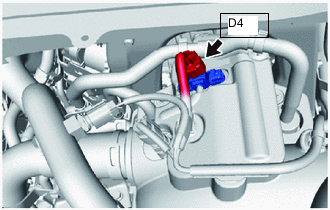
Disconnect the FC stack inlet air pressure sensor (turbo pressure sensor) connector.
-
Connect the cable to the negative (-) auxiliary battery terminal.
-
Turn the power switch on (IG).
-
*a Front view of wire harness connector
(to Hydrogen Tank Pressure Sensor (for Outlet Side))
Measure the voltage according to the value(s) in the table below.
Standard Voltage Tester Connection Condition Specified Condition R1-3 (VHPT) - R1-1 (GHPT) Power switch on (IG) 4.75 to 5.25 V R1-2 (HPT) - R1-1 (GHPT) Power switch on (IG) 4.935 to 5.065 V -
Turn the power switch off.
-
Disconnect the cable from the negative (-) auxiliary battery terminal.
-
Reconnect the FC stack inlet air pressure sensor (turbo pressure sensor) connector.
-
Reconnect the FC stack assembly (low-range hydrogen pressure sensor, medium-range hydrogen pressure sensor) connector.
-
Reconnect the hydrogen tank pressure sensor (for outlet side) connector.
Result Proceed to OK NG
OK
REPLACE FC STACK INLET AIR PRESSURE SENSOR (TURBO PRESSURE SENSOR) Click here
NG
-
-
CHECK HARNESS AND CONNECTOR (FC CONTROL ECU - HYDROGEN TANK PRESSURE SENSOR (FOR OUTLET SIDE))
-
Disconnect the FC control ECU connector.
-
Disconnect the hydrogen tank pressure sensor (for outlet side) connector.
-
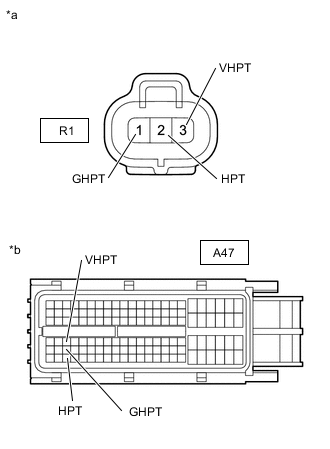
*a Front view of wire harness connector
(to Hydrogen Tank Pressure Sensor (for Outlet Side) )
*b Front view of wire harness connector
(to FC Control ECU)
Measure the resistance according to the value(s) in the table below.
Standard Resistance Tester Connection Condition Specified Condition A47-112 (HPT) - R1-2 (HPT) Always Below 1 Ω A47-89 (GHPT) - R1-1 (GHPT) Always Below 1 Ω A47-66 (VHPT) - R1-3 (VHPT) Always Below 1 Ω A47-112 (HPT) or R1-2 (HPT) - Body ground and other terminals Always 10 kΩ or higher A47-66 (VHPT) or R1-3 (VHPT) - Body ground and other terminals Always 10 kΩ or higher -
Reconnect the hydrogen tank pressure sensor (for outlet side) connector.
-
Reconnect the FC control ECU connector.
Result Proceed to OK NG
NG
REPAIR OR REPLACE HARNESS OR CONNECTOR
OK
-
-
CHECK HARNESS AND CONNECTOR (FC CONTROL ECU - FC STACK ASSEMBLY (LOW-RANGE HYDROGEN PRESSURE SENSOR))
CAUTION:
Be sure to wear insulated gloves.
-
Check that the service plug grip is not installed to FC stack assembly and EV battery.
Note
After removing the service plug grip, do not turn the power switch on (READY), unless instructed by the repair manual because this may cause a malfunction.
-
Disconnect the FC control ECU connector.
-
Disconnect the FC stack assembly (low-range hydrogen pressure sensor) connector.
-
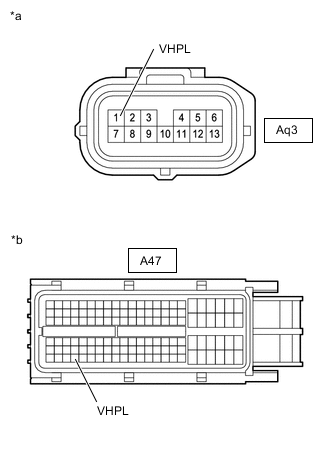
*a Front view of wire harness connector
(to FC Stack Assembly (Low-range Hydrogen Pressure Sensor))
*b Front view of wire harness connector
(to FC Control ECU)
Measure the resistance according to the value(s) in the table below.
Standard Resistance Tester Connection Condition Specified Condition A47-113 (VHPL) - Aq3-1 (VHPL) Always Below 1 Ω A47-113 (VHPL) or Aq3-1 (VHPL) - Body ground and other terminals Always 10 kΩ or higher -
Reconnect the FC stack assembly (low-range hydrogen pressure sensor) connector.
-
Reconnect the FC control ECU connector.
Result Proceed to OK NG
NG
REPAIR OR REPLACE HARNESS OR CONNECTOR
OK
-
-
CHECK HARNESS AND CONNECTOR (FC CONTROL ECU - FC STACK ASSEMBLY (MEDIUM-RANGE HYDROGEN PRESSURE SENSOR))
CAUTION:
Be sure to wear insulated gloves.
-
Check that the service plug grip is not installed to FC stack assembly and EV battery.
Note
After removing the service plug grip, do not turn the power switch on (READY), unless instructed by the repair manual because this may cause a malfunction.
-
Disconnect the FC control ECU connector.
-
Disconnect the FC stack assembly (medium-range hydrogen pressure sensor) connector.
-
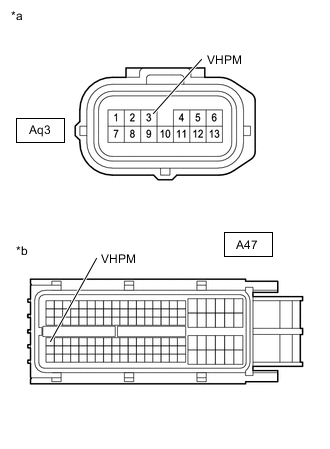
*a Front view of wire harness connector
(to FC Stack Assembly (Medium-range Hydrogen Pressure Sensor))
*b Front view of wire harness connector
(to FC Control ECU)
Measure the resistance according to the value(s) in the table below.
Standard Resistance Tester Connection Condition Specified Condition A47-64 (VHPM) - Aq3-3 (VHPM) Always Below 1 Ω A47-64 (VHPM) or Aq3-3 (VHPM) - Body ground and other terminals Always 10 kΩ or higher -
Reconnect the FC stack assembly (medium-range hydrogen pressure sensor) connector.
-
Reconnect the FC control ECU connector.
Result Proceed to OK NG
NG
REPAIR OR REPLACE HARNESS OR CONNECTOR
OK
-
-
CHECK HARNESS AND CONNECTOR (FC CONTROL ECU - FC STACK INLET AIR PRESSURE SENSOR (TURBO PRESSURE SENSOR))
-
Disconnect the FC control ECU connector.
-
Disconnect the FC stack inlet air pressure sensor (turbo pressure sensor) connector.
-
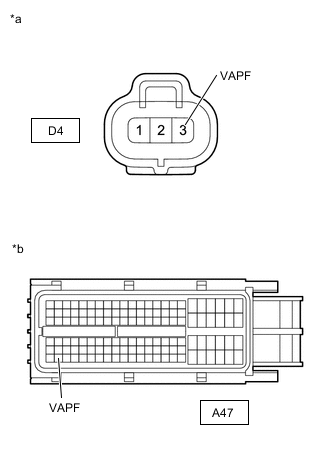
*a Front view of wire harness connector
(to FC Stack Inlet Air Pressure Sensor (Turbo Pressure Sensor))
*b Front view of wire harness connector
(to FC Control ECU)
Measure the resistance according to the value(s) in the table below.
Standard Resistance Tester Connection Condition Specified Condition A47-111 (VAPF) - D4-3 (VAPF) Always Below 1 Ω A47-111 (VAPF) or D4-3 (VAPF) - Body ground and other terminals Always 10 kΩ or higher -
Reconnect the FC control ECU connector.
-
Reconnect the FC stack inlet air pressure sensor (turbo pressure sensor) connector.
Result Proceed to OK NG
OK
REPLACE FC CONTROL ECU Click here
NG
REPAIR OR REPLACE HARNESS OR CONNECTOR
-