HYBRID BATTERY SYSTEM, Diagnostic DTC:P3011-123, P3012-123, P3013-123, P3014-123, P3015-123, P3016-123, P3017-123, P3018-123, P3019-123, P3020-123, P3021-123, P3022-123, P3023-123, P3024-123, P3025-123, P3026-123, P3027-123
| DTC Code | DTC Name |
|---|---|
| P3011-123 | Battery Block 1 Becomes Weak |
| P3012-123 | Battery Block 2 Becomes Weak |
| P3013-123 | Battery Block 3 Becomes Weak |
| P3014-123 | Battery Block 4 Becomes Weak |
| P3015-123 | Battery Block 5 Becomes Weak |
| P3016-123 | Battery Block 6 Becomes Weak |
| P3017-123 | Battery Block 7 Becomes Weak |
| P3018-123 | Battery Block 8 Becomes Weak |
| P3019-123 | Battery Block 9 Becomes Weak |
| P3020-123 | Battery Block 10 Becomes Weak |
| P3021-123 | Battery Block 11 Becomes Weak |
| P3022-123 | Battery Block 12 Becomes Weak |
| P3023-123 | Battery Block 13 Becomes Weak |
| P3024-123 | Battery Block 14 Becomes Weak |
| P3025-123 | Battery Block 15 Becomes Weak |
| P3026-123 | Battery Block 16 Becomes Weak |
| P3027-123 | Battery Block 17 Becomes Weak |
DESCRIPTION
Refer to the description for DTC P0A80-123.
| DTC No. | Detection Item | DTC Detection Condition | Trouble Area | Warning Indicate |
|---|---|---|---|---|
| P3011-123 | Battery Block 1 Becomes Weak | An internal malfunction of the EV battery is detected and the difference in voltage between each battery block or the internal resistance of each battery block is higher than the specified value. (1 trip detection logic) |
|
Master Warning Light: Comes on |
| P3012-123 | Battery Block 2 Becomes Weak | An internal malfunction of the EV battery is detected and the difference in voltage between each battery block or the internal resistance of each battery block is higher than the specified value. (1 trip detection logic) |
|
Master Warning Light: Comes on |
| P3013-123 | Battery Block 3 Becomes Weak | An internal malfunction of the EV battery is detected and the difference in voltage between each battery block or the internal resistance of each battery block is higher than the specified value. (1 trip detection logic) |
|
Master Warning Light: Comes on |
| P3014-123 | Battery Block 4 Becomes Weak | An internal malfunction of the EV battery is detected and the difference in voltage between each battery block or the internal resistance of each battery block is higher than the specified value. (1 trip detection logic) |
|
Master Warning Light: Comes on |
| P3015-123 | Battery Block 5 Becomes Weak | An internal malfunction of the EV battery is detected and the difference in voltage between each battery block or the internal resistance of each battery block is higher than the specified value. (1 trip detection logic) |
|
Master Warning Light: Comes on |
| P3016-123 | Battery Block 6 Becomes Weak | An internal malfunction of the EV battery is detected and the difference in voltage between each battery block or the internal resistance of each battery block is higher than the specified value. (1 trip detection logic) |
|
Master Warning Light: Comes on |
| P3017-123 | Battery Block 7 Becomes Weak | An internal malfunction of the EV battery is detected and the difference in voltage between each battery block or the internal resistance of each battery block is higher than the specified value. (1 trip detection logic) |
|
Master Warning Light: Comes on |
| P3018-123 | Battery Block 8 Becomes Weak | An internal malfunction of the EV battery is detected and the difference in voltage between each battery block or the internal resistance of each battery block is higher than the specified value. (1 trip detection logic) |
|
Master Warning Light: Comes on |
| P3019-123 | Battery Block 9 Becomes Weak | An internal malfunction of the EV battery is detected and the difference in voltage between each battery block or the internal resistance of each battery block is higher than the specified value. (1 trip detection logic) |
|
Master Warning Light: Comes on |
| P3020-123 | Battery Block 10 Becomes Weak | An internal malfunction of the EV battery is detected and the difference in voltage between each battery block or the internal resistance of each battery block is higher than the specified value. (1 trip detection logic) |
|
Master Warning Light: Comes on |
| P3021-123 | Battery Block 11 Becomes Weak | An internal malfunction of the EV battery is detected and the difference in voltage between each battery block or the internal resistance of each battery block is higher than the specified value. (1 trip detection logic) |
|
Master Warning Light: Comes on |
| P3022-123 | Battery Block 12 Becomes Weak | An internal malfunction of the EV battery is detected and the difference in voltage between each battery block or the internal resistance of each battery block is higher than the specified value. (1 trip detection logic) |
|
Master Warning Light: Comes on |
| P3023-123 | Battery Block 13 Becomes Weak | An internal malfunction of the EV battery is detected and the difference in voltage between each battery block or the internal resistance of each battery block is higher than the specified value. (1 trip detection logic) |
|
Master Warning Light: Comes on |
| P3024-123 | Battery Block 14 Becomes Weak | An internal malfunction of the EV battery is detected and the difference in voltage between each battery block or the internal resistance of each battery block is higher than the specified value. (1 trip detection logic) |
|
Master Warning Light: Comes on |
| P3025-123 | Battery Block 15 Becomes Weak | An internal malfunction of the EV battery is detected and the difference in voltage between each battery block or the internal resistance of each battery block is higher than the specified value. (1 trip detection logic) |
|
Master Warning Light: Comes on |
| P3026-123 | Battery Block 16 Becomes Weak | An internal malfunction of the EV battery is detected and the difference in voltage between each battery block or the internal resistance of each battery block is higher than the specified value. (1 trip detection logic) |
|
Master Warning Light: Comes on |
| P3027-123 | Battery Block 17 Becomes Weak | An internal malfunction of the EV battery is detected and the difference in voltage between each battery block or the internal resistance of each battery block is higher than the specified value. (1 trip detection logic) |
|
Master Warning Light: Comes on |
Tech Tips
-
These DTCs can be stored after clearing DTCs and driving the vehicle for approximately 10 minutes.
-
These DTCs are stored when a malfunction is detected in the EV battery or a battery voltage sensor. However, depending on the driving conditions, the malfunction may not be reproduced if the status of the EV battery changes. If internal resistance is abnormal, the voltage of the battery blocks indicated by the DTCs are likely to decrease more than others blocks voltage during acceleration (discharging), and increase more during deceleration (charging).
-
When the EV battery is malfunctioning:
-
- Voltage of 1 or more of the battery blocks has dropped.
-
- Voltage of all battery blocks is output randomly with no certain pattern.
-
When the battery voltage sensor is malfunctioning:
-
- Differences in battery block voltages have a certain pattern.
| DTC No. | Data List |
|---|---|
|
|
The following items can be helpful when performing repairs:
-
State of Charge (All Battery)
-
Ready Signal
-
Vehicle Speed
-
Accelerator Degree
-
Shift Sensor Shift Position
-
VB-Battery Voltage
-
Battery Pack Current Value (IB Correction)
-
Auxiliary Battery Voltage
-
Battery Voltage Low Time
-
DC Discharge Inhibit Time
-
SOC after IG-ON
-
Status of Charge Max
-
Status of Charge Min
-
Total Distance Traveled
Data List (EV)
-
FC Mode
-
FC Intermittent Operation
-
FC Voltage before Boosting
-
FC Current
-
Hydrogen Remaining
Data List (FC)
-
Battery Low Voltage-Last Operation
-
Battery Low Voltage-Last Trip
Operation History Data
Tech Tips
In order to ensure EV battery performance, appropriate cooling performance must be maintained. Perform the following items as necessary. If cooling performance has decreased and "MAINTENANCE REQUIRED FOR HYBRID BATTERY COOLING PARTS AT YOUR DEALER" is displayed on the multi-information display, make sure to perform the following items:
- Make sure the air intake port is not blocked.
- Make sure there are no gaps between the connecting parts of the ducts.
- Clean the No. 1 EV battery intake duct (filter).
Afterwards, clear the DTCs to reset the learning values even if no DTCs are stored.
CAUTION / NOTICE / HINT
Note
When the vehicle is parked with the power switch off, if the FC control ECU judges that the FC stack temperature will go below 0°C (32°F), it activates the FC air compressor, hydrogen pump and FC cooling water pump for a maximum of 180 seconds and drains water from the FC stack assembly. When performing inspection or repairs with the power switch off (not on (IG) or on (READY)), disconnect the cable from the negative (-) auxiliary battery terminal before performing work (If the auxiliary battery voltage is needed to conduct inspection, warm up the FC system beforehand).
Tech Tips
-
After the repair, clear the DTCs and perform the following procedure to check that DTCs are not output.
-
Drive the vehicle on urban roads for approximately 10 minutes.
(This DTC may not be stored if the vehicle is stopped or being driven at a constant speed.)
-
When disposing of an EV battery, make sure to return it through an authorized collection agent who is capable of handling it safely. If the EV battery is returned via the manufacturer specified route, it will be returned properly and in a safe manner by an authorized collection agent.
PROCEDURE
-
CHECK DTC OUTPUT (EV)
Result Result Proceed to P0AFC-123 is not output. A P0AFC-123 is also output. B
-
Connect the GTS to the DLC3.
-
Turn the power switch on (IG).
-
Enter the following menus: Powertrain / EV / Trouble Codes.
-
Check and record any hybrid control system DTCs, INF codes and freeze frame data.
-
Read output DTCs.
Powertrain > EV > Trouble CodesResult Result Proceed to P0AFC-123 is not output. A P0AFC-123 is also output. B -
Turn the power switch off.
-
Disconnect the GTS from the DLC3.
B 
GO TO DTC CHART (P0AFC-123) Click here
A 
-
-
READ VALUE USING GTS (VB1 - VB17)
-
Ensure the safety of the areas in front and at the back of the vehicle.
-
Apply the parking brake and secure the wheels using chocks.
-
Connect the GTS to the DLC3.
-
Turn the power switch on (READY).
-
Turn the air conditioning off and wait for 5 minutes or more.
-
Enter the following menus: Powertrain / EV / Data List / Battery Block Voltage -V01 to V17.
-
Firmly depress the brake pedal with your left foot.
-
Move the shift lever to D.
-
Record each Battery Block Voltage from the Data List "Battery Block Voltage -V01 to V17" while fully depressing the accelerator pedal.
Powertrain > EV > Data ListTester Display Battery Block Voltage -V01 Battery Block Voltage -V02 Battery Block Voltage -V03 Battery Block Voltage -V04 Battery Block Voltage -V05 Battery Block Voltage -V06 Battery Block Voltage -V07 Battery Block Voltage -V08 Battery Block Voltage -V09 Battery Block Voltage -V10 Battery Block Voltage -V11 Battery Block Voltage -V12 Battery Block Voltage -V13 Battery Block Voltage -V14 Battery Block Voltage -V15 Battery Block Voltage -V16 Battery Block Voltage -V17 -
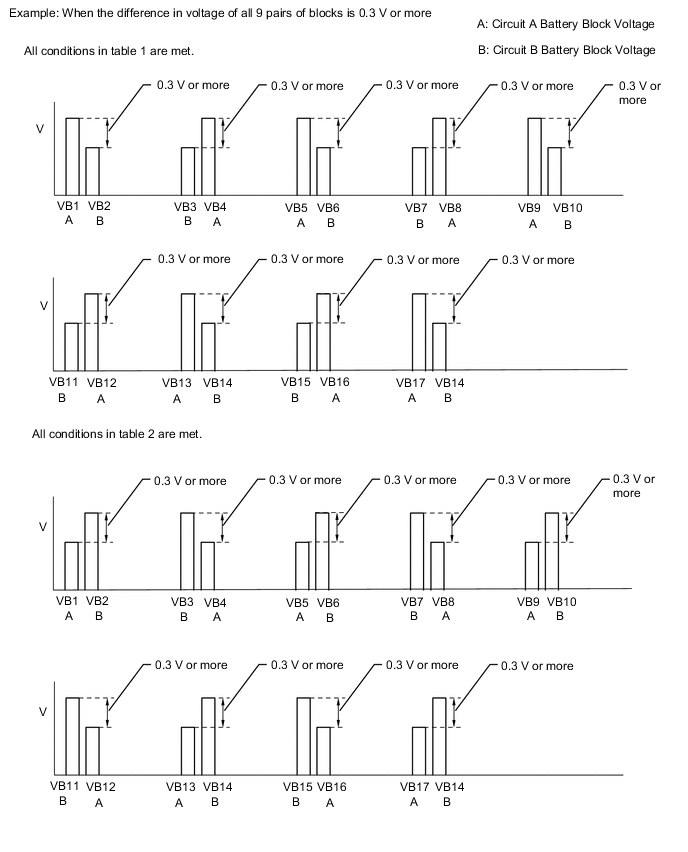
Compare the Battery Block Voltages "Battery Block Voltage -V01 to V17" between the even and odd number groups in each combination shown in the tables below.
Table 1 Circuit A Battery Block Circuit B Battery Block Condition Battery Block Voltage -V01 (VB1) Battery Block Voltage -V02 (VB2) "Battery Block Voltage -V01" - "Battery Block Voltage -V02" = 0.3 V or more Battery Block Voltage -V04 (VB4) Battery Block Voltage -V03 (VB3) "Battery Block Voltage -V04" - "Battery Block Voltage -V03" = 0.3 V or more Battery Block Voltage -V05 (VB5) Battery Block Voltage -V06 (VB6) "Battery Block Voltage -V05" - "Battery Block Voltage -V06" = 0.3 V or more Battery Block Voltage -V08 (VB8) Battery Block Voltage -V07 (VB7) "Battery Block Voltage -V08" - "Battery Block Voltage -V07" = 0.3 V or more Battery Block Voltage -V09 (VB9) Battery Block Voltage -V10 (VB10) "Battery Block Voltage -V09" - "Battery Block Voltage -V10" = 0.3 V or more Battery Block Voltage -V12 (VB12) Battery Block Voltage -V11 (VB11) "Battery Block Voltage -V12" - "Battery Block Voltage -V11" = 0.3 V or more Battery Block Voltage -V13 (VB13) Battery Block Voltage -V14 (VB14) "Battery Block Voltage -V13" - "Battery Block Voltage -V14" = 0.3 V or more Battery Block Voltage -V16 (VB16) Battery Block Voltage -V15 (VB15) "Battery Block Voltage -V16" - "Battery Block Voltage -V15" = 0.3 V or more Battery Block Voltage -V17 (VB17) Battery Block Voltage -V14 (VB14) "Battery Block Voltage -V17" - "Battery Block Voltage -V14" = 0.3 V or more Table 2 Circuit A Battery Block Circuit B Battery Block Condition Battery Block Voltage -V01 (VB1) Battery Block Voltage -V02 (VB2) "Battery Block Voltage -V02" - "Battery Block Voltage -V01" = 0.3 V or more Battery Block Voltage -V04 (VB4) Battery Block Voltage -V03 (VB3) "Battery Block Voltage -V03" - "Battery Block Voltage -V04" = 0.3 V or more Battery Block Voltage -V05 (VB5) Battery Block Voltage -V06 (VB6) "Battery Block Voltage -V06" - "Battery Block Voltage -V05" = 0.3 V or more Battery Block Voltage -V08 (VB8) Battery Block Voltage -V07 (VB7) "Battery Block Voltage -V07" - "Battery Block Voltage -V08" = 0.3 V or more Battery Block Voltage -V09 (VB9) Battery Block Voltage -V10 (VB10) "Battery Block Voltage -V10" - "Battery Block Voltage -V09" = 0.3 V or more Battery Block Voltage -V12 (VB12) Battery Block Voltage -V11 (VB11) "Battery Block Voltage -V11" - "Battery Block Voltage -V12" = 0.3 V or more Battery Block Voltage -V13 (VB13) Battery Block Voltage -V14 (VB14) "Battery Block Voltage -V14" - "Battery Block Voltage -V13" = 0.3 V or more Battery Block Voltage -V16 (VB16) Battery Block Voltage -V15 (VB15) "Battery Block Voltage -V15" - "Battery Block Voltage -V16" = 0.3 V or more Battery Block Voltage -V17 (VB17) Battery Block Voltage -V14 (VB14) "Battery Block Voltage -V14" - "Battery Block Voltage -V17" = 0.3 V or more Tech Tips
Make sure to compare Battery Block Voltage -V17 to Battery Block Voltage -V14 in accordance with the tables above.
Tech Tips
When an internal malfunction occurs in the battery voltage sensor, this symptom (difference in voltage of 0.3 V or more for all 9 pairs of blocks) will occur.
Result Result Proceed to All conditions in table 1 or table 2 are met. A Other than above B -
Turn the power switch off.
-
Disconnect the GTS from the DLC3.
A
REPLACE BATTERY VOLTAGE SENSOR Click here
B
-
-
CHECK DTC OUTPUT (EV)
-
Connect the GTS to the DLC3.
-
Turn the power switch on (IG).
-
Enter the following menus: Powertrain / EV / Trouble Codes.
-
Read output DTCs.
Powertrain > EV > Trouble CodesResult Result Proceed to P3015-123 is not output. A P3015-123 is output. B Tech Tips
DTC P3015-123 may also be stored if there is foreign matter, etc. adhering to the connecting part of the service plug grip.
-
Turn the power switch off.
-
Disconnect the GTS from the DLC3.
A
REPLACE EV BATTERY Click here
B
REPLACE EV BATTERY AND SERVICE PLUG GRIP
-