Click here
-
OUTLINE OF THEFT DETERRENT SYSTEM
-
The theft deterrent system can be set/canceled by locking/unlocking the doors using the following operation:
-
-
Entry lock operation
-
Wireless lock operation
Tip:w/ Entry and Start System w/o Entry and Start System Entry lock operation ○ - Wireless lock operation ○ ○
-
○: Available
-
-: Not available
-
-
-
The alarm function will be activated when someone attempts to forcibly unlock any of the doors or open any of the doors and engine hood while the system is in the armed state.
-
In the alarm sounding state, the system blinks the hazard warning lights. At the same time, the system sounds the vehicle horn and security horn to deter break-in and theft as well as to warn people around the vehicle.
-
The theft deterrent system has the active arming mode. There are 4 states; a disarmed state, an arming preparation state, an armed state and an alarm sounding state.
-
Disarmed state:
-
The alarm function is not operating.
-
The theft deterrent system is not operating.
-
-
Arming preparation state:
-
The time until the system goes into the armed state.
-
The theft deterrent system is not operating.
-
-
Armed state:
-
The theft deterrent system is operating.
-
-
Alarm sounding state:
-
The alarm function is operating.
Alarm time Approximately 27.5 seconds Table 1. Alarm Methods and Time Alarm Method Hazard Warning Lights Blinking Vehicle Horn Sounding
(approximately 0.4-second cycles)
Security Horn Assembly*1 Sounding
(approximately 0.4-second cycles)
Theft Warning Siren Assembly*2 Sounding
(approximately 0.4-second cycles)
Alarm Time Approximately 27.5 seconds
-
*1: w/ Security Horn Assembly
-
*2: w/ Theft Warning Siren Assembly
-
-
-
FUNCTION OF MAIN COMPONENTS
Component Function Theft warning indicator light assembly (security indicator light) Informs driver of theft deterrent system status. Security horn assembly*3 Sounds when attempted break-in or theft is detected. Theft Warning Siren Assembly*4 Sounds when attempted break-in or theft is detected. Hazard warning lights Blink when attempted break-in or theft is detected. Vehicle horns Sounds when attempted break-in or theft is detected. Door courtesy light switches Detects door status (open or closed). Door unlock detection switch Detects door status (locked or unlocked). Security courtesy switch Detects engine hood status (open or closed). Certification ECU (smart key ECU assembly)*1
-
Receives wireless door lock/unlock signal.
-
Receives entry door lock/unlock signal.
Body ECU*2 Receives wireless door lock/unlock signal. Engine hood courtesy switch (hood lock assembly) Detects engine hood status (open or closed). Combination meter assembly Receives door status (open or closed) signal.
-
*1: w/ Entry and Start System
-
*2: w/o Entry and Start System
-
*3: w/ Security Horn Assembly
-
*4: w/ Theft Warning Siren Assembly
-
-
ACTIVE ARMING MODE
-
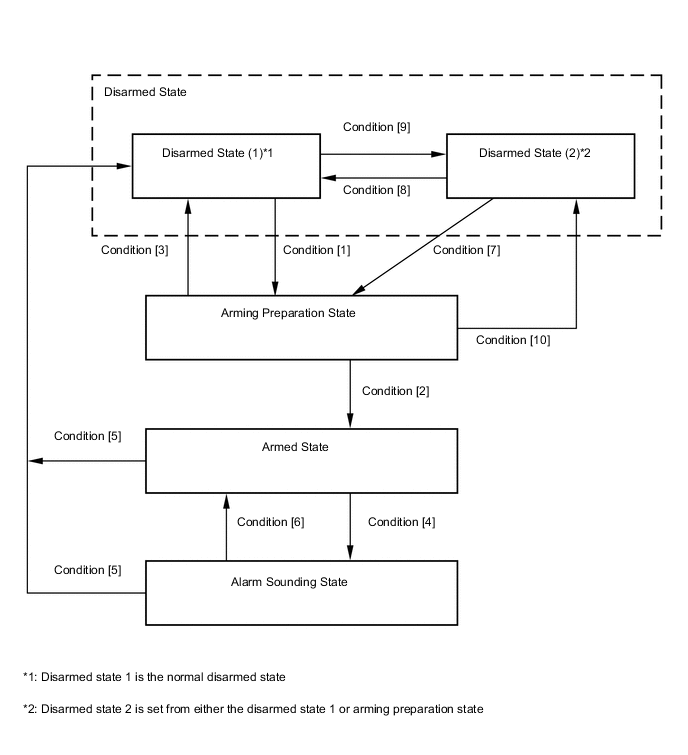
Active arming mode:
This system operates as described in the diagram below when one of the items for each condition is met.
Tip:The term "all doors" used in this section refers to the driver door, front passenger door, rear door LH* and rear door RH*.
-
*: except Single Cab
Table 2. w/ Entry and Start System Condition Item Condition [1] In disarmed state 1, when the engine switch is off, the system state is switched if the following condition is met:
-
With all doors and the engine hood closed, all doors are locked by wireless operation, the entry and start system or key linked power door lock operation.
Condition [2]
-
Allow approximately 30 seconds to elapse.
Condition [3]
-
All doors are unlocked by wireless operation, the entry and start system or key linked power door lock operation.
-
Any door is opened.
-
The engine switch is pushed.
-
The engine switch is turned on (ACC) or on (IG).
Condition [4]
-
The engine hood is opened when the engine hood is closed.
-
Any door is opened when all doors are closed.
-
When 5 seconds or more have elapsed after the engine switch is pressed, the power source mode is changed from off to on (IG) without pressing the engine switch.
-
The engine hood is open.
-
The power source mode is on (IG).
Condition [5]
-
The engine switch is turned on (IG) and the engine is running for more than 2 seconds.
-
All doors are unlocked by wireless operation, the entry and start system or key linked power door lock operation.
-
The engine switch is turned on (ACC) or on (IG) within 5 seconds after the engine switch was pushed.
Condition [6]
-
After approximately 27.5 seconds, alarm stops and system returns to armed state.
Condition [7]
-
The engine hood is closed when the engine hood is opened.
Condition [8]
-
Any door is opened.
-
The engine switch is pushed.
-
The engine switch is turned on (ACC) or on (IG).
-
All doors are unlocked by wireless operation, the entry and start system or key linked power door lock operation.
Condition [9] In disarmed state 1, when the engine switch is off, the system state is switched if the following condition is met:
-
With all doors closed and the engine hood opened, all doors are locked by wireless operation, the entry and start system or key linked power door lock operation.
Condition [10]
-
The engine hood is opened.
Table 3. w/o Entry and Start System Condition Item Condition [1] In disarmed state 1, when the ignition switch is off, the system state is switched if the following condition is met when the key is not in the key cylinder:
-
With all doors and the engine hood closed, all doors are locked by wireless operation or key linked power door lock operation.*1
Condition [2]
-
Allow approximately 30 seconds to elapse.
Condition [3]
-
All doors are unlocked by wireless operation or key linked power door lock operation.
-
Any door is opened.
-
Key is in the key cylinder.
-
The ignition switch is turned to ON.
Condition [4]
-
The engine hood is opened when the engine hood is closed.
-
Any door is opened when all doors are closed.
-
The ignition switch is turned to ON when the key is not in the key cylinder.
-
The engine hood is open.
-
Any door is opened
Condition [5]
-
The ignition switch is turned to ON and the engine is running for more than 2 seconds.
-
All doors are unlocked by wireless operation or key linked power door lock operation.
Condition [6]
-
After approximately 27.5 seconds, alarm stops and system returns to armed state.
Condition [7]
-
The engine hood is closed when the engine hood is opened.
Condition [8]
-
Any door is opened.
-
Key is in the key cylinder.
-
The ignition switch is turned to ON.
-
All doors are unlocked by wireless operation or key linked power door lock operation.
Condition [9] In disarmed state 1, when the ignition switch is off, the system state is switched if the following condition is met when the key is not in the key cylinder:
-
With all doors closed, and the engine hood opened, all doors are locked by wireless operation or key linked power door lock operation.
Condition [10]
-
The engine hood is opened.
-
-
-
SECURITY INDICATOR LIGHT OUTPUT
Tip:w/ Immobiliser System:
When the immobiliser system is set, the security indicator light blinks during both the disarmed state and the armed state, due to output signals from the immobiliser system.
-
According to the state of the theft deterrent system, the certification ECU (smart key ECU assembly)*1 or body ECU*2 outputs a signal to turn the security indicator light on. However, some of the actual lighting conditions of the security indicator light are different from the output signals of the certification ECU (smart key ECU assembly)*1 or body ECU*2.
-
*1: w/ Entry and Start System
-
*2: w/o Entry and Start System
Table 4. Output State of Theft Deterrent System Theft Warning Indicator Light Assembly (Security Indicator Light) Output Signal from certification ECU (smart key ECU assembly)*1 or body ECU*2 Actual Lighting Condition Disarmed state (1), (2) OFF OFF (Immobiliser system*3 unset)
BLINKING (Immobiliser system*3 set)
Arming preparation state ON ON Armed state BLINKING BLINKING Alarm sounding state ON ON
-
*1: w/ Entry and Start System
-
*2: w/o Entry and Start System
-
*3: w/ Immobiliser System
Table 5. Blinking Cycle Time Security Indicator Light 0.125 seconds ON 1.875 seconds OFF -
-
-
REMOTE ALARM FUNCTION (w/ Alarm Switch)
-
Remote alarm function makes it possible to voluntarily set off the remote alarm by pressing the alarm switch on the electrical key transmitter sub-assembly.
-
Conditions that cause remote alarm function to set off the remote alarm:
The alarm switch on the electrical key transmitter sub-assembly is pressed under the following conditions:
-
The ignition switch is off.
-
The theft deterrent system is not in the alarm sounding state.
-
-
Conditions that cause the remote alarm function to shut off the alarm:
Any of the following conditions is met during remote alarm function operation:
-
The ignition switch is to ON.
-
The alarm switch is pressed again.
-
Any of the switches on the electrical key transmitter sub-assembly (lock/unlock) is pressed.
-
The alarm ends (approximately 27.5 seconds have elapsed).
-
The theft deterrent system switches to the alarm sounding state. Under this condition, the theft deterrent system controls the alarm rather than the remote alarm function. In order to cancel this alarm, refer to the theft deterrent system alarm sounding state cancellation procedure.
-
-
-
-
THEFT WARNING SIREN ASSEMBLY (w/ Theft Warning Siren Assembly)
-
The theft warning siren assembly has an internal battery. If power to the theft warning siren assembly is interrupted or the communication line is open, the theft warning siren assembly detects it and sounds the alarm using the internal battery.
-
The theft warning siren assembly has the following alarm controls: normal alarm control and open circuit alarm control. Under normal alarm control, the alarm sounds based on instructions from the body ECU whereas under open circuit alarm control, the theft warning siren assembly judges current security conditions and sounds the alarm by itself.
-
Normal alarm control
The theft warning siren assembly sounds when the theft deterrent system is in the alarm sounding state and does not sound when the system is not in the alarm sounding state.
Tip:If communication interruption between the theft warning siren assembly and body ECU continues for 70 seconds or more while the theft deterrent system is in the alarm sounding state, the theft warning siren assembly stops sounding.
-
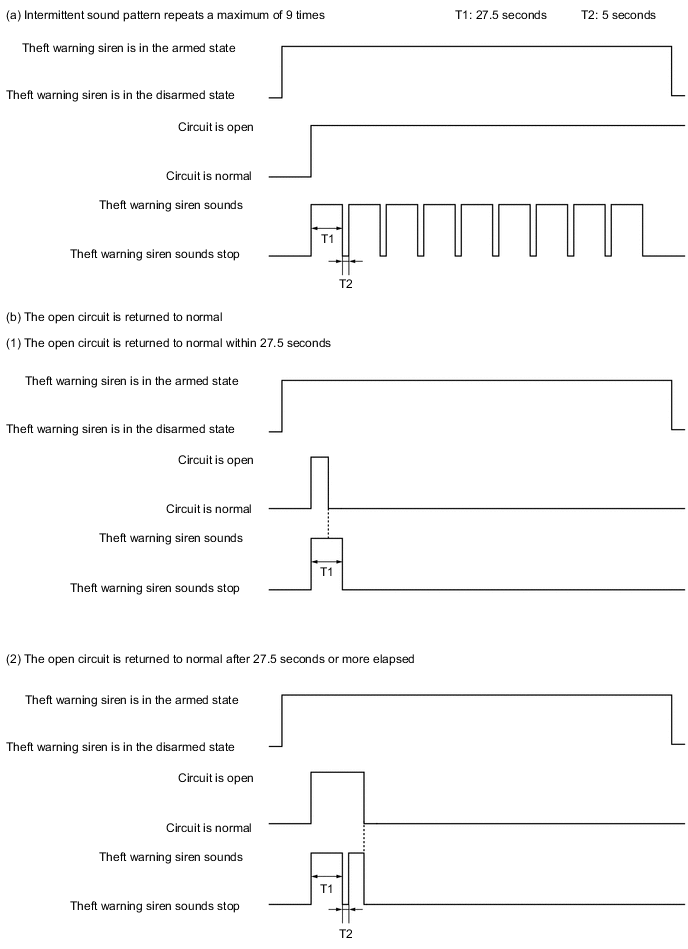
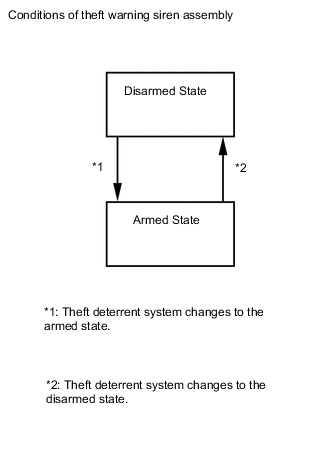
Open circuit alarm control
The theft warning siren assembly changes between the disarmed state and armed state in accordance with the theft deterrent system changes between the disarmed state and armed state. If the power source, ground or communication line is open while the theft warning siren assembly is in the armed state, the theft warning siren assembly sounds.
During the open circuit alarm sounding state, the theft warning siren assembly sounds intermittently for 27.5 seconds and then stops for 5 seconds. This pattern repeats a maximum of 9 times.
The intermittent sounding will stop when either condition is met:
1. The theft warning siren assembly changes to the disarmed state.
2. The open circuit is returned to normal.
-
-