| DTC Code | DTC Name |
|---|---|
| P2714 | Pressure Control Solenoid "D" Performance (Shift Solenoid Valve SLT) |
DESCRIPTION
Refer to DTC P2716.
| DTC No. | Detection Item | DTC Detection Condition | Trouble Area | MIL | Memory |
|---|---|---|---|---|---|
| P2714 | Pressure Control Solenoid "D" Performance (Shift Solenoid Valve SLT) | The TCM detects a malfunction of the shift solenoid valve SLT (ON side) according to the revolution difference of the turbine and output shaft, and also by the oil pressure (1-trip detection logic). |
|
- | DTC stored |
MONITOR DESCRIPTION
The TCM calculates the amount of heat absorbed by the friction material based on the difference in revolution (clutch slippage) between the turbine and output shaft. The TCM stores this DTC when the amount of heat absorption exceeds the specified value.
There are two reasons that make the revolution different.
-
When the shift solenoid valve SLT remains on, oil pressure goes down and clutch engagement force decreases.
-
When the shift solenoid valve remains on or off, the gear position commanded by the TCM and the actual gear position are not the same.
If you continue driving under these conditions, the clutch will burn out and the vehicle will no longer be drivable.
CAUTION / NOTICE / HINT
Perform registration and/or initialization when parts related to the automatic transmission are replaced.
After the repair, clear the DTCs and perform the following procedure to check that DTCs are not output.
-
Perform the D Position Shift Test in Road Test.
-
Check for DTCs again.
PROCEDURE
- Click here
CHECK DTC OUTPUT (IN ADDITION TO DTC P2714)
-
Connect the GTS to the DLC3.
-
Turn the ignition switch to ON.
-
Turn the GTS on.
-
Enter the following menus: Powertrain / ECT / Trouble codes.
- Powertrain > ECT > Trouble Codes
-
-
-
Read the DTCs using the GTS.
Result Result Proceed to Only P2714 is output A P2714 and other DTCs are output B Tip:If any other codes besides P2714 are output, perform troubleshooting for those DTCs first.
- AClick here
- B
GO TO DTC CHARTClick here
-
- Click here
PERFORM ACTIVE TEST USING GTS (SHIFT SOLENOID VALVE SLT)
Note:
-
Perform the test while the ATF temperature is between 50 and 80°C (122 and 176°F).
-
Be careful to prevent the hose of SST from interfering with the exhaust pipe.
-
Perform the test with the air conditioning off.
Tip:Using the GTS to perform Active Tests allows relays, VSVs, actuators and other items to be operated without removing any parts. This non-intrusive functional inspection can be very useful because intermittent operation may be discovered before parts or wiring is disturbed. Performing Active Tests early in troubleshooting is one way to save diagnostic time. Data List information can be displayed while performing Active Tests.
-
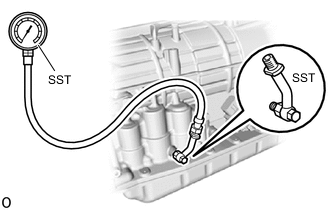
Remove the test plug from the transmission case and connect SST.
09993-19015 09993-00010 09993-00040 -
Connect the GTS to the DLC3.
-
Start the engine and warm it up.
-
Measure the line pressure with SST.
-
Turn the GTS on.
-
Enter the following menus: Powertrain / ECT / Active Test.
-
According to the display on the GTS, perform the Active Test.
-
Measure the line pressure.
- Powertrain > ECT > Active Test
Tester Display Measurement Item Control Range Diagnostic Note Activate the Solenoid (SLT) Operate shift solenoid valve SLT and raise line pressure ON or OFF
Tip:
-
OFF: Line pressure up (when Active Test "Activate the Solenoid (SLT)" is performed, TCM commands shift solenoid valve SLT to turn OFF)
-
ON: No action (normal operation)
[Vehicle Condition]
-
Vehicle stopped
-
Engine idling
-
-
-
- Powertrain > ECT > Active Test
Tester Display Activate the Solenoid (SLT) -
-
-
-
The "Activate the Solenoid (SLT)" in the Active Test is performed to check the line pressure changes by connecting SST to the automatic transmission, which is used in the Hydraulic Test as well.
Tip:Note that the pressure values in the Active Test and Hydraulic Test are different.
OK The line pressure changes as specified when performing the Active Test. Result Proceed to OK NG - Powertrain > ECT > Active Test
- OKClick here
- NGClick here
GO TO STEP 17
-
- Click here
PERFORM ACTIVE TEST USING GTS (RUNNING TEST)
CAUTION:This test should always be performed with at least 2 people.
Note:
-
Perform the test while the ATF temperature is between 50 and 80°C (122 and 176°F).
-
Perform the test with the air conditioning off.
Tip:Using the GTS to perform Active Tests allows relays, VSVs, actuators and other items to be operated without removing any parts. This non-intrusive functional inspection can be very useful because intermittent operation may be discovered before parts or wiring is disturbed. Performing Active Tests early in troubleshooting is one way to save diagnostic time. Data List information can be displayed while performing Active Tests.
-
Connect the GTS to the DLC3.
-
Clear the DTC.
- Powertrain > ECT > Clear DTCs
-
-
-
Warm up the engine.
-
Enter the following menus: Powertrain / ECT / Active Test.
-
According to the display on the GTS, perform the Active Test.
Tip:While driving, the shift position can be forcibly changed with the GTS.
Comparing the shift position commanded by the Active Test with the actual shift position enables you to confirm the problem.
- Powertrain > ECT > Active Test
Tester Display Measurement Item Control Range Diagnostic Note Control the Shift Position Operate shift solenoid valves and set each shift position
-
Press "→" button: Shift up
-
Press "←" button: Shift down
Possible to check operation of the shift solenoid valves.
[Vehicle Condition]
50 km/h (31 mph) or less
-
-
-
- Powertrain > ECT > Active Test
Active Test Display Control the Shift Position Data List Display Shift Status -
-
-
-
Tip:
-
This test can be conducted when the vehicle speed is 50 km/h (31 mph) or less.
-
The 4th to 5th up-shift must be performed with the accelerator pedal released.
-
The 5th to 4th down-shift must be performed with the accelerator pedal released.
-
Do not operate the accelerator pedal for at least 2 seconds after shifting and do not shift successively.
-
The shift position commanded by the TCM is shown in the Data List display on the GTS.
- Powertrain > ECT > Active Test
-
Compare the TCM gear shift command and the actual gear position.
OK Gear position changes in accordance with the GTS command. Result System Condition TCM Gear Shift Command Proceed to 1st 2nd 3rd 4th 5th Malfunction Shift solenoid valve S1 Stuck ON 1st 2nd 2nd 1st N*1 A Stuck OFF 4th 3rd 3rd 4th 5th Shift solenoid valve S2 Stuck ON*2 2nd 2nd 3rd 3rd N*1 B Stuck OFF*3 1st 1st 4th 4th 5th Shift solenoid valve SL2 Stuck ON 1st 2nd 3rd 4th N*1 C Stuck OFF 1st 2nd 3rd 4th 5th Shift solenoid valve SR Stuck ON*4 1st 2nd 3rd 4th 5th D Stuck OFF*5 1st 2nd 3rd 4th 4th Normal 1st 2nd 3rd 4th 5th E Tip:
-
*1: Neutral
-
*2: When shift solenoid valve S2 is stuck ON, the vehicle cannot drive in reverse.
-
*3: When shift solenoid valve S2 is stuck OFF, the 4th to 5th up-shift will have a large shift shock. Also, the 5th to 4th down-shift will have time lag.
-
*4: When shift solenoid valve SR is stuck ON, the condition can be determined by checking if shift shock has increased excessively.
-
*5: When shift solenoid valve SR is stuck OFF, moving the shift lever from N to D will cause a large shift shock.
-
Gear shift can be determined by paying attention to changes in engine speed.
-
-
- Click here
INSPECT SHIFT SOLENOID VALVE S1
-
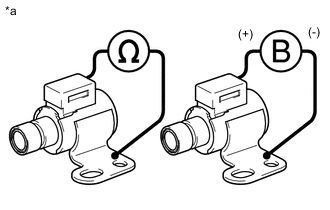
*a Component without harness connected
(Shift Solenoid Valve S1)
Remove shift solenoid valve S1.
-
Measure the resistance according to the value(s) in the table below.
Standard Resistance Tester Connection Condition Specified Condition Shift solenoid valve S1 connector terminal - Shift solenoid valve S1 body 20°C (68°F) 11 to 15 Ω -
Apply 12 V battery voltage to the shift solenoid valve and check that the valve moves and makes an operating noise.
OK Measurement Condition Specified Condition
-
Battery positive (+) → Shift solenoid valve S1 connector
-
Battery negative (-) → Shift solenoid valve S1 body
Valve moves and makes an operating noise Result Proceed to OK NG -
- OKClick here
- NG
REPLACE SHIFT SOLENOID VALVE S1Click here
-
- Click here
INSPECT TRANSMISSION VALVE BODY ASSEMBLY
-
Check the transmission valve body assembly.
OK There are no foreign objects on any valve. Result Proceed to OK NG
- OKClick here
- NG
REPAIR OR REPLACE TRANSMISSION VALVE BODY ASSEMBLYClick here
-
- Click here
INSPECT TORQUE CONVERTER ASSEMBLY
-
Check the torque converter assembly.
OK The torque converter assembly operates normally. Result Proceed to OK NG
- OK
REPAIR OR REPLACE AUTOMATIC TRANSMISSION ASSEMBLYClick here
- NG
REPLACE TORQUE CONVERTER ASSEMBLYClick here
-
- Click here
INSPECT SHIFT SOLENOID VALVE S2
-
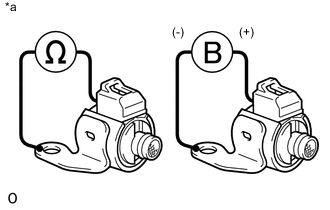
*a Component without harness connected
(Shift Solenoid Valve S2)
Remove shift solenoid valve S2.
-
Measure the resistance according to the value(s) in the table below.
Standard Resistance Tester Connection Condition Specified Condition Shift solenoid valve S2 connector terminal - Shift solenoid valve S2 body 20°C (68°F) 11 to 15 Ω -
Apply 12 V battery voltage to the shift solenoid valve and check that the valve moves and makes an operating noise.
OK Measurement Condition Specified Condition
-
Battery positive (+) → Shift solenoid valve S2 connector
-
Battery negative (-) → Shift solenoid valve S2 body
Valve moves and makes an operating noise Result Proceed to OK NG -
- OKClick here
- NG
REPLACE SHIFT SOLENOID VALVE S2Click here
-
- Click here
INSPECT TRANSMISSION VALVE BODY ASSEMBLY
-
Check the transmission valve body assembly.
OK There are no foreign objects on any valve. Result Proceed to OK NG
- OKClick here
- NG
REPAIR OR REPLACE TRANSMISSION VALVE BODY ASSEMBLYClick here
-
- Click here
INSPECT TORQUE CONVERTER ASSEMBLY
-
Check the torque converter assembly.
OK The torque converter assembly operates normally. Result Proceed to OK NG
- OK
REPAIR OR REPLACE AUTOMATIC TRANSMISSION ASSEMBLYClick here
- NG
REPLACE TORQUE CONVERTER ASSEMBLYClick here
-
- Click here
INSPECT SHIFT SOLENOID VALVE SL2
-
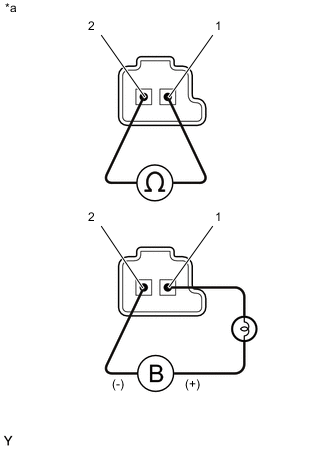
*a Component without harness connected
(Shift Solenoid Valve SL2)
Remove shift solenoid valve SL2.
-
Measure the resistance according to the value(s) in the table below.
Standard Resistance Tester Connection Condition Specified Condition 1 - 2 20°C (68°F) 5.0 to 5.6 Ω -
Apply 12 V battery voltage to the shift solenoid valve and check that the valve moves and makes an operating noise.
OK Measurement Condition Specified Condition
-
Battery positive (+) with a 21 W bulb → Terminal 1
-
Battery negative (-) → Terminal 2
Valve moves and makes an operating noise Result Proceed to OK NG -
- OKClick here
- NG
REPLACE SHIFT SOLENOID VALVE SL2Click here
-
- Click here
INSPECT TRANSMISSION VALVE BODY ASSEMBLY
-
Check the transmission valve body assembly.
OK There are no foreign objects on any valve. Result Proceed to OK NG
- OKClick here
- NG
REPAIR OR REPLACE TRANSMISSION VALVE BODY ASSEMBLYClick here
-
- Click here
INSPECT TORQUE CONVERTER ASSEMBLY
-
Check the torque converter assembly.
OK The torque converter assembly operates normally. Result Proceed to OK NG
- OK
REPAIR OR REPLACE AUTOMATIC TRANSMISSION ASSEMBLYClick here
- NG
REPLACE TORQUE CONVERTER ASSEMBLYClick here
-
- Click here
INSPECT SHIFT SOLENOID VALVE SL1
-
*a Component without harness connected
(Shift Solenoid Valve SL1)
Remove shift solenoid valve SL1.
-
Measure the resistance according to the value(s) in the table below.
Standard Resistance Tester Connection Condition Specified Condition 1 - 2 20°C (68°F) 5.0 to 5.6 Ω -
Apply 12 V battery voltage to the shift solenoid valve and check that the valve moves and makes an operating noise.
OK Measurement Condition Specified Condition
-
Battery positive (+) with a 21 W bulb → Terminal 1
-
Battery negative (-) → Terminal 2
Valve moves and makes an operating noise Result Proceed to OK NG -
- OKClick here
- NG
REPLACE SHIFT SOLENOID VALVE SL1Click here
-
- Click here
INSPECT SHIFT SOLENOID VALVE SR
-
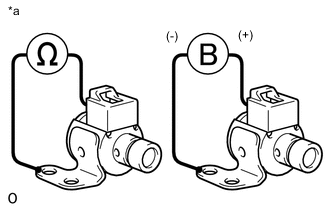
*a Component without harness connected
(Shift Solenoid Valve SR)
Remove shift solenoid valve SR.
-
Measure the resistance according to the value(s) in the table below.
Standard Resistance Tester Connection Condition Specified Condition Shift solenoid valve SR connector terminal - Shift solenoid valve SR body 20°C (68°F) 11 to 15 Ω -
Apply 12 V battery voltage to the shift solenoid valve and check that the valve moves and makes an operating noise.
OK Measurement Condition Specified Condition
-
Battery positive (+) → Shift solenoid valve SR connector
-
Battery negative (-) → Shift solenoid valve SR body
Valve moves and makes operating noise Result Proceed to OK NG -
- OKClick here
- NG
REPLACE SHIFT SOLENOID VALVE SRClick here
-
- Click here
INSPECT TRANSMISSION VALVE BODY ASSEMBLY
-
Check the transmission valve body assembly.
OK There are no foreign objects on any valve. Result Proceed to OK NG
- OKClick here
- NG
REPAIR OR REPLACE TRANSMISSION VALVE BODY ASSEMBLYClick here
-
- Click here
INSPECT TORQUE CONVERTER ASSEMBLY
-
Check the torque converter assembly.
OK The torque converter assembly operates normally. Result Proceed to OK NG
- OK
REPAIR OR REPLACE AUTOMATIC TRANSMISSION ASSEMBLYClick here
- NG
REPLACE TORQUE CONVERTER ASSEMBLYClick here
-
- Click here
INSPECT SHIFT SOLENOID VALVE SLT
-
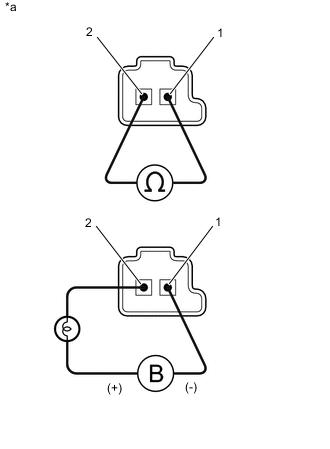
*a Component without harness connected
(Shift Solenoid Valve SLT)
Remove shift solenoid valve SLT.
-
Measure the resistance according to the value(s) in the table below.
Standard Resistance Tester Connection Condition Specified Condition 1 - 2 20°C (68°F) 5.0 to 5.6 Ω -
Apply 12 V battery voltage to the shift solenoid valve and check that the valve moves and makes an operating noise.
OK Measurement Condition Specified Condition
-
Battery positive (+) with a 21 W bulb → Terminal 2
-
Battery negative (-) → Terminal 1
Valve moves and makes an operating noise Result Proceed to OK NG -
- OKClick here
- NG
REPLACE SHIFT SOLENOID VALVE SLTClick here
-
- Click here
INSPECT TRANSMISSION VALVE BODY ASSEMBLY
-
Check the transmission valve body assembly.
OK There are no foreign objects on any valve. Result Proceed to OK NG
- OKClick here
- NG
REPAIR OR REPLACE TRANSMISSION VALVE BODY ASSEMBLYClick here
-
- Click here
INSPECT TORQUE CONVERTER ASSEMBLY
-
Check the torque converter assembly.
OK The torque converter assembly operates normally. Result Proceed to OK NG
- OK
REPAIR OR REPLACE AUTOMATIC TRANSMISSION ASSEMBLYClick here
- NG
REPLACE TORQUE CONVERTER ASSEMBLYClick here
-