STOP AND START SYSTEM, Diagnostic DTC:P161D
| DTC Code | DTC Name |
|---|---|
| P161D | Starter Delay Circuit |
DESCRIPTION
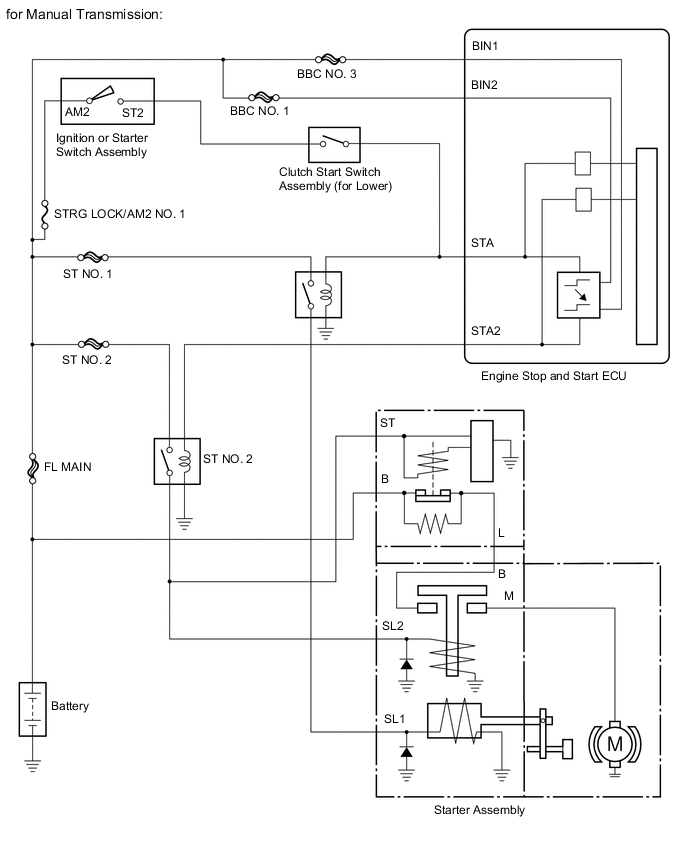
By using the starter delay circuit, the engine stop and start ECU can activate the ST NO. 2 relay (for starter motor operation) after activating the ST NO. 1 relay (for starter pinion operation) to operate the starter assembly.
By monitoring the condition of the ST NO. 1 relay (for starter pinion operation) and ST NO. 2 relay (for starter motor operation), the engine stop and start ECU detects if the transistor of the starter delay circuit is stuck. If the transistor of the starter delay circuit is stuck on, the engine stop and start ECU blinks the stop and start cancel indicator light and stores DTC P161D. If the transistor of the starter delay circuit is stuck on, the ST NO. 1 relay (for starter pinion operation) and ST NO. 2 relay (for starter motor operation) will be activated simultaneously.
Figure 1. w/ Entry and Start System:
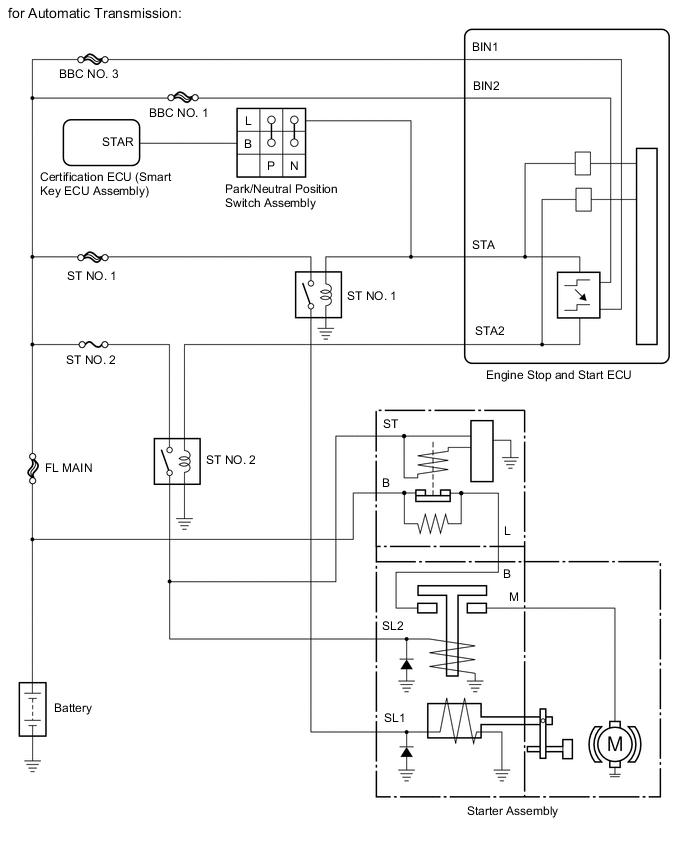
Figure 2. w/o Entry and Start System:
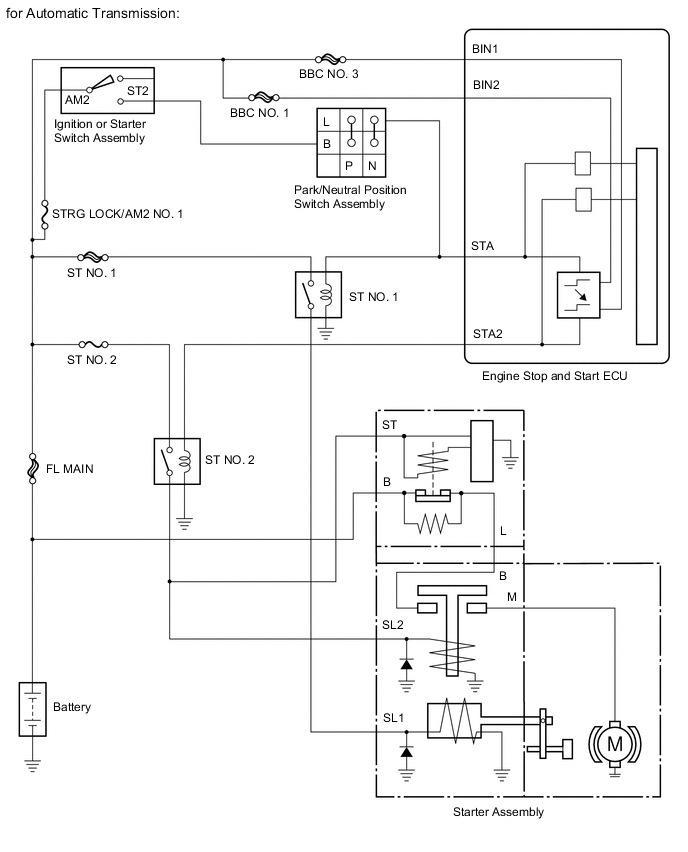
Figure 3. w/ Entry and Start System:
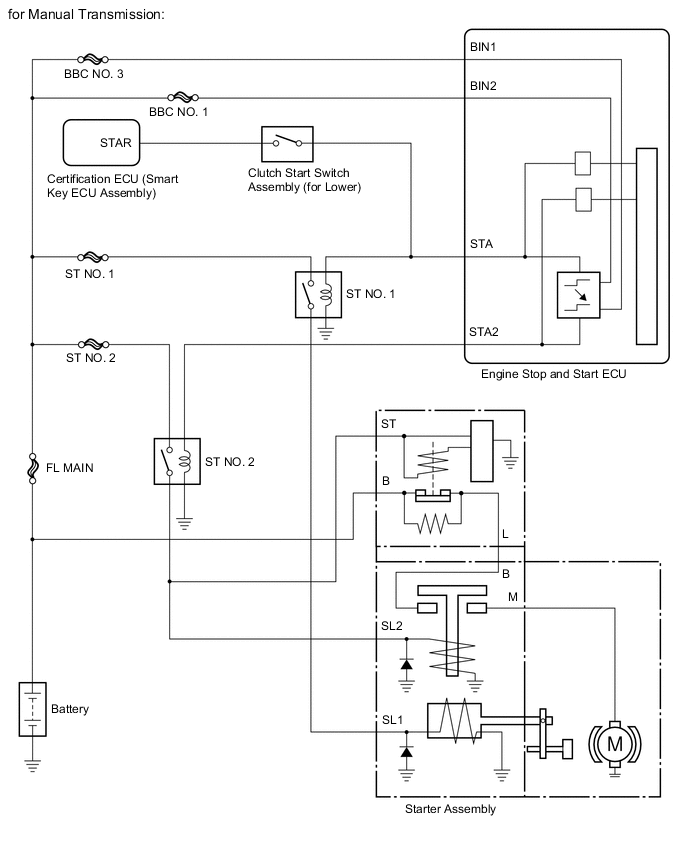
Figure 4. w/o Entry and Start System:
| DTC No. | Detection Item | DTC Detection Condition | Trouble Area | Warning Indicate | Memory |
|---|---|---|---|---|---|
| P161D | Starter Delay Circuit | Both of the following conditions are met (1 trip detection logic):
|
Engine stop and start ECU | Blinks | DTC stored |
CONFIRMATION DRIVING PATTERN
Tech Tips
DTCs for the stop and start system are not cleared even if the malfunction has been repaired. After repairing the malfunction, be sure to clear the DTCs.
-
Tech Tips
-
If the cable is disconnected from the battery terminal, stop and start control is prohibited until refresh charge is completed.
In this case, let the vehicle idle with the battery temperature at 11°C (51°F) or higher for 5 to 60 minutes to complete the refresh charge. (The refresh charge is complete when the Data List item Status of Battery Charge Control changes from "Refresh Charge Mode".)
-
If the GTS is not available and the Data List item Status of Battery Charge Control cannot be checked, charge the battery by idling the engine for approximately 5 to 60 minutes or driving the vehicle, and then drive the vehicle and check that stop and start control operates.
If the engine is started with the hood open, the system determines that a jump start has occurred. Therefore, make sure that the hood is closed before starting the engine and driving the vehicle.
-
After the refresh charge completes, turn the engine switch off, wait for at least 30 seconds, and then start the engine again.
If the vehicle enters refresh charge mode again while the engine is idling, the initial refresh charge did not properly complete, so wait for the refresh charge to complete.
-
Allow the engine to idle for 3 minutes after the engine warms up and check that the engine speed is within 50 rpm of the target idle speed.
CONFIRMATION AFTER TROUBLESHOOTING
-
Connect the GTS to the DLC3.
-
Turn the ignition switch to ON and turn the GTS on.
-
Clear the DTCs.
-
Start the engine and warm it up.
-
Drive the vehicle at 7 km/h (4.3 mph) or more.
CAUTION:
When performing Confirmation Driving Pattern, obey all speed limits and traffic laws.
-
for Automatic Transmission:
Depress the brake pedal and stop the vehicle.
for Manual Transmission:
Stop the vehicle, move the shift lever to neutral and release the clutch pedal.
-
Keep the engine stopped by stop and start control. (for Automatic Transmission: Keep the shift lever in D.)
-
for Automatic Transmission:
Release the brake pedal with the shift lever in D to start the engine.
for Manual Transmission:
Depress the clutch pedal and start the engine.
Tech Tips
If the engine cranks slowly when the engine is restarted, it can be determined that the battery voltage is low.
-
Drive the vehicle at 7 km/h (4.3 mph) or more.
CAUTION:
When performing Confirmation Driving Pattern, obey all speed limits and traffic laws.
-
for Automatic Transmission:
Depress the brake pedal and stop the vehicle.
for Manual Transmission:
Stop the vehicle, move the shift lever to neutral and release the clutch pedal.
-
Keep the engine stopped by stop and start control. (for Automatic Transmission: Keep the shift lever in D.)
-
for Automatic Transmission:
Release the brake pedal with the shift lever in D to start the engine.
for Manual Transmission:
Depress the clutch pedal and start the engine.
Tech Tips
If the engine cranks slowly when the engine is restarted, it can be determined that the battery voltage is low.
-
Drive the vehicle at 7 km/h (4.3 mph) or more.
CAUTION:
When performing Confirmation Driving Pattern, obey all speed limits and traffic laws.
-
for Automatic Transmission:
Depress the brake pedal and stop the vehicle.
for Manual Transmission:
Stop the vehicle, move the shift lever to neutral and release the clutch pedal.
-
Keep the engine stopped by stop and start control. (for Automatic Transmission: Keep the shift lever in D.)
-
for Automatic Transmission:
Release the brake pedal with the shift lever in D to start the engine.
for Manual Transmission:
Depress the clutch pedal and start the engine.
Tech Tips
If the engine cranks slowly when the engine is restarted, it can be determined that the battery voltage is low.
-
Check that no DTCs are output.
-
-
Tech Tips
-
If the cable is disconnected from the battery terminal, stop and start control is prohibited until refresh charge is completed.
In this case, let the vehicle idle with the battery temperature at 11°C (51°F) or higher for 5 to 60 minutes to complete the refresh charge. (The refresh charge is complete when the Data List item Status of Battery Charge Control changes from "Refresh Charge Mode".)
-
If the GTS is not available and the Data List item Status of Battery Charge Control cannot be checked, charge the battery by idling the engine for approximately 5 to 60 minutes or driving the vehicle, and then drive the vehicle and check that stop and start control operates.
If the engine is started with the hood open, the system determines that a jump start has occurred. Therefore, make sure that the hood is closed before starting the engine and driving the vehicle.
-
After the refresh charge completes, turn the engine switch off, wait for at least 30 seconds, and then start the engine again.
If the vehicle enters refresh charge mode again while the engine is idling, the initial refresh charge did not properly complete, so wait for the refresh charge to complete.
STOP AND START SYSTEM OPERATION CHECK
-
Start the engine and warm it up.
-
Turn the air conditioning system off.
-
Drive the vehicle at 7 km/h (4.3 mph) or more.
CAUTION:
When performing Confirmation Driving Pattern, obey all speed limits and traffic laws.
-
for Automatic Transmission:
Depress the brake pedal and stop the vehicle.
for Manual Transmission:
Stop the vehicle, move the shift lever to neutral and release the clutch pedal.
-
Allow the engine to stop by stop and start control. (for Automatic Transmission: Keep the shift lever in D.)
-
for Automatic Transmission:
Release the brake pedal with the shift lever in D to start the engine.
for Manual Transmission:
Depress the clutch pedal and start the engine.
-
WIRING DIAGRAM
CAUTION / NOTICE / HINT
Note
-
Before replacing the engine stop and start ECU, read the number of starter operations and total number of engine starts and write it into a new engine stop and start ECU.
-
After replacing the engine stop and start ECU or air conditioning amplifier assembly, reset and perform learning of the air conditioning information in the engine stop and start ECU.
-
After replacing the engine stop and start ECU or airbag sensor assembly, clear and calibrate the deceleration sensor zero point in the engine stop and start ECU.
-
for Automatic Transmission:
When the engine stop and start ECU is replaced, check the electromagnetic oil pump.
Tech Tips
Using the GTS, read the freeze frame data before troubleshooting. System condition information is recorded as freeze frame data the moment a DTC is stored. This information can be useful when troubleshooting.
PROCEDURE
-
CHECK ENGINE STOP AND START ECU (STA, STA2 SIGNAL)
-
Connect an oscilloscope to terminals G126-21 (STA), G126-23 (STA2) and G126-6 (DGND).
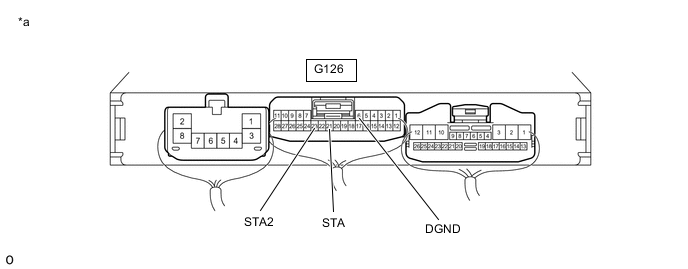
*a Component with harness connected
(Engine Stop and Start ECU)
- - -
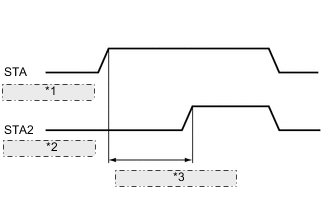
*1 (ST NO. 1 Relay) *2 (ST NO. 2 Relay) *3 0.016 seconds or more Check the waveform immediately after turning the engine starts.
Item Condition Tester Connection G126-21 (STA) - G126-6 (DGND)
G126-23 (STA2) - G126-6 (DGND)
Condition Engine started by ignition or starter switch assembly (w/o Entry and Start System) or push start switch assembly (w/ Entry and Start System) operation Result Result Proceed to Time between ST NO. 1 relay (for starter pinion) turning on and ST NO. 2 relay (for starter motor) turning on becomes 0.016 seconds or more A Time between ST NO. 1 relay (for starter pinion) turning on and ST NO. 2 relay (for starter motor) turning on becomes less than 0.016 seconds B
A 
USE SIMULATION METHOD TO CHECK Click here
B
REPLACE ENGINE STOP AND START ECU Click here
-