CANISTER INSPECTION
PROCEDURE
-
INSPECT CANISTER
-
Visually check the canister.
-
Visually check the canister for cracks or damage.
If cracks or damage are found, replace the canister.
-
-
Inspect the ventilation of the canister.
-
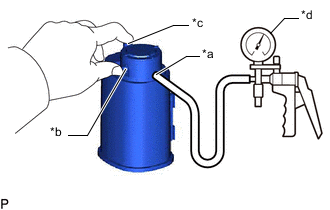
*a Port (A) *b Port (B) *c Port (C) *d Vacuum Pump Using a vacuum pump, apply vacuum (1.96 kPa (15 mmHg, 0.579 in. Hg)) to the port (A) with the port (B) and port (C) closed.
OK Air does not flow. -
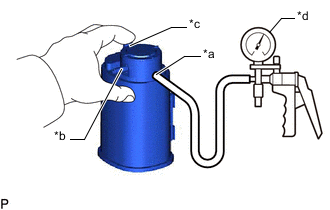
*a Port (A) *b Port (B) *c Port (C) *d Vacuum Pump Using a vacuum pump, apply vacuum (1.96 kPa (15 mmHg, 0.579 in. Hg)) to the port (A) with the port (C) closed.
OK Air is sucked into the port (B). -
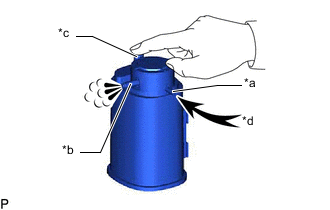
*a Port (A) *b Port (B) *c Port (C) *d Air Close the port (C) and apply compressed air (4.41 kPa (0.04 kgf/cm2, 0.6 psi)) to the port (A).
OK Air flows out from the port (B). -
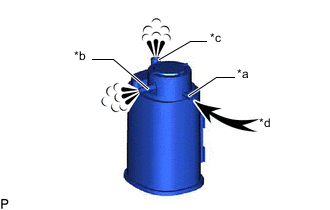
*a Port (A) *b Port (B) *c Port (C) *d Air Apply compressed air (4.41 kPa (0.04 kgf/cm2, 0.6 psi)) to the port (A).
OK Air flows out from the port (B) and port (C).
-
-