| DTC Code | DTC Name |
|---|---|
| Turbocharger Oil Leak and White Smoke |
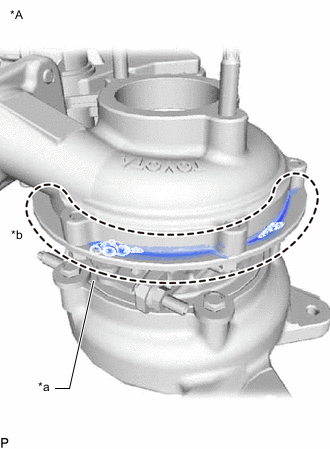
| *A | Fig. 4 |
| *a | In the case of an actual oil leak, oil leaks from the sealed part |
| *b | Oil Leak Check Point (FIPG Sealing Part) |
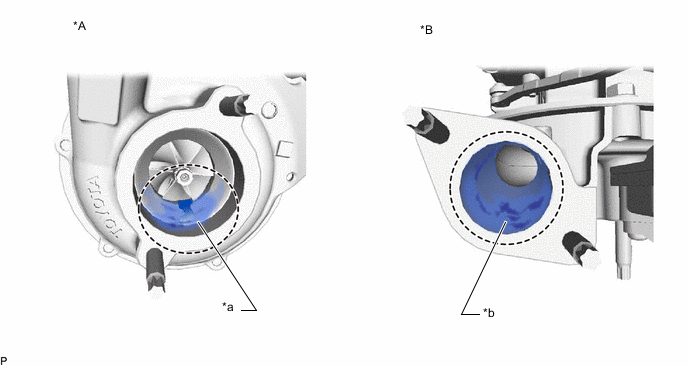
| *A | Fig. 2 | *B | Fig. 3 |
| *a | Oil Existence at Compressor Inlet (Max. 5 cm3) |
*b | Oil Existence at Compressor Outlet |
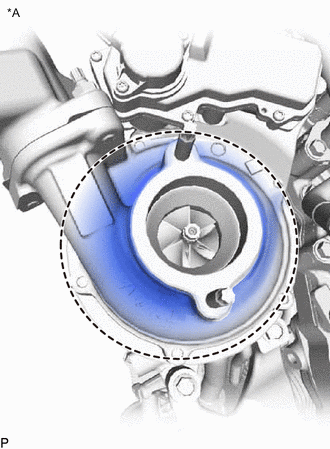
| *A | Fig. 1 |
DESCRIPTION
| Type of Oil Leak | Outline | Major Trouble Area |
|---|---|---|
| Internal oil leak (white smoke) | Oil leak from the bearing housing into the compressor housing (intake side) or turbine housing (exhaust side) through the seal ring. Internal oil leaks cannot be seen from outside the turbocharger. If an oil leak occurs from the turbine seal, a large amount of white smoke is emitted from the exhaust pipe. |
|
| External oil leak | Oil leak from inside to outside the turbocharger. (Example: FIPG seal, oil pipe flange, or oil pipe union) Includes oil leaks that are visible outside the turbocharger. |
|
-
Turbocharger oil leaks are classified into two types, internal oil leaks and external oil leaks.
-
The following illustration shows the parts of the turbocharger.
-
If an oil leak or white smoke occurs, sometimes the turbocharger is replaced even though it is not the cause of the problem.
-
Oil may leak from the seal ring if the turbocharger is placed with its shaft vertical. However, this is unrelated to oil leaks during operation.
-
Oil traces on the compressor housing surface or oil at the compressor inlet or outlet can mistakenly be evaluated as a leak from the turbocharger.
-
If the oil stain is similar to the one shown in the illustration (fig. 1), it may be oil spray from parts surrounding the turbocharger or oil leaking from the air cleaner hose. Therefore, this kind of oil stain on the outer surface of the turbocharger is not an oil leak from the turbocharger (external oil leak), and is not related to white smoke. For identification of an actual turbocharger outer oil leak, check only the sealing part shown below.
-
A certain amount of oil is contained in the intake system because blow-by gas containing oil mist is returned to the intake system by the PCV. Therefore, the oil amount at the compressor inlet shown in the left figure (fig. 2) is normal and not an oil leak from the turbocharger (internal oil leak). Also, oil at the compressor outlet as shown in fig. 3 is normal.
-
This is an illustration (fig. 4) of an air leak test performed by applying soapy water to the area of the leak. Bubbles indicate the leak point.
Click here
-
*A Fig. 5 - - *1 Compressor Outlet Elbow *2 Compressor Housing *a Trace of Oil Leak from Compressor Outlet Elbow and Compressor Housing Connection Part *b Oil Leak from Compressor Outlet Elbow and Compressor Housing Connection Part *1 Bearing Housing Plate *2 FIPG Sealing Part *3 Compressor Housing *a Oil Leak *1 Oil Drain - - *a Coked Oil *b Oil Drain Clogged with Coked Oil Faults and Symptoms of Turbocharger Parts Table 1. Compressor Side Seal Ring Main fault Seal ring damage Symptom Oil leak into compressor housing Excessive oil consumption Note If the compressor seal ring is defective, a large oil leak may be found between the compressor outlet and the intercooler and between the intercooler and intake manifold. If a large oil leak is found in the compressor inlet, the oil did not come from the turbocharger. It may indicate a malfunction in the PCV system. Table 2. Turbine Side Seal Ring Main fault Seal ring damage Symptom Oil leak into turbine housing Large amount of white smoke emitted from the exhaust pipe Excessive oil consumption Note If the turbine seal ring is defective, a large amount of white smoke is emitted continuously. If the white smoke is emitted only immediately after the engine is started and then disappears, or if a small amount of smoke is emitted intermittently, the oil did not come from the turbocharger. Another part may be defective. If wet oil is found at the turbine inlet, the oil did not come from the turbocharger. Another part may be defective. Table 3. Bearing Housing (Oil Drain Clogging) Main fault Blocked oil drain due to oil coking Symptom Large amount of white smoke emitted from the exhaust pipe Tip: Oil coking results due to inadequate oil management If the oil drain is blocked due to oil coking, the oil cannot be removed smoothly. Oil leaking from the bearing housing into the compressor housing and turbine housing generates a large amount of white smoke in the exhaust pipe. Table 4. Turbine Shaft Main fault Damage Seized Symptom Shaft does not rotate Oil leak into compressor housing Large amount of white smoke emitted from the exhaust pipe Lack of power Abnormal noise from the turbocharger Note A turbine shaft defect may cause a sensation of a lack of power due to inadequate boost pressure. At low temperatures, shaft rotation may feel heavy due to the oil viscosity. Do not mistake this for non-rotating shaft. Table 5. Compressor Impeller Main fault Damage Symptom Shaft does not rotate Oil leak into compressor housing Lack of power Note If the compressor impeller is defective, a large oil leak may be found between the compressor outlet and the intercooler and between the intercooler and intake manifold. The boost pressure may stop the oil at the compressor seal ring. If the boost pressure does not rise due to a damaged compressor impeller, oil flows into the compressor housing. Table 6. Compressor Housing FIPG Sealing Part Main fault Oil leak from the FIPG seal Symptom If an oil stain is separate from the FIPG seal, it may be evaluated as oil sprayed from turbocharger peripheral parts. If the oil stain reaches the flange connector, it may be evaluated as a defective flange connection. Table 7. Intake Hoses Main fault Oil leak from the compressor housing and compressor outlet elbow connector. Symptom If oil stain traces exist at the hose connector, it may be evaluated as a defective hose connection.
PROCEDURE
- Click here
CHECK TURBOCHARGER SUB-ASSEMBLY (OIL LEAK CHECK)
-
Check whether the oil leak is internal or external.
Tip:White smoke is unrelated to external oil leaks.
Type of Oil Leak Outline Internal oil leak (white smoke) An internal oil leak from the bearing housing into the compressor housing (intake side) or turbine housing (exhaust side) through the seal ring cannot be seen from outside the turbocharger. If an oil leak occurs from the turbine seal, a large amount of white smoke is emitted from the exhaust pipe. External oil leak Oil leak from inside to outside the turbocharger (Example: FIPG seal, oil pipe flange, or oil pipe union). Includes oil leaks that are visible outside the turbocharger. Result Result Proceed to External oil leak A Internal oil leak B
-
- Click here
REPLACE DEFECTIVE PARTS (PARTS LEAKING OIL)
-
Replace the parts that are leaking oil.
Tip:
-
If oil leaks from the contact surface between the compressor housing and bearing housing, the seal is defective. Replace the turbocharger sub-assembly.
-
If oil leaks from the surface of the oil pipe flange, the installation may be incorrect due to loose nuts or a defective gasket. Check the installation or replace the gasket.
Result Result NEXT -
- NEXT
END
-
- Click here
CHECK TURBOCHARGER SUB-ASSEMBLY (SPECIFIED OIL LEAK POSITION)
-
Remove the compressor inlet elbow from the turbocharger sub-assembly.
-
Check for excessive oil or oil deposits at the compressor inlet.
Tip:
-
The PCV gas contains a certain amount of oil mist. This can accumulate in front of the compressor inlet, creating a certain amount of oil, as shown in Fig. 2.
-
Excessive oil at the compressor inlet may cause a malfunction in the PCV system.
-
A certain amount of oil on the compressor housing surface results from oil mist in the blowby gas and is not a malfunction.
-
-
Remove the compressor outlet elbow from the turbocharger sub-assembly.
-
Check for excessive oil or oil deposits at the compressor outlet.
Tip:The PCV gas contains a certain amount of oil mist. This can create a certain amount of oil, as shown in Fig. 3.
-
Remove the exhaust manifold converter sub-assembly.
-
Check for excessive oil or oil deposits in the turbine housing.
Tip:
-
Do not mistake carbon soot for oil.
-
If the turbocharger shaft is tilted, a small amount of oil flows out of the bearing housing. Do not mistake oil that flows out of the bearing housing during and after removal of the turbocharger sub-assembly for oil that existed before the turbocharger assembly was removed.
-
Excessive oil or oil deposits in the turbine inlet comes from a cylinder exhaust port and may indicate a problem with one or more cylinders.
Result Result Proceed to No excessive oil in the compressor inlet or outlet or the turbine housing A Excessive oil in the compressor inlet or outlet B Excessive oil in the turbine housing C -
- A
GO TO WHITE SMOKE EMITTEDClick here
- BClick here
- CClick here
-
- Click here
CHECK TURBOCHARGER SUB-ASSEMBLY
-
Check for damage to the compressor impeller.
-
Check for interference between the compressor impeller and the compressor housing.
Result Result Proceed to No damage or interference A Damage or interference exists B
- AClick here
- B
REPLACE TURBOCHARGER SUB-ASSEMBLYClick here
-
- Click here
CHECK TURBOCHARGER SUB-ASSEMBLY
-
Check that the turbine shaft rotates smoothly, without catching.
-
Check for loose turbine mounting nuts and for axial play in the turbine shaft.
Tip:If the turbine shaft catches or if there no play or excessive play, it could indicate a seal problem due to seizing or poor sliding due to a deposit build up.
Standard value 0.10 mm (0.00394 in.) or less Result Result Proceed to No turbine shaft malfunction A Turbine shaft malfunction B
- AClick here
- B
REPLACE TURBOCHARGER SUB-ASSEMBLYClick here
-
- Click here
CHECK TURBO OIL INLET PIPE SUB-ASSEMBLY
-
Remove the turbo oil inlet pipe sub-assembly.
-
Check for blockage of the turbo oil inlet pipe sub-assembly due to accumulated deposits or deformation.
Tip:If no malfunction exists in the turbo oil inlet pipe sub-assembly, there may be a seal defect due to oil coking in the bearing housing.
Result Result Proceed to No clogging A Clogging B
- A
REPLACE TURBOCHARGER SUB-ASSEMBLYClick here
- B
REPLACE TURBO OIL INLET PIPE SUB-ASSEMBLYClick here
-
- Click here
CHECK TURBOCHARGER SUB-ASSEMBLY
-
Check for damage to the turbine wheel.
-
Check for interference between the turbine wheel and the turbine housing.
Result Result Proceed to The turbine wheel is not damaged and there is no interference between the turbine wheel and turbine housing A turbine wheel is damaged
(there is no interference between the turbine wheel and turbine housing)
B There is interference between the turbine wheel and turbine housing
- AClick here
GO TO STEP 5
- B
REPLACE TURBOCHARGER SUB-ASSEMBLYClick here
-