| DTC Code | DTC Name |
|---|---|
| Lack of Power (Turbocharger System) |
CAUTION / NOTICE / HINT
-
The diagnosis flowchart is for lack of power due to turbocharger factors.
-
If symptom-specific diagnosis indicates a turbocharger related problem, check using this flowchart.
PROCEDURE
- Click here
CHECK TURBOCHARGER SUB-ASSEMBLY
-
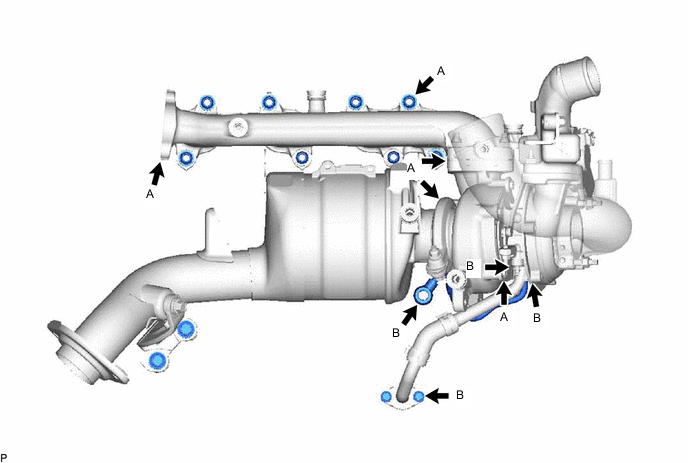
Check that no soot or oil adheres to the turbocharger sub-assembly connectors.
Tip:If adhering soot or an oil leak exists, air leaking at that position may be the cause of the lack of boost pressure.
Result Result Proceed to No adhering soot or an oil A Soot adhering around the turbine housing, flange, or exhaust pipe clamp (A in the illustration) B Oil leak from the contact surface between the compressor housing and bearing housing (B in the illustration) C
- AClick here
- BClick here
- C
REPLACE TURBOCHARGER SUB-ASSEMBLYClick here
-
- Click here
INSPECT TURBOCHARGER SUB-ASSEMBLY (TURBINE SHAFT)
-
Remove the turbocharger sub-assembly.
-
Check that the turbine shaft rotates smoothly, without catching.
-
Check for loose turbine mounting nuts and for axial play in the turbine shaft.
Tip:If the turbine shaft catches or if there is no play or excessive play, it could indicate improper sealing due to seizing or poor sliding because of a deposit build-up.
Standard value 0.10 mm (0.00394 in.) or less Result Result Proceed to No turbine shaft malfunction A Turbine shaft malfunction B -
- AClick here
- B
REPLACE TURBOCHARGER SUB-ASSEMBLYClick here
-
- Click here
INSPECT TURBOCHARGER SUB-ASSEMBLY
-
Check for interference between the turbine wheel and the turbine housing.
Tip:When there is interference between the turbine wheel and turbine housing and the turbine wheel is damaged, check for fragments of the turbine wheel in the exhaust manifold converter sub-assembly.
Result Result Proceed to No damage or interference A Damage or interference exists B
- AClick here
- B
REPLACE TURBOCHARGER SUB-ASSEMBLYClick here
-
- Click here
INSPECT TURBOCHARGER NOZZLE VANE PLATE
-
Inspect the turbocharger nozzle vane plate.
-
Remove the e-washer from the turbocharger nozzle vane control actuator.
-
-
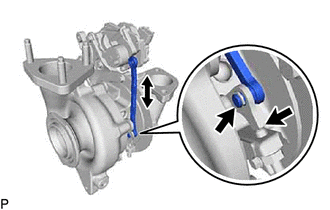
Move the turbocharger vane control rod sub-assembly and check that the turbocharger nozzle vane plate moves.
Result Result Proceed to Catches, but operates* OK Gets stuck and does not operate NG Tip:*: Check several times.
- OK
REPLACE TURBOCHARGER NOZZLE VANE CONTROL ACTUATORClick here
- NG
REPLACE TURBOCHARGER SUB-ASSEMBLYClick here
-
- Click here
CHECK EXHAUST MANIFOLD CONVERTER SUB-ASSEMBLY
-
Check for deformation or cracks in the mounting surfaces on the exhaust manifold converter sub-assembly and the turbocharger sub-assembly.
Tip:Deformation or cracks on a mounting surface may allow exhaust gas to leak from the damaged position.
Standard No deformation or cracks on a mounting surface Result Result Proceed to No problem with the mounting surface A Deformation or cracks on the exhaust manifold converter sub-assembly mounting surface B Deformation or cracks on the turbocharger sub-assembly mounting surface C
- AClick here
- B
REPLACE EXHAUST MANIFOLD CONVERTER SUB-ASSEMBLYClick here
- C
REPLACE TURBOCHARGER SUB-ASSEMBLYClick here
-
- Click here
REPLACE EXHAUST PIPE CLAMP AND GASKET
-
Replace the exhaust pipe clamp and the gasket.
Result Proceed to NEXT
- NEXTClick here
-
- Click here
PERFORM SIMULATION TEST
-
Check that the abnormal state has disappeared.
Result Proceed to NEXT
- NEXT
END
-