SMART ENTRY AND START SYSTEM(for Entry Function) All Door Entry Lock/Unlock Functions and Wireless Functions do not Operate
DESCRIPTION
When the entry operation and wireless operation of the door lock functions do not operate, a malfunction or wave interference may be occurring in either of the following: 1) the certification ECU (smart key ECU assembly); or 2) the electrical key transmitter sub-assembly. If the entry lock and wireless lock operations cannot be performed, there may be electrical key transmitter sub-assembly malfunctions, wave interference or problems in the communication which is used for the smart entry and wireless function.
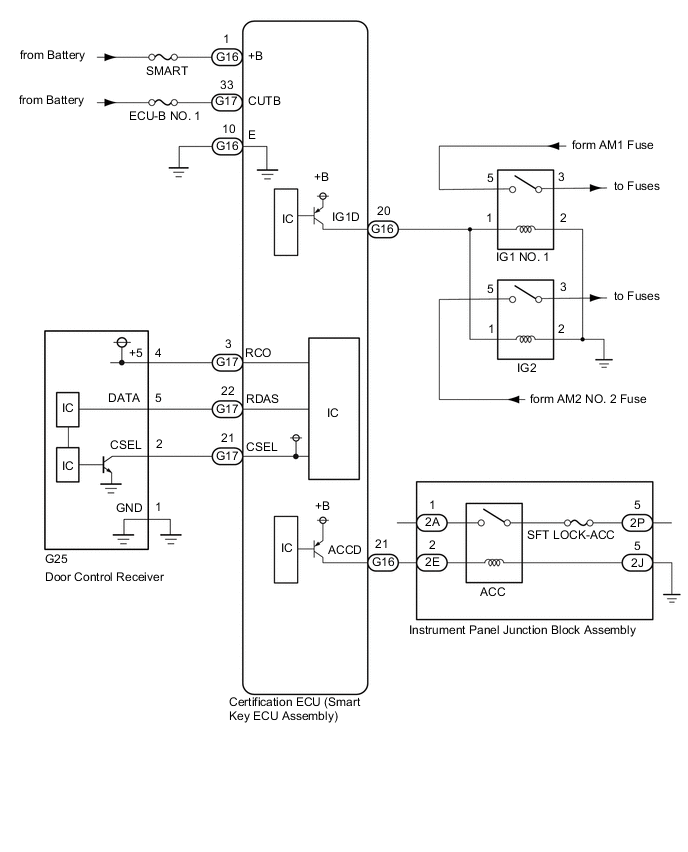
WIRING DIAGRAM
Figure 1. for LHD:
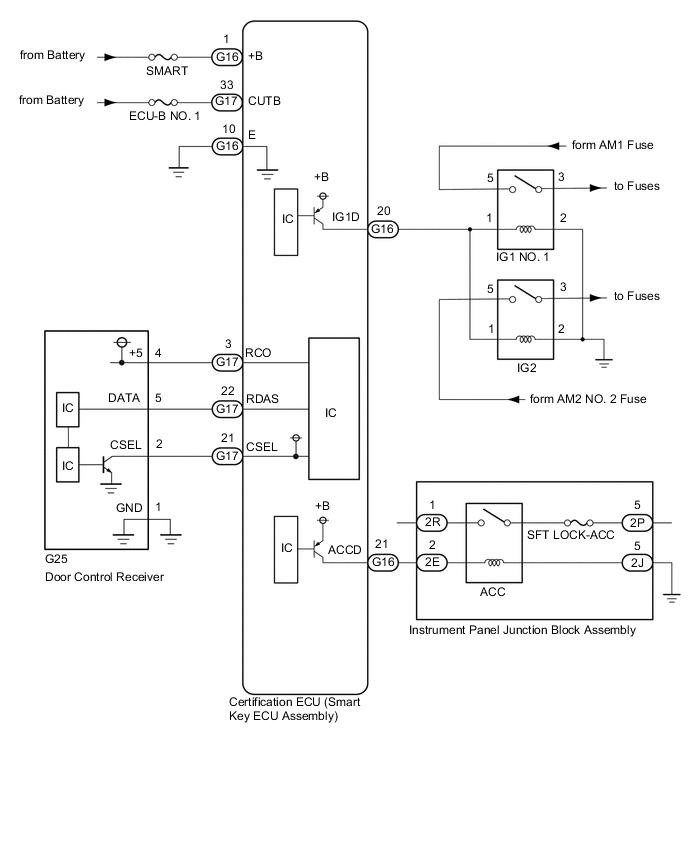
Figure 2. for RHD:
CAUTION / NOTICE / HINT
Note
-
The smart entry and start system (for Entry Function) uses the CAN communication system and LIN communication system. First inspect the communication systems by following How to Proceed with Troubleshooting.
Troubleshoot the smart entry and start system (for Entry Function) after confirming that the communication systems are functioning properly.
-
When using the GTS with the vehicle engine switch off, connect the GTS to the vehicle and turn a courtesy light switch on and off at intervals of 1.5 seconds or less until communication between the GTS and the vehicle begins. Then select the Model Code "KEY REGIST" under manual mode and enter the following menus: Body Electrical / Entry&Start(CAN).
While using the GTS, periodically turn a courtesy light switch on and off at intervals of 1.5 seconds or less to maintain communication between the GTS and the vehicle.
-
Check that there are no electrical key transmitter sub-assemblies in the vehicle.
-
Before performing the inspection, check that DTC B1242 (wireless door lock control) or DTC B27B0 is not output.
-
Inspect the fuses for circuits related to this system before performing the following procedure.
-
Before replacing the certification ECU (smart key ECU assembly), refer to the smart entry and start system (for Entry Function) precaution.
-
After repair, confirm that no DTCs are output by performing the "DTC Output Confirmation Operation".
-
w/ Automatic Light Control System:
If the body ECU has been replaced, it is necessary to initialize the body ECU.
-
w/ Door Control Battery:
As the door control battery is installed between the vehicle battery and body ECU, first perform the inspections to confirm that there are no malfunctions in the power source circuit for the body ECU before performing this troubleshooting procedure.
Tech Tips
-
If all door entry lock and unlock functions do not operate, the cause of the malfunction may be stored in the certification ECU (smart key ECU assembly).
-
If the cause of the malfunction is stored in the certification ECU (smart key ECU assembly), the following table is helpful in checking whether the malfunction was caused by wave interference.
Body Electrical > Entry&Start > Utility
| Tester Display |
|---|
| Operation History |
| Parameter Name | Cause of Problem and Countermeasure |
|---|---|
| Lock / Key RF Signal Interference | When entry lock operation was performed, the electrical key transmitter sub-assembly could not be confirmed due to wave interference. If the cause of the malfunction has not been stored but the vehicle has been moved and an entry lock operation has been successfully performed, the possibility of wave interference is high. |
| Unlock / Key RF Signal Interference | When entry unlock operation was performed, the electrical key transmitter sub-assembly could not be confirmed due to wave interference. If the cause of the malfunction has not been stored but the vehicle has been moved and an entry unlock operation has been successfully performed, the possibility of wave interference is high. |
| Operating Trunk Switch / Key RF Signal Interference | When entry back door open operation was performed, the electrical key transmitter sub-assembly could not be confirmed due to wave interference. If the cause of the malfunction has not been stored but the vehicle has been moved and an entry back door open operation has been successfully performed, the possibility of wave interference is high. |
PROCEDURE
-
INSPECT BATTERY VOLTAGE
-
Measure the voltage of the vehicle battery.
Standard voltage 11 to 14 V Tech Tips
It may be possible to tell whether the vehicle battery is discharged by operating the horn.
If the voltage is below 11 V, recharge or replace the vehicle battery before proceeding.
Result Proceed to NEXT
NEXT 
-
-
CHECK FOR DTC
-
Open the driver door using the mechanical key built into the electrical key transmitter sub-assembly.
-
Connect the GTS and check for DTCs.
Body Electrical > Entry&Start > Trouble CodesTech Tips
When using the GTS with the engine switch off to troubleshoot, connect the GTS to the DLC3 and turn a courtesy light switch on and off at 1.5 second intervals until communication between the GTS and vehicle begins.
OK DTC is not output. Result Proceed to OK NG
NG 
GO TO DIAGNOSTIC TROUBLE CODE CHART Click here
OK
-
-
CHECK DOOR AJAR WARNING OPERATION
-
When door unlock by entry lock or wireless door lock operation functions even though all doors are closed, check the door ajar warning operation.
Result Result Proceed to Door ajar warning does not operate. A Door ajar warning operates. B
B
GO TO LIGHTING SYSTEM Click here
A
-
-
CHECK POWER DOOR LOCK CONTROL SYSTEM
-
When the door control switch on the power window master switch on the driver door is operated, check that the doors unlock and lock according to the switch operation.
OK Door locks operate normally. Result Proceed to OK NG
NG
GO TO POWER DOOR LOCK CONTROL SYSTEM Click here
OK
-
-
CHECK KEY DIAGNOSTIC MODE
-
Check the following antennas in key diagnostic mode.
-
Select either channel 1 or channel 2 and perform the key diagnostic mode inspection for each channel.
Tech Tips
If the buzzer sounds with [CH1] displayed but not with [CH2], the electrical key transmitter sub-assembly cannot be detected by channel 2 due to a malfunction, such as wave interference.
Body Electrical > Entry&Start > UtilityTester Display Communication Check(Key Diag Mode)
-
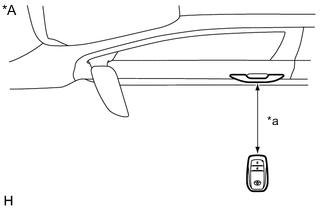
*A for LHD *a 0.7 to 1 m (2.30 to 3.28 ft.) 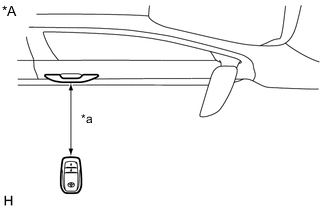
*A for RHD *a 0.7 to 1 m (2.30 to 3.28 ft.) Check the electrical key antenna (for Driver Door):
When the electrical key transmitter sub-assembly is brought within 0.7 to 1 m (2.30 to 3.28 ft.) of the front door outside handle assembly (for Driver Door), check that the wireless door lock buzzer sounds.
-
*A for LHD *a 0.7 to 1 m (2.30 to 3.28 ft.)
*A for RHD *a 0.7 to 1 m (2.30 to 3.28 ft.) Check the electrical key antenna (for Front Passenger Door):
When the electrical key transmitter sub-assembly is brought within 0.7 to 1 m (2.30 to 3.28 ft.) of the front door outside handle assembly (for Front Passenger Door), check that the wireless door lock buzzer sounds.
-
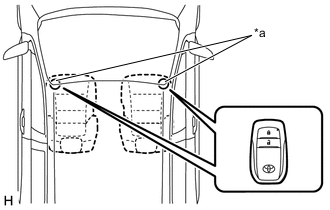
*a Inspection Point Check the No. 1 indoor electrical key antenna assembly (front floor):
When the electrical key transmitter sub-assembly is at either inspection point, check that the wireless door lock buzzer sounds.
-
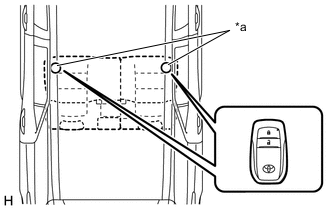
*a Inspection Point Check the No. 2 indoor electrical key antenna assembly (rear floor):
When the electrical key transmitter sub-assembly is at either inspection point, check that the wireless door lock buzzer sounds.
-
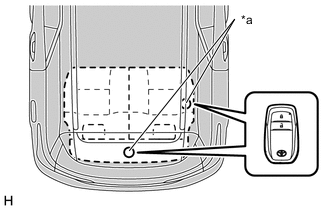
*a Inspection Point Check the No. 2 indoor electrical key antenna assembly (inside luggage):
When the electrical key transmitter sub-assembly is at either inspection point, check that the wireless door lock buzzer sounds.
-
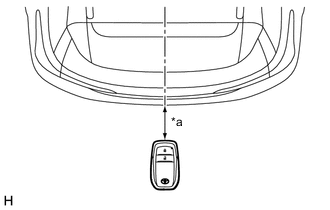
*a 0.7 to 1 m (2.30 to 3.28 ft.) Check the No. 2 indoor electrical key antenna assembly (back door):
When the electrical key transmitter sub-assembly is at either inspection point, check that the wireless door lock buzzer sounds.
OK Wireless door lock buzzer sounds. Result Result Proceed to Diagnostic mode inspections fail for both channels A Diagnostic mode inspections succeed for both channels B Diagnostic mode inspection succeeds for only one of the channels C -
B 
CHECK CERTIFICATION ECU (SMART KEY ECU ASSEMBLY) Click here
C
CHECK WAVE ENVIRONMENT Click here
A
-
-
CHECK WAVE ENVIRONMENT
-
Bring the electrical key transmitter sub-assembly near the door control receiver and perform a wireless and entry function operation check.
Tech Tips
-
When the electrical key transmitter sub-assembly is brought near the door control receiver, the possibility of wave interference decreases, and it can be determined if wave interference is causing the problem symptom.
-
If the inspection result is that the problem only occurs in certain locations or at certain times of day, the possibility of wave interference is high. Also, added vehicle components may cause wave interference. If installed, remove them and perform the operation check.
-
There may be wave interference if the vehicle is near broadcasting antennas, large video displays, wireless garage door opener systems, wireless security cameras, home security systems, etc. In this case, move the vehicle to a different location and check if there is any improvement.
-
If a tool for checking electric waves, such as a signal strength meter, is available, move around the area while observing both the LF band (used by the vehicle antenna to form the detection area) and RF band (used by the electrical key transmitter sub-assembly for transmission) to check for locations where there is wave interference.
OK Wireless and entry functions operate normally. Result Proceed to OK NG -
NG
AFFECTED BY WAVE INTERFERENCE
OK
-
-
CHECK TRANSMITTER BATTERY
-
Check the transmitter battery level of the electrical key transmitter sub-assembly that was checked first.
-
Press and hold the lock switch of the transmitter for 5 seconds and check the number of times that the transmitter LED illuminates.
Result Result Proceed to Transmitter LED does not illuminate when switch is pressed and held A Transmitter LED illuminates 3 times or more when switch is pressed and held B Transmitter LED illuminates once or twice but not a third time C Tech Tips
-
The electrical key transmitter sub-assembly sends voltage information to the certification ECU (smart key ECU assembly) when it is being used. The certification ECU (smart key ECU assembly) displays "Yes" for the "Key Low Battery" item of the Data List when this voltage information indicates 2.2 V or less.
-
Even if the transmitter battery is depleted, it is still possible to start the engine by holding the electrical key transmitter sub-assembly against the engine switch, depressing the brake pedal and pressing the engine switch.
-
-
B
CHECK ELECTRICAL KEY TRANSMITTER SUB-ASSEMBLY Click here
C
REPLACE TRANSMITTER BATTERY Click here
A
-
-
INSPECT TRANSMITTER BATTERY (VOLTAGE)
-
Inspect the transmitter battery.
Note
When removing the transmitter battery, make sure not to touch the electronic circuit board, as static electricity may cause a malfunction to occur.
-
Measure the voltage of the transmitter battery.
Result Proceed to OK NG -
OK
REPLACE ELECTRICAL KEY TRANSMITTER SUB-ASSEMBLY
NG
REPLACE TRANSMITTER BATTERY Click here
-
-
CHECK ELECTRICAL KEY TRANSMITTER SUB-ASSEMBLY
-
Check if there are any other registered electrical key transmitter sub-assemblies.
Result Result Proceed to There are no other registered electrical key transmitter sub-assemblies A There is another registered electrical key transmitter sub-assembly B
B
GO TO STEP 11 Click here
A
-
-
ELECTRICAL KEY TRANSMITTER SUB-ASSEMBLY REGISTRATION (NEW ELECTRICAL KEY TRANSMITTER SUB-ASSEMBLY)
-
Register a new electrical key transmitter sub-assembly.
Tech Tips
Refer to the Service Bulletin.
Result Proceed to NEXT
NEXT
-
-
CHECK ENTRY DOOR LOCK OPERATION
-
Using another registered electrical key transmitter sub-assembly, check if an entry lock/unlock operation can be performed twice in succession.
OK Entry lock/unlock operate normally. Result Proceed to OK NG
OK
END (ELECTRICAL KEY TRANSMITTER SUB-ASSEMBLY WAS DEFECTIVE)
NG
-
-
CHECK HARNESS AND CONNECTOR (CERTIFICATION ECU (SMART KEY ECU ASSEMBLY) - DOOR CONTROL RECEIVER)
-
Disconnect the G16 and G17 certification ECU (smart key ECU assembly) connectors.
-
Disconnect the G25 door control receiver connector.
-
Measure the resistance according to the value(s) in the table below.
Standard Resistance Tester Connection Condition Specified Condition G17-3 (RCO) - G25-4 (+5) Always Below 1 Ω G17-22 (RDAS) - G25-5 (DATA) Always Below 1 Ω G17-21 (CSEL) - G25-2 (CSEL) Always Below 1 Ω G16-10 (E) - Body ground Always Below 1 Ω G25-1 (GND) - Body ground Always Below 1 Ω G17-3 (RCO) or G25-4 (+5) - Body ground Always 10 kΩ or higher G17-22 (RDAS) or G25-5 (DATA) - Body ground Always 10 kΩ or higher G17-21 (CSEL) or G25-2 (CSEL) - Body ground Always 10 kΩ or higher Result Proceed to OK NG
NG
REPAIR OR REPLACE HARNESS OR CONNECTOR
OK
-
-
CHECK ENTRY DOOR LOCK OPERATION
-
Connect the G16 and G17 certification ECU (smart key ECU assembly) connectors.
-
Connect the G25 door control receiver connector.
-
Check the entry lock/unlock operation.
Result Result Proceed to Entry lock/unlock does not operate A Entry lock/unlock operate normally B
B
END (CONNECTOR WAS NOT CONNECTED PROPERLY)
A
-
-
CHECK DOOR CONTROL RECEIVER
-
Measure the resistance according to the value(s) in the table below.
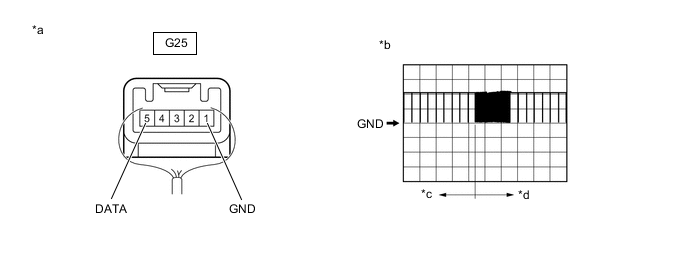
*a Component with harness connected
(Door Control Receiver)
*b Waveform 1 *c Before lock or unlock button of electrical key transmitter sub-assembly pressed *d After lock or unlock button of electrical key transmitter sub-assembly pressed Standard Resistance Tester Connection Condition Specified Condition G25-1 (GND) - Body ground Always Below 1 Ω -
Using an oscilloscope, check the waveform.
OK Tester Connection Condition Tool Setting Specified Condition G25-5 (DATA) - G25-1 (GND)
-
Engine switch off
-
All doors locked
-
Lock or unlock button of electrical key transmitter sub-assembly not pressed → pressed
Procedure:
5 V/DIV., 500 ms./DIV. Pulse generation
(See waveform 1)
Result Proceed to OK NG -
NG
REPLACE DOOR CONTROL RECEIVER Click here
OK
-
-
CHECK CERTIFICATION ECU (SMART KEY ECU ASSEMBLY)
-
Measure the voltage according to the value(s) in the table below.
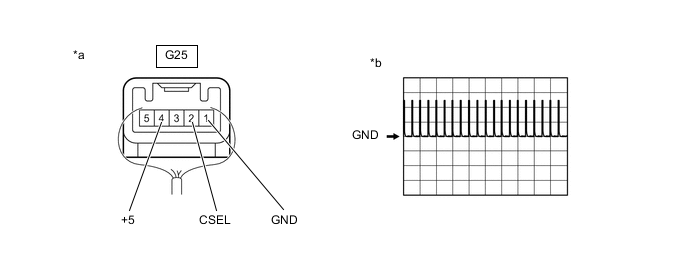
*a Component with harness connected
(Door Control Receiver)
*b Waveform 1 Standard Voltage Tester Connection Condition Specified Condition G25-4 (+5) - G25-1 (GND) Procedure:
-
All doors closed
-
All doors locked
-
Electrical key transmitter sub-assembly switch pressed
Below 1 V → 4.5 to 5.5 V -
-
Using an oscilloscope, check the waveform.
OK Tester Connection Condition Tool Setting Specified Condition G25-2 (CSEL) - G25-1 (GND) Procedure:
-
Engine switch off
-
All doors closed
2 V/DIV., 500 ms./DIV. Pulse generation
(See waveform 1)
Result Proceed to OK NG -
NG
REPLACE CERTIFICATION ECU (SMART KEY ECU ASSEMBLY)
OK
-
-
REPLACE CERTIFICATION ECU (SMART KEY ECU ASSEMBLY)
-
Replace the certification ECU (smart key ECU assembly) with a new one.
Tech Tips
Refer to the Service Bulletin.
Result Proceed to NEXT
NEXT
-
-
CHECK WIRELESS DOOR LOCK CONTROL SYSTEM
-
Check that the wireless door lock functions operate normally.
OK Wireless door lock functions operate normally. Result Proceed to OK NG
OK
END (CERTIFICATION ECU (SMART KEY ECU ASSEMBLY) WAS DEFECTIVE)
NG
REPLACE BODY ECU for LHD: Click here for RHD: Click here
-
-
CHECK CERTIFICATION ECU (SMART KEY ECU ASSEMBLY)
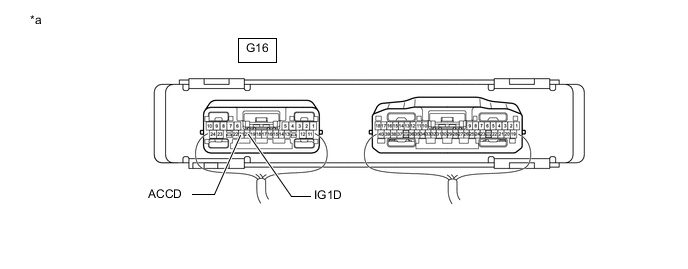
*a Component with harness connected
(Certification ECU (Smart Key ECU Assembly))
- -
-
Connect the GTS to the DLC3.
-
Turn the engine switch on (IG).
-
Turn the GTS on.
-
Enter the following menus: Body Electrical / Power Source Control / Data List.
-
According to the display on the GTS, read the Data List.
Body Electrical > Power Source Control > Data ListTester Display Measurement Item Range Normal Condition Diagnostic Note Power Supply Condition Power supply state ST ON, ALL OFF, IG ON or ACC ON ALL OFF: Engine switch off (ACC and IG)
ACC ON: Engine switch on (ACC)
IG ON: Engine switch on (IG) (IG1 relay on)
ST ON: Sending engine start request signal
- -
Measure the voltage according to the value(s) in the table below.
Standard Voltage Tester Connection Switch Condition Specified Condition G16-20 (IG1D) - Body ground Engine switch off Below 1 V Engine switch on (ACC) Below 1 V Engine switch on (IG) 9 V or higher G16-21 (ACCD) - Body ground Engine switch off Below 1 V Engine switch on (ACC) 8.5 V or higher Engine switch on (IG) 8.5 V or higher Tech Tips
Using the GTS, measure the voltage while confirming the power source mode on the Data List.
Result Proceed to OK NG
NG
REPLACE CERTIFICATION ECU (SMART KEY ECU ASSEMBLY)
OK
-
-
INSPECT IG1 NO.1 RELAY
Result Proceed to OK NG
-
Remove the IG1 NO. 1 relay.
-
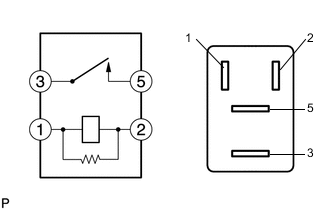
Measure the resistance according to the value(s) in the table below.
Standard Resistance Tester Connection Condition Specified Condition 3 - 5 Battery voltage not applied to terminals 1 and 2 10 kΩ or higher Battery voltage applied to terminals 1 and 2 Below 1 Ω Result Proceed to OK NG
NG
REPLACE IG1 NO.1 RELAY
OK
-
-
CHECK HARNESS AND CONNECTOR (CERTIFICATION ECU (SMART KEY ECU ASSEMBLY) - IG1 NO.1 RELAY)
Result Proceed to OK NG
-
Disconnect the G16 certification ECU (smart key ECU assembly) connector.
-
Remove the IG1 NO. 1 relay.
-
Measure the resistance according to the value(s) in the table below.
Standard Resistance Tester Connection Condition Specified Condition G16-20 (IG1D) - IG1 NO. 1 relay terminal 1 Always Below 1 Ω IG1 NO. 1 relay terminal 2 - Body ground Always Below 1 Ω G16-20 (IG1D) or IG1 NO. 1 relay terminal 1 - Body ground Always 10 kΩ or higher Result Proceed to OK NG
NG
REPAIR OR REPLACE HARNESS OR CONNECTOR
OK
-
-
INSPECT IG2 RELAY
Result Proceed to OK NG
-
Remove the IG2 relay.
-
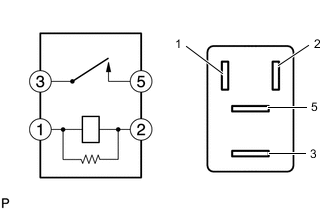
Measure the resistance according to the value(s) in the table below.
Standard Resistance Tester Connection Condition Specified Condition 3 - 5 Battery voltage not applied to terminals 1 and 2 10 kΩ or higher Battery voltage applied to terminals 1 and 2 Below 1 Ω Result Proceed to OK NG
NG
REPLACE IG2 RELAY
OK
-
-
CHECK HARNESS AND CONNECTOR (CERTIFICATION ECU (SMART KEY ECU ASSEMBLY) - IG2 RELAY)
Result Proceed to OK NG
-
Disconnect the G16 certification ECU (smart key ECU assembly) connector.
-
Remove the IG2 relay.
-
Measure the resistance according to the value(s) in the table below.
Standard Resistance Tester Connection Condition Specified Condition G16-20 (IG1D) - IG2 relay terminal 1 Always Below 1 Ω IG2 relay terminal 2 - Body ground Always Below 1 Ω G16-20 (IG1D) or IG2 relay terminal 1 - Body ground Always 10 kΩ or higher Result Proceed to OK NG
NG
REPAIR OR REPLACE HARNESS OR CONNECTOR
OK
-
-
INSPECT INSTRUMENT PANEL JUNCTION BLOCK ASSEMBLY (ACC RELAY)
Result Proceed to OK NG
-
Remove the instrument panel junction block assembly.
for LHD: Click here
for RHD: Click here
-
Remove the body ECU from the instrument panel junction block assembly.
for LHD: Click here
for RHD: Click here
-
Measure the resistance according to the value(s) in the table below.
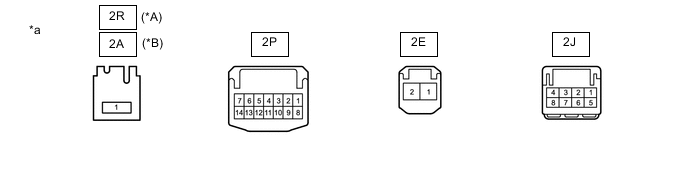
*A for LHD *B for RHD *a Component without harness connected (Instrument Panel Junction Block Assembly) - - Standard Resistance for LHD: Tester Connection Condition Specified Condition 2R-1 - 2P-5 Battery voltage not applied to terminals 2E-2 and 2J-5 10 kΩ or higher Battery voltage applied to terminals 2E-2 and 2J-5 Below 1 Ω for RHD: Tester Connection Condition Specified Condition 2A-1 - 2P-5 Battery voltage not applied to terminals 2E-2 and 2J-5 10 kΩ or higher Battery voltage applied to terminals 2E-2 and 2J-5 Below 1 Ω Result Proceed to OK NG
NG
REPLACE ACC RELAY
OK
-
-
CHECK HARNESS AND CONNECTOR (CERTIFICATION ECU (SMART KEY ECU ASSEMBLY) - ACC RELAY)
Result Proceed to OK NG
-
Disconnect the G16 certification ECU (smart key ECU assembly) connector.
-
Disconnect the 2E and 2J instrument panel junction block assembly connectors.
-
Measure the resistance according to the value(s) in the table below.
Standard Resistance Tester Connection Condition Specified Condition G16-21 (ACCD) - 2E-2 Always Below 1 Ω 2J-5 - Body ground Always Below 1 Ω G16-21 (ACCD) or 2E-2 - Body ground Always 10 kΩ or higher Result Proceed to OK NG
NG
REPAIR OR REPLACE HARNESS OR CONNECTOR
OK
-
-
CHECK HARNESS AND CONNECTOR (CERTIFICATION ECU (SMART KEY ECU ASSEMBLY) - BATTERY AND BODY GROUND)
-
Disconnect the certification ECU (smart key ECU assembly) connectors.
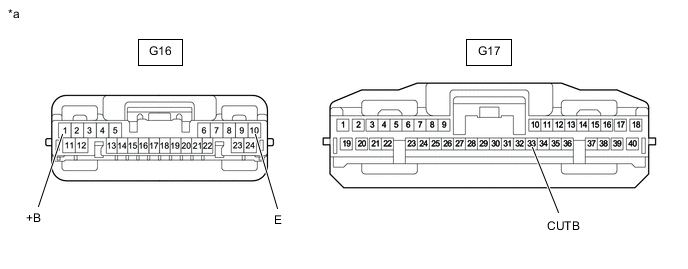
*a Front view of wire harness connector
(to Certification ECU (Smart Key ECU Assembly))
- - -
Measure the resistance according to the value(s) in the table below.
Standard Resistance Tester Connection Condition Specified Condition G16-10 (E) - Body ground Always Below 1 Ω -
Measure the voltage according to the value(s) in the table below.
Standard Voltage Tester Connection Condition Specified Condition G17-33 (CUTB) - Body ground Always 11 to 14 V G16-1 (+B) - Body ground Always 11 to 14 V Result Proceed to OK NG
NG
REPAIR OR REPLACE HARNESS OR CONNECTOR
OK
-
-
CHECK ENTRY DOOR LOCK OPERATION
-
Connect the certification ECU (smart key ECU assembly) connectors.
-
Check the entry lock/unlock operation.
OK Entry lock/unlock operate normally. Result Proceed to OK NG
OK
END (CONNECTOR WAS NOT CONNECTED PROPERLY)
NG
-
-
REPLACE CERTIFICATION ECU (SMART KEY ECU ASSEMBLY)
-
Replace the certification ECU (smart key ECU assembly) with a new one.
Tech Tips
Refer to the Service Bulletin.
Result Proceed to NEXT
NEXT
-
-
CHECK WIRELESS DOOR LOCK CONTROL SYSTEM
-
Check that the wireless door lock functions operate normally.
OK Wireless door lock functions operate normally. Result Proceed to OK NG
OK
END (CERTIFICATION ECU (SMART KEY ECU ASSEMBLY) WAS DEFECTIVE)
NG
REPLACE BODY ECU for LHD: Click here for RHD: Click here
-
-
CHECK WAVE ENVIRONMENT
-
Bring the electrical key transmitter sub-assembly that was checked first near the door control receiver and select the failed channel (the channel in which the buzzer did not sound) to recheck the key diagnostic mode.
Tech Tips
-
When the electrical key transmitter sub-assembly is brought near the door control receiver, the possibility of wave interference decreases, and it can be determined if wave interference is causing the problem symptom.
-
If the inspection result is that the problem only occurs in certain locations or at certain times of day, the possibility of wave interference is high. Also, added vehicle components may cause wave interference. If installed, remove them and perform the operation check.
-
There may be wave interference if the vehicle is near broadcasting antennas, large video displays, wireless garage door opener systems, wireless security cameras, home security systems, etc. In this case, move the vehicle to a different location and check if there is any improvement.
-
If a tool for checking electric waves, such as a signal strength meter, is available, move around the area while observing both the LF band (used by the vehicle antenna to form the detection area) and RF band (used by the electrical key transmitter sub-assembly for transmission) to check for locations where there is wave interference.
OK Wireless and entry functions operate normally. Result Proceed to OK NG -
NG
AFFECTED BY WAVE INTERFERENCE
OK
-
-
CHECK ELECTRICAL KEY TRANSMITTER SUB-ASSEMBLY
-
Check if there are any other registered electrical key transmitter sub-assemblies.
Result Result Proceed to There are no other registered electrical key transmitter sub-assemblies A There is another registered electrical key transmitter sub-assembly B
B
GO TO STEP 32 Click here
A
-
-
ELECTRICAL KEY TRANSMITTER SUB-ASSEMBLY REGISTRATION (NEW ELECTRICAL KEY TRANSMITTER SUB-ASSEMBLY)
-
Register a new electrical key transmitter sub-assembly.
Tech Tips
Refer to the Service Bulletin.
Result Proceed to NEXT
NEXT
-
-
CHECK KEY DIAGNOSTIC MODE
-
Bring another registered electrical key transmitter sub-assembly near the door control receiver and select the failed channel (the channel in which the buzzer did not sound) to recheck the key diagnostic mode.
Tech Tips
-
When the electrical key transmitter sub-assembly is brought near the door control receiver, the possibility of wave interference decreases, and it can be determined if wave interference is causing the problem symptom.
-
If the inspection result is that the problem only occurs in certain locations or at certain times of day, the possibility of wave interference is high. Also, added vehicle components may cause wave interference. If installed, remove them and perform the operation check.
-
There may be wave interference if the vehicle is near broadcasting antennas, large video displays, wireless garage door opener systems, wireless security cameras, home security systems, etc. In this case, move the vehicle to a different location and check if there is any improvement.
-
If a tool for checking electric waves, such as a signal strength meter, is available, move around the area while observing both the LF band (used by the vehicle antenna to form the detection area) and RF band (used by the electrical key transmitter sub-assembly for transmission) to check for locations where there is wave interference.
OK Wireless door lock buzzer sounds. Result Proceed to OK NG -
OK
END (ELECTRICAL KEY TRANSMITTER SUB-ASSEMBLY WAS DEFECTIVE)
NG
-
-
CHECK HARNESS AND CONNECTOR (CERTIFICATION ECU (SMART KEY ECU ASSEMBLY) - DOOR CONTROL RECEIVER)
-
Disconnect the G17 certification ECU (smart key ECU assembly) connector.
-
Disconnect the G25 door control receiver connector.
-
Measure the resistance according to the value(s) in the table below.
Standard Resistance Tester Connection Condition Specified Condition G17-21 (CSEL) - G25-2 (CSEL) Always Below 1 Ω G17-21 (CSEL) or G25-2 (CSEL) - Body ground Always 10 kΩ or higher Result Proceed to OK NG
NG
REPAIR OR REPLACE HARNESS OR CONNECTOR
OK
-
-
CHECK ENTRY DOOR LOCK OPERATION
-
Connect the G17 certification ECU (smart key ECU assembly) connector.
-
Connect the G25 door control receiver connector.
-
Check the entry lock/unlock operation.
Result Result Proceed to Entry lock/unlock does not operate A Entry lock/unlock operate normally B
B
END (CONNECTOR WAS NOT CONNECTED PROPERLY)
A
-
-
CHECK CERTIFICATION ECU (SMART KEY ECU ASSEMBLY)
-
Using an oscilloscope, check the waveform.
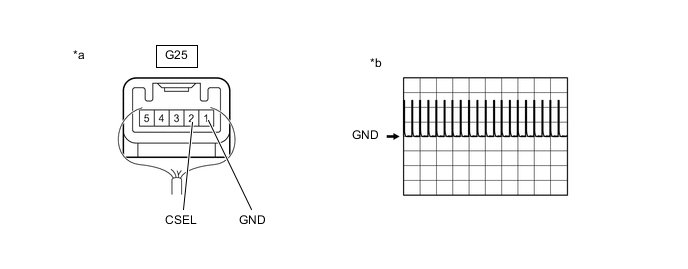
*a Component with harness connected
(Door Control Receiver)
*b Waveform 1 OK Tester Connection Condition Tool Setting Specified Condition G25-2 (CSEL) - G25-1 (GND) Procedure:
-
Engine switch off
-
All doors closed
2 V/DIV., 500 ms./DIV. Pulse generation
(See waveform 1)
Result Proceed to OK NG -
NG
REPLACE CERTIFICATION ECU (SMART KEY ECU ASSEMBLY)
OK
-
-
CHECK DOOR CONTROL RECEIVER
-
Using an oscilloscope, check the waveform.
Tech Tips
Inspection should be performed while the electrical key antenna check in key diagnostic mode is being performed on the failed channel (the channel in which the buzzer did not sound).
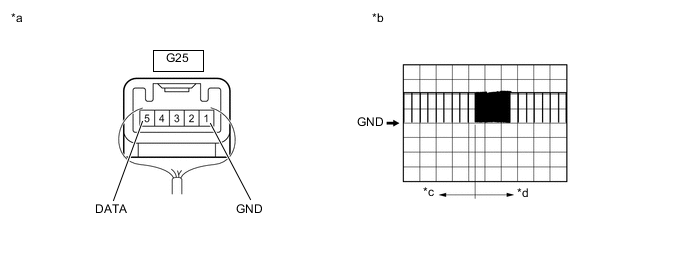
*a Component with harness connected
(Door Control Receiver)
*b Waveform 1 *c Before lock or unlock button of electrical key transmitter sub-assembly pressed *d After lock or unlock button of electrical key transmitter sub-assembly pressed OK Tester Connection Condition Tool Setting Specified Condition G25-5 (DATA) - G25-1 (GND) Procedure:
-
Engine switch off
-
All doors locked
-
Lock or unlock button of electrical key transmitter sub-assembly not pressed → pressed
5 V/DIV., 500 ms./DIV. Pulse generation
(See waveform 1)
Result Proceed to OK NG -
NG
REPLACE DOOR CONTROL RECEIVER Click here
OK
-
-
REPLACE CERTIFICATION ECU (SMART KEY ECU ASSEMBLY)
-
Replace the certification ECU (smart key ECU assembly) with a new one.
Tech Tips
Refer to Service Bulletin.
Result Proceed to NEXT
NEXT
-
-
CHECK WIRELESS DOOR LOCK CONTROL SYSTEM
-
Check that the wireless door lock functions operate normally.
OK Wireless door lock functions operate normally. Result Proceed to OK NG
OK
END (CERTIFICATION ECU (SMART KEY ECU ASSEMBLY) WAS DEFECTIVE)
NG
REPLACE BODY ECU for LHD: Click here for RHD: Click here
-