POWER STEERING SYSTEM ON-VEHICLE INSPECTION

PROCEDURE
-
INSPECT DRIVE BELT
-
BLEED AIR FROM POWER STEERING SYSTEM
Note
Do not allow foreign matter in the oil reservoir sub-assembly.
-
Check the fluid level.
-
Jack up the front of the vehicle and support it with stands.
-
Turn the steering wheel.
-
With the engine stopped, turn the steering wheel slowly from lock to lock several times.
-
-
Lower the vehicle.
-
Start the engine. Run the engine at idle for a few minutes.
-
Turn the steering wheel.
-
With the engine idling, turn the steering wheel to the left or right full lock position and hold it there for 2 to 3 seconds. Then turn the steering wheel to the opposite full lock position and hold it there for 2 to 3 seconds.
-
Repeat the step above several times.
-
-
Stop the engine.
-
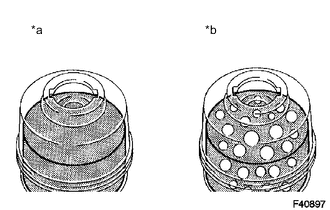
*a Correct *b Incorrect Check for foaming or emulsification. If the system has to be bled twice because of foaming or emulsification, check for fluid leaks in the system.
-
Check the fluid level.
-
-
CHECK FLUID LEVEL
Note
Do not allow foreign matter in the oil reservoir sub-assembly.
-
Keep the vehicle level.
-
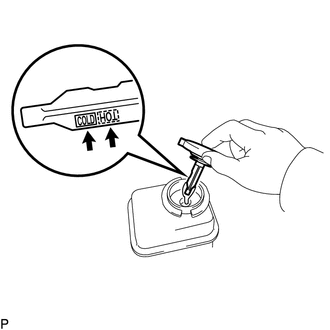
With the engine stopped, check the power steering fluid level in the oil reservoir. If necessary, add power steering fluid.
Power steering fluid Automatic transmission Fluid DEXRON II or III or equivalent Tech Tips
If the fluid is hot, check that the fluid level is within the HOT range on the oil reservoir. If the fluid is cold, check that the fluid level is within the COLD range.
-
Start the engine and run it at idle.
-
Turn the steering wheel to the left or right full lock position, and then turn the steering wheel to the opposite full lock position. Repeat this several times to raise the fluid temperature.
Standard fluid temperature 40 to 80°C (104 to 176°F) -
*a Correct *b Incorrect Check for foaming or emulsification. If foaming or emulsification is identified, bleed air from the power steering system.
-
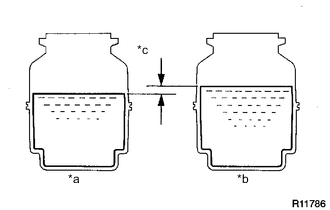
*a Engine idling *b Engine stopped *c 5 mm or less With the engine idling, measure the fluid level in the oil reservoir.
-
Stop the engine.
-
Wait a few minutes and remeasure the fluid level in the oil reservoir.
Maximum fluid level increase 5 mm (0.197 in.) If a problem is found, bleed air from the power steering system.
-
Check the fluid level.
-
-
CHECK STEERING FLUID PRESSURE
-
Disconnect the pressure feed tube.
-
Connect SST as shown in the illustration below.
- SST
- 09640-10011 ( 09641-01010, 09641-01030, 09641-01040 )
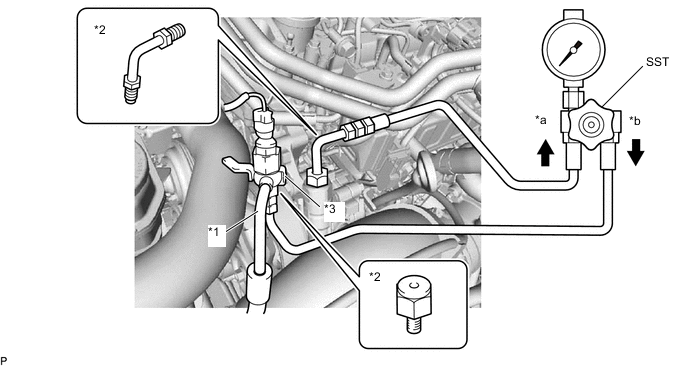
*1 Pressure Feed Tube *2 Attachment *3 Gasket - - *a In *b Out Note
Check that the valve of SST is in the open position.
-
Bleed air from the power steering system.
Note
Check the level of power steering fluid and refill as necessary.
-
Start the engine and run it at idle.
-
Turn the steering wheel to the left or right full lock position. Then turn the steering wheel to the opposite full lock position. Repeat this several times to raise the fluid temperature.
Standard fluid temperature 40 to 80°C (104 to 176°F) -
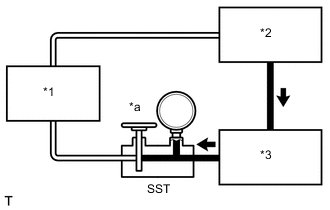
*1 Power Steering Link *2 Oil Reservoir *3 Vane Pump Assembly *a Closed With the engine idling, close the valve of SST and observe the reading on SST.
Maximum fluid pressure 9300 to 10000 kPa (94.9 to 101 kgf/cm2, 1349 to 1450 psi) Note
-
Do not keep the valve closed for more than 10 seconds.
-
Do not let the fluid temperature become too high.
If the pressure is above the maximum, check for fluid leaks and replace parts as necessary.
-
-
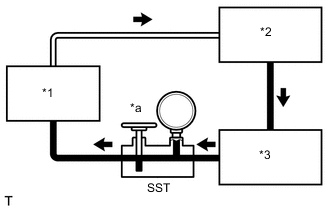
*1 Power Steering Link *2 Oil Reservoir *3 Vane Pump Assembly *a Open With the engine idling, fully open the valve.
-
Measure the fluid pressure at engine speeds of 1000 rpm and 3000 rpm.
Standard fluid pressure difference 490 kPa (4.99 kgf/cm2, 71 psi) or less Note
Do not turn the steering wheel.
If the pressure difference is not within the specified range, check for fluid leaks and replace parts as necessary.
-
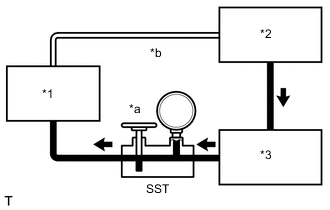
*1 Power Steering Link *2 Oil Reservoir *3 Vane Pump Assembly *a Open *b Steering wheel to the full lock position With the engine idling and the valve fully opened, turn the steering wheel to the full lock position.
Maximum fluid pressure 9300 to 10000 kPa (94.9 to 101 kgf/cm2, 1349 to 1450 psi) Note
-
Do not keep the steering wheel in the lock position for more than 10 seconds.
-
Do not let the fluid temperature become too high.
If the pressure is above the maximum, check for fluid leaks and replace parts as necessary.
-
-
Disconnect SST.
-
Connect the pressure feed tube.
-
Bleed air from the power steering system.
Note
Check the level of power steering fluid and refill as necessary.
-
-
CHECK STEERING RESISTANCE
-
Center the steering wheel.
-
Remove the steering pad.
-
Start the engine and run it at idle.
-
Measure the steering resistance in both directions.
Standard steering resistance (Reference) 6.0 N*m (61 kgf*cm, 53 in.*lbf) Tech Tips
The tire type, tire pressure and type of surface beneath the vehicle should be taken into consideration before making your diagnosis.
-
Install the steering pad.
-