AUDIO AND VISUAL SYSTEM(except 8 Speakers) OPERATION CHECK
-
REMOTE TOUCH SELF CHECK
Note
-
Before entering self-diagnostic mode, make sure there are no obstacles which may interfere with operation of the remote touch screen, and that the touch screen is not dirty.
-
Do not touch the touch screen except when required.
-
Since the remote touch screen may recognize a pinch in/out or flick operation if operated with 2 fingers, always use 1 finger to operate the remote touch in self-diagnostic mode.
Tech Tips
The following checks can be done via the self check:
-
DTC check for the remote touch
-
Switch illumination check
-
Touch screen operation position recognition condition check
-
Switch operation check
-
Vibration feedback generation condition check
-
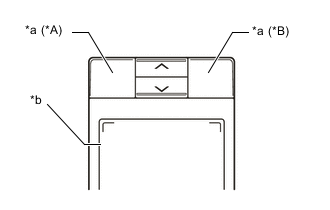
*A for RHD *B for LHD *a "HOME" Switch *b Touch Screen Press Operation Activate Self-check Mode
-
Set the light control switch to TAIL.
-
With the frame of the touch screen and "HOME" switch pressed, turn the engine switch on (ACC) and enter self-diagnostic mode.
Note
If the frame of the touch screen is not pressed to enter self-diagnostic mode, a self-diagnosis cannot be performed properly.
-
-
Switch Illumination Check and DTC Check
-
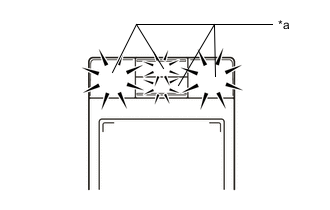
*a Switch Illumination Check that the switch illumination turns on.
Tech Tips
When DTCs are stored as present DTCs during the self check, the switch illumination blinks at 0.5-second intervals. The illumination will continue to blink until the self check is completed.
-
-
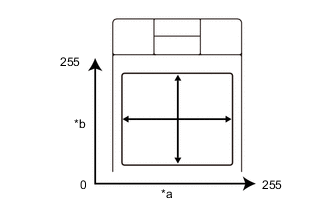
*a Lateral Axis *b Longitudinal Axis Touch screen operation position recognition condition check
-
Operate the touch screen laterally and longitudinally and check that the brightness of the switch illumination changes.
Tech Tips
-
If the brightness of the switch illumination changes according to the touch screen operation, the touch screen operation position is correctly recognized.
-
The brightness of the switch illumination changes between 0% and 100% according to the touch screen position coordinates.
-
The touch screen position coordinates change between 0 and 255 on the lateral axis and longitudinal axis.
-
When the touch screen operation position coordinates are Lateral Axis: 0 and Longitudinal Axis: 0, the brightness of the switch illumination is 0% (off). When the coordinates are Lateral Axis: 255 and Longitudinal Axis: 255, the brightness of the switch illumination is 100% (illuminated).
-
-
-
Switch Operation Check
-
Check that the switch illumination turns on at 100% when each switch is pressed with the touch screen operated at the lower left position.
Tech Tips
If the switch illumination turns on at 100% brightness when a switch is pressed, the switch being pressed is operating normally.
-
-
Vibration feedback generation condition check
-
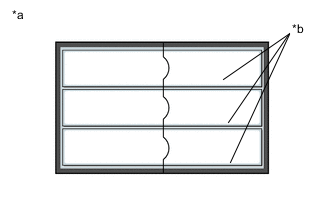
*a Default Feedback Force Image *b Button Operate the remote touch screen to move the pointer displayed on the multi-display assembly screen and check the remote that touch screen generates vibration feedback according to the display screen and pointer display position.
Tech Tips
-
If the remote touch generates vibration feedback according to the display screen and pointer display position, the remote touch is correctly receiving the reaction force setting signal sent by the radio receiver assembly.
-
If the remote touch cannot receive the reaction force setting signal sent by the radio receiver assembly, use the default feedback force image stored in the remote touch to generate vibration feedback on the touch screen.
-
-
-
End Self-diagnostic Mode
-
Wait 30 seconds without performing any operations or turn the engine switch off to end self diagnostic mode.
-
-
-
CHECK PANEL & STEERING SWITCH
Tech Tips
-
The radio receiver assembly panel switches and steering switches are checked in the following procedure.
-
Illustrations may differ from the actual vehicle screen depending on the device settings and options. Therefore, some detailed areas may not be shown exactly the same as on the actual vehicle screen.
-
Enter diagnostic mode.
-
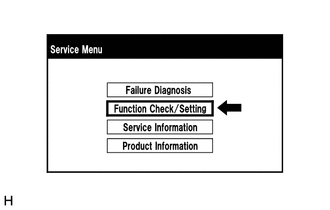
Select "Function Check/Setting" from the "Service Menu" screen.
-
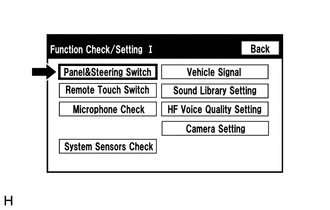
Select "Panel & Steering Switch" from the "Function Check/Setting I" screen.
-
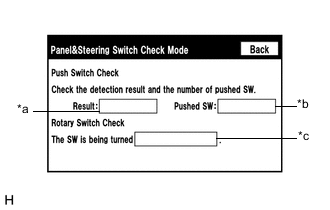
Panel & Steering Switch Check Mode
Screen Description Display Content *a: Switch condition "Pushed" is displayed when any switch is pushed. *b: Number of switches pushed
-
Number of switches pushed at once is displayed.
-
If more than 3 switches are pushed at once, "More than 3" is displayed.
*c: Rotary switch direction Direction of rotary switch is displayed.
-
Operate each switch and check that the switch conditions are correctly displayed.
Note
When the return switch on the remote operation board is pressed and held for 3 seconds or more, diagnostic mode will be canceled.
-
-
-
CHECK HARD DISK DRIVE (w/ Sound Library Function)
Tech Tips
-
Check the hard disk drive (HDD) built into the radio receiver assembly.
-
Illustrations may differ from the actual vehicle screen depending on the device settings and options. Therefore, some detailed areas may not be shown exactly the same as on the actual vehicle screen.
-
Enter diagnostic mode.
-
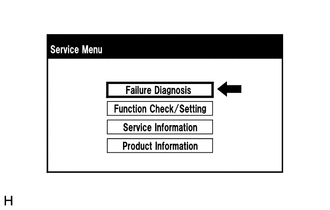
Select "Failure Diagnosis" from the "Service Menu" screen.
-
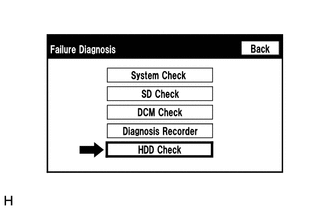
Select "HDD Check" from the "Failure Diagnosis" screen.
-
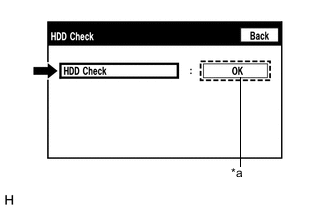
*a Result HDD Check
-
Select "HDD Check" to start the HDD check.
-
Check the result displayed when the HDD check is complete.
Screen Description Display (Result) Description Checking Check is in progress OK Hard disk drive is normal NG Hard disk drive is malfunctioning Tech Tips
-
After selecting "HDD Check", it may take a while until the result is displayed.
-
If the cabin temperature is -20°C (-4°F) or lower, or 65°C (149°F) or higher, the HDD may not operate normally, and "NG" may be shown on the display. Make sure to perform the inspection with the cabin at an appropriate temperature.
-
If "NG" is displayed even when the cabin temperature is appropriate, replace the radio receiver assembly with a new one.
-
-
-
-
CHECK REMOTE TOUCH SWITCH
Tech Tips
-
The remote touch screen is checked in the following procedure.
-
Illustrations may differ from the actual vehicle screen depending on the device settings and options. Therefore, some detailed areas may not be shown exactly the same as on the actual vehicle screen.
-
Enter diagnostic mode.
-
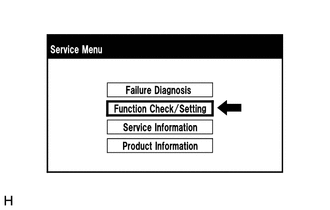
Select "Function Check/Setting" from the "Service Menu" screen.
-
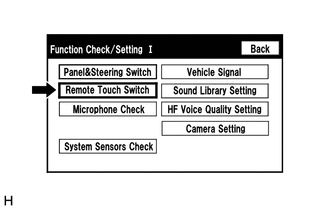
Select "Remote Touch Switch" from the "Function Check/Setting I" screen.
-
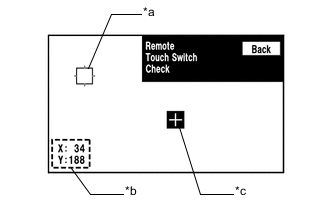
Remote Touch Switch Check
Screen Description Display Content *a: Pointer Displays the location of the pointer. *b: Coordinate
-
Displays the coordinates of the pointer
-
"X" and "Y" indicate the lateral and longitudinal axes
-
Coordinates are displayed by numbers between 5 and 250 for each axis starting from the lower left of the screen
*c: "+" mark Displayed at the location where the pointer was located when the remote touch screen was pressed or double tapped.
-
While "Remote Touch Switch Check" is displayed, move the pointer to any blank area of the screen, and then press or double tap the touch screen.
Tech Tips
-
The "+" mark is displayed at the pointer position when the touch screen is pressed or double tapped.
-
Even if the pointer is moved, the "+" mark will remain at the position where the pointer was when the touch screen was pressed or double tapped.
-
-
Operate the remote touch screen switch to move the pointer. When the location of the pointer is changed by operating the touch screen, check that the coordinate values "X" and "Y" change between 5 and 250.
-
-
-
CHECK MICROPHONE
Tech Tips
-
The microphone and microphone input level are checked in the following procedure.
-
Illustrations may differ from the actual vehicle screen depending on the device settings and options. Therefore, some detailed areas may not be shown exactly the same as on the actual vehicle screen.
-
Enter diagnostic mode.
-
Select "Function Check/Setting" from the "Service Menu" screen.
-
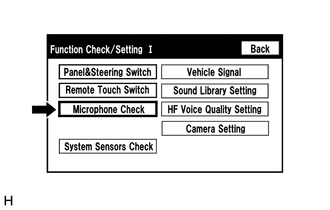
Select "Microphone Check" from the "Function Check/Setting I" screen.
-
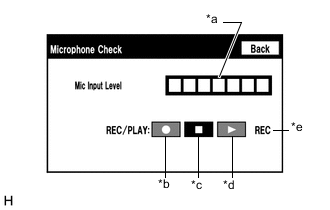
Microphone Check
Screen Description Display Content *a: Microphone input level meter Monitors the microphone input level every 0.1 seconds and displays the results in 8 different levels. *b: Recording switch Starts recording. *c: Stop switch Stops recording and playing. *d: Play switch Plays the recorded voice. *e: Recording indicator Comes on while recording.
-
When speaking into the microphone, check that the microphone input level meter changes according to the input level.
Tech Tips
The microphone is active at all times when this screen is displayed.
-
Push the recording switch and perform voice recording.
Tech Tips
-
Select the recording switch with the blower motor of the air conditioning system stopped. If an outlet of the air conditioning system is facing the microphone, noise may be recorded.
-
While recording or playing, switches other than the stop switch cannot be pushed.
-
When no recording is present, the play switch cannot be pushed.
-
Recording will stop after 5 seconds or when the stop switch is pushed.
-
-
Check that the recording indicator remains on while recording and that the recording can be played normally.
-
-
-
CHECK GPS & VEHICLE SENSORS
Tech Tips
-
GPS information, vehicle signals and sensor signals are checked in the following procedure.
-
Illustrations may differ from the actual vehicle screen depending on the device settings and options. Therefore, some detailed areas may not be shown exactly the same as on the actual vehicle screen.
-
Enter diagnostic mode.
-
Select "Function Check/Setting" from the "Service Menu" screen.
-
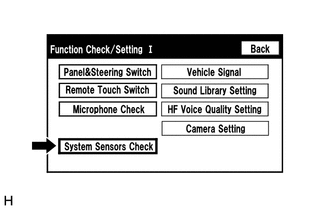
Select "System Sensors Check" from the "Function Check/Setting I" screen.
-
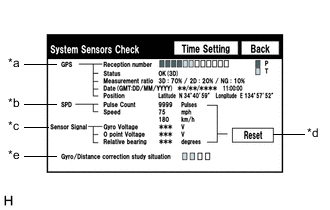
System Sensors Check
*a: GPS Display Content Reception number Displays reception condition of the satellites used to determine vehicle position Blue: P (In use) System is using GPS signal for location. Yellow: T (Receiving) System is tracking GPS signal for location. No color: Not in use System cannot receive GPS signal. (Searching for GPS signal) Status Displays reception status of the satellites used to determine vehicle position OK (H3D) High accuracy 3-dimensional location method is being used. OK (H2D) High accuracy 2-dimensional location method is being used. OK (3D) 3-dimensional location method is being used. OK (2D) 2-dimensional location method is being used. NG Location data cannot be used. error Reception error has occurred. - Any other state. Measurement ratio Displays the ratio of satellites performing measurements 3D The ratio of satellites performing 3D positioning, Hyper 3D positioning and Hyper 2D positioning is displayed. 2D The ratio of satellites performing 2D positioning is displayed. NG The ratio of satellites not performing measurement is displayed. Date Date/time information obtained from GPS signals is displayed in Greenwich Mean Time (GMT). Position Latitude and longitude information on current position is displayed. *b: SPD Display Content Pulse Count Displays the accumulated number of input pulses beginning when this screen is displayed Speed Displays vehicle speed *c: Sensor Signal Display Content Note Gyro Voltage Displays the output voltage of the gyro sensor - 0 point Voltage Displays the zero-point voltage of the gyro sensor - Relative bearing Displays the output angle of the gyro sensor The amount of change in bearing angle (degrees) after the system sensor check screen is displayed (clockwise: "+", counterclockwise: "-"). *d: Reset Display Content Reset When this switch is pressed and held for 3 seconds or more, the values for display items of SPD signal and gyro sensor signal are reset and "0" is displayed. *e: Gyro/Distance Correction Study Situation Display Content Gyro/Distance correction study situation Displays learning status of Gyro/Distance correction
-
When the "System Sensors Check" screen is displayed, check all the sensor signals.
Tech Tips
This screen is updated once per second.
-
-
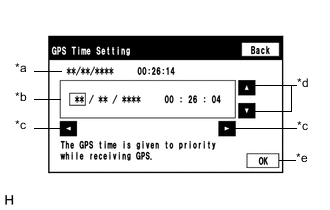
GPS Time Setting
Screen Description Display Content *a: Time display Displays the date and time in the device. *b: Time setting screen Setting is possible only when GPS signals are not being received. *c: Cursor movement switch Moves the cursor on the date and time setting screen to the right and left. *d: Adjustment switch Adjusts values of items selected by the cursor. *e: OK switch Selecting this switch after setting the date and time updates the date and time in the device (only when GPS signals are not received).
-
When GPS signals are not being received, the date and time in the device can be adjusted.
Tech Tips
Time setting is possible only when GPS signals are not being received. When the navigation system is receiving GPS signals, priority is given to displaying the date and time received via GPS.
-
-
-
CHECK VEHICLE SIGNAL
Tech Tips
-
Vehicle signals received by the radio receiver assembly are checked in the following procedure.
-
Illustrations may differ from the actual vehicle screen depending on the device settings and options. Therefore, some detailed areas may not be shown exactly the same as on the actual vehicle screen.
-
Enter diagnostic mode.
-
Select "Function Check/Setting" from the "Service Menu" screen.
-
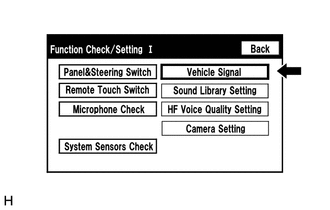
Select "Vehicle Signal" from the "Function Check/Setting I" screen.
-
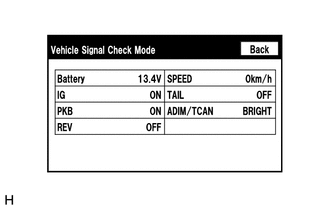
Vehicle Signal Check Mode
Screen Description Display Content Battery Battery voltage is displayed. IG Engine switch ON/OFF state is displayed. PKB Parking brake ON/OFF state is displayed. REV Reverse signal ON/OFF state is displayed. SPEED Vehicle speed is displayed in km/h. TAIL Tail signal (light control switch) ON/OFF state is displayed. ADIM/TCAN Brightness state DIM (with)/BRIGHT (without) is displayed. Tech Tips
-
Only items sending vehicle signals will be displayed.
-
This screen displays vehicle signals received by the radio receiver assembly.
-
This screen is updated once per second.
-
When the "Vehicle Signal Check Mode" screen is displayed, check all the vehicle signal conditions.
-
-
-
CHECK SOUND LIBRARY SETTING (w/ Sound Library Function)
Tech Tips
-
It is possible to check the sound library information and turn the sound library function on and off.
-
Illustrations may differ from the actual vehicle screen depending on the device settings and options. Therefore, some detailed areas may not be shown exactly the same as on the actual vehicle screen.
-
Enter diagnostic mode.
-
Select "Function Check/Setting" from the "Service Menu" screen.
-
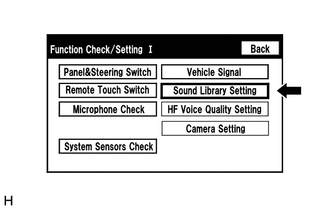
Select "Sound Library Setting" from the "Function Check/Setting I" screen.
-
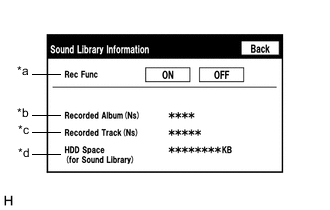
Sound Library Information
Screen Description Display Content *a: Recording function setting for HDD Recording to HDD permitted (ON)/not permitted (OFF) *b: Number of albums Number of albums recorded on HDD *c: Number of tracks Number of tracks recorded on HDD *d: Free space in HDD Free space on HDD partition for sound library
-
-
CHECK HANDS-FREE VOICE QUALITY AND VOLUME SETTING
Note
-
Adjustment of the settings is required for each registered cellular phone.
-
If no cellular phone has been registered, all switches cannot be selected.
Tech Tips
-
The hands-free voice of a "Bluetooth" compatible phone can be adjusted using the following procedure.
-
Illustrations may differ from the actual vehicle screen depending on the device settings and options. Therefore, some detailed areas may not be shown exactly the same as on the actual vehicle screen.
-
Enter diagnostic mode.
-
Select "Function Check/Setting" from the "Service Menu" screen.
-
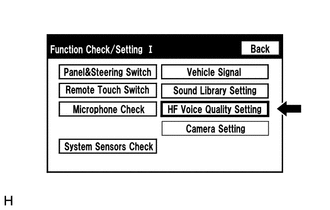
Select "HF Voice Quality Setting" from the "Function Check/Setting I" screen.
-
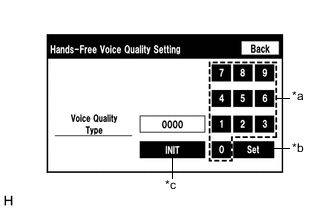
*a Numeric Keypad *b Setting Button *c Reset Button Hands-Free Voice Quality Setting
-
If necessary, refer to the table below to adjust the voice quality type with the numeric keypad.
-
When adjusting the settings, use the numeric keypad on the screen to input the voice quality type according to the table.
Settings Parameter Target Phenomenon Voice Quality Type Positive Effect of Changing Voice Quality Negative Effect of Changing Voice Quality A
(Noise)
The other party hears background noise when listening to your voice. 1000 The amount of background noise the other party hears when listening to your voice is reduced. The volume of voice the other party hears when listening to your voice may temporarily drop. B
(Noise)
The other party hears a lot of background noise when listening to your voice. 2000 The amount of background noise the other party hears when listening to your voice is sharply reduced. The volume of voice the other party hears when listening to your voice may temporarily drop. C
(Echo)
The other party hears weak echoes. 0100 The amount of echo is reduced (low level). Sound quality of the other party deteriorates (low level). D
(Echo)
The other party hears strong echoes. 0200 The amount of echo is reduced (high level). Sound quality of the other party deteriorates (high level). Settings (When Multiple Phenomena Occurred) Parameter Target Phenomenon Voice Quality Type Positive Effect of Changing Voice Quality Negative Effect of Changing Voice Quality A+C The other party hears background noise and weak echoes when listening to your voice. 1100
-
The amount of background noise the other party hears when listening to your voice is reduced.
-
The amount of echo is reduced (low level).
-
The volume of voice may drop temporarily.
-
Sound quality of the other party deteriorates (low level).
A+D The other party hears background noise and strong echoes when listening to your voice. 1200
-
The amount of background noise the other party hears when listening to your voice is reduced.
-
The amount of echo is reduced (high level).
-
The volume of voice may drop temporarily.
-
Sound quality of the other party deteriorates (high level).
B+C The other party hears a lot of background noise and weak echoes when listening to your voice. 2100
-
The amount of background noise the other party hears when listening to your voice is sharply reduced.
-
The amount of echo is reduced (low level).
-
The volume of voice may drop temporarily.
-
Sound quality of the other party deteriorates (low level).
B+D The other party hears a lot of background noise and strong echoes when listening to your voice. 2200
-
The amount of background noise the other party hears when listening to your voice is sharply reduced.
-
The amount of echo is reduced (high level).
-
The volume of voice may drop temporarily.
-
Sound quality of the other party deteriorates (high level).
Tech Tips
-
The default value is "0000".
-
Settings will be applied when the setting button is selected.
-
If voice quality type values that are not in the table are input, the setting will not be applied and a positive effect may not be gained.
-
If the quality of phone calls decreases due to the changed settings, return the settings to "0000" by pressing the "INIT" switch.
-
-
-
-
CHECK DAB RECEPTION (w/ DAB Function)
Tech Tips
-
The reception condition of Digital Audio Broadcast (DAB) can be checked.
-
Illustrations may differ from the actual vehicle screen depending on the device settings and options. Therefore, some detailed areas may not be shown exactly the same as on the actual vehicle screen.
-
Enter diagnostic mode.
-
Select "Function Check/Setting" from the "Service Menu" screen.
-
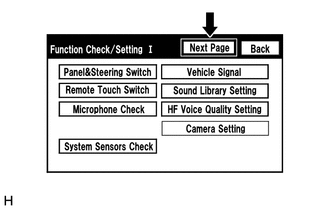
Select "Next Page" from the "Function Check/Setting I" screen.
-
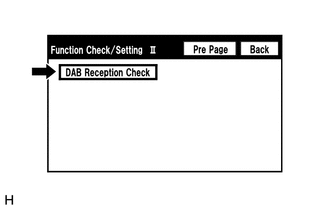
Select "DAB Reception Check" from the "Function Check/Setting II" screen.
-
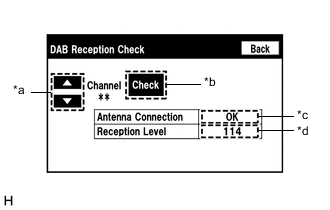
DAB Reception Check
Screen Description Display Content *a: Up or down switch Enables the channel to be changed to the one to be checked. *b: Check/STOP switch
-
Check: Starts checking
-
STOP: Stops checking
*c: Antenna connection check
-
OK: Connected properly
-
NG: Not connected properly
-
-: Not equipped with DAB antenna.
Displays DAB antenna reception levels as follows:
*d: DAB tuner reception level check result description
-
111 or more: Font color is black (good reception).
-
110 or less: Font color is red (poor reception).
-
-: Not equipped with DAB antenna.
Displays DAB antenna reception levels as follows:
-
Select the "Check" button to start the DAB reception check.
-
Check that the results are displayed when the DAB reception check is performed.
-
-
-
CLEAR PASSWORD OF EXPORT/IMPORT MEMORY POINT FUNCTION
Tech Tips
-
This function allows the initialization of a password which was set on the radio receiver assembly when exporting/importing memory points.
-
Illustrations may differ from the actual vehicle screen depending on the device settings and options. Therefore, some detailed areas may not be shown exactly the same as on the actual vehicle screen.
-
Enter diagnostic mode.
-
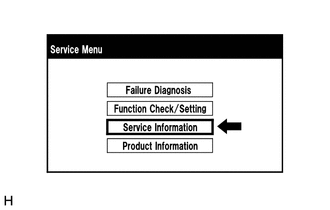
Select "Service Information" from the "Service Menu" screen.
-
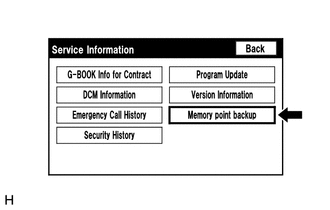
Select "Memory point backup" from the "Service Information" screen.
-
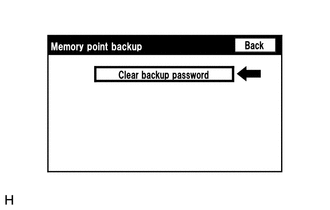
Clear backup password
Tech Tips
Depending on the manufacturer, some component names and versions will be displayed differently.
-
Select "Clear backup password" from the "Memory point backup" screen.
-
-
-
CHECK SPEAKER
Tech Tips
-
This function is used when checking the speaker wiring and whether the speakers are functioning properly.
-
Illustrations may differ from the actual vehicle screen depending on the device settings and options. Therefore, some detailed areas may not be shown exactly the same as on the actual vehicle screen.
-
Turn audio mode on and play any audio source.
Tech Tips
This audio source will be used for the speaker check.
-
Enter diagnostic mode.
-
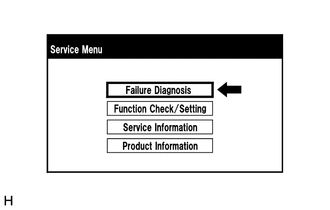
Select "Failure Diagnosis" from the "Service Menu" screen.
-
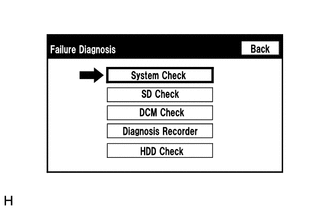
Select "System Check" from the "Failure Diagnosis" screen.
-
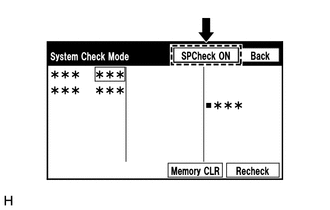
Select "SPCheck ON" from the "System Check Mode" screen.
-
Check the speaker wiring and check that the speakers are functioning properly.
Tech Tips
-
Check that each speaker outputs sound from the selected audio source properly.
-
"SPCheck OFF" is displayed during the speaker check.
-
Sound can be heard from the speakers around the vehicle in order beginning from a speaker on the front side.
-
More than one speaker may sound simultaneously depending on the speaker wiring.
-
-
Sound stops when any of the following conditions are met:
-
The "SPCheck OFF" switch is pressed.
-
The engine switch is turned off.
-
Diagnostic mode is turned off.
-
The screen is changed to another screen.
-
Audio mode is turned off.
-
-
-
CHECK SOFTWARE ERROR HISTORY
Tech Tips
This function is used to check the cause when the radio receiver assembly screen is blacked out.
-
Check Software Error History.
-
Connect the GTS to the DLC3.
-
Turn the engine switch on (IG).
-
Turn the GTS on.
-
Enter the following menus: Body Electrical / Navigation System / Utility / Software Error History.
Body Electrical > Navigation System > UtilityTester Display Software Error History -
When an item is stored for Software Error History, record it before repairing the radio receiver assembly.
Software Error History Screen Description Error Description Trigger Detail Software Reset Navi Microcomputer Hexadecimal Number Audio Microcomputer CAN Microcomputer No Video Signal Front Monitor Rear Monitor MOST Cold Restart Always Tech Tips
-
Software Error History can store up to 5 history data items. If a new software error occurs when 5 data items have already been stored, the oldest data is cleared and the new data is stored.
-
If an error that is unsupported by the GTS occurs, a "-" is displayed for the display items.
-
-
-
Clear Software Error History.
-
When DTCs are cleared using any of the following operations, Software Error History will be cleared as well.
-
Cleared using the GTS.
-
Cleared using the system check mode screen.
-
Cleared using the unit check mode screen.
-
-
-
-
CHECK OPTICAL DISC ERROR HISTORY
Tech Tips
This function is used to check the cause of an optical disc error.
-
Check Optical Disc Error History.
-
Connect the GTS to the DLC3.
-
Turn the engine switch on (IG).
-
Turn the GTS on.
-
Enter the following menus: Body Electrical / Navigation System / Utility / Optical Disc Error History.
Body Electrical > Navigation System > UtilityTester Display Optical Disc Error History -
When an item is stored for Optical Disc Error History, record it before proceeding with troubleshooting.
Optical Disc Error History Screen Description Display Content Error Type Displays the type of error. Device Displays the malfunctioning device. Date Displays the date and time that the malfunction occurred. "Error Type" Screen Description Error Type Detection Condition Action Read Error When a disc read error occurs. Proceed to next suspected area shown in Problem Symptoms Table.
Disc damaged/upside down/dirty When it is determined that any of the following is the cause of the disc read error:
-
The disc cannot be read.
-
The disc cannot be read because of dirt or scratches.
-
The disc cannot be read because it is inserted upside down.
Cannot determine disc type An unsuitable disc is inserted. DPS error When an error occurs while decoding MP3/WMA/AAC files. Some files are corrupt
-
When MP3/WMA/AAC files cannot be played back because they are unsupported.
-
Even though the file extensions are MP3, WMA or AAC, files cannot be played back because the header information cannot be read.
Some files cannot be found
-
When a disc without music data is played back.
-
When there are no playable MP3/WMA/AAC files.
Copy protection violation When a file with copyright protection that cannot be played back is played back. "Device" Screen Description Device Component DVD-P Radio receiver assembly*1 CD-P Radio receiver assembly*2 R-Seat DVD-P Not available
-
*1: w/ DVD Player
-
*2: w/ CD or VCD Player
Tech Tips
-
Optical Disc Error History can store up to 7 history data items. If a new optical disc error occurs when 7 data items have already been stored, the oldest data is cleared and the new data is stored.
-
If an error that is unsupported by the GTS occurs, a "-" or blank is displayed for the display items.
-
-
-
Clear Optical Disc Error History.
-
When DTCs are cleared using any of the following operations, Optical Disc Error History will be cleared as well.
-
Cleared using the GTS.
-
Cleared using the system check mode screen.
-
Cleared using the unit check mode screen.
-
-
-
-
Tech Tips
-
This function is used to detect disconnection of the video devices.
-
In order to inspect the RSE, a disc should be inserted into the radio receiver assembly.
CHECK VIDEO DEVICE CONNECTION CHECK
-
Check Video Device Connection Check.
-
Connect the GTS to the DLC3.
-
Turn the engine switch on (IG).
-
Turn the GTS on.
-
Enter the following menus: Body Electrical / Navigation System / Utility / Video Device Connection Check.
Body Electrical > Navigation System > UtilityTester Display Video Device Connection Check -
When an item is stored for Video Device Connection Check, record it before proceeding with troubleshooting.
Tech Tips
-
DTCs are stored when errors are detected.
-
Depending on the vehicle, some of the items are not displayed on the "Error Detected Image Line (Type)" screen.
Video Device Connection Check Screen Description Error Detected Image Line (Type) Areas to be Checked H/U - > Separate Display (GVIF) Digital video signal between the radio receiver assembly and multi-display assembly H/U - > Full RSE (GVIF) Not available RSE - > Seat Back Display RH (GVIF) Not available RSE - > Seat Back Display LH (GVIF) Not available Rear Camera - > H/U (NTSC) NTSC video signal between the radio receiver assembly and rear television camera assembly IPA/BGM/PVM ECU - > Separate Display (GVIF) Digital video signal between the parking assist ECU and multi-display assembly IPA/BGM/PVM ECU - > H/U (NTSC) Not available IPA/BGM/PVM ECU - > H/U (GVIF) Not available -
-
-
Clear Video Device Connection Check.
-
When DTCs are cleared using any of the following operations, Video Device Connection Check will be cleared as well.
-
Cleared using the GTS.
-
Cleared using the system check mode screen.
-
Cleared using the unit check mode screen.
-
-
-
-
Tech Tips
This function is used to check the connection history when the connection between the radio receiver assembly and a "Bluetooth" device is unstable.
CHECK "Bluetooth" CONNECTION HISTORY
-
Check "Bluetooth" Connection History.
Tech Tips
-
"Bluetooth" Connection History displays data stored in the internal memory of the ECU, such as the date a "Bluetooth" connection was attempted and the progress of a "Bluetooth" connection.
-
By checking "Bluetooth" Connection History, the date, cause, etc. of a "Bluetooth" device failing to register or connect can be analyzed.
-
"Bluetooth" connection history indicates the estimated cause of a malfunction, but does not determine it. Therefore, checking "Bluetooth" Connection History may not improve the problem.
-
Performing inspection using the GTS before recording the "Bluetooth" Connection History may clear the operation history.
-
Connect the GTS to the DLC3.
-
Turn the engine switch on (IG).
-
Turn the GTS on.
-
Enter the following menus: Body Electrical / Navigation System / Utility / Bluetooth Connection History.
Body Electrical > Navigation System > UtilityTester Display Bluetooth Connection History -
When an item is stored for "Bluetooth" Connection History, record it before proceeding with troubleshooting.
"Bluetooth" Connection History Screen Description Item Content Occurrence Start Date/Time Date and time of "Bluetooth" connection are displayed. Occurrence End Date/Time Date and time of "Bluetooth" disconnection are displayed. History Type Type of "Bluetooth" Connection History is displayed. Result "Bluetooth" connection result is displayed. Contents "Bluetooth" connection status is displayed. "Bluetooth" Address "Bluetooth" device address is displayed. Continuance Time The number of retries when "Bluetooth" connection was performed is displayed. History Type: ACC ON Result Contents Detail Areas to be Checked - - Engine switch on (ACC) - History Type: Registration Result Contents Detail Areas to be Checked Success (HFP) No Error "Bluetooth" device was registered as a hands-free device properly. - Success (AVP) No Error "Bluetooth" device was registered as a "Bluetooth" audio device properly. - Failure Time Out Could not perform "Bluetooth" connection properly.
-
Check that the "Bluetooth" device is in the cabin.
-
Check that the "Bluetooth" device is not connected to another device using the "Bluetooth" connection.
-
Restart the "Bluetooth" device and operate it again.
Authentication Error Wrong PIN code was input for PIN code verification. Perform "Bluetooth" device registration again. (Input PIN code correctly.) Did not select the confirmation button even though a passkey was displayed. Perform "Bluetooth" device registration again. (When a passkey is displayed, select the confirmation button.) A verification error occurred between the radio receiver assembly and "Bluetooth" device. Restart the radio receiver assembly and "Bluetooth" device, and operate them again. ACL Link Disconnection "Bluetooth" connection was disconnected by operating the "Bluetooth" device. Perform "Bluetooth" device registration again. "Bluetooth" connection could not be established due to wave interference around the vehicle. Check for wave interference and perform "Bluetooth" device registration again. "Bluetooth" device was outside the communication area. Bring the "Bluetooth" device near the radio receiver assembly and perform "Bluetooth" device registration again. "Bluetooth" setting on the "Bluetooth" device was off. Change the "Bluetooth" setting to on and perform "Bluetooth" device registration again. "Bluetooth" device was off. Turn the "Bluetooth" device on and perform "Bluetooth" device registration again. A malfunction occurred in the "Bluetooth" device. Restart the "Bluetooth" device and operate it again. Memory Write Failure "Bluetooth" device information could not be stored in the radio receiver assembly. Perform "Bluetooth" device registration again. Other Error An error other than above occurred. After turning the engine switch off and back on (IG) again, perform "Bluetooth" device registration again. Cancel No Error Registration was suspended by operating the radio receiver assembly or "Bluetooth" device. - History Type: Connection Result Contents Detail Areas to be Checked
-
Auto Connect Success (HFP)
-
Manual Connect Success (HFP)
No Error "Bluetooth" device was connected as a hands-free device properly. -
-
Auto Connect Failure (HFP)
-
Manual Connect Failure (HFP)
Time Out Could not perform "Bluetooth" connection properly.
-
Check that the "Bluetooth" device is in the cabin.
-
Check that the "Bluetooth" device is not connected to another device using the "Bluetooth" connection.
-
Restart the "Bluetooth" device and operate it again.
Authentication Error Verification of authentication key between the radio receiver assembly and "Bluetooth" device failed. If "Bluetooth" connection failed again even though the "Bluetooth" connection was performed, perform registration again. A verification error occurred between the radio receiver assembly and "Bluetooth" device. Restart the radio receiver assembly and "Bluetooth" device, and operate them again. Page Time Out Could not find a "Bluetooth" device near the radio receiver assembly. Bring the "Bluetooth" device near the radio receiver assembly and perform "Bluetooth" connection again. "Bluetooth" connection could not be established due to wave interference around the vehicle. Check for wave interference and perform "Bluetooth" connection again. "Bluetooth" device was outside the communication area. Bring the "Bluetooth" device near the radio receiver assembly and perform "Bluetooth" connection again. "Bluetooth" setting on the "Bluetooth" device was off. Change the "Bluetooth" setting to on and perform "Bluetooth" connection again. "Bluetooth" device was off. Turn the "Bluetooth" device on and perform "Bluetooth" connection again. A malfunction occurred in the "Bluetooth" device. Restart the "Bluetooth" device and operate it again. History Type: Connection Result Contents Detail Areas to be Checked
-
Auto Connect Failure (HFP)
-
Manual Connect Failure (HFP)
ACL Link Disconnection "Bluetooth" connection was disconnected by operating the "Bluetooth" device. Perform "Bluetooth" connection again. "Bluetooth" connection could not be established due to wave interference around the vehicle. Check for wave interference and perform "Bluetooth" connection again. "Bluetooth" device was outside the communication area. Bring the "Bluetooth" device near the radio receiver assembly and perform "Bluetooth" connection again. "Bluetooth" setting on the "Bluetooth" device was off. Change the "Bluetooth" setting to on and perform "Bluetooth" connection again. "Bluetooth" device was off. Turn the "Bluetooth" device on and perform "Bluetooth" connection again. A malfunction occurred in the "Bluetooth" device. Restart the "Bluetooth" device and operate it again. SDP Error HFP was disabled on the "Bluetooth" device. Enable HFP on the "Bluetooth" device and perform "Bluetooth" connection again. "Bluetooth" device which operation had not been confirmed was used. Check that the "Bluetooth" device is hands-free compatible and its operation has been confirmed.
Other Error An error other than above occurred. After turning the engine switch off and back on (IG) again, perform "Bluetooth" device registration again. Manual Connect Cancel (HFP) No Error Connection was interrupted by operating the radio receiver assembly or "Bluetooth" device. - History Type: Connection Result Contents Detail Areas to be Checked
-
Auto Connect Success (AVP)
-
Manual Connect Success (AVP)
No Error "Bluetooth" device was connected as a "Bluetooth" audio device properly. -
-
Auto Connect Failure (AVP)
-
Manual Connect Failure (AVP)
Time Out Could not perform "Bluetooth" connection properly.
-
Check that the "Bluetooth" device is in the cabin.
-
Check that the "Bluetooth" device is not connected to another device using the "Bluetooth" connection.
-
Restart the "Bluetooth" device and operate it again.
Authentication Error Verification of authentication key between the radio receiver assembly and "Bluetooth" device failed. If "Bluetooth" connection failed again even though the "Bluetooth" connection was performed, perform registration again. A verification error occurred between the radio receiver assembly and "Bluetooth" device. Restart the radio receiver assembly and "Bluetooth" device, and operate them again. Page Time Out Could not find a "Bluetooth" device near the radio receiver assembly. Bring the "Bluetooth" device near the radio receiver assembly and perform "Bluetooth" connection again. "Bluetooth" connection could not be established due to wave interference around the vehicle. Check for wave interference and perform "Bluetooth" connection again. "Bluetooth" device was outside the communication area. Bring the "Bluetooth" device near the radio receiver assembly and perform "Bluetooth" connection again. "Bluetooth" setting on the "Bluetooth" device was off. Change the "Bluetooth" setting to on and perform "Bluetooth" connection again. "Bluetooth" device was off. Turn the "Bluetooth" device on and perform "Bluetooth" connection again. A malfunction occurred in the "Bluetooth" device. Restart the "Bluetooth" device and operate it again. History Type: Connection Result Contents Detail Areas to be Checked
-
Auto Connect Failure (AVP)
-
Manual Connect Failure (AVP)
ACL Link Disconnection "Bluetooth" connection was disconnected by operating the "Bluetooth" device. Perform "Bluetooth" connection again. "Bluetooth" connection could not be established due to wave interference around the vehicle. Check for wave interference and perform "Bluetooth" connection again. "Bluetooth" device was outside the communication area. Bring the "Bluetooth" device near the radio receiver assembly and perform "Bluetooth" connection again. "Bluetooth" setting on the "Bluetooth" device was off. Change the "Bluetooth" setting to on and perform "Bluetooth" connection again. "Bluetooth" device was off. Turn the "Bluetooth" device on and perform "Bluetooth" connection again. A malfunction occurred in the "Bluetooth" device. Restart the "Bluetooth" device and operate it again. SDP Error AVP was disabled on the "Bluetooth" device. Enable AVP on the "Bluetooth" device and perform "Bluetooth" connection again. "Bluetooth" device which operation had not been confirmed was used. Check that the "Bluetooth" device is "Bluetooth" audio compatible and its operation has been confirmed.
Other Error An error other than above occurred. After turning the engine switch off and back on (IG) again, perform "Bluetooth" device registration again. Manual Connect Cancel (AVP) No Error Connection was interrupted by operating the radio receiver assembly or "Bluetooth" device. - History Type: Disconnection Result Contents Detail Areas to be Checked Disconnection Complete (HFP) Link Loss The "Bluetooth" device was moved outside of the communication area. Move the "Bluetooth" device into the communication area. "Bluetooth" connection was disconnected due to wave interference around the vehicle. Check for wave interference and perform "Bluetooth" connection again. A malfunction occurred in the "Bluetooth" device. Restart the "Bluetooth" device and operate it again. Disconnection from Partner "Bluetooth" connection was disconnected by operating the "Bluetooth" device. - Disconnection from Self "Bluetooth" connection was disconnected by operating the radio receiver assembly. - Other Error An error other than above occurred. After turning the engine switch off and back on (IG) again, perform "Bluetooth" device registration again. Disconnection Complete (AVP) Link Loss The "Bluetooth" device was moved outside of the communication area. Move the "Bluetooth" device into the communication area. "Bluetooth" connection was disconnected due to wave interference around the vehicle. Check for wave interference and perform "Bluetooth" connection again. A malfunction occurred in the "Bluetooth" device. Restart the "Bluetooth" device and operate it again. Disconnection from Partner "Bluetooth" connection was disconnected by operating the "Bluetooth" device. - Disconnection from Self "Bluetooth" connection was disconnected by operating the radio receiver assembly. - Other Error An error other than above occurred. After turning the engine switch off and back on (IG) again, perform "Bluetooth" device registration again. History Type: Send Result Contents Detail Areas to be Checked Success No Error Call was made properly. - Failure Out of Service Outside the cellular phone service area. Move the vehicle into a cellular phone service area, check that the "Bluetooth" device is connected to the vehicle and operate the device again. Redial Regulation Redial of the "Bluetooth" device was restricted and could not make a hands-free call. Restart the "Bluetooth" device and operate it again. Other Error Could not make a hands-free call due to a "Bluetooth" device malfunction. Restart the "Bluetooth" device and operate it again. Could not make a hands-free call due to a radio receiver assembly malfunction. After turning the engine switch off and back on (IG) again, perform "Bluetooth" device registration again. Could not make a hands-free call from the radio receiver assembly because the call status of the "Bluetooth" device was not transmitted to the radio receiver assembly. Restart the "Bluetooth" device and operate it again. -
-
-
Clear "Bluetooth" Connection History.
-
When DTCs are cleared using any of the following operations, "Bluetooth" Connection History will be cleared as well.
-
Cleared using the GTS.
-
Cleared using the system check mode screen.
-
Cleared using the unit check mode screen.
-
-
-
-
CHECK "Wi-Fi" CONNECTION HISTORY (w/ "Wi-Fi" Function)
Tech Tips
This function is used to check the connection history when the connection between the radio receiver assembly and a "Wi-Fi" device is unstable.
-
Check "Wi-Fi" Connection History.
-
Connect the GTS to the DLC3.
-
Turn the engine switch on (IG).
-
Turn the GTS on.
-
Enter the following menus: Body Electrical / Navigation System / Utility / Wi-Fi Connection History.
Body Electrical > Navigation System > UtilityTester Display Wi-Fi Connection History -
When an item is stored for "Wi-Fi" Connection History, record it before proceeding with troubleshooting.
"Wi-Fi" Connection History Screen Description Item Content Occurrence Date/Time Year is displayed in 4 digits and month, date, hour, minute and second are displayed in 2 digits Result Connect/Disconnect Success Timeout Communication Error Authentication Failure Disconnection Failure Other Failure Contents No Error AP Connection Error AP Connection Error (WPS) DHCP Connection Error DNS Connection Error HTTP Connection Error Other Error Destination MAC Address Displayed in lower case hexadecimal format with "-" inserted every two characters. Destination SSID Data is read as ASCII code Data is read as ASCII code WLAN Standard 802.11 b 802.11 g 802.11 n Undetectable Received Signal Strength -127 dBm to +127 dBm Data Rate 1.0 Mbps 2.0 Mbps 5.5 Mbps 6.0 Mbps 6.5 Mbps 9.0 Mbps 11.0 Mbps 12.0 Mbps 13.0 Mbps 18.0 Mbps 19.5 Mbps 24.0 Mbps 26.0 Mbps 36.0 Mbps 39.0 Mbps 48.0 Mbps 52.0 Mbps 54.0 Mbps 58.5 Mbps 65.0 Mbps Undetectable Packet Error Rate Displayed in decimal format with "%" Tech Tips
If there is nothing to display in the "Content" column, "-" or "No Information" is displayed.
-
-
-
ENFORM RESET PROCEDURE (w/ Enform Function)
-
Duplicate the problem symptom.
-
Check cellular phone compatibility.
-
Check if the cellular phone/vehicle is compatible (Refer to http://www.lexus.com.au/).
-
If the cellular phone is not compatible, recommend to the customer a compatible cellular phone.
-
-
Delete all paired devices from the cellular phone.
-
This procedure varies based on phone model. Contact the service provider or cellular phone manufacturer if assistance is required.
-
-
Remove the Enform app from the phone.
Note
Only perform this step if the customer is present and approves.
-
The procedure varies based on phone model. Contact the service provider or cellular phone manufacturer if assistance is required.
-
-
Reset the phone.
Note
Only perform this step if the customer is present and approves.
-
Turn off the phone and remove the battery for 15 seconds. For instructions on how to reset cellular devices, refer to the appropriate manufacturer's website.
-
-
Reinstall the Enform app on the phone (if removed).
-
This procedure varies based on phone model. Contact the service provider or cellular phone manufacturer if assistance is required.
-
-
Delete all personal data from the radio receiver assembly.
-
Delete all personal data from the radio receiver assembly.
Note
Only perform this step if the customer is present and approves.
Tech Tips
Re-installation of applications must be completed before applications will appear on the radio receiver assembly.
-
-
Disconnect the cable from the negative (-) battery terminal.
Note
After turning the engine switch off, waiting time may be required before disconnecting the cable from the negative (-) battery terminal. Therefore, make sure to read the disconnecting the cable from the negative (-) battery terminal notices before proceeding with work.
-
Record all radio station presets.
-
Disconnect the cable from the negative (-) battery terminal and leave it disconnected for 2 minutes.
-
-
Check if the problem symptom has been repaired.
-