AUTOMATIC TRANSAXLE SYSTEM, Diagnostic DTC:P27567F

| DTC Code | DTC Name |
|---|---|
| P27567F | Torque Converter Clutch Pressure Control Solenoid Control Actuator Stuck Off |
SYSTEM DESCRIPTION
The ECM uses the signals from the throttle position sensor, air-flow meter, turbine (input) speed sensor, output speed sensor and crankshaft position sensor to monitor the engagement condition of the lock-up clutch.
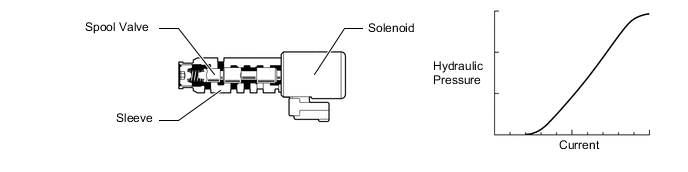
The ECM compares the engagement condition of the lock-up clutch with the lock-up schedule in the ECM memory to detect shift solenoid valve SLU, valve body and torque converter clutch mechanical problems.
| DTC No. | Detection Item | DTC Detection Condition | Trouble Area | MIL | Memory | Note |
|---|---|---|---|---|---|---|
| P27567F | Torque Converter Clutch Pressure Control Solenoid Control Actuator Stuck Off | Either condition is met (2-trip detection logic):
|
|
Comes on | DTC stored | SAE: P2757 |
MONITOR DESCRIPTION
Torque converter lock-up is controlled by the ECM based on the turbine (input) speed sensor NT, output speed sensor NC, engine speed, engine load, engine temperature, vehicle speed, transmission fluid temperature, and gear selection. The ECM determines the lock-up status of the torque converter by comparing the engine speed (NE) to the input turbine speed (NT). The ECM calculates the actual transmission gear by comparing input turbine speed (NT) to output shaft speed (NC). When conditions are appropriate, the ECM requests "lock-up" by applying control voltage to shift solenoid SLU. When SLU is turned on, it applies pressure to the lock-up relay valve and locks the torque converter clutch.
If the ECM detects no lock-up after lock-up has been requested or if it detects lock-up when it is not requested, the ECM interprets this as a fault in shift solenoid valve SLU or lock-up system performance.
The ECM will illuminate the MIL and store this DTC.
Example:
When any of the following conditions are met, the system judges it as a malfunction.
-
There is a difference in rotation speed between the input side (engine speed) and output side (input turbine speed) of the torque converter when the ECM commands lock-up.
(Engine speed is at least 70 rpm greater than input turbine speed.)
-
There is no difference in rotation speed between the input side (engine speed) and output side (input turbine speed) of the torque converter when the ECM commands lock-up off.
(The difference between engine speed and input turbine speed is less than 35 rpm.)
CAUTION / NOTICE / HINT
Note
Perform registration and/or initialization when parts related to the automatic transaxle are replaced.
-
ACTIVE TEST
Tech Tips
Using the GTS to perform Active Tests allows relays, VSVs, actuators and other items to be operated without removing any parts. This non-intrusive functional inspection can be very useful because intermittent operation may be discovered before parts or wiring is disturbed. Performing Active Tests early in troubleshooting is one way to save diagnostic time. Data List information can be displayed while performing Active Tests.
-
Warm up the engine.
-
Turn the engine switch off.
-
Connect the GTS to the DLC3.
-
Turn the engine switch on (IG).
-
Turn the GTS on.
-
Enter the following menus: Powertrain / Transmission / Active Test.
-
According to the display on the GTS, perform the Active Test.
Powertrain > Transmission > Active TestTester Display Measurement Item Control Range Diagnostic Note Activate the Lock Up Solenoid Controls the shift solenoid SLU and SL to set the automatic transaxle to the lock-up condition. ON/OFF
Start/Stop
Can be used to check SLU and SL solenoid operation.
[Vehicle Condition]
-
Throttle valve opening angle: Less than 20%
-
Vehicle speed: 60 km/h (37 mph) or more, and 6th gear
Powertrain > Transmission > Active TestTester Display Activate the Lock Up Solenoid Tech Tips
-
This test can be conducted when the vehicle speed is 60 km/h (37 mph) or more.
-
-
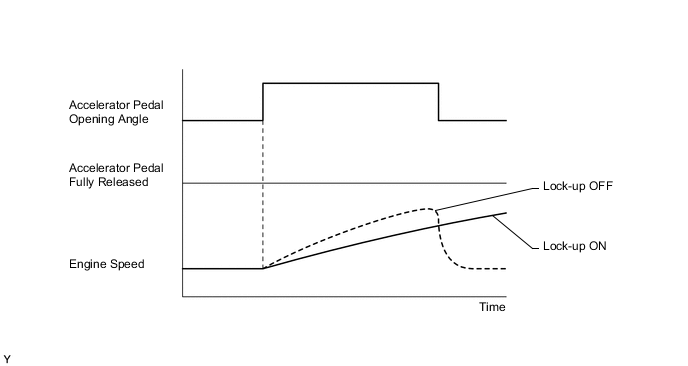
Lightly depress the accelerator pedal and check that the engine speed does not change abruptly.
Tech Tips
-
When changing the accelerator pedal opening angle while driving, if the engine speed does not change, lock-up is on.
-
Slowly release, but not fully, the accelerator pedal in order to decelerate. (Fully releasing the pedal will close the throttle valve and lock-up may be turned off.)
-
-
PROCEDURE
-
CHECK OTHER DTCS OUTPUT (IN ADDITION TO DTC P27567F)
-
Connect the GTS to the DLC3.
-
Turn the engine switch on (IG).
-
Turn the GTS on.
-
Enter the following menus: Powertrain / Transmission / Trouble Codes.
Powertrain > Transmission > Trouble Codes -
Read the DTCs using the GTS.
Result Result Proceed to Only DTC P27567F is output A P27567F and other DTCs are output B Tech Tips
If any DTCs other than P27567F are output, perform troubleshooting for those DTCs first.
B 
GO TO DTC CHART Click here
A 
-
-
INSPECT SHIFT SOLENOID VALVE SLU
-
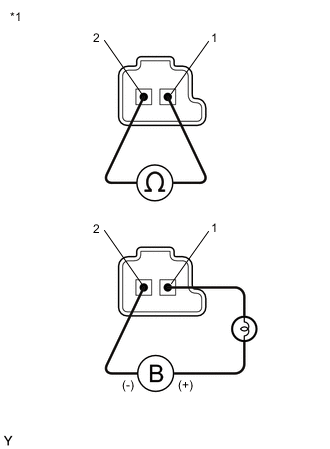
*1 Shift Solenoid Valve SLU Remove shift solenoid valve SLU.
-
Measure the resistance according to the value(s) in the table below.
Standard Resistance Tester Connection Condition Specified Condition 1 - 2 20°C (68°F) 5.0 to 5.6 Ω -
Apply 12 V battery voltage to the shift solenoid valve and check that the valve moves and makes an operating noise.
OK Measurement Condition Specified Condition
-
Battery positive (+) with a 21 W bulb → Terminal 1
-
Battery negative (-) → Terminal 2
Valve moves and makes an operating noise Result Proceed to OK NG -
NG
REPLACE SHIFT SOLENOID VALVE SLU Click here
OK
-
-
INSPECT TRANSMISSION VALVE BODY ASSEMBLY
-
Check the transmission valve body assembly.
OK There is no foreign matter on each valve and they operate smoothly. Result Proceed to OK NG
NG
REPLACE TRANSMISSION VALVE BODY ASSEMBLY Click here
OK
-
-
INSPECT TORQUE CONVERTER ASSEMBLY
-
Check the torque converter assembly.
OK The torque converter clutch operates normally. Result Proceed to OK NG
OK
REPLACE AUTOMATIC TRANSAXLE ASSEMBLY Click here
NG
REPLACE TORQUE CONVERTER ASSEMBLY Click here
-