PRE-CRASH SAFETY SYSTEM SYSTEM DESCRIPTION
-
PRE-CRASH SYSTEM
-
The pre-crash system detects vehicles and obstacles in front of the vehicle and performs the following: 1) optimally uses system controls to avoid collisions, and 2) uses system controls to reduce impact during a collision.
-
The operation of this system can be disabled by the pre-crash system cancel switch assembly.
Tech Tips
While the pre-crash system is disabled, the PCS warning indicator on the combination meter assembly is illuminated.
-
Operation of the pre-crash brake assist and pre-crash brake control can be disabled by the combination switch assembly (VSC OFF switch).
Tech Tips
When the pre-crash brake assist control and pre-crash brake control are disabled, the multi-information display will display "VSC System Switched Off. Pre-crash Brake System Disengaged." for 6 seconds and the PCS warning indicator on the combination meter assembly illuminates.
-
Operation of the pre-crash brake assist and pre-crash brake control can be disabled by entering expert mode.
-
-
OUTLINE OF PRE-CRASH SYSTEM
Operating Condition Control Transmitting ECU Receiving ECU Part Operated Collision is possible Pre-crash alarm Driving Support ECU Assembly
-
Combination meter assembly (warning message)
-
Millimeter wave radar sensor assembly (warning buzzer)
-
Combination meter assembly (warning message)
-
Skid control buzzer assembly (warning buzzer)
Collision is possible Pre-crash brake assist Driving Support ECU Assembly Brake actuator assembly (skid control ECU) Brake system Collision is unavoidable Pre-crash brake Driving Support ECU Assembly Brake actuator assembly (skid control ECU) Brake system
-
When operating according to millimeter wave radar sensor assembly detection:
The millimeter wave radar sensor assembly detects vehicles and other objects on the road in front of the user's vehicle. The driving support ECU assembly determines if the possibility of a collision is high or if a collision is unavoidable based on object position, speed and track information. If the driving support ECU assembly determines that the possibility of collision is high or that a collision is unavoidable, it transmits this information to the following areas via CAN communication:
-
Combination meter assembly (warning message) (activates pre-crash alarm)
-
Millimeter wave radar sensor assembly (warning buzzer) (activates pre-crash alarm)
-
Brake actuator assembly (skid control ECU) (activates pre-crash brake assist)
-
Brake actuator assembly (skid control ECU) (activates pre-crash brake)
-
-
-
OUTLINE OF PRE-CRASH ALARM
-
When the system determines that there is a high possibility of colliding with an obstacle in front of the vehicle, the multi-information display and warning buzzer are used to warn the driver and help with collision avoidance.
-
-
OUTLINE OF PRE-CRASH BRAKE ASSIST CONTROL
-
The pre-crash brake assist operates depending on what the millimeter wave radar sensor assembly detects. The system then enters standby mode before a collision. When the driver depresses the brake pedal, brake fluid pressure is increased to improve fluid pressure response and improve the rate of deceleration.
-
Operating conditions
-
Refer to the millimeter wave radar sensor assembly description under "Outline of Pre-crash System" (see above).
-
When the driver depresses the brake pedal after the driving support ECU assembly determines that the possibility of a collision is high:
Brake fluid pressure is increased at the same time the driver depresses the brake pedal.
-
-
-
OUTLINE OF PRE-CRASH BRAKE CONTROL
-
The pre-crash brake operation is performed depending on what the millimeter wave radar sensor assembly detects.
-
Operating conditions
-
Refer to the millimeter wave radar sensor assembly description under "Outline of Pre-crash System" (see above).
-
When the driving support ECU assembly determines that a collision is unavoidable, the system performs brake control (pre-crash brake operation) to reduce the vehicle speed.
When a preceding vehicle is detected, the system advances brake control (pre-crash brake operation) activation timing in order to increase speed reduction performance.
-
-
-
OPERATIVE CONDITION AND INOPERATIVE CONDITION OF EACH CONTROL (REVIEW)
Tech Tips
Each function will operate when all items marked (○) are satisfied.
Pre-crash Alarm Pre-crash Brake Assist Pre-crash Brake Engine switch is on (IG) ○ ○ ○ When warning message is not displayed on multi-information display * * * Operates when the vehicle speed is 15 km/h (10 mph) or more and relative speed is 15 km/h (10 mph) or more ○ x ○ Operates when the vehicle speed is 5 km/h (4 mph) or more and relative speed is 30 km/h (19 mph) or more x x x Operates when the vehicle speed is 30 km/h (19 mph) or more and relative speed is 30 km/h (19 mph) or more x ○ x When Pre-crash system cancel switch assembly is not turned on ○ ○ ○ When the VSC system is disabled ○ x x When the VSC system is enabled ○ ○ ○ When in expert mode ○ x x
-
○: Operation conditions are included
-
x: Not operation conditions are included
-
*: Inoperative parts differ depending on malfunction areas
-
-
CASES OF UNNECESSARY PRE-CRASH SYSTEM OPERATION
-
When the millimeter wave radar sensor assembly detects an object in front of the vehicle under the following conditions, the driving support ECU assembly may determine that the possibility of a collision is high or a collision is unavoidable, and activate the Pre-crash system. This activation of the system is not abnormal.
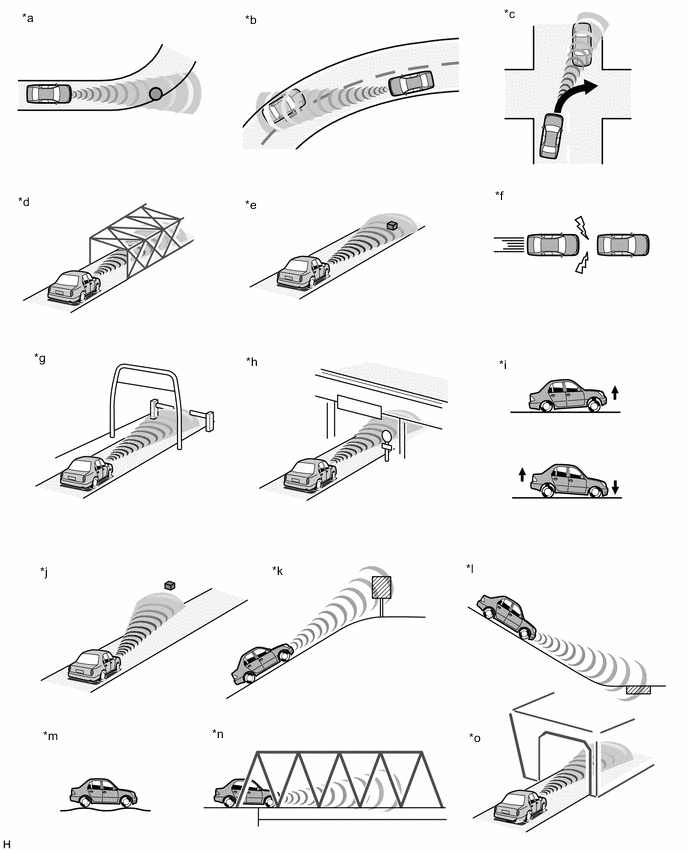
*a There are objects on the side of the road at the beginning of a curve (a guardrail, street lamp, billboard, etc.). *b Passing an oncoming vehicle on a curve. *c There is an oncoming vehicle when making a left turn. *d Crossing a narrow metal bridge. *e There are metal objects on the road. *f Approaching a leading vehicle suddenly. *g Approaching an electrical toll collection gate (reacts to bar). *h Crossing an overpass, traffic sign, signboard. *i The vehicle height drastically changes (nose-up, nose-down). *j Misalignment of millimeter wave radar sensor assembly (reinstallation, collision, etc.). *k There is a billboard or sign at the top of an incline. *l There are metal objects at the bottom of a decline (a metal plate covering road construction, a mesh drain cover, a manhole, etc.). *m Roughness in road surface. *n When driving under an overpass *o When passing through a tunnel - - Tech Tips
-
The pre-crash system will not activate when approaching safety cones or other plastic objects as they cannot be detected by the millimeter wave radar sensor assembly.
-
The pre-crash system may or may not activate when the millimeter wave radar sensor assembly detects the following objects: people, bicycles, motorcycles, trees, animals, snow fences, etc.
-
Detection performance may deteriorate under the following conditions.
-
On a tight curve or bumpy road
-
Something or someone suddenly emerges in the direction of travel of the driver's vehicle at a place such as an intersection
-
Another vehicle suddenly cuts in the traveling direction of the driver's own vehicle
-
In severe weather such as heavy rain, fog, snow or a sand storm
-
Vehicle is skidding sideways while the vehicle stability control system is not operating
-
Vehicle height changes significantly (front of vehicle inclined either upward or downward)
-
Millimeter wave radar sensor assembly is misaligned (due to reinstallation or collision)
-
An obstacle suddenly appears in front of the vehicle due to the steering wheel being turned sharply, etc.
Object Type Example Objects that cannot be detected Plastic items (safety cones) Objects that cannot be detected in a stable manner People, bicycles, motorcycles, trees, animals, snow fences, etc.
-
-