| DTC Code | DTC Name |
|---|---|
| Speaker Circuit |
DESCRIPTION
If there is a short in a speaker circuit, the stereo component amplifier assembly detects it and stops output to the speakers.
Thus sound cannot be heard from the speakers even if there is no malfunction in the stereo component amplifier assembly or speakers.
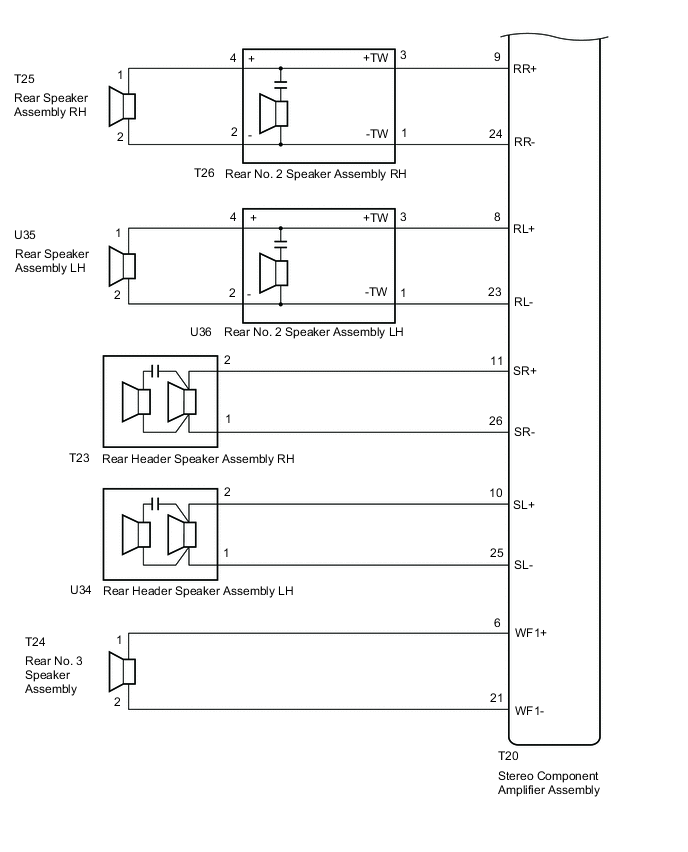
PROCEDURE
- Click here
CHECK SPEAKER (OPERATION CHECK)
-
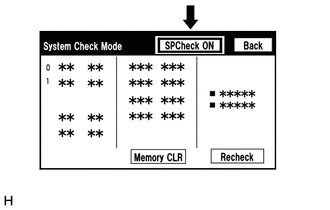
Enter the "System Check Mode" screen. Refer to Check Speaker in Operation Check.
-
Perform the operation check above and determine the speaker that is not operating.
Result Not Operating Speaker Proceed to Front No. 2 speaker assembly A Front No. 1 speaker assembly B Front No. 3 speaker assembly C Rear speaker assembly or rear No. 2 speaker assembly D Rear header speaker assembly E Rear No. 3 speaker assembly F Tip:If sound cannot be heard from any speaker, inspect all of them.
-
- Click here
CHECK HARNESS AND CONNECTOR (STEREO COMPONENT AMPLIFIER ASSEMBLY - FRONT NO. 2 SPEAKER ASSEMBLY)
-
Disconnect the T20 stereo component amplifier assembly connector.
-
Disconnect the O54 and O55 front No. 2 speaker assembly connectors.
-
Measure the resistance according to the value(s) in the table below.
Standard Resistance Tester Connection Condition Specified Condition T20-13 (FR+) - O54-2 (+) Always Below 1 Ω T20-28 (FR-) - O54-1 (-) Always Below 1 Ω T20-12 (FL+) - O55-2 (+) Always Below 1 Ω T20-27 (FL-) - O55-1 (-) Always Below 1 Ω T20-13 (FR+) or O54-2 (+) - Body ground Always 10 kΩ or higher T20-28 (FR-) or O54-1 (-) - Body ground Always 10 kΩ or higher T20-12 (FL+) or O55-2 (+) - Body ground Always 10 kΩ or higher T20-27 (FL-) or O55-1 (-) - Body ground Always 10 kΩ or higher Result Proceed to OK NG
- OKClick here
- NG
REPAIR OR REPLACE HARNESS OR CONNECTOR
-
- Click here
REPLACE FRONT NO. 2 SPEAKER ASSEMBLY
-
Remove the front No. 2 speaker assembly.
-
Inspect the front No. 2 speaker assembly.
OK Malfunction disappears. Result Proceed to OK NG
- OK
END
- NG
PROCEED TO NEXT SUSPECTED AREA SHOWN IN PROBLEM SYMPTOMS TABLEClick here
-
- Click here
CHECK HARNESS AND CONNECTOR (STEREO COMPONENT AMPLIFIER ASSEMBLY - FRONT NO. 1 SPEAKER ASSEMBLY)
-
Disconnect the T20 stereo component amplifier assembly connector.
-
Disconnect the R14 and S14 front No. 1 speaker assembly connectors.
-
Measure the resistance according to the value(s) in the table below.
Standard Resistance Tester Connection Condition Specified Condition T20-5 (WFR+) - R14-1 Always Below 1 Ω T20-20 (WFR-) - R14-2 Always Below 1 Ω T20-4 (WFL+) - S14-1 Always Below 1 Ω T20-19 (WFL-) - S14-2 Always Below 1 Ω T20-5 (WFR+) or R14-1 - Body ground Always 10 kΩ or higher T20-20 (WFR-) or R14-2 - Body ground Always 10 kΩ or higher T20-4 (WFL+) or S14-1 - Body ground Always 10 kΩ or higher T20-19 (WFL-) or S14-2 - Body ground Always 10 kΩ or higher Result Proceed to OK NG
- OKClick here
- NG
REPAIR OR REPLACE HARNESS OR CONNECTOR
-
- Click here
INSPECT FRONT NO. 1 SPEAKER ASSEMBLY
-
Remove the front No. 1 speaker assembly.
-
Inspect the front No. 1 speaker assembly.
Result Proceed to OK NG
- OK
PROCEED TO NEXT SUSPECTED AREA SHOWN IN PROBLEM SYMPTOMS TABLEClick here
- NG
REPLACE FRONT NO. 1 SPEAKER ASSEMBLYClick here
-
- Click here
CHECK HARNESS AND CONNECTOR (STEREO COMPONENT AMPLIFIER ASSEMBLY - FRONT NO. 3 SPEAKER ASSEMBLY)
-
Disconnect the T20 stereo component amplifier assembly connector.
-
Disconnect the O56 front No. 3 speaker assembly connector.
-
Measure the resistance according to the value(s) in the table below.
Standard Resistance Tester Connection Condition Specified Condition T20-7 (CTR+) - O56-2 (+) Always Below 1 Ω T20-22 (CTR-) - O56-1 (-) Always Below 1 Ω T20-7 (CTR+) or O56-2 (+) - Body ground Always 10 kΩ or higher T20-22 (CTR-) or O56-1 (-) - Body ground Always 10 kΩ or higher Result Proceed to OK NG
- OKClick here
- NG
REPAIR OR REPLACE HARNESS OR CONNECTOR
-
- Click here
REPLACE FRONT NO. 3 SPEAKER ASSEMBLY
-
Remove the front No. 3 speaker assembly.
-
Inspect the front No. 3 speaker assembly.
OK Malfunction disappears. Result Proceed to OK NG
- OK
END
- NG
PROCEED TO NEXT SUSPECTED AREA SHOWN IN PROBLEM SYMPTOMS TABLEClick here
-
- Click here
CHECK HARNESS AND CONNECTOR (STEREO COMPONENT AMPLIFIER ASSEMBLY - REAR NO. 2 SPEAKER ASSEMBLY)
-
Disconnect the T20 stereo component amplifier assembly connector.
-
Disconnect the T26 and U36 rear No. 2 speaker assembly connectors.
-
Measure the resistance according to the value(s) in the table below.
Standard Resistance Tester Connection Condition Specified Condition T20-9 (RR+) - T26-3 (+TW) Always Below 1 Ω T20-24 (RR-) - T26-1 (-TW) Always Below 1 Ω T20-8 (RL+) - U36-3 (+TW) Always Below 1 Ω T20-23 (RL-) - U36-1 (-TW) Always Below 1 Ω T20-9 (RR+) or T26-3 (+TW) - Body ground Always 10 kΩ or higher T20-24 (RR-) or T26-1 (-TW) - Body ground Always 10 kΩ or higher T20-8 (RL+) or U36-3 (+TW) - Body ground Always 10 kΩ or higher T20-23 (RL-) or U36-1 (-TW) - Body ground Always 10 kΩ or higher Result Proceed to OK NG
- OKClick here
- NG
REPAIR OR REPLACE HARNESS OR CONNECTOR
-
- Click here
CHECK HARNESS AND CONNECTOR (REAR SPEAKER ASSEMBLY - REAR NO. 2 SPEAKER ASSEMBLY)
-
Disconnect the T25 and U35 rear speaker assembly connectors.
-
Disconnect the T26 and U36 rear No. 2 speaker assembly connectors.
-
Measure the resistance according to the value(s) in the table below.
Standard Resistance Tester Connection Condition Specified Condition T25-1 - T26-4 (+) Always Below 1 Ω T25-2 - T26-2 (-) Always Below 1 Ω U35-1 - U36-4 (+) Always Below 1 Ω U35-2 - U36-2 (-) Always Below 1 Ω T25-1 or T26-4 (+) - Body ground Always 10 kΩ or higher T25-2 or T26-2 (-) - Body ground Always 10 kΩ or higher U35-1 or U36-4 (+) - Body ground Always 10 kΩ or higher U35-2 or U36-2 (-) - Body ground Always 10 kΩ or higher Result Proceed to OK NG
- OKClick here
- NG
REPAIR OR REPLACE HARNESS OR CONNECTOR
-
- Click here
INSPECT REAR SPEAKER ASSEMBLY
-
Remove the rear speaker assembly.
-
Inspect the rear speaker assembly.
Result Proceed to OK NG
- OKClick here
- NG
REPLACE REAR SPEAKER ASSEMBLYClick here
-
- Click here
REPLACE REAR NO. 2 SPEAKER ASSEMBLY
-
Remove the rear No. 2 speaker assembly.
-
Inspect the rear No. 2 speaker assembly.
OK Malfunction disappears. Result Proceed to OK NG
- OK
END
- NG
PROCEED TO NEXT SUSPECTED AREA SHOWN IN PROBLEM SYMPTOMS TABLEClick here
-
- Click here
CHECK HARNESS AND CONNECTOR (STEREO COMPONENT AMPLIFIER ASSEMBLY - REAR HEADER SPEAKER ASSEMBLY)
-
Disconnect the T20 stereo component amplifier assembly connector.
-
Disconnect the T23 and U34 rear header speaker assembly connectors.
-
Measure the resistance according to the value(s) in the table below.
Standard Resistance Tester Connection Condition Specified Condition T20-11 (SR+) - T23-2 Always Below 1 Ω T20-26 (SR-) - T23-1 Always Below 1 Ω T20-10 (SL+) - U34-2 Always Below 1 Ω T20-25 (SL-) - U34-1 Always Below 1 Ω T20-11 (SR+) or T23-2 - Body ground Always 10 kΩ or higher T20-26 (SR-) or T23-1 - Body ground Always 10 kΩ or higher T20-10 (SL+) or U34-2 - Body ground Always 10 kΩ or higher T20-25 (SL-) or U34-1 - Body ground Always 10 kΩ or higher Result Proceed to OK NG
- OKClick here
- NG
REPAIR OR REPLACE HARNESS OR CONNECTOR
-
- Click here
REPLACE REAR HEADER SPEAKER ASSEMBLY
-
Remove the rear header speaker assembly.
-
Inspect the rear header speaker assembly.
OK Malfunction disappears. Result Proceed to OK NG
- OK
END
- NG
PROCEED TO NEXT SUSPECTED AREA SHOWN IN PROBLEM SYMPTOMS TABLEClick here
-
- Click here
CHECK HARNESS AND CONNECTOR (STEREO COMPONENT AMPLIFIER ASSEMBLY - REAR NO. 3 SPEAKER ASSEMBLY)
-
Disconnect the T20 stereo component amplifier assembly connector.
-
Disconnect the T24 rear No. 3 speaker assembly connector.
-
Measure the resistance according to the value(s) in the table below.
Standard Resistance Tester Connection Condition Specified Condition T20-6 (WF1+) - T24-1 Always Below 1 Ω T20-21 (WF1-) - T24-2 Always Below 1 Ω T20-6 (WF1+) or T24-1 - Body ground Always 10 kΩ or higher T20-21 (WF1-) or T24-2 - Body ground Always 10 kΩ or higher Result Proceed to OK NG
- OKClick here
- NG
REPAIR OR REPLACE HARNESS OR CONNECTOR
-
- Click here
INSPECT REAR NO. 3 SPEAKER ASSEMBLY
-
Remove the rear No. 3 speaker assembly.
-
Inspect the rear No. 3 speaker assembly.
Result Proceed to OK NG
- OK
PROCEED TO NEXT SUSPECTED AREA SHOWN IN PROBLEM SYMPTOMS TABLEClick here
- NG
REPLACE REAR NO. 3 SPEAKER ASSEMBLYClick here
-