HEADUP DISPLAY SYSTEM Main Switch Circuit
DESCRIPTION
The headup display switch (No. 2 combination switch assembly) and combination meter mirror ECU are connected via direct line. The combination meter mirror ECU can be turned off and on by operating the headup display switch (No. 2 combination switch assembly).
WIRING DIAGRAM
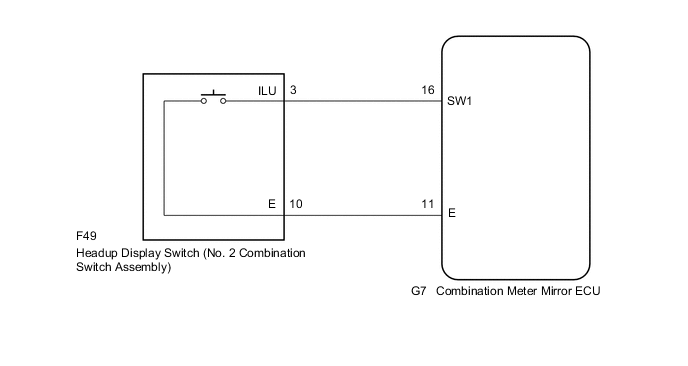
PROCEDURE
-
READ VALUE USING GTS (MAIN SWITCH)
-
Connect the GTS to the DLC3.
-
Turn the power switch on (IG).
-
Turn the GTS on.
-
Enter the following menus: Body Electrical / Head Up Display / Data List.
-
Read the Data List according to the display on the GTS.
Body Electrical > Head Up Display > Data ListTester Display Measurement Item Range Normal Condition Diagnostic Note Main Switch Headup display switch OFF or ON OFF: Switch released
ON: Switch pushed
-
Body Electrical > Head Up Display > Data ListTester Display Main Switch OK Headup display switch condition displayed on the GTS changes with the actual switch operation. Result Proceed to OK NG
OK 
REPLACE COMBINATION METER MIRROR ECU Click here
NG 
-
-
INSPECT HEADUP DISPLAY SWITCH (NO. 2 COMBINATION SWITCH ASSEMBLY)
-
Remove the headup display switch (No. 2 combination switch assembly).
-
Inspect the headup display switch (No. 2 combination switch assembly).
Result Proceed to OK NG
NG
REPLACE HEADUP DISPLAY SWITCH (NO. 2 COMBINATION SWITCH ASSEMBLY) Click here
OK
-
-
CHECK HARNESS AND CONNECTOR (COMBINATION METER MIRROR ECU - HEADUP DISPLAY SWITCH (NO. 2 COMBINATION SWITCH ASSEMBLY))
-
Disconnect the G7 combination meter mirror ECU connector.
-
Measure the resistance according to the value(s) in the table below.
Standard Resistance Tester Connection Condition Specified Condition G7-16 (SW1) - F49-3 (ILU) Always Below 1 Ω G7-11 (E) - F49-10 (E) Always Below 1 Ω G7-16 (SW1) or F49-3 (ILU) - Body ground Always 10 kΩ or higher G7-11 (E) or F49-10 (E) - Body ground Always 10 kΩ or higher Result Proceed to OK NG
OK
REPLACE COMBINATION METER MIRROR ECU Click here
NG
REPAIR OR REPLACE HARNESS OR CONNECTOR
-