CAMSHAFT OIL CONTROL VALVE INSPECTION
PROCEDURE
-
INSPECT CAMSHAFT TIMING OIL CONTROL VALVE ASSEMBLY
-
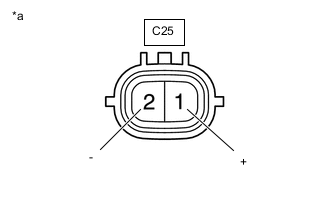
*a Component without harness connected
(Camshaft Timing Oil Control Valve Assembly)
Measure the resistance according to the value(s) in the table below.
Standard Resistance Tester Connection Condition Specified Condition C25-1 (+) - C25-2 (-) 20°C (68°F) 6.9 to 7.9 Ω If the result is not as specified, replace the camshaft timing oil control valve assembly.
-
Check the operation.
-
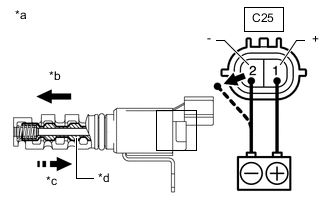
*a Component without harness connected
(Camshaft Timing Oil Control Valve Assembly)
*b When Battery Voltage Applied *c When Battery Voltage Cut Off *d Spool Valve Connect a positive (+) lead from the battery to terminal 1 and a negative (-) lead to terminal 2, and check the movement of the spool valve.
OK Tester Connection Condition Specified Condition C25-1 (+) - Auxiliary battery positive (+)
C25-2 (-) - Auxiliary battery positive (-)
Battery voltage applied Valve moves in left arrow direction shown in illustration C25-1 (+) - Auxiliary battery positive (+)
C25-2 (-) - Auxiliary battery positive (-)
Battery voltage cut off Valve moves in right arrow direction shown in illustration Note
Confirm that the valve moves freely and does not stick in any position.
If the result is not as specified, replace the camshaft timing oil control valve assembly.
Tech Tips
Accumulation of foreign matter can cause minor pressure leaks. Minor pressure leaks will cause the camshaft to advance or retard, and this will cause a DTC to be stored.
-
-