BLIND SPOT MONITOR SYSTEM OPERATION CHECK
-
BLIND SPOT MONITOR BEAM AXIS CONFIRMATION
Tech Tips
The blind spot monitor beam axis confirmation is performed to confirm whether the sensor's beam axis is correct, and perform adjustment of the beam axis by using reflector.
-
When performing the blind spot monitor beam axis confirmation, move the vehicle to a place where the space shown in the illustration can be secured.
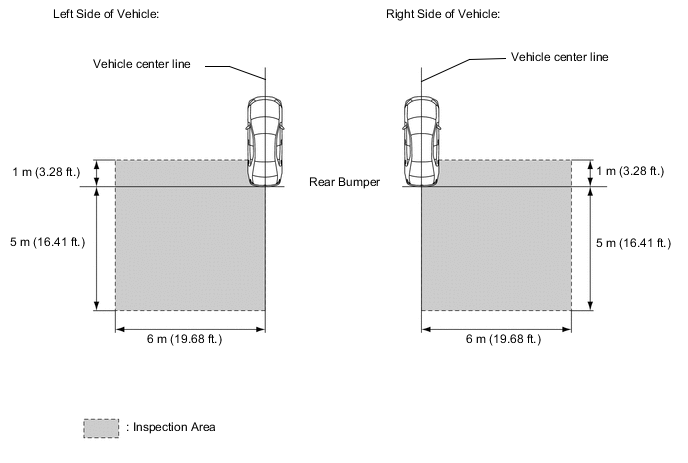
Note
-
Perform this inspection on level ground.
-
Make sure that there are no metal objects around the vehicle or on the ground.
-
Unload the vehicle before beginning the inspection.
-
Confirm that the tire pressure is correct before beginning the inspection.
-
Do not place any objects other than the reflector (such as a large metallic object) in or allow people to enter the inspection area (W 6 m [19.68 ft.] x L 6 m [19.68 ft.] x H 4 m [13.12 ft.]) shown in the illustration.
-
-
Place the reflector.
-
From the center of the rear bumper (center of the emblem), hang a weight with a pointed tip, and mark the rear center point of the vehicle on the ground (mark A).
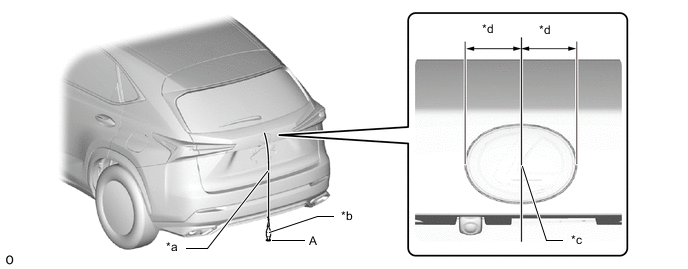
*a String *b Weight *c Center point *d Equal Distance to Center Tech Tips
Lightly flick the string with your fingers several times to confirm that the string is aligned with mark A.
-
From the center of the front bumper (center of the emblem), hang a weight with a pointed tip, and mark the front center point of the vehicle on the ground (mark B).
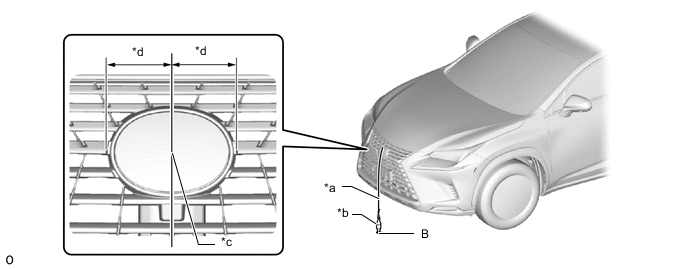
*a String *b Weight *c Center point *d Equal Distance to Center Tech Tips
Lightly flick the string with your fingers several times to confirm that the string is aligned with mark B.
-
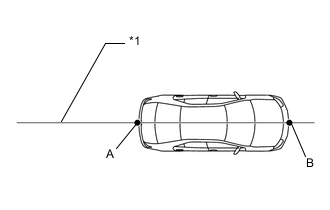
*1 Vehicle center line Draw a vehicle center line so that it passes through mark A and B (front and rear center points).
-
Enlarge and print out the poster shown in the illustration.
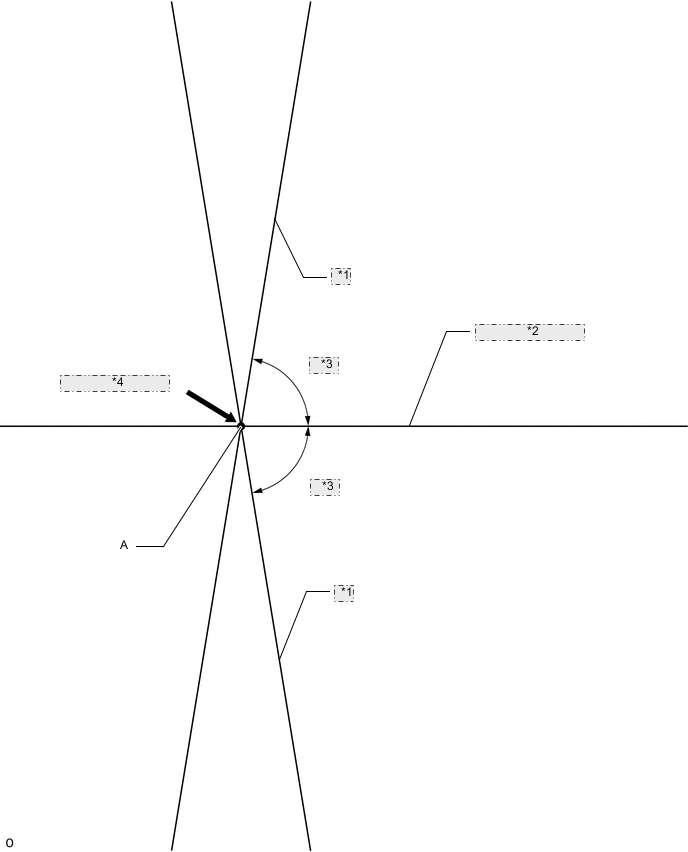
Poster *1 Line C *2 Vehicle center line *3 80.7° *4 Edge of rear bumper -
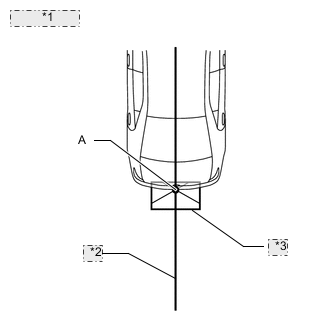
*1 Vehicle Rear *2 Vehicle center line *3 Poster Attach the printed poster to the floor with the vehicle center line aligned with point A as shown in the illustration.
-
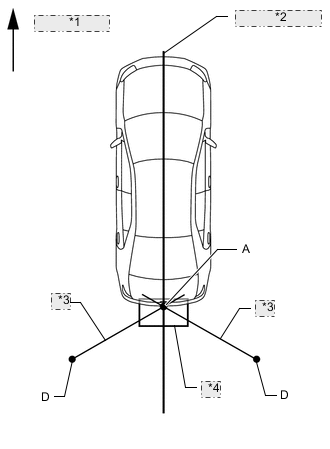
*1 Vehicle front *2 Vehicle center line *3 String *4 Poster Align a piece of string with line C and mark point D at a distance of 3668 mm (12.03 ft.) from point A.
-
Set the reflector at the point D shown in the illustration below.
- SST
- 09870-60000 ( 09870-60010 )
- 09870-60040
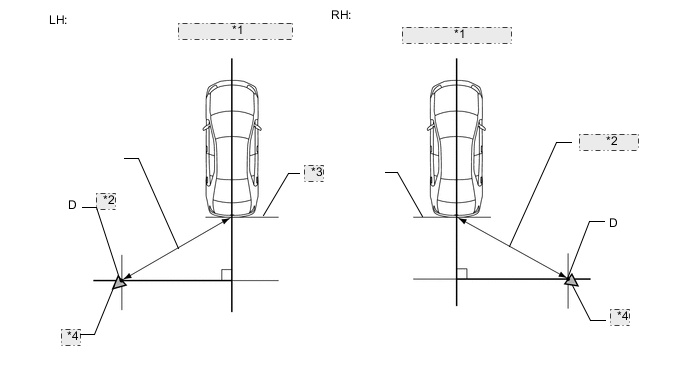
*1 Vehicle center line *2 3668 mm (12.03 ft.) *3 Rear bumper *4 Reflector Note
-
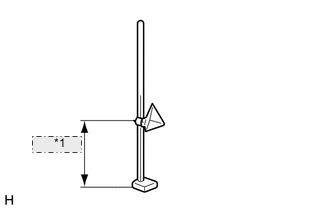
*1 790 mm (2.59 ft.) Set the reflector so that its center is 790 mm (2.59 ft.) above the ground.
-
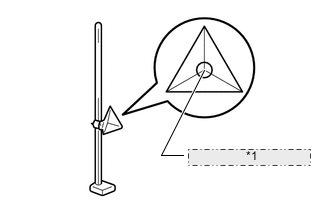
*1 Center of triangular pyramid The center of the triangular pyramid is the reference point for the setting position and angle.
-
-
Perform the blind spot monitor beam axis display.
-
Connect the GTS to the DLC3.
-
Turn the power switch on (IG).
-
Turn the blind spot monitor system on.
-
Turn the GTS on.
-
Enter the following menus: Body Electrical / Blind Spot Monitor Master or Blind Spot Monitor Slave / Utility / BSM Master Beam Axis Display or BSM Slave Beam Axis Display.
Body Electrical > Blind Spot Monitor Master > UtilityTester Display BSM Master Beam Axis Display
Body Electrical > Blind Spot Monitor Slave > UtilityTester Display BSM Slave Beam Axis Display -
Check the results displayed for the BSM beam axis display.
Tech Tips
If the results are outside the allowable range, it is possible that the reflector position is incorrect, there is a metallic object near the inspection area or the blind spot monitor sensor installation condition is abnormal, so check the reflector positioning, the inspection area and the blind spot monitor sensor installation condition, and perform the inspection again.
-
-
Perform the blind spot monitor beam axis adjustment.
-
Enter the following menus: Body Electrical / Blind Spot Monitor Master or Blind Spot Monitor Slave / Utility / BSM Master Beam Axis Adjustment or BSM Slave Beam Axis Adjustment.
Tech Tips
When values on the axis display are in the allowable range, performing this adjustment compensates for any deviation from the normal value.
Body Electrical > Blind Spot Monitor Master > UtilityTester Display BSM Master Beam Axis Adjustment
Body Electrical > Blind Spot Monitor Slave > UtilityTester Display BSM Slave Beam Axis Adjustment
-
-
-
BLIND SPOT MONITOR SENSOR INSTALLATION CONDITION INSPECTION
Note
-
Perform this inspection on level ground.
-
Unload the vehicle before beginning the inspection.
-
Confirm that the tire pressure is correct before beginning the inspection.
Tech Tips
The blind spot monitor sensor installation condition inspection is performed to confirm whether the sensor is perpendicular to the floor surface (+/-2.2°) by using a digital angle gauge, and that the sensor is 16 to 24° from the line parallel to the vehicle center line.
-
Remove the rear bumper.
-
Place the digital angle gauge on a level (gradient within 1%) and perform zero-point adjustment as shown in the illustration.
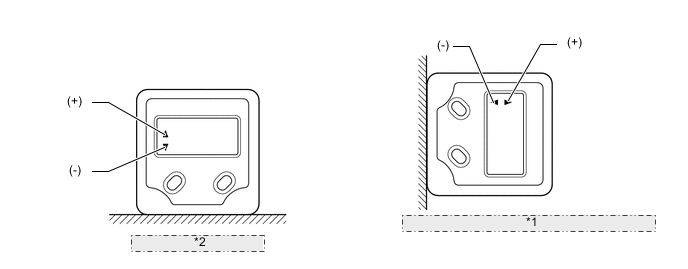
*1 After storing zero point, indicates 90° when fully horizontal *2 When storing zero point -
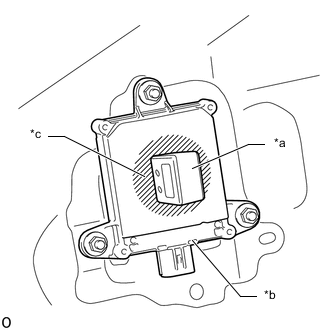
*a Digital Angle Gauge *b Blind Spot Monitor Sensor *c Outward Facing Surface Set the digital angle gauge to the outward facing surface of the blind spot monitor sensor as shown in the illustration, and check that the perpendicular angle of the blind spot monitor sensor is within the permissible range.
-
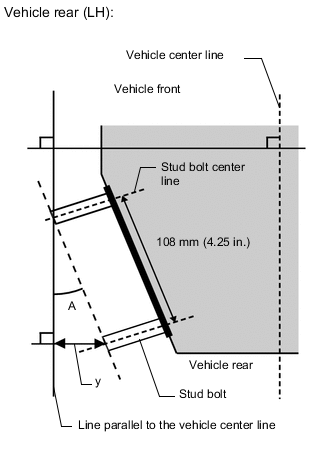
Using the sensor installation stud bolt center lines as a reference, check that the stud bolts are as shown in the illustration.
Tech Tips
If the results are not as specified, it is possible that the blind spot monitor sensor installation area (frame, stud bolt) is deformed, so make corrections as necessary.
-