SMART ENTRY AND START SYSTEM(for Start Function) TERMINALS OF ECU
-
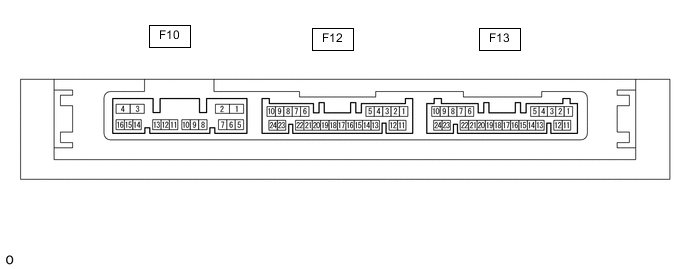
CHECK CERTIFICATION ECU (SMART KEY ECU ASSEMBLY)
-
Disconnect the F10 and F13 certification ECU (smart key ECU assembly) connectors.
-
Measure the voltage and resistance according to the value(s) in the table below.
Tech Tips
Measure the values on the wire harness side with the connector disconnected.
Terminal No. (Symbol) Input/Output Wiring Color Terminal Description Condition Specified Condition Related Data List Item F10-12 (STA) - Body ground Input LG - Body ground When starting the engine, this monitors the voltage sent from terminal STAR to the starter relay to judge whether the engine is "being started". 20°C (68°F) 106.78 to 115.98 Ω - F10-10 (STAR) - Body ground Input/Output GR - Body ground Outputs voltage to the starter relay
-
Outputs voltage (12 V) to the starter relay when starting the engine. (Max. 30 sec. Turns off when an engine speed of 500 rpm or more continues for 500 ms or more.)
Tech Tips
When Hi is selected, a start request signal (STAR) will not be output even though a start request signal (STSW) is input.
Shift lever in any position other than P or N → Shift lever in P or N (at 20°C (68°F)) 10 kΩ or higher → 107.05 to 116.33 Ω - Receives neutral start switch (P, N position detection) signal
-
Monitors whether the neutral start switch is on (P or N) or off (other than P or N). Applies voltage via a resistor (large) in the certification ECU (smart key ECU assembly). When the neutral start switch is on, due to the starter relay coil resistance (small) using some of the voltage, the voltage at terminal STAR will be low (2.7 V or less), and when the neutral start switch is off, the voltage will be high (9 V or more).
Perform the following operation except while the engine is cranking:
-
Shift lever in any position other than P or N → Shift lever in P or N (at 20°C (68°F))
30 kΩ or higher → 107.05 to 116.33 Ω Neutral SW/ Clutch SW F10-14 (NE) - Body ground Input Y - Body ground Engine speed signal Always 10 kΩ or higher Engine Condition F10-2 (STP1) - Body ground Input G - Body ground Stop light switch signal Brake pedal depressed → Brake pedal released 9 V or higher → 1 V or less Stop Light Switch1 F13-10 (+B) - F13-11 (E) Input GR - W-B Power source Always 11 to 14 V - F13-23 (SLP) - F13-11 (E) Input LG - W-B Steering lock position signal Steering locked 10 kΩ or higher Steering Unlock Switch F13-22 (P) - F13-11 (E) Input V - W-B P position signal Shift lever in P → Shift lever not in P 30 kΩ or higher → Below 200 Ω Shift P Signal F13-11 (E) - Body ground - W-B - Body ground GND Always Below 1 Ω - F13-18 (SSW2) - Body ground Input V - Body ground SSW2 contact signal
Tech Tips
Backup for SSW1. Behaves the same way as SSW1.
Engine switch pushed → Engine switch not pushed Below 15 Ω → 10 kΩ or higher Start Switch2 F13-16 (SSW1) - Body ground Input Y - Body ground SSW1 contact signal Engine switch pushed → Engine switch not pushed Below 15 Ω → 10 kΩ or higher Start Switch1 F13-9 (ACCD) - Body ground Output GR - Body ground ACC signal 20°C (68°F) 130.92 to 190.74 Ω ACC Relay Monitor F10-3 (IG1D) - Body ground Output G - Body ground IG signal 20°C (68°F) 87.32 to 127.14 Ω IG Relay Monitor (Outside) F13-5 (SPD) - Body ground Input BE - Body ground Vehicle speed signal Always 30 kΩ or higher Vehicle Speed Signal -
-
Reconnect the F10 and F13 certification ECU (smart key ECU assembly) connectors.
-
Measure the voltage and check for pulses according to the value(s) in the table below.
Terminal No. (Symbol) Input/Output Wiring Color Terminal Description Condition Specified Condition Related Data List Item F10-12 (STA) - F13-11 (E) Input LG - W-B When starting the engine, this monitors the voltage sent from terminal STAR to the starter relay to judge whether the engine is "being started". With the brake pedal depressed, the engine switch is pressed and held (starter on) → After approx. 1 sec. has elapsed, the engine switch is released (starter off) 6 V or higher* → 1.0 V or less - F10-10 (STAR) - F13-11 (E) Input/Output GR - W-B Outputs voltage to the starter relay
-
Outputs voltage (12 V) to the starter relay when starting the engine. (Max. 30 sec. Turns off when an engine speed of 500 rpm or more continues for 500 ms or more.)
Tech Tips
When Hi is selected, a start request signal (STAR) will not be output even though a start request signal (STSW) is input.
With the brake pedal depressed, the engine switch is pressed and held → After approx. 1 sec. has elapsed, the engine switch is released 6 V or higher* → 1.0 V or less - Receives neutral start switch (P, N position detection) signal
-
Monitors whether the neutral start switch is on (P or N) or off (other than P or N). Applies voltage via a resistor (large) in the certification ECU (smart key ECU assembly). When the neutral start switch is on, due to the starter relay coil resistance (small) using some of the voltage, the voltage at terminal STAR will be low (2.7 V or less), and when the neutral start switch is off, the voltage will be high (9 V or more).
Perform the following operation except while the engine is cranking:
-
Shift lever in any position other than P or N → Shift lever in P or N (at 20°C (68°F))
9 V or higher → 2.7 V or less Neutral SW/ Clutch SW F10-14 (NE) - F13-11 (E) Input Y - W-B Engine speed signal Idling (engine warmed up) Pulse generation
(See waveform 1)
Engine Condition F10-2 (STP1) - F13-11 (E) Input G - W-B Stop light switch signal Brake pedal released → Brake pedal depressed 1 V or less → 9 V or higher Stop Light Switch1 F13-23 (SLP) - F13-11 (E) Input LG - W-B Steering lock position signal Steering locked → Steering unlocked 11 to 14 V → 1.5 V or less Steering Unlock Switch F13-24 (SLR+) - F13-11 (E) Output V - W-B Steering lock motor operation command signal
(Steering lock motor operation permission signal sent from the certification ECU (smart key ECU assembly))
When a door is opened, the steering lock motor will be operated if all of the following conditions are met:
-
The steering is unlocked.
-
The engine switch is off.
-
The shift lever is in P.
Pulse generation
(See waveform 2)
- F13-22 (P) - F13-11 (E) Input V - W-B P position signal Shift lever in P → Shift lever not in P 9 V or higher → 2.76 V or less Shift P Signal F13-18 (SSW2) - F13-11 (E) Input V - W-B SSW2 contact signal
Tech Tips
Backup for SSW1. Behaves the same way as SSW1.
Engine switch not pushed → Engine switch pushed 9 V or higher → 1 V or less Start Switch2 F13-16 (SSW1) - F13-11 (E) Input Y - W-B SSW1 contact signal Engine switch not pushed → Engine switch pushed 9 V or higher → 1 V or less Start Switch1 F13-9 (ACCD) - F13-11 (E) Output GR - W-B ACC signal Engine switch off → Engine switch on (ACC) 1 V or less → 8.5 V or higher ACC Relay Monitor F10-3 (IG1D) - F13-11 (E) Output G - W-B IG signal Engine switch on (ACC) → Engine switch on (IG) 1 V or less → 9 V or higher IG Relay Monitor (Outside) F13-5 (SPD) - F13-11 (E) Input BE - W-B Vehicle speed signal Vehicle being driven at approx. 5 km/h (3 mph) Pulse generation
(See waveform 3)
Vehicle Speed Signal Tech Tips
-
*: While the engine is cranking, the battery voltage may drop to approximately 6 V.
-
The waveform of the steering lock actuator motor stopped can be checked without performing any particular operation.
-
The waveform of the steering lock actuator motor operating can be checked if either of the following operations is performed:
-
To unlock the steering, bring the electrical key transmitter sub-assembly into the cabin and turn the engine switch on (ACC) or on (IG).
-
To lock the steering, open a door with the engine switch off and the shift lever in P.
-
-
Using an oscilloscope, check the waveform of the ECU.
Note
The oscilloscope waveform shown in the illustration is an example for reference only. Noise, chattering, etc. are not shown.
-
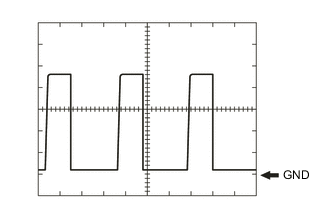
Waveform 1
Item Content Tester Connection F10-14 (NE) - F13-11 (E) Tool Setting 2 V/DIV., 2 ms./DIV. Condition Idling (engine warmed up) Tech Tips
The wavelength becomes shorter as the engine speed increases.
-
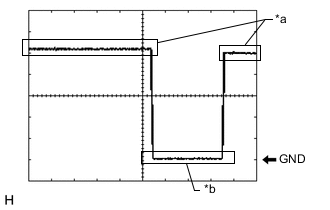
*a Steering lock motor not operating *b Steering lock motor operating Waveform 2
Item Content Tester Connection F13-24 (SLR+) - F13-11 (E) Tool Setting 2 V/DIV., 200 ms./DIV. Condition Steering lock motor stopped → Steering lock motor operating → Steering lock motor stopped -
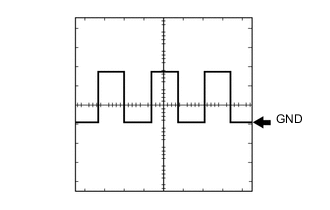
Waveform 3
Item Content Tester Connection F13-5 (SPD) - F13-11 (E) Tool Setting 5 V/DIV., 20 ms./DIV. Condition Vehicle being driven at approx. 5 km/h (3 mph) Tech Tips
The wavelength becomes shorter as the vehicle speed increases.
-
-
-
CHECK STEERING LOCK ECU (STEERING LOCK ACTUATOR ASSEMBLY)
-
CHECK ID CODE BOX (IMMOBILISER CODE ECU) (W/ REAR SEAT HEATER)
-
CHECK ECM
-
CHECK ENGINE SWITCH