BRAKE FLUID BLEEDING
CAUTION / NOTICE / HINT
Note
-
Move the shift lever to P and apply the parking brake before bleeding the brakes.
-
Add brake fluid to keep the level between the MIN and MAX lines of the reservoir while bleeding the brakes.
-
If brake fluid leaks onto any painted surface, immediately wash it off.
-
Do not operate the brake actuator assembly while air is in the brake system or in the brake master cylinder sub-assembly. Doing so may cause air to enter the brake actuator assembly.
-
If bleeding the brake actuator assembly is difficult due to air in the brake actuator assembly, replace it with a new one.
Tech Tips
If any work is performed on the brake system or if air in the brake lines is suspected, bleed the air from the brake system.
PROCEDURE
-
FILL RESERVOIR WITH BRAKE FLUID
-
BLEED BRAKE MASTER CYLINDER SUB-ASSEMBLY
Note
-
To prevent brake fluid from damaging painted surfaces, cover any surrounding parts with a piece of cloth.
-
Be sure to clean your hands before bleeding the brake master cylinder sub-assembly to avoid any potential contamination of the brake system. Contamination, for example by dirt particles or mineral oil, could lead to functional brake problems.
Tech Tips
If the brake master cylinder sub-assembly is reinstalled or runs out of brake fluid, bleed the brake master cylinder sub-assembly.
-
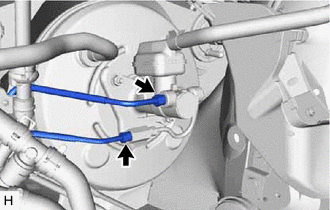
Using a union nut wrench, disconnect the 2 brake lines from the brake master cylinder sub-assembly.
Note
-
Do not kink or damage the brake lines.
-
Do not allow any foreign matter such as dirt or dust to enter the brake lines from the connecting parts.
-
-
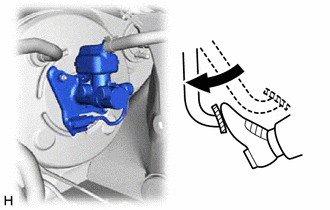
Slowly depress the brake pedal and hold it.*1
-
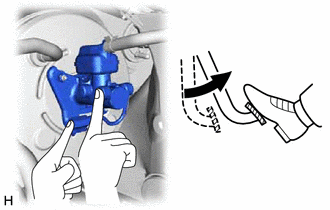
Cover the 2 outer holes with fingers, and release the brake pedal.*2
-
Repeat steps *1 and *2, 3 or 4 times.
-
Using a union nut wrench, connect the 2 brake lines to the brake master cylinder sub-assembly.
- Torque:
- 19.5 N*m { 199 kgf*cm, 14 ft.*lbf }
Note
-
Do not kink or damage the brake lines.
-
Do not allow the brake lines to twist or interfere with other parts or the vehicle body during tightening.
-
Do not allow any foreign matter such as dirt or dust to enter the brake lines from the connecting parts.
-
Use the formula to calculate special torque values for situations where the union nut wrench is combined with a torque wrench.
-
-
BLEED BRAKE LINE
-
BLEED BRAKE SYSTEM
Note
-
After bleeding the brake system, if the required height or feel of the brake pedal cannot be obtained, perform air bleeding of the brake actuator assembly with the GTS by following the procedure below.
-
To prevent brake fluid from damaging painted surfaces, cover any surrounding parts with a piece of cloth.
-
Depress the brake pedal more than 20 times with the ignition switch off.
-
Connect the GTS to the DLC3.
-
Turn the ignition switch to ON and turn the GTS on.
Note
Do not start the engine.
-
Enter the following menus: Chassis / ABS/VSC/TRC / Utility / Air Bleeding.
Chassis > ABS/VSC/TRC > UtilityTester Display Air Bleeding -
Bleed brake system by following the instructions on the GTS.
-
After air bleeding, tighten each bleeder plug.
- Torque:
- Front Brake
- 8.3 N*m { 85 kgf*cm, 73 in.*lbf }
- Rear Brake
- 10.8 N*m { 110 kgf*cm, 8 ft.*lbf }
-
Turn the GTS off and turn the ignition switch off.
-
Disconnect the GTS from the DLC3.
-
-
INSPECT FOR BRAKE FLUID LEAK
-
INSPECT BRAKE FLUID LEVEL IN RESERVOIR