METER / GAUGE SYSTEM Speed Signal Circuit
DESCRIPTION
The combination meter assembly receives the vehicle speed signal from this circuit. The wheel speed sensors produce an output that varies according to the vehicle speed. The wheel speed sensor output is received by the brake actuator assembly (skid control ECU) which uses this information to create the vehicle speed signal*1. The vehicle speed signal consists of pulses sent to the combination meter assembly from the brake actuator assembly (skid control ECU). To create this signal, 12 V is output from IG2 which is behind a resistor in the combination meter assembly. This voltage is sent to the brake actuator assembly (skid control ECU). The pulse signal is created by switching the transistor in the brake actuator assembly (skid control ECU) on and off, making the voltage on the wire drop to 0 V. A similar system is used for the output of this signal from the combination meter assembly via terminal +S. A voltage of 12 V or 5 V is applied to terminal +S from each ECU or relay that is connected to this terminal. The transistor in the combination meter assembly is controlled by the signal from the brake actuator assembly (skid control ECU). When this transistor is turned on, this transistor makes the voltage supplied by the various ECUs (via their respective internal resistors) drop to 0 V. Each ECU connected to terminal +S of the combination meter assembly controls its respective system based on this pulse signal.
-
*1: This vehicle speed signal is created by the brake actuator assembly (skid control ECU). There is no actual component that is referred to as the vehicle speed sensor. In addition, for some systems, vehicle speed information may be received via CAN communication.
Tech Tips
This circuit is used for the systems connected to terminal +S. This signal is not used for combination meter assembly operation. Combination meter assembly components such as the speedometer operate using data received via CAN communication.
WIRING DIAGRAM
-
for 1AR-FE
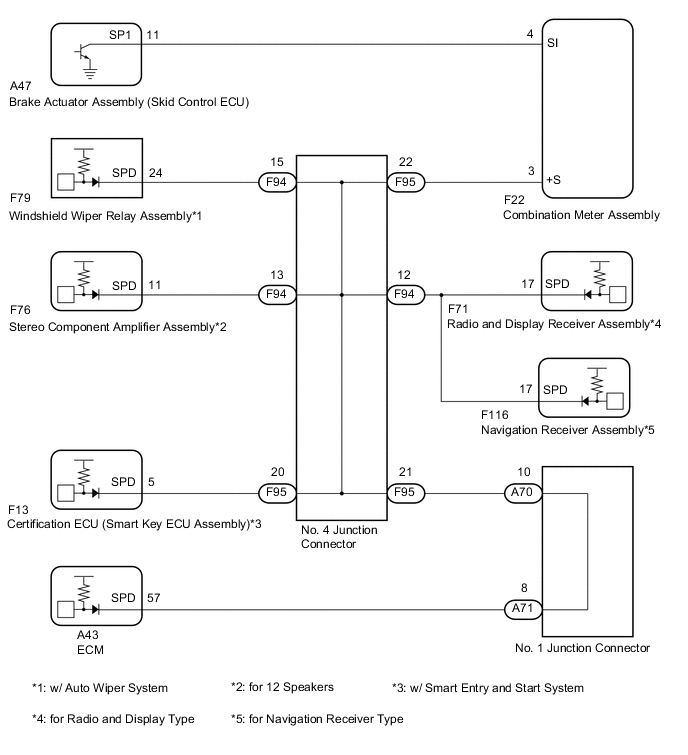
-
for 2GR-FE
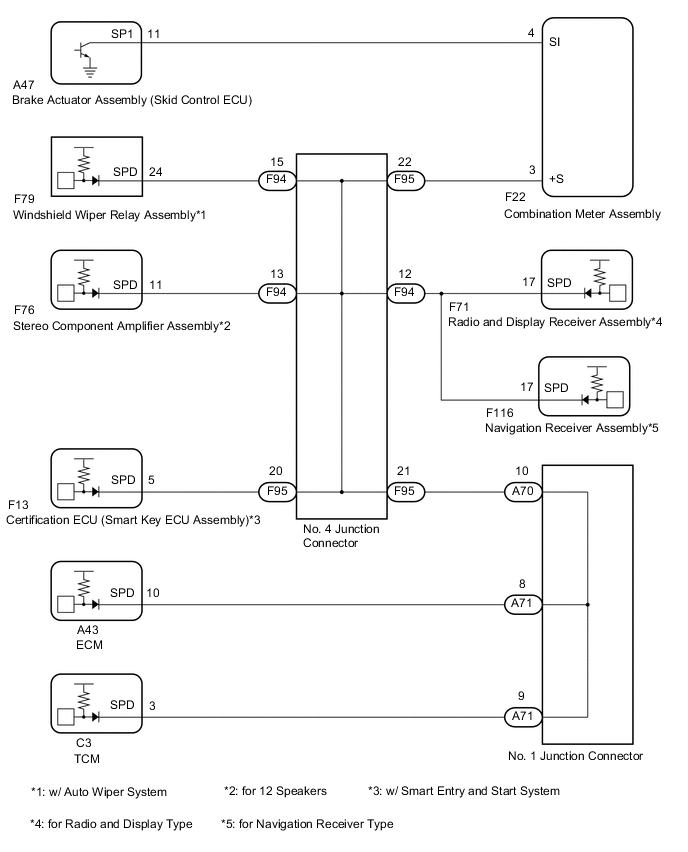
PROCEDURE
-
INSPECT ECU TERMINAL VOLTAGE (INPUT VOLTAGE)
-
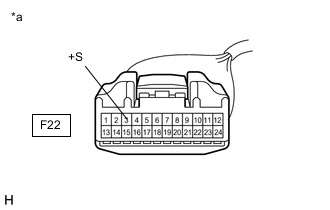
*a Front view of wire harness connector
(to Combination Meter Assembly)
Disconnect the F22 combination meter assembly connector.
-
Measure the voltage according to the value(s) in the table below.
Standard Voltage Tester Connection Condition Specified Condition F22-3 (+S) - Body ground Ignition switch ON 4.5 to 14 V Tech Tips
If any of the ECUs specified in the wiring diagram supplies power to the combination meter assembly, the combination meter assembly will output a waveform.
Result Proceed to OK NG
NG 
CHECK HARNESS AND CONNECTOR (COMBINATION METER ASSEMBLY - NO. 4 JUNCTION CONNECTOR) Click here
OK 
-
-
INSPECT COMBINATION METER ASSEMBLY (OUTPUT VOLTAGE)
-
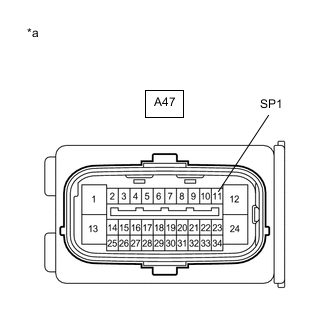
*a Front view of wire harness connector
(to Brake Actuator Assembly (Skid Control ECU))
Disconnect the A47 brake actuator assembly (skid control ECU) connector.
-
Measure the voltage according to the value(s) in the table below.
Standard Voltage Tester Connection Condition Specified Condition A47-11 (SP1) - Body ground Ignition switch ON 11 to 14 V Result Proceed to OK NG
NG
CHECK HARNESS AND CONNECTOR (COMBINATION METER ASSEMBLY - BRAKE ACTUATOR ASSEMBLY (SKID CONTROL ECU)) Click here
OK
-
-
INSPECT BRAKE ACTUATOR ASSEMBLY (SKID CONTROL ECU ASSEMBLY) (INPUT WAVEFORM)
-
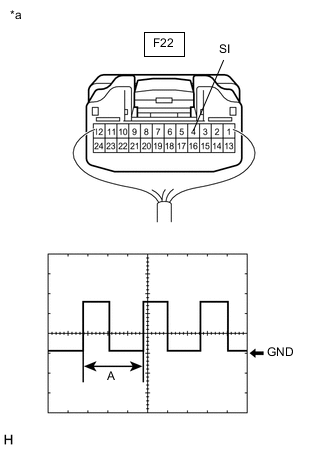
*a Component with harness connected
(Combination Meter Assembly)
Check the input waveform.
-
Remove the combination meter assembly with the connector(s) still connected.
-
Connect an oscilloscope to terminal F22-4 (SI) and body ground.
-
Turn the ignition switch to ON.
-
Turn a wheel slowly.
-
Check the signal waveform according to the condition(s) in the table below.
Item Condition Tool setting 5 V/DIV., 20 ms./DIV. Vehicle condition Ignition switch ON, wheel being rotated OK The waveform is similar to that shown in the illustration. Tech Tips
When the system is functioning normally, one wheel revolution generates 4 pulses. As the vehicle speed increases, the width indicated by (A) in the illustration narrows.
Result Proceed to OK NG -
OK 
REPLACE COMBINATION METER ASSEMBLY Click here
NG
REPLACE BRAKE ACTUATOR ASSEMBLY (SKID CONTROL ECU ASSEMBLY) Click here
-
-
CHECK HARNESS AND CONNECTOR (COMBINATION METER ASSEMBLY - BRAKE ACTUATOR ASSEMBLY (SKID CONTROL ECU))
-
Disconnect the F22 combination meter assembly connector.
-
Disconnect the A47 brake actuator assembly (skid control ECU assembly) connector.
-
Measure the resistance according to the value(s) in the table below.
Standard Resistance Tester Connection Condition Specified Condition F22-4 (SI) - A47-11 (SP1) Always Below 1 Ω F22-4 (SI) - Body ground Always 10 kΩ or higher Result Proceed to OK NG
OK
REPLACE COMBINATION METER ASSEMBLY Click here
NG
REPAIR OR REPLACE HARNESS OR CONNECTOR
-
-
CHECK HARNESS AND CONNECTOR (COMBINATION METER ASSEMBLY - NO. 4 JUNCTION CONNECTOR)
-
Disconnect the F22 combination meter assembly connector.
-
Disconnect the F95 No. 4 junction connector.
-
Measure the resistance according to the value(s) in the table below.
Standard Resistance Tester Connection Condition Specified Condition F22-3 (+S) - F95-22 Always Below 1 Ω F22-3 (+S) - Body ground Always 10 kΩ or higher Result Proceed to OK NG
NG
REPAIR OR REPLACE HARNESS OR CONNECTOR
OK
-
-
CHECK HARNESS AND CONNECTOR (NO. 4 JUNCTION CONNECTOR)
-
Inspect for a short in the wire harness and connectors connected to the No. 4 junction connector shown in the wiring diagram.
Tech Tips
If voltage is not present, it is possible that an ECU or circuit has a malfunction. The malfunctioning ECU or circuit will be diagnosed in the following steps.
-
Disconnect the F94 No. 4 junction connector.
-
Measure the voltage according to the value(s) in the table below.
Standard Voltage Tester Connection Condition Specified Condition F94-12 - Body ground Ignition switch ON 4.5 to 14 V F94-13 - Body ground*1 Ignition switch ON 4.5 to 14 V F94-15 - Body ground*2 Ignition switch ON 4.5 to 14 V F95-20 - Body ground*3 Ignition switch ON 4.5 to 14 V F95-21 - Body ground Ignition switch ON 4.5 to 14 V
-
*1: for 12 Speakers
*2: w/ Auto Wiper System
*3: w/ Smart Entry and Start System
Result Result Proceed to Voltage is not present in one circuit. A Voltage is present in all of the circuits. B -
B
REPLACE NO. 4 JUNCTION CONNECTOR
A
-
-
SYSTEM CHECK
-
Select the circuit for which voltage was not present in step 6.
Result Result System that uses the circuit Proceed to F94-12 - Body ground Audio and visual system*1 or Navigation system*2 A F94-13 - Body ground Navigation system*3 B F94-15 - Body ground Auto wiper system*4 C F95-20 - Body ground Smart entry and start system*5 D F95-21 - Body ground SFI system or Automatic transaxle system*6 E
-
*1: for Radio and Display Type
*2: for Navigation Receiver Type
*3: for 12 Speakers
*4: w/ Auto Wiper System
*5: w/ Smart Entry and Start System
*6: for 2GR-FE
-
B
CHECK HARNESS AND CONNECTOR (STEREO COMPONENT AMPLIFIER ASSEMBLY - BODY GROUND) Click here
C
CHECK HARNESS AND CONNECTOR (WINDSHIELD WIPER RELAY ASSEMBLY - BODY GROUND) Click here
D
CHECK HARNESS AND CONNECTOR (CERTIFICATION ECU (SMART KEY ECU ASSEMBLY) - BODY GROUND) Click here
E
CHECK HARNESS AND CONNECTOR (NO. 4 JUNCTION CONNECTOR - NO. 1 JUNCTION CONNECTOR) Click here
A
-
-
CHECK HARNESS AND CONNECTOR (RADIO AND DISPLAY RECEIVER ASSEMBLY OR NAVIGATION RECEIVER ASSEMBLY - BODY GROUND)
-
Disconnect the F71 radio and display receiver assembly*1 or F116 navigation receiver assembly*2 connector.
-
Measure the resistance according to the value(s) in the table below.
Standard Resistance Tester Connection Condition Specified Condition F71-17 (SPD) - Body ground*1 Always 10 kΩ or higher F116-17 (SPD) - Body ground*2 Always 10 kΩ or higher
-
*1: for Radio and Display Type
*2: for Navigation Receiver Type
Result Result Proceed to OK (for Radio and Display Type) A OK (for Navigation Receiver Type) B NG C -
A
REPLACE RADIO AND DISPLAY RECEIVER ASSEMBLY Click here
B
REPLACE NAVIGATION RECEIVER ASSEMBLY Click here
C
REPAIR OR REPLACE HARNESS OR CONNECTOR
-
-
CHECK HARNESS AND CONNECTOR (STEREO COMPONENT AMPLIFIER ASSEMBLY - BODY GROUND)
-
Disconnect the F76 stereo component amplifier assembly connector.
-
Measure the resistance according to the value(s) in the table below.
Standard Resistance Tester Connection Condition Specified Condition F76-11 (SPD) - Body ground Always 10 kΩ or higher Result Proceed to OK NG
OK
REPLACE STEREO COMPONENT AMPLIFIER ASSEMBLY Click here
NG
REPAIR OR REPLACE HARNESS OR CONNECTOR
-
-
CHECK HARNESS AND CONNECTOR (WINDSHIELD WIPER RELAY ASSEMBLY - BODY GROUND)
-
Disconnect the F79 windshield wiper relay assembly connector.
-
Measure the resistance according to the value(s) in the table below.
Standard Resistance Tester Connection Condition Specified Condition F79-24 (SPD) - Body ground Always 10 kΩ or higher Result Proceed to OK NG
OK
REPLACE WINDSHIELD WIPER RELAY ASSEMBLY Click here
NG
REPAIR OR REPLACE HARNESS OR CONNECTOR
-
-
CHECK HARNESS AND CONNECTOR (CERTIFICATION ECU (SMART KEY ECU ASSEMBLY) - BODY GROUND)
-
Disconnect the F13 certification ECU (smart key ECU assembly) connector.
-
Measure the resistance according to the value(s) in the table below.
Standard Resistance Tester Connection Condition Specified Condition F13-5 (SPD) - Body ground Always 10 kΩ or higher Result Proceed to OK NG
OK
REPLACE CERTIFICATION ECU (SMART KEY ECU ASSEMBLY)
NG
REPAIR OR REPLACE HARNESS OR CONNECTOR
-
-
CHECK HARNESS AND CONNECTOR (NO. 4 JUNCTION CONNECTOR - NO. 1 JUNCTION CONNECTOR)
-
Disconnect the F95 No. 4 junction connector.
-
Disconnect the A70 No. 1 junction connector.
-
Measure the resistance according to the value(s) in the table below.
Standard Resistance Tester Connection Condition Specified Condition F95-21 - A70-10 Always Below 1 Ω F95-21 - Body ground Always 10 kΩ or higher Result Proceed to OK NG
NG
REPAIR OR REPLACE HARNESS OR CONNECTOR
OK
-
-
CHECK HARNESS AND CONNECTOR (NO. 1 JUNCTION CONNECTOR)
-
Inspect for a short in the wire harness and connectors connected to the No. 1 junction connector shown in the wiring diagram.
Tech Tips
If voltage is not present, it is possible that an ECU or circuit has a malfunction. The malfunctioning ECU or circuit will be diagnosed in the following steps.
-
Disconnect the A71 No. 1 junction connector.
-
Measure the voltage according to the value(s) in the table below.
Standard Voltage Tester Connection Condition Specified Condition A71-8 - Body ground Ignition switch ON 4.5 to 14 V A71-9 - Body ground*1 Ignition switch ON 4.5 to 14 V
-
*1: for 2GR-FE
Result Result Proceed to Voltage is not present in one circuit. A Voltage is present in all of the circuits. B -
B
REPLACE NO. 1 JUNCTION CONNECTOR
A
-
-
SYSTEM CHECK
-
Select the circuit for which voltage was not present in step 6.
Result Result System that uses the circuit Proceed to A71-8 - Body ground SFI system A A71-9 - Body ground Automatic transaxle system*1 B
-
*1: for 2GR-FE
-
B
CHECK HARNESS AND CONNECTOR (TCM - BODY GROUND) Click here
A
-
-
CHECK HARNESS AND CONNECTOR (ECM - BODY GROUND)
-
Disconnect the A43 ECM connector.
-
Measure the resistance according to the value(s) in the table below.
Standard Resistance Tester Connection Condition Specified Condition A43-57 (SPD) - Body ground*1 Always 10 kΩ or higher A43-10 (SPD) - Body ground*2 Always 10 kΩ or higher
-
*1: for 1AR-FE
*2: for 2GR-FE
Result Proceed to OK NG -
OK
REPLACE ECM for 1AR-FE: Click here
REPLACE ECM for 2GR-FE: Click hereNG
REPAIR OR REPLACE HARNESS OR CONNECTOR
-
-
CHECK HARNESS AND CONNECTOR (TCM - BODY GROUND)
-
Disconnect the C3 TCM connector.
-
Measure the resistance according to the value(s) in the table below.
Standard Resistance Tester Connection Condition Specified Condition C3-3 (SPD) - Body ground Always 10 kΩ or higher Result Proceed to OK NG
OK
REPLACE TCM Click here
NG
REPAIR OR REPLACE HARNESS OR CONNECTOR
-