AUTOMATIC TRANSAXLE SYSTEM Transmission Control Switch Circuit
DESCRIPTION
When the shift lever is in S and it is moved toward "-" or "+", it is possible to select different shift ranges (1st through 6th range).
Moving the shift lever toward "+" increases the shift range by one, and moving the shift lever toward "-" decreases the shift range by one.
WIRING DIAGRAM
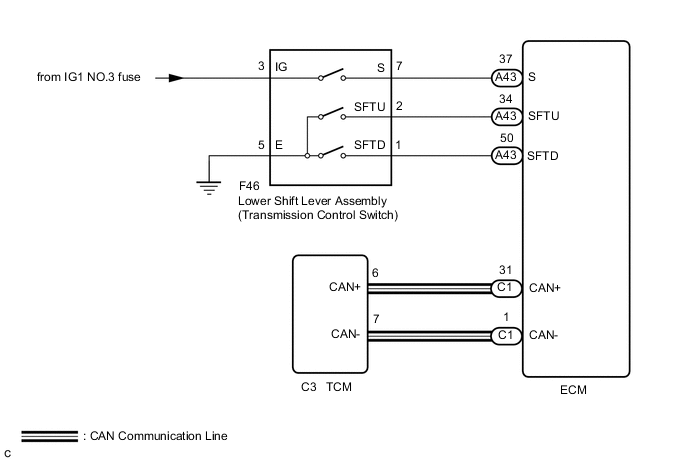
CAUTION / NOTICE / HINT
Note
Inspect the fuses for circuits related to this system before performing the following inspection procedure.
Tech Tips
-
Refer to inspection procedure for CAN communication system.
-
If the CAN communication system is malfunctioning, the TCM cannot receive current data from the ECM. In this case, the freeze frame data output from the TCM has not been updated, so it will not be useful for inspection. However, reading the Data List as the first step in troubleshooting is effective to find malfunctions.
-
The malfunction area can be checked using the Bus Check function on the GTS.
PROCEDURE
-
CHECK HARNESS AND CONNECTOR (BATTERY - TRANSMISSION CONTROL SWITCH)
-
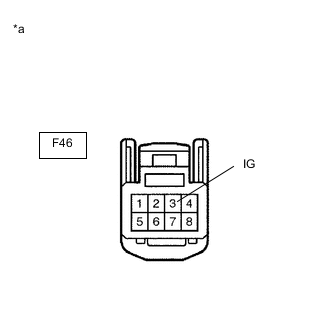
*a Front view of wire harness connector
(to Transmission Control Switch)
Disconnect the transmission control switch connector.
-
Measure the voltage according to the value(s) in the table below.
Standard Voltage Tester Connection Condition Specified Condition F46-3 (IG) - Body ground Ignition switch ON 11 to 14 V Ignition switch off Below 1 V Result Proceed to OK NG
NG 
CHECK POWER SOURCE CIRCUIT
OK 
-
-
CHECK HARNESS AND CONNECTOR (TRANSMISSION CONTROL SWITCH - BODY GROUND)
-
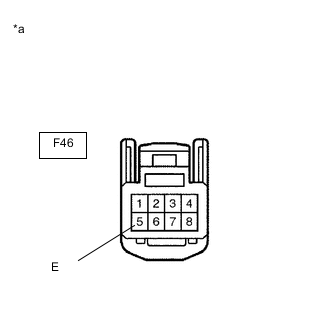
*a Front view of wire harness connector
(to Transmission Control Switch)
Measure the resistance according to the value(s) in the table below.
Standard Resistance Tester Connection Condition Specified Condition F46-5 (E) - Body ground Always Below 1 Ω Result Proceed to OK NG
NG
REPAIR OR REPLACE HARNESS OR CONNECTOR
OK
-
-
INSPECT TRANSMISSION FLOOR SHIFT ASSEMBLY (TRANSMISSION CONTROL SWITCH)
-
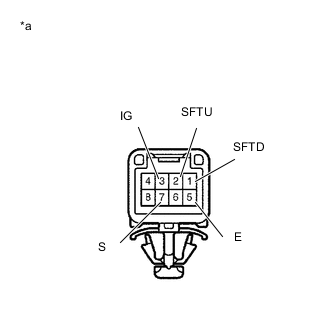
*a Component without harness connected
(Transmission Control Switch)
Measure the resistance between each terminal of the transmission control switch when the shift lever is moved to each position.
Standard Resistance Tester Connection Condition Specified Condition F46-3 (IG) - F46-7 (S) Shift lever in S, "+" or "-" Below 1 Ω Shift lever not in S, "+" or "-" 10 kΩ or higher F46-2 (SFTU) - F46-5 (E) Shift lever held in "+"
(Up-shift)
Below 1 Ω Shift lever not held in "+" 10 kΩ or higher F46-1 (SFTD) - F46-5 (E) Shift lever held in "-"
(Down-shift)
Below 1 Ω Shift lever not held in "-" 10 kΩ or higher Result Proceed to OK NG
NG
REPLACE TRANSMISSION FLOOR SHIFT ASSEMBLY (TRANSMISSION CONTROL SWITCH) Click here
OK
-
-
CHECK HARNESS AND CONNECTOR (TRANSMISSION CONTROL SWITCH - ECM)
-
Connect the transmission control switch connector.
-
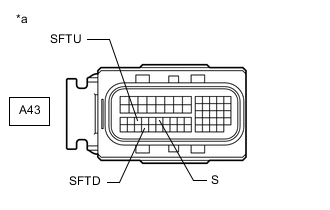
*a Front view of wire harness connector
(to ECM)
Disconnect the ECM connector.
-
Turn the ignition switch to ON.
-
Measure the voltage according to the value(s) in the table below.
Standard Voltage Tester Connection Condition Specified Condition A43-37 (S) - Body ground
-
Ignition switch ON
-
Shift lever in S, "+" or "-"
11 to 14 V A43-37 (S) - Body ground
-
Ignition switch ON
-
Shift lever not in S, "+" or "-"
Below 1 V -
-
Turn the ignition switch off.
-
Measure the resistance according to the value(s) in the table below.
Standard Resistance Tester Connection Condition Specified Condition A43-34 (SFTU) - Body ground Shift lever held in "+"
(Up-shift)
Below 1 Ω Shift lever not held in "+" 10 kΩ or higher A43-50 (SFTD) - Body ground Shift lever held in "-"
(Down-shift)
Below 1 Ω Shift lever not held in "-" 10 kΩ or higher Result Proceed to OK NG
OK
PROCEED TO NEXT SUSPECTED AREA SHOWN IN PROBLEM SYMPTOMS TABLE Click here
NG
REPAIR OR REPLACE HARNESS OR CONNECTOR
-