ENGINE ON-VEHICLE INSPECTION

PROCEDURE
-
INSPECT ENGINE COOLANT
-
INSPECT ENGINE OIL
-
CHECK BATTERY CONDITION
-
INSPECT SPARK PLUG
-
INSPECT AIR CLEANER FILTER ELEMENT SUB-ASSEMBLY
-
Remove the air cleaner filter element sub-assembly.
-
Visually check that the air cleaner filter element sub-assembly is not damaged or excessively oily.
Tech Tips
-
If there is any dirt or clogs in the air cleaner filter element sub-assembly, clean it with compressed air.
-
If any dirt or clogs remain even after cleaning the air cleaner filter element sub-assembly with compressed air, replace it.
-
-
Install the air cleaner filter element sub-assembly.
-
-
INSPECT V-RIBBED BELT
-
INSPECT V-RIBBED BELT TENSIONER ASSEMBLY
-
Remove the V-ribbed belt.
-
Turn the V-ribbed belt tensioner assembly clockwise and counterclockwise and check that it turns smoothly and does not catch.
Tech Tips
If the V-ribbed belt tensioner assembly does not turn smoothly or catches, replace the V-ribbed belt tensioner assembly.
-
Install the V-ribbed belt.
-
-
INSPECT VALVE LASH ADJUSTER ASSEMBLY NOISE
-
Rev up the engine several times. Check that the engine does not emit unusual noises.
-
If unusual noises occur, warm up the engine and idle it for 30 minutes or more, then perform the inspection.
Tech Tips
If any defects or problems are found during the inspection, perform valve lash adjuster assembly inspection.
-
-
INSPECT IGNITION TIMING
Note
-
Check the ignition timing with the cooling fans off.
-
Turn off all the electrical systems and the A/C.
-
When checking the ignition timing, the transaxle should be in neutral or park.
-
Warm up and stop the engine.
-
When using the GTS:
-
Connect the GTS to the DLC3.
-
Start the engine and run it at idle.
-
Turn the GTS on.
-
Enter the following menus: Powertrain / Engine / Data List / Ignition Timing Cylinder #1.
Powertrain > Engine > Data ListTester Display Ignition Timing Cylinder #1 Standard Ignition Timing 12 to 24° BTDC at idle -
Check that the ignition timing advances immediately when the engine speed is increased.
-
Enter the following menus: Powertrain / Engine / Active Test / Activate the TC Terminal / ON.
Powertrain > Engine > Active TestActive Test Display Activate the TC Terminal Data List Display Ignition Timing Cylinder #1 -
Monitor Ignition Timing cylinder #1 of the Data List.
Standard Ignition Timing 8 to 12° BTDC at idle
-
-
When not using the GTS:
-
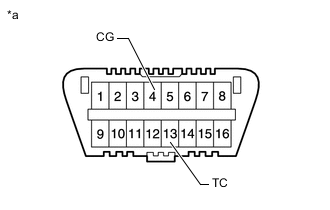
*a DLC3 Using SST, connect terminals 13 (TC) and 4 (CG) of the DLC3.
- SST
- 09843-18040
Note
Confirm the terminal numbers before connecting them. Connecting the wrong terminals may damage electrical components.
-
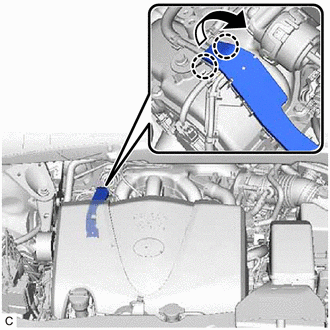
Disengage the 2 claws and open the cover.
-
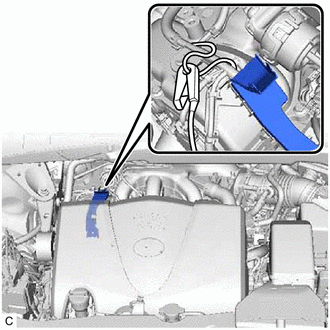
Connect the clip of the timing light to the ignition coil wire for the No. 1 cylinder.
Note
Use a timing light that detects primary signals.
-
Start the engine and run it at idle.
-
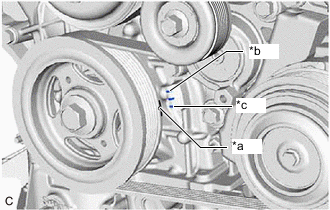
*a Cutout *b 10° BTDC *c TDC Check the ignition timing at idle.
Standard Ignition Timing 8 to 12° BTDC at idle Tech Tips
-
If the cutout of the crankshaft pulley is approximately aligned the protrusion (10° CA BTDC) of the timing chain cover assembly, the ignition timing meets the standard.
-
Run the engine at 1000 to 1300 rpm for 5 seconds, and then check that the engine speed returns to engine idle speed.
-
-
Disconnect terminals 13 (TC) and 4 (CG) of the DLC3.
-
Check the ignition timing at idle.
Standard Ignition Timing 12 to 24° BTDC at idle -
Confirm that the ignition timing advances immediately when the engine speed is increased.
-
Disconnect the clip of the timing light from the ignition coil wire for the No. 1 cylinder.
-
Close the cover and engage the 2 claws.
-
-
-
INSPECT ENGINE IDLE SPEED
Note
-
Check the idle speed with the cooling fans off.
-
Turn off all the electrical systems and the A/C.
-
When checking the idle speed, the transaxle should be in neutral or park.
-
Warm up and stop the engine.
-
When using the GTS:
-
Connect the GTS to the DLC3.
-
Start the engine and run it at idle.
-
Turn the GTS on.
-
Enter the following menus: Powertrain / Engine / Data List / Engine Speed.
Powertrain > Engine > Data ListTester Display Engine Speed -
Read the value displayed on the GTS.
Standard Idle Speed 650 to 750 rpm
-
-
When not using the GTS:
-
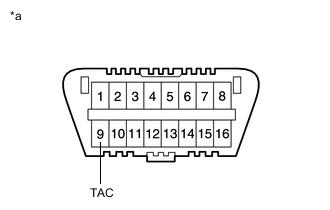
*a DLC3 Using SST, connect a tachometer probe to terminal 9 (TAC) of the DLC3.
- SST
- 09843-18030
Note
Be sure to connect the tachometer probe to the correct terminal. Connecting to the wrong terminal may result in damage to electrical components.
-
Start the engine and run it at idle.
-
Check the idle speed.
Standard Idle Speed 650 to 750 rpm -
Turn the engine switch off.
-
Disconnect the tachometer probe from terminal 9 (TAC) of the DLC3.
-
-
-
INSPECT COMPRESSION
Note
Keep the intake manifold and spark plug holes free of foreign matter when measuring the compression pressure.
-
Warm up and stop the engine.
-
Check for DTCs.
-
Remove the 6 spark plugs.
-
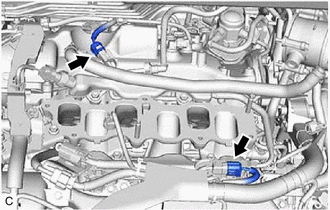
Disconnect the 2 No. 5 engine wire connectors (for Port Injection).
Note
Perform this step in order to stop fuel injection to prevent damage to the catalyst due to unburned fuel.
-
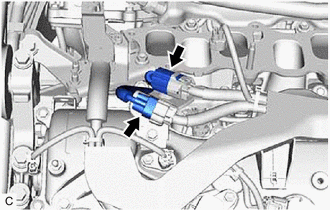
Disconnect the No. 6 engine wire connector and No. 7 engine wire connector (for Direct Injection).
Note
Perform this step in order to stop fuel injection to prevent damage to the catalyst due to unburned fuel.
-
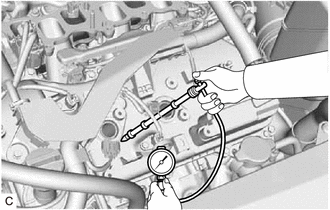
Check the cylinder compression pressure.
-
Insert a compression gauge into the spark plug hole.
-
While cranking the engine, measure the compression pressure.
Standard Compression Pressure 1400 kPa (14.3 kgf/cm2, 203 psi) Minimum Compression Pressure 1050 kPa (10.7 kgf/cm2, 152 psi) Pressure Difference between Each Cylinder 200 kPa (2.0 kgf/cm2, 29 psi) or less Note
-
Always use a fully charged battery to obtain an engine speed of 250 rpm or more.
-
Inspect all cylinders in the same way.
-
Measure the compression pressure as quickly as possible.
-
-
If the cylinder compression is low, pour a small amount of engine oil into the cylinder through the spark plug hole then inspect the cylinder compression pressure again.
Tech Tips
-
If adding oil increases the compression pressure, the piston rings and/or cylinder bore may be worn or damaged.
-
If the compression pressure stays low, a valve may be stuck or seated improperly, or there may be leaks in the cylinder head gasket.
-
-
-
Connect the No. 6 engine wire connector and No. 7 engine wire connector (for Direct Injection).
-
Connect the 2 No. 5 engine wire connectors (for Port Injection).
-
Install the 6 spark plugs.
-
Clear the DTCs.
Note
After performing the inspection, clear the DTCs and confirm that DTCs are not stored again or that the normal system code is output if using a check wire.
-
-
INSPECT CO/HC
Tech Tips
This check determines whether or not the idle CO/HC complies with regulations.
-
Start the engine.
-
Run the engine speed at 2500 rpm for approximately 180 seconds.
-
Insert a CO/HC meter testing probe at least 40 cm (1.31 ft.) into the tailpipe during idle.
-
Immediately check the CO/HC concentration at idle and then at an engine speed of 2500 rpm.
Tech Tips
When performing a 2 mode test (with the engine idling/running at 2500 rpm), the measurement procedures are determined by applicable local regulations.
If the CO/HC concentration does not comply with the regulations, perform troubleshooting in the order given below.
-
Check for DTCs.
-
See the following table for possible causes, then inspect the applicable parts and repair them if necessary.
CO HC Problem Cause Normal High Rough idle
-
Faulty ignition:
-
Incorrect valve timing
-
Fouled, shorted or improperly gapped spark plugs
-
Incorrect valve clearance (valve lash adjuster assembly)
-
Leaks in intake or exhaust valves
-
Leaks in cylinders
Low High Rough idle
(Fluctuating HC reading)
-
Vacuum leaks:
-
PCV hoses
-
Intake manifold
-
Throttle with motor body assembly
-
Brake booster line
-
Lean mixture causing misfire
High High Rough idle
(Black smoke from exhaust)
-
Restricted air cleaner filter element sub-assembly
-
Plugged PCV valve
-
Faulty SFI system:
-
Fuel pressure regulator assembly
-
Engine coolant temperature sensor
-
Mass air flow meter sub-assembly
-
ECM
-
Fuel injector assemblies
-
Throttle position sensor (built into throttle with motor body assembly)
-
-
-