CYLINDER BLOCK REASSEMBLY
CAUTION / NOTICE / HINT
PROCEDURE
-
INSTALL CYLINDER HEAD STUD BOLT
Note
If a stud bolt is deformed or its threads are damaged, replace it.
-
Using E8 and E10 "TORX" socket wrenches, install the stud bolts.
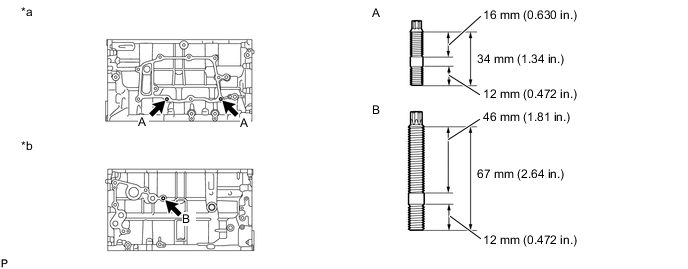
*a RH Side *b LH Side - Torque:
- Stud Bolt (A)
- 6.5 N*m { 66 kgf*cm, 58 in.*lbf }
- Stud Bolt (B)
- 8.5 N*m { 87 kgf*cm, 75 in.*lbf }
-
-
INSTALL NO. 2 OIL NOZZLE SUB-ASSEMBLY
-
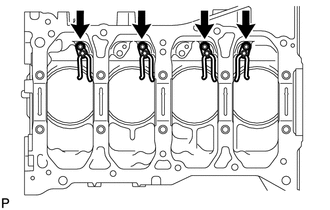
Using a 5 mm hexagon wrench, install the 4 No. 2 oil nozzle sub-assemblies with the 4 bolts.
- Torque:
- 10 N*m { 102 kgf*cm, 7 ft.*lbf }
-
-
INSTALL NO. 1 OIL NOZZLE SUB-ASSEMBLY
-
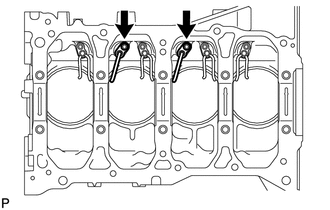
Using a 5 mm hexagon wrench, install the 2 No. 1 oil nozzle sub-assemblies with the 2 bolts.
- Torque:
- 10 N*m { 102 kgf*cm, 7 ft.*lbf }
-
-
INSTALL PISTON
-
Using a screwdriver, install a new piston pin hole snap ring (rear side) at one end of the piston pin hole.
-
Gradually heat the piston to 80 to 90°C (176 to 194°F).
-
Coat the piston, piston pin and connecting rod sub-assembly with engine oil.
-
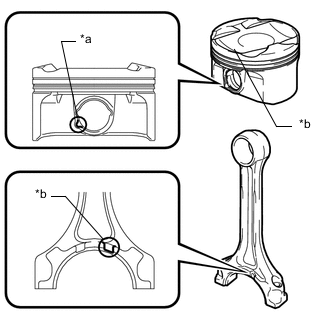
*a Cutout *b Front Mark Align the cutout of the piston and front mark of the connecting rod sub-assembly, insert the connecting rod sub-assembly into the piston, and then push in the piston pin with your thumb until the piston pin comes into contact with the snap ring.
Tech Tips
The piston and piston pin are a matched set.
-
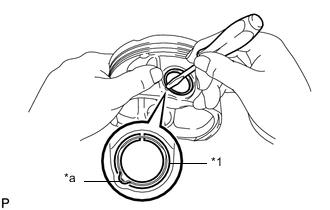
*1 Piston Pin Hole Snap Ring *a Cutout Using a screwdriver, install a new piston pin hole snap ring (front side) on the other side of the piston pin hole.
Tech Tips
Be sure that the end gap of the piston pin hole snap ring is not aligned with the cutout of the piston.
-
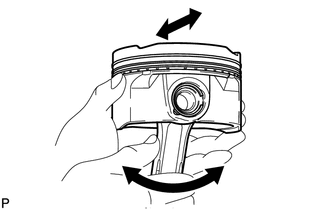
Check the fitting condition between the piston and piston pin.
-
Move the connecting rod sub-assembly back and forth on the piston pin. Check the fitting condition.
If abnormal movement is felt, replace the piston and piston pin as a set.
-
Rotate the piston back and forth on the piston pin. Check the fitting condition.
If abnormal movement is felt, replace the piston and piston pin as a set.
-
-
-
INSTALL PISTON RING SET
-
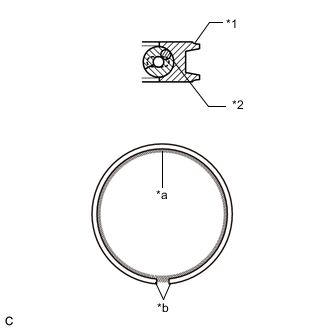
*1 Oil Ring *2 Oil Ring Expander *a Coil Joint *b Oil Ring End Install the oil ring expander and oil ring by hand.
Tech Tips
Arrange the oil ring ends and coil joint as shown in the illustration.
-
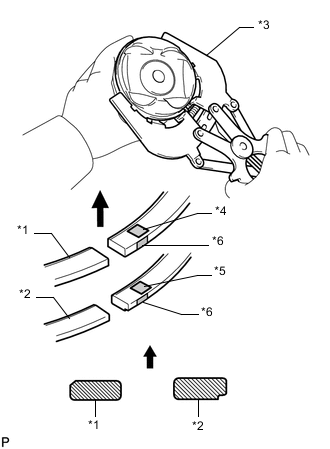
*1 No. 1 Compression Ring *2 No. 2 Compression Ring *a Piston Ring Expander *b Code Mark (N1) *c Code Mark (N2) *d Paint Mark 
Upward Using a piston ring expander, install the No. 1 compression ring and No. 2 compression ring with the code mark positioned as shown in the illustration.
Piston Ring Mark Item Code Mark No. 1 Compression Ring N1 No. 2 Compression Ring N2 Note
Install the compression rings with the code marks facing upward.
-
-
INSTALL CRANKSHAFT PULLEY KEY
-
Install the 2 crankshaft pulley keys to the crankshaft.
-
-
INSTALL CRANKSHAFT BEARING
-
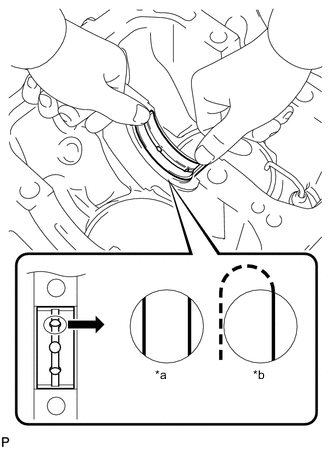
*a Correct *b Incorrect Clean the main journal and both surfaces of the crankshaft bearing and No. 2 crankshaft bearing.
-
Install the crankshaft bearing to the cylinder block sub-assembly as shown in the illustration.
Note
-
Do not apply engine oil to the crankshaft bearings and the contact surfaces.
-
Both sides of the oil groove in the cylinder block sub-assembly should be visible through the oil feed holes in the crankshaft bearing. The amount visible on each side of the holes should be equal.
-
Do not allow coolant to come into contact with the crankshaft bearing inner surface.
-
If any coolant comes into contact with the crankshaft bearing inner surface, replace the crankshaft bearing with a new one.
-
-
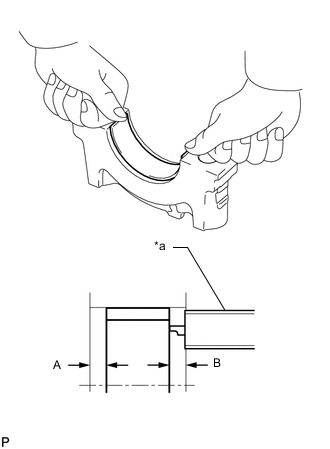
*a Vernier Caliper Install the No. 2 crankshaft bearing onto the crankshaft bearing cap.
-
Using a vernier caliper, measure the distance between the crankshaft bearing cap edge and the No. 2 crankshaft bearing edge.
Difference Between (A) and (B) 0 to 0.7 mm (0 to 0.0276 in.) Note
-
Do not apply engine oil to the crankshaft bearings and the contact surfaces.
-
Do not allow coolant to come into contact with the crankshaft bearing inner surface.
-
If any coolant comes into contact with the crankshaft bearing inner surface, replace the crankshaft bearing with a new one.
-
-
-
INSTALL CRANKSHAFT THRUST WASHER
-
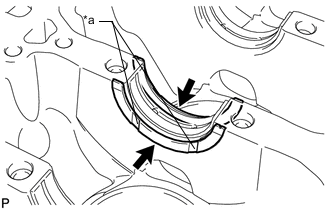
*a Oil Groove Apply engine oil to the crankshaft thrust washers.
-
Install the 2 crankshaft thrust washers onto the No. 3 journal position of the cylinder block sub-assembly with the oil grooves facing outward.
-
-
INSTALL CRANKSHAFT
-
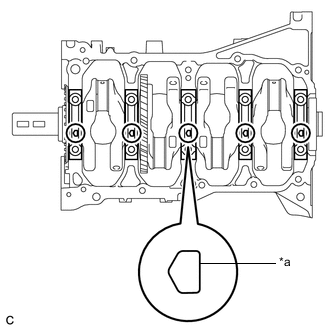
*a Front Mark Apply engine oil to the crankshaft bearing, and place the crankshaft on the cylinder block sub-assembly.
-
Confirm the front marks and numbers, and install the crankshaft bearing caps onto the cylinder block sub-assembly with the front marks as shown in the illustration.
Tech Tips
The crankshaft bearing cap bolts are tightened in 3 progressive steps.
-
Apply a light coat of engine oil to the threads and under the heads of the crankshaft bearing cap bolts.
-
Step 1:
-
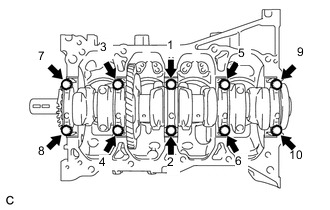
Uniformly install and tighten the 10 crankshaft bearing cap bolts in several steps in the order shown in the illustration.
- Torque:
- 20 N*m { 204 kgf*cm, 15 ft.*lbf }
-
-
Step 2:
-
Tighten the 10 crankshaft bearing cap bolts again in the order shown in the illustration.
- Torque:
- 40 N*m { 408 kgf*cm, 30 ft.*lbf }
If a crankshaft bearing cap bolt does not meet the specified torque, replace it.
-
-
Step 3:
-
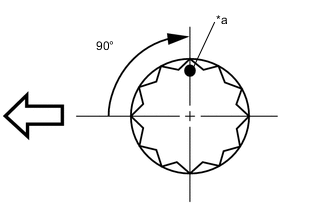
*a Paint Mark 
Engine Front Mark the front of the crankshaft bearing cap bolts with paint.
-
Tighten the crankshaft bearing cap bolts by 90° in the order shown in the illustration.
-
Check that the paint marks are now at a 90° angle to the front.
-
-
Check that the crankshaft turns smoothly.
-
-
INSTALL CONNECTING ROD BEARING
-
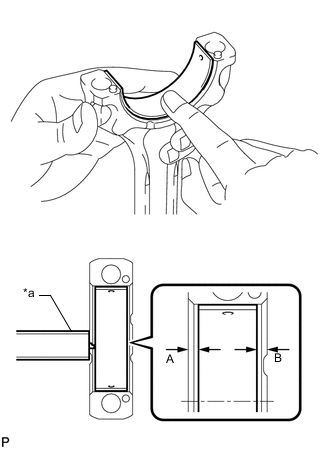
*a Vernier Caliper Clean the connecting rod bearing contact surface of the connecting rod sub-assembly and connecting rod cap, and both surfaces of both connecting rod bearings.
-
Install the connecting rod bearings to the connecting rod sub-assemblies and connecting rod caps.
-
Using a vernier caliper, measure the distance between the edges of the connecting rod sub-assembly and connecting rod bearing, and the edges of the connecting rod bearing cap and connecting rod bearing.
Difference Between (A) and (B) 0 to 0.7 mm (0 to 0.0276 in.) Note
-
Do not apply engine oil to the connecting rod bearings and the contact surfaces.
-
Do not allow coolant to come into contact with the connecting rod bearing inner surface.
-
If any coolant comes into contact with the connecting rod bearing inner surface, replace the connecting rod bearing with a new one.
-
-
-
INSTALL PISTON WITH CONNECTING ROD
-
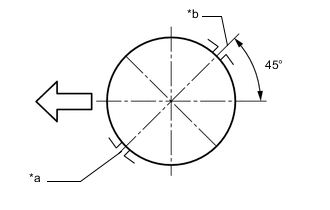
*1 No. 1 Compression Ring and Oil Ring *2 No. 2 Compression Ring and Oil Ring Expander Engine Front Apply engine oil to the cylinder walls, pistons, and surfaces of the connecting rod bearings.
-
Position the piston rings so that the ring ends are as shown in the illustration.
-
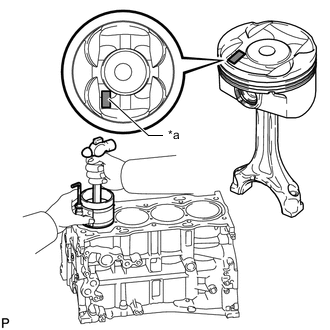
*a Front Mark Using a hammer handle and piston ring compressor, press a piston with connecting rod into each cylinder with the front mark of the piston facing the engine front.
Note
When inserting the piston with connecting rod into the cylinder block sub-assembly, make sure the oil nozzle does not interfere with the connecting rod sub-assembly.
Tech Tips
The front mark is "1L" printed in raised letters.
-
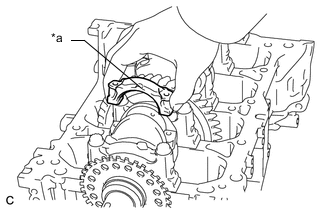
*a Front Mark Check that the front mark of the connecting rod cap is facing in the correct direction.
Note
Match the connecting rod cap with the connecting rod sub-assembly.
-
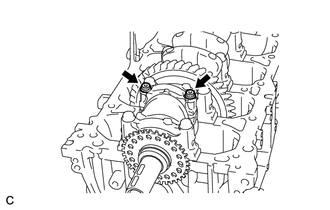
Apply a light coat of engine oil to the threads and under the heads of the 2 connecting rod bolts.
-
Temporarily install the 2 connecting rod bolts.
Tech Tips
The connecting rod bolts are tightened in 2 progressive steps.
-
Step 1:
-
Alternately tighten the 2 connecting rod bolts in several steps.
- Torque:
- 40 N*m { 408 kgf*cm, 30 ft.*lbf }
-
-
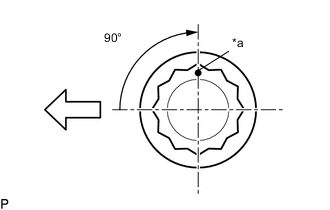
*a Paint Mark Engine Front Step 2:
-
Mark the front of the 2 connecting rod bolts with paint.
-
Tighten the connecting rod bolts by 90° as shown in the illustration.
-
Check that the paint marks are now at a 90° angle to the front.
-
-
Check that the crankshaft turns smoothly.
-