THEFT DETERRENT SYSTEM TERMINALS OF ECU
-
CHECK MAIN BODY ECU (MULTIPLEX NETWORK BODY ECU) AND INSTRUMENT PANEL JUNCTION BLOCK ASSEMBLY
-
Remove the main body ECU (multiplex network body ECU) from instrument panel junction block assembly.
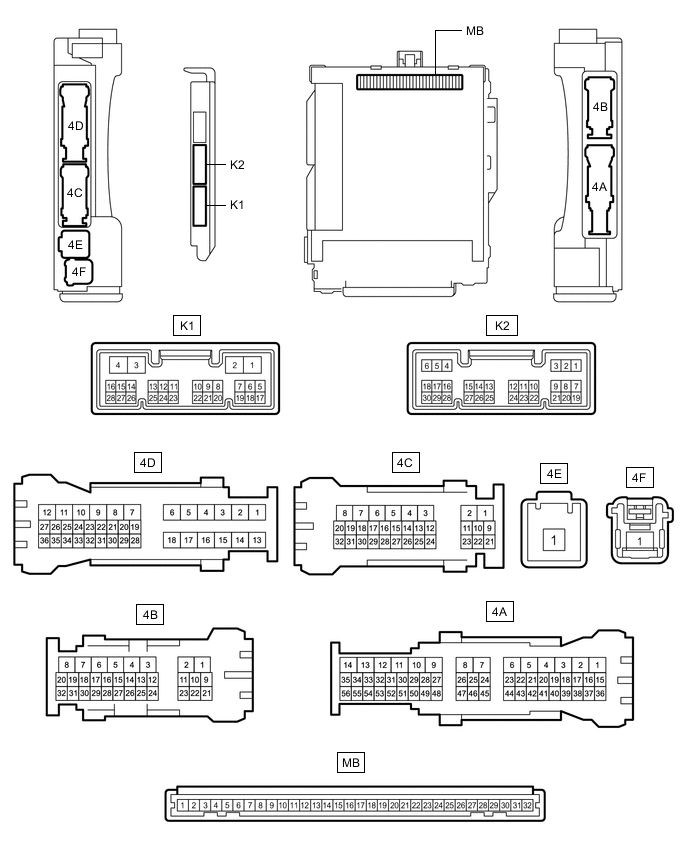
-
Reconnect the instrument panel junction block assembly connectors.
-
Measure the resistance and voltage according to the value(s) in the table below.
Tech Tips
Measure the values on the wire harness side with the connector disconnected.
Tester Connection Wiring Color Terminal Description Condition Specified Condition MB-31 (BECU) - Body ground - Auxiliary battery power supply Power switch off 11 to 14 V MB-32 (IG) - Body ground - Ignition power supply (IG signal) Power switch on (IG) → off 11 to 14 V → Below 1 V MB-30 (ACC) - Body ground - Ignition power supply (ACC signal) Power switch on (ACC) → off 11 to 14 V → Below 1 V MB-11 (GND1) - Body ground - Ground Always Below 1 Ω K2-6 (FLCY) - Body ground V - Body ground Front door courtesy light switch assembly (for LH) input Front door LH closed (OFF) → open (ON) 10 kΩ or higher → Below 1 Ω K2-27 (FRCY) - Body ground V - Body ground Front door courtesy light switch assembly (for RH) input Front door RH closed (OFF) → open (ON) 10 kΩ or higher → Below 1 Ω MB-13 (LCTY) - Body ground - Rear door courtesy light switch assembly (for LH) input Rear door LH closed (OFF) → open (ON) 10 kΩ or higher → Below 1 Ω MB-2 (RCTY) - Body ground - Rear door courtesy light switch assembly (for RH) input Rear door RH closed (OFF) → open (ON) 10 kΩ or higher → Below 1 Ω MB-4 (LGCY) - Body ground - Luggage compartment door courtesy light switch input Luggage compartment door closed (OFF) → open (ON) 10 kΩ or higher → Below 1 Ω K2-11 (HCTY) - Body ground W - Body ground Engine hood courtesy switch input Engine hood open (OFF) → closed (ON) 10 kΩ or higher → Below 1 Ω K2-18 (TKUL) - Body ground R - Body ground Luggage compartment door unlock switch input Luggage compartment door lock key cylinder in neutral position → unlock position 10 kΩ or higher → Below 1 Ω If the result is not as specified, there may be a malfunction in the wire harness.
-
Install the main body ECU (multiplex network body ECU) to instrument panel junction block assembly.
-
Measure the voltage and check for pulses according to the value(s) in the table below.
Tester Connection Wiring Color Terminal Description Condition Specified Condition 4B-26 (LSFL) - Body ground G - Body ground Front door LH unlock detection switch input Front door LH unlocked Below 1 V Front door LH locked Pulse generation 4B-27 (LSFR) - Body ground B - Body ground Front door RH unlock detection switch input Front door RH unlocked Below 1 V Front door RH locked Pulse generation 4B-23 (LSWL) - Body ground L - Body ground Rear door LH unlock detection switch input Rear door LH unlocked Below 1 V Rear door LH locked Pulse generation K2-2 (LSWR) - Body ground W - Body ground Rear door RH unlock detection switch input Rear door RH unlocked Below 1 V Rear door RH locked Pulse generation K2-29 (L2) - Body ground L - Body ground*5
G - Body ground*6
Driver door key-linked lock input Driver door key cylinder turned to lock position Below 1 V Driver door key cylinder off Pulse generation K2-2 (UL3) - Body ground LG - Body ground*5
Y - Body ground*6
Driver door key-linked unlock input Driver door key cylinder turned to unlock position Below 1 V Driver door key cylinder off Pulse generation K1-6 (GCS) - Body ground*2 B - Body ground Communication line between main body ECU (multiplex network body ECU) and tilt sensor (yaw rate and acceleration sensor) Theft deterrent system changes from disarmed state to armed preparation state. Pulse generation
(See waveform 1)
K1-12 (ISIF) - Body ground*1 G - Body ground Intrusion sensor (theft warning ultrasonic sensor) signal input No moving object detected by sensor 11 to 14 V Theft deterrent system changes from disarmed state to armed preparation state. Pulse generation
(See waveform 2)
K1-13 (SSW1) - Body ground*1*2 L - Body ground Intrusion sensor cancel switch signal Intrusion sensor cancel switch not pushed Pulse generation Intrusion sensor cancel switch pushed Below 1 V K1-18 (SSCL) - Body ground*4 R - Body ground Theft warning siren assembly drive Theft warning siren assembly sounding
(Theft deterrent system in alarm sounding state)
Pulse generation
(Below 1 V ← → 11 to 14 V)
4C-26 (SH) - Body ground*3 L - Body ground Security horn assembly drive Security horn assembly sounding
(Theft deterrent system is in alarm sounding state)
Pulse generation
(Below 1 V ← → 11 to 14 V)
4C-24 (HORN) - Body ground L - Body ground Vehicle horns drive Vehicle horns sounding
(Theft deterrent system is in alarm sounding state)
Pulse generation
(Below 1 V ← → 11 to 14 V)
-
*1: w/ Intrusion Sensor Cancel Switch
-
*2: w/ Tilt Sensor
-
*3: w/ Security Horn Assembly
-
*4: w/o Security Horn Assembly
-
*5: for LHD
-
*6: for RHD
If the result is not as specified, the main body ECU (multiplex network body ECU) may be malfunctioning.
-
-
Using an oscilloscope, check the waveform.
Tech Tips
The waveform shown in the illustration is an example for reference only. Noise, chattering, etc. are not shown.
-
Waveform 1 (Reference)
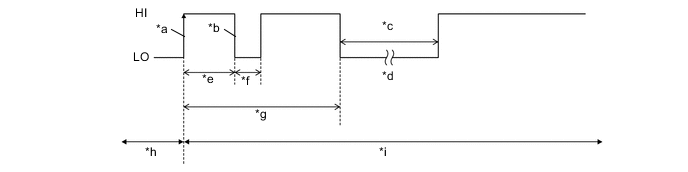
*a CSIF Initial Signal *b CSIF Initial Response *c Approximately 1.0 Second *d Initial Diagnosis *e Approximately 1.0 to 1.6 Seconds *f Approximately 0.05 Seconds *g Approximately 5.5 Seconds *h Disarmed State *i Arming Preparation State - - -
Waveform 2 (Reference)
*a IOUT Initial Signal *b IOUT Initial Response *c Approximately 1.0 Second *d Initial Diagnosis *e Approximately 1.0 to 1.6 Seconds *f Approximately 0.05 Seconds *g Approximately 5.5 Seconds *h Disarmed State *i Arming Preparation State - -
-
-