PROCEDURE
- Click here
INSPECT FOR COOLANT LEAK (for Inverter)
-
Remove the reserve tank cap from the inverter reserve tank assembly.
CAUTION:To avoid the danger of being burned, do not remove the reserve tank cap while the coolant for the inverter is still hot.
-
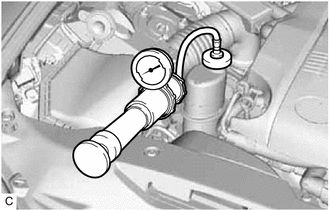
Install a radiator cap tester to the inverter reserve tank assembly.
-
Pump the radiator cap tester to 122 kPa (1.2 kgf/ cm2, 18 psi), and then check that the pressure does not drop.
Tip:If the pressure drops, check the hoses, radiator assembly, inverter water pump assembly, and inverter with converter assembly for leaks.
-
Reinstall the reserve tank cap to the inverter reserve tank assembly.
-
- Click here
INSPECT COOLANT LEVEL IN RESERVE TANK (for Inverter)
-
The coolant should be between the low (L) and full (F) lines when the coolant for the inverter is cold.
Tip:If the coolant level is low, check for leaks and add TOYOTA Super Long Life Coolant (SLLC) or similar high quality ethylene glycol based non-silicate, non-amine, non-nitrite, and non-borate coolant with long-life hybrid organic acid technology up to the full (F) line.
-
- Click here
INSPECT COOLANT QUALITY (for Inverter)
-
Remove the reserve tank cap from the inverter reserve tank assembly.
CAUTION:To avoid the danger of being burned, do not remove the reserve tank cap while the coolant for the inverter is still hot.
-
Check for excessive deposits of rust or scale on and around the reserve tank cap and its opening.
Tip:If excessively dirty, replace the coolant for the inverter.
-
Reinstall the reserve tank cap.
-
- Click here
INSPECT RESERVE TANK CAP (for Inverter)
-
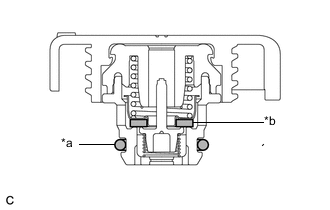
*a O-ring *b Rubber Packing Inspect the reserve tank cap.
-
If there are water stains or foreign matter on the O-ring, clean it with water and finger scouring.
Note:Do not use any tools.
-
Check that the O-ring is not deformed, cracked, or damaged.
-
Check that the O-ring is not swollen.
-
-
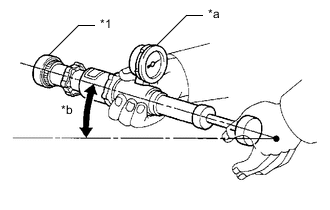
*1 Reserve Tank Cap *a Radiator Cap Tester *b 30° or more Check the reserve tank cap operation.
-
Apply coolant (for inverter) to the O-ring and rubber packing before using a radiator cap tester.
-
Install the reserve tank cap to the radiator cap tester.
-
Pump the radiator cap tester several times and check the maximum pressure.
Table 1. Judgment Criterion Standard value (for brand-new cap) 94 to 122 kPa (1.0 to 1.2 kgf/cm2, 13.6 to 18 psi)
Minimum standard value (for used cap) 94 kPa (1.0 kgf/cm2, 13.6 psi)
Pump speed 1 pump per second Note:When using the radiator cap tester, tilt it upward 30° or more.
Tip:If the maximum pressure is less than the minimum standard value, replace the reserve tank cap.
-
-