HYBRID CONTROL SYSTEM, Diagnostic DTC:P0A1B-554
| DTC Code | DTC Name |
|---|---|
| P0A1B-554 | Drive Motor "A" Control Module |
DESCRIPTION
For a description of the boost converter.
If a malfunction occurs in the boost converter, the MG ECU detects it and transmits this information to the hybrid vehicle control ECU assembly.
| DTC No. | Detection Item | DTC Detection Condition | Trouble Area | MIL | Warning Indicate |
|---|---|---|---|---|---|
| P0A1B-554 | Drive Motor "A" Control Module | Boost converter fail signal detection (overcurrent due to MG ECU malfunction)* (1 trip detection logic) |
|
Comes on | Master Warning Light: Comes on |
*: Inverter with converter assembly may be suspected as a main case of the malfunction.
CAUTION / NOTICE / HINT
CAUTION:
-
Before inspecting the high-voltage system or disconnecting the low voltage connector of the inverter with converter assembly, take safety precautions such as wearing insulated gloves and removing the service plug grip to prevent electrical shocks. After removing the service plug grip, put it in your pocket to prevent other technicians from accidentally reconnecting it while you are working on the high-voltage system.
-
After removing the service plug grip, wait for at least 10 minutes before touching any of the high-voltage connectors or terminals. After waiting for 10 minutes, check the voltage at the terminals in the inspection point in the inverter with converter assembly. The voltage should be 0 V before beginning work.
Tech Tips
Waiting for at least 10 minutes is required to discharge the high-voltage capacitor inside the inverter with converter assembly.
Note
After turning the power switch off, waiting time may be required before disconnecting the cable from the negative (-) auxiliary battery terminal. Therefore, make sure to read the disconnecting the cable from the negative (-) auxiliary battery terminal notices before proceeding with work.
Tech Tips
After the repair, clear the DTCs and perform the following procedure to check that DTCs are not output.
-
Turn the power switch on (READY) and wait for 5 seconds or more.
-
With the engine stopped and the shift lever in P, depress the accelerator pedal to start the engine.
PROCEDURE
-
CHECK DTC OUTPUT (HYBRID CONTROL)
-
Connect the GTS to the DLC3.
-
Turn the power switch on (IG).
-
Enter the following menus: Powertrain / Hybrid Control / Trouble Codes.
-
Check for DTCs.
Powertrain > Hybrid Control > Trouble CodesResult Result Proceed to P0A1B-554 only is output, or DTCs except the ones in the table below are also output. A Any of the following DTCs are also output. B Relevant DTC P06B0-163 Sensor Power Supply "A" Circuit / Open P06D6-511 Sensor Reference Voltage "F" Circuit / Open P06E6-164 Sensor Power Supply "C" Circuit / Open P0A1A-151, 166, 517, 658, 791, 809 Generator Control Module P0A1B-198, 505, 786, 794, 806 Drive Motor "A" Control Module P0A1D (all INF codes)*1 Hybrid Powertrain Control Module P0A3F-243 Drive Motor "A" Position Sensor Circuit P0A40-500, 506, 808 Drive Motor "A" Position Sensor Circuit Range / Performance P0A41-245 Drive Motor "A" Position Sensor Circuit Low P0A4B-253 Generator Position Sensor Circuit P0A4C-513, 518, 811 Generator Position Sensor Circuit Range / Performance P0A4D-255 Generator Position Sensor Circuit Low P0A78-287, 807 Drive Motor "A" Inverter Performance P0A7A-325, 810 Generator Inverter Performance P0BEA-290 Drive Motor "A" Phase V Current Sensor Circuit Range / Performance P0BEE-298 Drive Motor "A" Phase W Current Sensor Circuit Range / Performance P0C76-523 Hybrid Battery System Discharge Time Too Long P0D2E-586 Drive Motor "A" Inverter Voltage Sensor Circuit Range / Performance P0D2F-266 Drive Motor "A" Inverter Voltage Sensor Circuit Low P0D30-267 Drive Motor "A" Inverter Voltage Sensor Circuit High P0E05-328 Generator Phase V Current Sensor Circuit Range / Performance P0E09-336 Generator Phase W Current Sensor Circuit Range / Performance P0E32-585 DC/DC Converter Voltage Sensor "A" Range / Performance P0E33-589 DC/DC Converter Voltage Sensor "A" Low P0E34-590 DC/DC Converter Voltage Sensor "A" High P1C2A-155 Generator A/D Converter Circuit P1C2B-192 Drive Motor "A" A/D Converter Circuit P1C2D-587 Hybrid Battery Voltage / DC/DC Converter Voltage Correlation P1C3C-294 Drive Motor "A" Phase V Current Sensor Correlation P1C3D-302 Drive Motor "A" Phase W Current Sensor Correlation P1C3E-333 Generator Phase V Current Sensor Correlation P1C3F-341 Generator Phase W Current Sensor Correlation P1C4A-288 Drive Motor "A" Phase V Current Sensor Sub Circuit Range / Performance P1C4F-296 Drive Motor "A" Phase W Current Sensor Sub Circuit Range / Performance P1C54-326 Generator Phase V Current Sensor Sub Circuit Range / Performance P1C59-334 Generator Phase W Current Sensor Sub Circuit Range / Performance P1C6D-501 Drive Motor "A" Phase V Current Sensor Offset Range / Performance P1C6E-502 Drive Motor "A" Phase W Current Sensor Offset Range / Performance P1C71-515 Generator Phase V Current Sensor Offset Range / Performance P1C72-516 Generator Phase W Current Sensor Offset Range / Performance P1C73-512 Sensor Standard Voltage "F" Circuit / Open P1CA6-156 Generator Control Module Malfunction P1CA7-193 Drive Motor Control Module Malfunction P1CAC-200 Generator Position Sensor Angle Malfunction P1CAD-168 Drive Motor "A" Position Sensor Angle Malfunction P1CAF-792 Generator Position Sensor REF Signal Cycle Malfunction P1CB0-795 Drive Motor "A" Position Sensor REF Signal Cycle Malfunction P1CB2-793 Generator Position Sensor REF Signal Stop Malfunction P1CB3-796 Drive Motor "A" Position Sensor REF Signal Stop Malfunction P3133-659 Communication Error from Generator to Drive Motor "A" P3134-661 Communication Error from Drive Motor "A" to Generator Tech Tips
-
*1: If any INF codes are output for this DTC, refer to the corresponding diagnostic procedure.
-
P0A1B-554 may be stored due to a malfunction which also causes DTCs in the preceding table to be stored. In this case, first troubleshoot the output DTCs in the preceding table. Then, perform a test to attempt to reproduce the problems, and check that no DTCs are output.
-
-
Turn the power switch off.
B 
GO TO DTC CHART (HYBRID CONTROL SYSTEM) Click here
A 
-
-
CHECK CONNECTOR CONNECTION CONDITION (INVERTER WITH CONVERTER ASSEMBLY CONNECTOR)
Result Result Proceed to OK A NG (The connector is not connected securely.) B NG (The terminals are not making secure contact or are deformed, or water or foreign matter exists in the connector.) C CAUTION:
Be sure to wear insulated gloves.
-
Check that the service plug grip is not installed.
Note
After removing the service plug grip, do not turn the power switch on (READY), unless instructed by the repair manual because this may cause a malfunction.
-
Check the connection condition of the low voltage connector of the inverter with converter assembly and the contact pressure of each terminal. Check the terminals for deformation, and check the connector for water ingress and foreign matter.
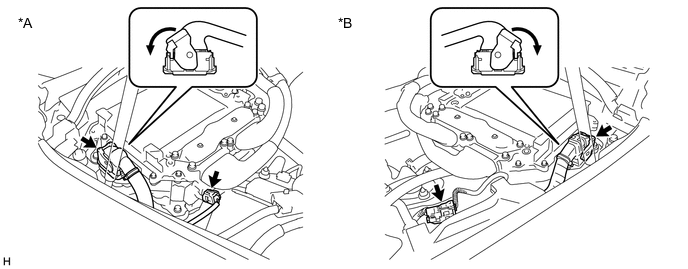
*A for LHD *B for RHD Note
Before disconnecting the connector, confirm that it is properly connected by checking that the locking claws are engaged and that the connector does not pull out.
OK - The connector is connected securely. - The terminals are not deformed and are connected securely. - No water or foreign matter in the connector. Result Result Proceed to OK A NG (The connector is not connected securely.) B NG (The terminals are not making secure contact or are deformed, or water or foreign matter exists in the connector.) C Tech Tips
When connecting the connector, insert it with the locking lever in the raised position. Rotate the lever downward and make sure that the connector is pulled into its socket. When the locking lever is in its fully closed position, a click will be heard as its locking claws engage. After the click is heard, pull up on the connector to confirm that it is properly connected.
A
REPLACE INVERTER WITH CONVERTER ASSEMBLY Click here
B
CONNECT SECURELY
C
REPAIR OR REPLACE HARNESS OR CONNECTOR
-