VEHICLE STABILITY CONTROL SYSTEM TEST MODE PROCEDURE

-
WARNING LIGHT AND INDICATOR LIGHT INITIAL CHECK
-
Release the parking brake.
Note
Before releasing the parking brake, move the shift lever to P.
Tech Tips
When the parking brake is applied or the brake fluid level is low, the brake warning light comes on.
-
When the engine switch is turned on (IG), check that the ABS warning, brake warning, VSC OFF indicator and slip indicator lights all come on for approximately 3 seconds.
Tech Tips
-
If the skid control ECU (brake actuator assembly) stores a DTC, the ABS warning and slip indicator lights will come on.
-
If any of the indicators remains on or does not come on, proceed to troubleshooting for the light circuits listed below.
Trouble Area See Procedure ABS warning light circuit (Remains on) ABS warning light circuit (Does not come on) Brake warning light circuit (Remains on) Brake warning light circuit (Does not come on) VSC OFF indicator light circuit (Remains on) VSC OFF indicator light circuit (Does not come on) Slip indicator light circuit (Remains on) Slip indicator light circuit (Does not come on) -
-
-
SENSOR CHECK USING TEST MODE (SIGNAL CHECK) (When Using GTS)
Tech Tips
-
VSC does not operate in Test Mode (signal check), regardless of whether the sensor check is normal or abnormal.
-
When a malfunction occurs in an ABS system sensor, the ABS warning light illuminates.
-
When a malfunction occurs in a VSC system sensor, the slip indicator light illuminates.
-
Procedure to enter Test Mode
-
Turn the engine switch off.
-
Check that the steering wheel is centered.
-
Apply the parking brake.
-
Check that the shift lever is in P.
-
Connect the GTS to the DLC3.
-
Turn the engine switch on (IG).
-
Turn the GTS on.
-
Switch the skid control ECU (brake actuator assembly) to Test Mode using the GTS. Enter the following menus: Chassis / ABS/VSC/TRC / Utility / Signal Check.
Chassis > ABS/VSC/TRC > UtilityTester Display Signal Check -
Check that the ABS warning and slip indicator lights come on for several seconds and then blink in the Test Mode pattern.
Tech Tips
If the ABS warning and slip indicator lights do not blink, inspect the ABS warning and slip indicator light circuits.
-
Check the ABS sensors.
Tech Tips
Check that the ABS warning light is blinking in the Test Mode pattern before performing the following ABS sensor checks.
-
-
Acceleration Sensor Check
-
Keep the vehicle stationary on a level surface for 1 second or more.
Tech Tips
The acceleration sensor check can be performed by following the master cylinder pressure sensor check procedure below.
-
-
Lost Booster Pressure Judgment Check and Master Cylinder Pressure Sensor Zero Point Calibration
-
Depress the brake pedal several times to release vacuum from the brake booster assembly with the engine stopped.
-
Turn the engine switch on (IG).
-
Check that the brake warning light comes on when depressing the brake pedal with a force of 59.0 N (6.0 kgf, 13.2 lbf) or more for 1 second or more. (The lost booster pressure state is judged to be normal.)
-
Start the engine while depressing the brake pedal with a force of 59.0 N (6.0 kgf, 13.2 lbf) or more for 1 second or more.
-
Check that the brake warning light goes off when quickly releasing the brake pedal. (The lost booster pressure state is judged to be normal.)
-
Leave the vehicle for 1 second or more. (Master cylinder pressure sensor zero point calibration)
Note
-
If depressing the brake pedal slowly or repeatedly, the master cylinder pressure sensor zero point calibration is not performed normally.
-
If the lost booster pressure judgment check results are not normal, then the master cylinder pressure sensor check cannot be performed.
-
If rechecking after the engine has started, end Test Mode, enter Test Mode again, and release vacuum in the booster by pumping the brake pedal prior to rechecking.
Tech Tips
If the lost booster pressure state is not judged to be normal, the brake warning light comes on and Test Mode (signal check) inspection item (Output Master Cylinder Pressure Sensor) is displayed.
-
-
-
Master Cylinder Pressure Sensor Check
-
Leave the vehicle in a stationary condition and release the brake pedal for 1 second or more, and quickly and continuously depress the brake pedal with a force of 98 N (10 kgf, 22.0 lbf) for 1 second.
-
Check that the ABS warning light stays on for 3 seconds.
Tech Tips
-
Confirm that the ABS warning light comes on.
-
While the ABS warning light stays on, continue to depress the brake pedal with a force of 98 N (10 kgf, 22.0 lbf) or more.
-
The ABS warning light comes on for 3 seconds every time the preceding brake pedal operation is performed.
-
-
-
Speed Sensor Check
-
Drive the vehicle straight-ahead.
Accelerate the vehicle to a speed of 45 km/h (28 mph) or more for several seconds.
Tech Tips
-
The sensor check may not complete if wheelspin occurs.
-
The ABS warning light comes on immediately if a malfunction is detected during the speed sensor check.
Note
-
The speed sensor check may not complete if the speed sensor check is started while turning the steering wheel or spinning the wheels.
-
After the ABS warning light goes off, if vehicle speed exceeds 80 km/h (50 mph), a sensor check code will be stored again. Decelerate or stop the vehicle before the speed reaches 80 km/h (50 mph).
-
-
Check that the ABS warning light goes off.
Tech Tips
-
The ABS warning light goes off when the sensor check has completed.
-
The ABS warning light comes on immediately after a malfunction has been detected during the speed sensor check.
-
-
Stop the vehicle.
Tech Tips
When the sensor check has completed, the ABS warning light goes off while the vehicle is being driven, and blinks in the Test Mode pattern while the vehicle is stopped.
Note
If the sensor check has not completed, the ABS warning light will blink while the vehicle is being driven and the ABS will not operate.
-
-
VSC Sensor Check
Tech Tips
Check that the slip indicator light is blinking in the Test Mode pattern before performing the following VSC sensor check.
-
VSC OFF Switch (Combination Switch Assembly) Check
-
Press the VSC OFF switch (combination switch assembly).
-
Check that the VSC OFF indicator light comes on.
-
Press the VSC OFF switch (combination switch assembly) again.
-
-
End of Sensor Check
-
If the sensor check is completed, the ABS warning light and slip indicator light blink (Test Mode (signal check)) when the vehicle stops and the ABS warning light is off while the vehicle is being driven.
Note
-
When Test Mode (signal check) is started with the GTS and all items display complete, the sensor check ends.
-
If the sensor check is not complete, the ABS warning light blinks when the vehicle is in motion and the ABS does not operate.
-
If a DTC is detected in Test Mode (signal check), the ABS warning light or slip indicator light illuminates.
-
-
-
End of Test Mode (Signal Check)
-
End Test Mode (signal check) using the GTS
-
Turn the engine switch off and enter normal mode.
-
Remove the GTS.
-
-
-
Test Mode (Signal Check) Inspection Item Chart
Item Name Range Judgment Description Trouble Area Output Signal of Front Speed Sensor RH Incomplete/complete Check for foreign matter, check the gap between the sensor and rotor
-
Open or short in speed sensor
-
Open or short in sensor system wire harness
-
Defective connector contact or increased terminal resistance
-
Speed sensor installation defect
-
Sensor rotor system malfunction
Output Signal of Front Speed Sensor LH Incomplete/complete Check for foreign matter, check the gap between the sensor and rotor
-
Open or short in speed sensor
-
Open or short in sensor system wire harness
-
Defective connector contact or increased terminal resistance
-
Speed sensor installation defect
-
Sensor rotor system malfunction
Output Signal of Rear Speed Sensor RH Incomplete/complete Check for foreign matter, check the gap between the sensor and rotor
-
Open or short in speed sensor
-
Open or short in sensor system wire harness
-
Defective connector contact or increased terminal resistance
-
Speed sensor installation defect
-
Sensor rotor system malfunction
Output Signal of Rear Speed Sensor LH Incomplete/complete Check for foreign matter, check the gap between the sensor and rotor
-
Open or short in speed sensor
-
Open or short in sensor system wire harness
-
Defective connector contact or increased terminal resistance
-
Speed sensor installation defect
-
Sensor rotor system malfunction
Change in Output Signal of Front Speed Sensor RH Incomplete/complete
-
Check the stability of the sensor input waveform
-
Check the straight ahead / reverse signal inputs
-
Foreign object attached to speed sensor
-
Sensor rotor system malfunction
Change in Output Signal of Front Speed Sensor LH Incomplete/complete
-
Check the stability of the sensor input waveform
-
Check the straight ahead / reverse signal inputs
-
Foreign object attached to speed sensor
-
Sensor rotor system malfunction
Change in Output Signal of Rear Speed Sensor RH Incomplete/complete
-
Check the stability of the sensor input waveform
-
Check the straight ahead / reverse signal inputs
-
Foreign object attached to speed sensor
-
Sensor rotor system malfunction
Change in Output Signal of Rear Speed Sensor LH Incomplete/complete
-
Check the stability of the sensor input waveform
-
Check the straight ahead / reverse signal inputs
-
Foreign object attached to speed sensor
-
Sensor rotor system malfunction
Output Voltage Deceleration Sensor Incomplete/complete Check the acceleration sensor output voltage
-
Acceleration sensor zero point stored incorrectly
-
Acceleration sensor connector connection malfunction
-
Acceleration sensor internally stuck
-
Defective acceleration sensor installation
Memory System Information Incomplete/complete Check stored system information (skid control ECU (brake actuator assembly)) against vehicle specification
-
ECM incorrectly installed
-
Brake actuator assembly incorrectly installed
-
CAN communication between ECM and skid control ECU (brake actuator assembly)
Output Master Cylinder Pressure Sensor Incomplete/complete
-
Check the master cylinder pressure sensor zero point voltage
-
Check that the sensitivity of the master cylinder pressure sensor is normal
-
Open circuit or short in master cylinder pressure sensor circuit
-
Open or short in stop light switch assembly circuit or defective connector connection
-
Stop light switch assembly stuck OFF
Judgment of Failure State Incomplete/complete Check that the brake pedal load sensing switch is normal
-
Open or short in brake pedal load sensing switch system wire harness
-
Brake pedal load sensing switch stuck ON/OFF
-
-
-
SENSOR CHECK USING TEST MODE (SIGNAL CHECK) (When Using SST Check Wire)
Tech Tips
-
VSC does not operate in Test Mode (signal check), regardless of whether the sensor check is normal or abnormal.
-
When a malfunction occurs in an ABS system sensor, the ABS warning light illuminates.
-
When a malfunction occurs in a VSC system sensor, the slip indicator light illuminates.
-
Procedure to enter Test Mode
-
Turn the engine switch off.
-
Check that the steering wheel is centered.
-
Apply the parking brake.
-
Check that the shift lever is in P.
-
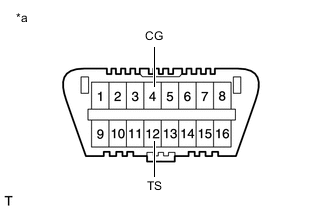
*a Front view of DLC3 Using SST, connect terminals TS and CG of the DLC3.
- SST
- 09843-18040
-
Turn the engine switch on (IG).
-
Check that the ABS warning and slip indicator lights come on for several seconds and then blink in the Test Mode pattern.
Tech Tips
If the ABS warning and slip indicator lights do not blink, inspect the TS and CG terminal circuit and ABS warning and slip indicator light circuits.
-
Check the ABS sensors.
Tech Tips
Check that the ABS warning light is blinking in the Test Mode pattern before performing the following ABS sensor checks.
-
-
Acceleration Sensor Check
-
Keep the vehicle stationary on a level surface for 1 second or more.
Tech Tips
The acceleration sensor check can be performed by following the master cylinder pressure sensor check procedure below.
-
-
Lost Booster Pressure Judgment Check and Master Cylinder Pressure Sensor Zero Point Calibration
-
Depress the brake pedal several times to release vacuum from the brake booster assembly with the engine stopped.
-
Turn the engine switch on (IG).
-
Check that the brake warning light comes on when depressing the brake pedal with a force of 59.0 N (6.0 kgf, 13.2 lbf) or more for 1 second or more. (The lost booster pressure state is judged to be normal.)
-
Start the engine while depressing the brake pedal with a force of 59.0 N (6.0 kgf, 13.2 lbf) or more for 1 second or more.
-
Check that the brake warning light goes off when quickly releasing the brake pedal. (The lost booster pressure state is judged to be normal.)
-
Leave the vehicle for 1 second or more. (Master cylinder pressure sensor zero point calibration)
Note
-
If depressing the brake pedal slowly or repeatedly, the master cylinder pressure sensor zero point calibration is not performed normally.
-
If the lost booster pressure judgment check results are not normal, then the master cylinder pressure sensor check cannot be performed.
-
If rechecking after the engine has started, end Test Mode, enter Test Mode again, and release vacuum in the booster by pumping the brake pedal prior to rechecking.
-
-
-
Master Cylinder Pressure Sensor Check
-
Leave the vehicle in a stationary condition and release the brake pedal for 1 second or more, and quickly and continuously depress the brake pedal with a force greater than 98 N (10 kgf, 22.0 lbf) for 1 second.
-
Check that the ABS warning light stays on for 3 seconds.
Tech Tips
-
Confirm that the ABS warning light comes on.
-
While the ABS warning light stays on, continue to depress the brake pedal with a force of 98 N (10 kgf, 22.0 lbf) or more.
-
The ABS warning light comes on for 3 seconds every time the preceding brake pedal operation is performed.
-
-
-
Speed Sensor Check
-
Drive the vehicle straight-ahead.
Accelerate the vehicle to a speed of 45 km/h (28 mph) or more for several seconds.
Note
The speed sensor check may not complete if the speed sensor check is started while turning the steering wheel or spinning the wheels.
Tech Tips
-
The sensor check may not complete if wheelspin occurs.
-
The ABS warning light comes on immediately if a malfunction is detected during the speed sensor check.
-
-
Check that the ABS warning light goes off.
Tech Tips
-
The ABS warning light goes off when the sensor check has completed.
-
The ABS warning light comes on immediately after a malfunction has been detected during the speed sensor check.
-
-
Stop the vehicle.
Note
If the sensor check has not completed, the ABS warning light will blink while the vehicle is being driven and the ABS will not operate.
Tech Tips
When the sensor check has completed, the ABS warning light goes off while the vehicle is being driven, and blinks in the Test Mode pattern while the vehicle is stopped.
-
-
VSC Sensor Check
Tech Tips
Check that the slip indicator light is blinking in the Test Mode pattern before performing the following VSC sensor check.
-
VSC OFF Switch (Combination Switch Assembly) Check
-
Press the VSC OFF switch (combination switch assembly).
-
Check that the VSC OFF indicator light comes on.
-
Press the VSC OFF switch (combination switch assembly) again.
-
-
End of Sensor Check
-
If the sensor checks have completed, the ABS warning light blinks in the Test Mode pattern when the vehicle is stopped and the ABS warning light goes off while the vehicle is being driven.
Note
If the sensor checks have not completed, the ABS warning light will blink while the vehicle is being driven and the ABS will not operate.
-
-