AUTOMATIC TRANSMISSION SYSTEM(for 2GR-FKS) HYDRAULIC TEST
-
PERFORM HYDRAULIC TEST
CAUTION:
-
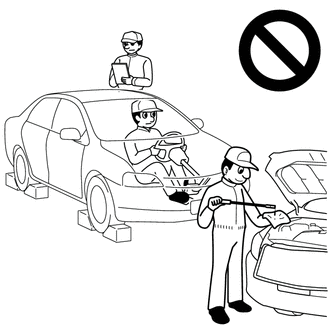
Do not perform a stall test if there are any people or objects near the vehicle.
-
The vehicle could begin moving suddenly, resulting in a serious accident.
-
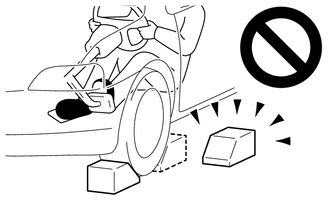
Do not perform a stall test if any wheel chocks are out of position.
-
The vehicle could begin moving suddenly, resulting in a serious accident.
-
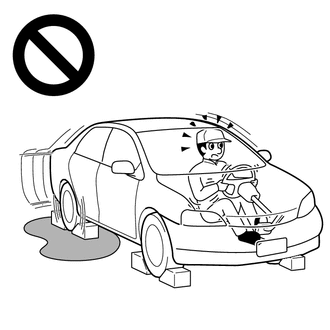
Do not perform the stall test on a slippery or low-friction surface that could allow the tires to spin.
-
The vehicle could begin moving suddenly, resulting in a serious accident.
-
A line pressure test should always be carried out with at least 2 people. One person should observe the condition of wheels and wheel chocks while the other is performing the test.
-
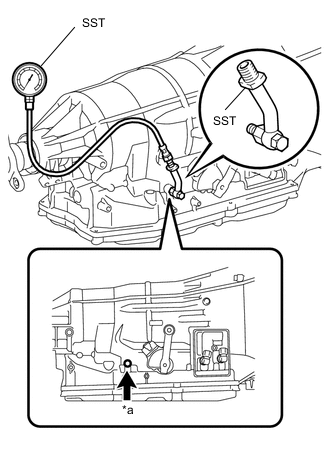
*a Test Plug Measure the line pressure.
Note
-
Perform this test with the ATF (Automatic Transmission Fluid) at the normal operating temperature: 50 to 80°C (122 to 176°F)
-
Be careful to prevent the SST hose from contacting the exhaust pipe.
-
This check must be conducted after checking and confirming that the engine is normal.
-
Perform this test with the A/C off.
-
Do not perform the stall test for longer than 5 seconds.
-
When performing the stall speed test repeatedly, wait for 15 seconds or more between tests.
-
Warm up the ATF.
-
Remove the test plug on the center of the right side of the transmission case side and connect SST.
- SST
- 09993-19015 ( 09993-00010, 09993-00040 )
-
Fully apply the parking brake and chock all 4 wheels.
-
Start the engine and check the idle speed.
-
Keep your left foot firmly on the brake pedal and move the shift lever to D.
-
Measure the line pressure when the engine is idling.
-
Depress the accelerator pedal as much as possible with your right foot. Quickly read the highest line pressure reading when the engine speed reaches stall speed.
-
Measure the line pressure again with the shift lever in R.
Evaluation Problem Possible Cause Measured values at all positions are higher than specified
-
Shift solenoid valve SLT defective
-
Regulator valve defective
Measured values at all positions are lower than specified
-
Shift solenoid valve SLT defective
-
Regulator valve defective
-
Oil pump defective
Pressure is low when shift lever is in D only
-
D position circuit fluid leak
-
C1 clutch defective
Pressure is low when shift lever is in R only
-
R position circuit fluid leak
-
C4 clutch defective
-
B2 brake defective
-
-
-