AUTOMATIC TRANSMISSION SYSTEM(for 8AR-FTS), Diagnostic DTC:P27567F
| DTC Code | DTC Name |
|---|---|
| P27567F | Torque Converter Clutch Pressure Control Solenoid Control Actuator Stuck Off |
DESCRIPTION
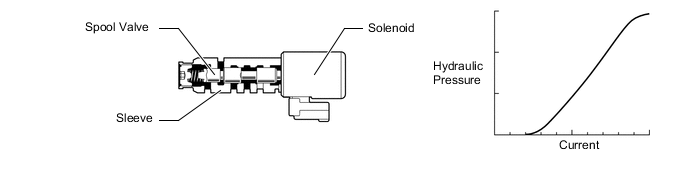
The ECM controls the lock-up solenoid, and performs lock-up and flex lock-up control.
The ECM compares the engagement condition of the lock-up clutch with the lock-up schedule in the ECM memory to detect solenoid (SLU) valve, transmission valve body assembly and torque converter mechanical problems.
| DTC No. | Detection Item | DTC Detection Condition | Trouble Area | MIL | Memory | Note |
|---|---|---|---|---|---|---|
| P27567F | Torque Converter Clutch Pressure Control Solenoid Control Actuator Stuck Off | 1. Diagnosis Condition 2. Malfunction Status 3. Malfunction Time 4. Other
SLU stuck ON malfunction:
SLU stuck OFF malfunction: |
|
Comes on | DTC stored | SAE Code: P2757 |
MONITOR DESCRIPTION
Torque converter lock-up is controlled by the ECM based on the transmission revolution sensor (NT), engine speed, engine load, engine temperature, vehicle speed, transmission fluid temperature, and gear selection. The ECM determines the lock-up status of the torque converter by comparing the engine speed (NE) to the input turbine rpm (NT). The ECM calculates the actual transmission gear by comparing the input turbine speed (NT) to the output shaft speed (SP2). When conditions are appropriate, the ECM requests "lock-up" by applying control voltage to the solenoid (SLU) valve. When the solenoid (SLU) valve is turned on, it applies pressure to the lock-up relay valve and locks the torque converter assembly.
If the ECM detects no lock-up after lock-up has been requested or if it detects lock-up when it is not requested, the ECM interprets this as a malfunction of the solenoid (SLU) valve, illuminates the MIL and stores this DTC.
Tech Tips
Example:
When any of the following is met, the system judges it as a malfunction.
-
There is a difference in speed between the input side (engine speed) and output side (input turbine speed) of the torque converter when the ECM commands lock-up. (Engine speed is at least 70 rpm more than input turbine speed.)
-
There is no difference in speed between the input side (engine speed) and output side (input turbine speed) of the torque converter when the ECM commands lock-up off. (The difference between engine speed and input turbine speed is less than 20 rpm.)
CAUTION / NOTICE / HINT
Note
Perform registration and/or initialization when parts related to the automatic transmission are replaced.
Tech Tips
After performing repair, clear the DTCs and perform the following procedure to check that DTCs are not output.
-
Perform the Lock-up Function inspection in Road Test.
-
Turn the engine switch off.
-
Perform step (1) again.
-
Check for DTCs again.
PROCEDURE
-
CHECK DTC OUTPUT (IN ADDITION TO DTC P27567F)
-
Connect the GTS to the DLC3.
-
Turn the engine switch on (IG).
-
Turn the GTS on.
-
Enter the following menus: Powertrain / Transmission / Trouble Codes.
Powertrain > Transmission > Trouble Codes -
Read the DTCs using the GTS.
Result Result Proceed to Only DTC P27567F is output A DTC P27567F and other DTCs are output B Tech Tips
If any DTCs other than P27567F are output, perform troubleshooting for those DTCs first.
B 
GO TO DTC CHART Click here
A 
-
-
INSPECT SOLENOID (SLU) VALVE
-
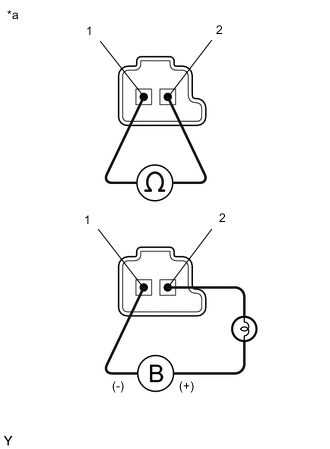
*a Component without harness connected
(Solenoid (SLU) Valve)
Remove the solenoid (SLU) valve.
-
Measure the resistance according to the value(s) in the table below.
Standard Resistance Tester Connection Condition Specified Condition Terminal 1 of the solenoid (SLU) valve - Terminal 2 20°C (68°F) 5.0 to 5.6 Ω -
Connect a positive (+) lead from the battery with a 21 W bulb to terminal 2 and a negative (-) lead to terminal 1 of the solenoid valve connector. Check that the valve moves and makes an operating sound.
OK Valve moves and makes an operating sound. Result Proceed to OK NG
NG
REPLACE SOLENOID (SLU) VALVE Click here
OK
-
-
INSPECT TRANSMISSION VALVE BODY ASSEMBLY
-
Check the transmission valve body assembly.
OK There is no foreign matter on each valve and they operate smoothly. Result Proceed to OK NG
NG
REPAIR OR REPLACE TRANSMISSION VALVE BODY ASSEMBLY Click here
OK
-
-
INSPECT TORQUE CONVERTER ASSEMBLY
-
Check the torque converter assembly.
OK The torque converter operates normally. Result Proceed to OK NG
NG
REPLACE TORQUE CONVERTER ASSEMBLY Click here
OK
-
-
REPAIR OR REPLACE AUTOMATIC TRANSMISSION ASSEMBLY
-
Repair or replace the automatic transmission assembly.
Result Proceed to NEXT
NEXT
PERFORM A/T CODE REGISTRATION Click here
-