AUTOMATIC TRANSMISSION SYSTEM, Diagnostic DTC:P0717

| DTC Code | DTC Name |
|---|---|
| P0717 | Turbine Speed Sensor Circuit No Signal |
DESCRIPTION
This sensor detects the rotation speed of the turbine which shows the input shaft revolution speed. By comparing the input turbine speed signal (NT) with the counter gear speed signal (SP2), the ECM detects the shift timing of the gears and appropriately controls the engine torque and hydraulic pressure according to various conditions. Thus, providing smooth gear shifts.
| DTC No. | Detection Item | DTC Detection Condition | Trouble Area | MIL | Memory |
|---|---|---|---|---|---|
| P0717 | Turbine Speed Sensor Circuit No Signal | ECM detects conditions (a), (b) and (c) continuously for 5 sec. or more: (1-trip detection logic)
|
|
Comes on | DTC stored |
Reference (Using an oscilloscope):
Check the waveform between the terminals NT+ and NT- of the ECM connector.
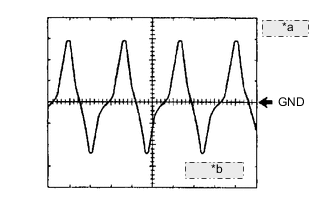
| *a | 1 V/DIV. |
| *b | 2 ms./DIV. |
| Standard |
|---|
| Refer to the illustration. |
| Terminal | NT+ - NT- |
| Tool setting | 1 V/DIV., 2 ms./DIV. |
| Vehicle condition | Engine idle speed (P or N position) |
MONITOR DESCRIPTION
This DTC indicates that pulse are not output from the transmission revolution sensor (NT) (Turbine (input) speed sensor) or output irregularly. The NT terminal of the ECM detects the revolution speed signal from transmission revolution sensor (NT) (input RPM). The ECM outputs a gearshift signal comparing the transmission revolution sensor (NT) with the transmission revolution sensor (SP2).
While the vehicle is being driven in 4th, 5th or 6th gear with the shift lever in D, if the input shaft revolution (speed) is less than 300 rpm*1 with the output shaft revolution (speed) 1000 rpm or more*2, the ECM interprets this as malfunction, illuminates the MIL and stores the DTC.
*1: Pulse is not output or is irregularly output.
*2: The vehicle speed is approx. 50 km/h (31 mph) or more.
WIRING DIAGRAM
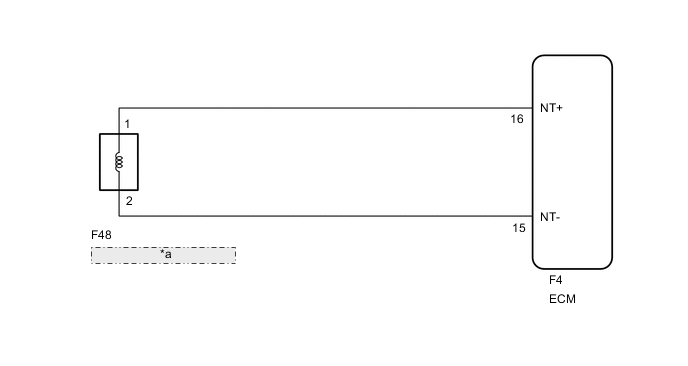
| *a | Transmission Revolution Sensor (NT) |
CAUTION / NOTICE / HINT
Note
Perform registration and/or initialization when parts related to the automatic transmission are replaced.
-
DATA LIST
Tech Tips
Using the GTS to read the Data List allows the values or states of switches, sensors, actuators and other items to be read without removing any parts. This non-intrusive inspection can be very useful because intermittent conditions or signals may be discovered before parts or wiring is disturbed. Reading the Data List information early in troubleshooting is one way to save diagnostic time.
Note
In the table below, the values listed under "Normal Condition" are reference values. Do not depend solely on these reference values when deciding whether a part is faulty or not.
-
Warm up the engine.
-
Turn the engine switch off.
-
Connect the GTS to the DLC3.
-
Turn the engine switch on (IG).
-
Turn the GTS on.
-
Enter the following menus: Powertrain / Engine and ECT / Data List / SPD (NT).
-
According to the display on the GTS, read the "Data List".
Powertrain > Engine > Data ListTester Display Measurement Item Range Normal Condition Diagnostic Note SPD (NT) Input shaft speed Min.: 0 rpm
Max.: 12750 rpm
-
Lock-up ON (after warming up engine): Input turbine speed (NT) equal to engine speed
-
Lock-up OFF (idling with shift lever in N): Input turbine speed (NT) nearly equal to engine speed
Data is displayed in increments of 50 rpm.
Powertrain > Engine > Data ListTester Display SPD (NT) Tech Tips
-
SPD (NT) is always 0 while driving:
Open or short in the sensor or circuit.
-
SPD (NT) is always more than 0 and less than 300 rpm while driving the vehicle at 50 km/h (31 mph) or more:
Sensor malfunction, improper installation, or intermittent connection malfunction of the circuit.
-
-
PROCEDURE
-
INSPECT TRANSMISSION REVOLUTION SENSOR (NT) INSTALLATION
-
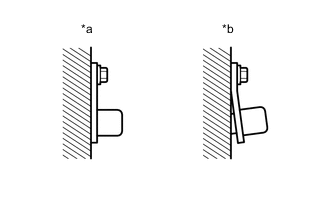
*a OK *b NG Check the transmission revolution sensor (NT) installation.
OK The installation bolt is tightened properly and there is no clearance between the sensor and transmission case. Result Proceed to OK NG
NG 
SECURELY INSTALL TRANSMISSION REVOLUTION SENSOR (NT) OR REPLACE TRANSMISSION REVOLUTION SENSOR (NT) Click here
OK 
-
-
INSPECT TRANSMISSION REVOLUTION SENSOR (NT)
-
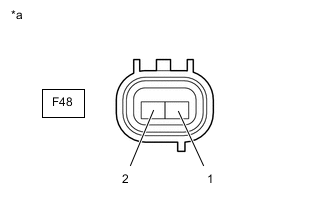
*a Component without harness connected
(Transmission Revolution Sensor (NT))
Disconnect the F48 transmission revolution sensor (NT) connector from the transmission.
-
Measure the resistance according to the value(s) in the table below.
Standard Resistance Tester Connection Condition Specified Condition 1 - 2 20°C (68°F) 560 to 680 Ω Result Proceed to OK NG
NG
REPLACE TRANSMISSION REVOLUTION SENSOR (NT) Click here
OK
-
-
CHECK HARNESS AND CONNECTOR (TRANSMISSION REVOLUTION SENSOR (NT) - ECM)
-
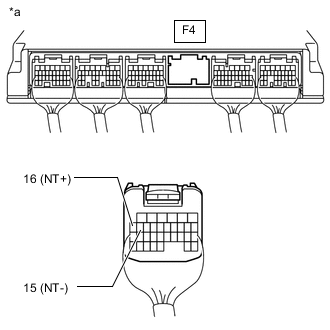
*a Rear view of wire harness connector
(to ECM)
Connect the transmission revolution sensor (NT) connector.
-
Disconnect the F4 ECM connector.
-
Measure the resistance according to the value(s) in the table below.
Standard Resistance Tester Connection Condition Specified Condition F4-16 (NT+) - F4-15 (NT-) 20°C (68°F) 560 to 680 Ω -
Measure the resistance according to the value(s) in the table below.
Standard Resistance (Check for short) Tester Connection Condition Specified Condition F4-16 (NT+) - Body ground Always 10 kΩ or higher F4-15 (NT-) - Body ground Always 10 kΩ or higher Result Proceed to OK NG
OK
REPLACE ECM Click here
NG
REPAIR OR REPLACE HARNESS OR CONNECTOR
-