ENTRY AND START SYSTEM(for Start Function), Diagnostic DTC:B2286, B228A, P0335
| DTC Code | DTC Name |
|---|---|
| B2286 | Runnable Signal Malfunction |
| B228A | Engine Speed Signal Circuit |
| P0335 | Crankshaft Position Sensor Circuit Malfunction (NE Signal) |
DESCRIPTION
These DTCs are stored when the engine speed signal sent by the ECM via direct line and the engine speed signal sent via CAN communication do not match.
Tech Tips
-
DTC B2286 is not stored for vehicles with stop and start system.
-
DTC B228A is stored only for vehicles with stop and start system.
-
When the cable is disconnected and reconnected to the negative (-) battery terminal, the power source mode returns to the state it was in before the cable was disconnected.
| DTC No. | Detection Item | DTC Detection Condition | Trouble Area | DTC Output from |
|---|---|---|---|---|
| B2286 | Runnable Signal Malfunction | The engine speed signal sent by the ECM via direct line and the engine speed signal sent via CAN communication (1-trip detection logic*) do not match. |
|
Disconnect the cable from the negative (-) battery terminal, wait 30 seconds and reconnect the cable to the negative (-) battery terminal. Wait 20 seconds or more with the engine switch off, then start the engine and maintain an engine speed of 1000 rpm or more for 20 seconds or more. |
| B228A | Engine Speed Signal Circuit | The engine speed signal sent by the ECM via direct line and the engine speed signal sent via CAN communication (1- trip detection logic*) do not match. |
|
Disconnect the cable from the negative (-) battery terminal, wait 30 seconds and reconnect the cable to the negative (-) battery terminal. Wait 20 seconds or more with the engine switch off, and then start the engine. Make sure that the engine speed is 1000 rpm or more for 20 seconds or more after starting the engine. |
| P0335 | Crankshaft Position Sensor Circuit Malfunction (NE Signal) | The engine speed signal sent by the ECM via direct line and the engine speed signal sent via CAN communication (1-trip detection logic*) do not match. |
|
Allow the engine to idle for 10 seconds or more. |
*: Only detected while a malfunction is present and the engine switch is on (IG)
| Vehicle Condition when Malfunction Detected | Fail-safe Function when Malfunction Detected |
|---|---|
|
|
| DTC | Data List Item | Active Test Item |
|---|---|---|
| B2286 B228A P0335 |
Power Source Control:
Starting Control: |
- |
WIRING DIAGRAM
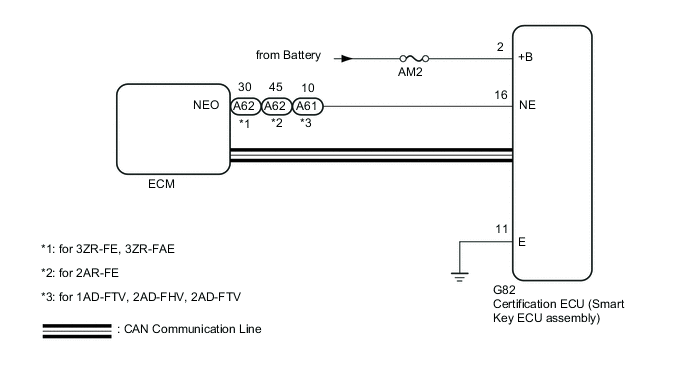
CAUTION / NOTICE / HINT
Note
-
When using the GTS with the engine switch off to troubleshoot:
Connect the GTS to the DLC3 and turn a courtesy light switch on and off at 1.5 second intervals until communication between the GTS and vehicle begins.
-
The entry and start system (for Start Function) uses a multiplex communication system (LIN communication system) and the CAN communication system. Inspect the communication function by following How to Proceed with Troubleshooting Click here. Troubleshoot the entry and start system (for Start Function) after confirming that the communication systems are functioning properly.
-
Before replacing the certification ECU (smart key ECU assembly) or ECM, refer to the entry and start system (for Start Function) precaution.
-
Inspect the fuses of circuits related to this system before performing the following inspection procedure.
-
After performing repairs, perform the operation that fulfills the DTC output confirmation operation, and then confirm that no DTCs are output again.
PROCEDURE
-
READ VALUE USING GTS (ENGINE CONDITION, ENGINE SPEED)
-
Connect the GTS to the DLC3.
-
Turn the engine switch on (IG).
-
Turn the GTS on.
-
Enter the following menus: Body Electrical / Power Source Control or Starting Control / Data List.
-
According to the display on the GTS, read the Data List.
Body Electrical > Power Source Control > Data ListTester Display Measurement Item Range Normal Condition Diagnostic Note Engine Condition Engine state Stop or Run Run: Engine running
Stop: Engine stopped
-
Body Electrical > Starting Control > Data ListTester Display Measurement Item Range Normal Condition Diagnostic Note Engine Speed Engine speed 0 to 16383 r/min Fluctuates in accordance with engine speed -
Body Electrical > Power Source Control > Data ListTester Display Engine Condition
Body Electrical > Starting Control > Data ListTester Display Engine Speed OK The Data List item changes in accordance with the engine condition. Result Proceed to OK NG (for 1AD-FTV) NG (for 2AD-FHV) NG (for 2AD-FTV (for DPF)) NG (for 2AD-FTV (for CCo)) NG (for 2AR-FE) NG (for 3ZR-FAE) NG (for 3ZR-FE)
NG (for 1AD-FTV) 
GO TO ECD SYSTEM (HOW TO PROCEED WITH TROUBLESHOOTING) Click here
NG (for 2AD-FHV)
GO TO ECD SYSTEM (HOW TO PROCEED WITH TROUBLESHOOTING) Click here
NG (for 2AD-FTV (for DPF))
GO TO ECD SYSTEM (HOW TO PROCEED WITH TROUBLESHOOTING) Click here
NG (for 2AD-FTV (for CCo))
GO TO ECD SYSTEM (HOW TO PROCEED WITH TROUBLESHOOTING) Click here
NG (for 2AR-FE)
GO TO SFI SYSTEM (HOW TO PROCEED WITH TROUBLESHOOTING) Click here
NG (for 3ZR-FAE)
GO TO SFI SYSTEM (HOW TO PROCEED WITH TROUBLESHOOTING) Click here
NG (for 3ZR-FE)
GO TO SFI SYSTEM (HOW TO PROCEED WITH TROUBLESHOOTING) Click here
OK 
-
-
CHECK HARNESS AND CONNECTOR (POWER SOURCE)
-
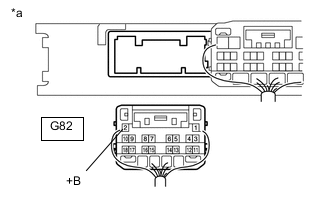
*a Rear view of wire harness connector
(to Certification ECU (Smart Key ECU Assembly))
Disconnect the G82 certification ECU (smart key ECU assembly) connector.
-
Measure the voltage according to the value(s) in the table below.
Standard Voltage Tester Connection Condition Specified Condition G82-2 (+B) - Body ground Always 11 to 14 V Result Proceed to OK NG
NG
REPAIR OR REPLACE HARNESS OR CONNECTOR IN CIRCUIT CONNECTED TO POWER SOURCE
OK
-
-
CHECK HARNESS AND CONNECTOR (GROUND)
-
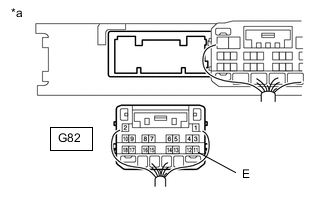
*a Rear view of wire harness connector
(to Certification ECU (Smart Key ECU Assembly))
Disconnect the G82 certification ECU (smart key ECU assembly) connector.
-
Measure the resistance according to the value(s) in the table below.
Standard Resistance Tester Connection Condition Specified Condition G82-11 (E) - Body ground Always Below 1 Ω Result Proceed to OK NG
NG
REPAIR OR REPLACE HARNESS OR CONNECTOR
OK
-
-
CHECK HARNESS AND CONNECTOR (CERTIFICATION ECU (SMART KEY ECU ASSEMBLY) - ECM)
-
Disconnect the A61 or A62 connector from the ECM.
-
Measure the resistance according to the value(s) in the table below.
Standard Resistance for 3ZR-FE, 3ZR-FAE Tester Connection Condition Specified Condition G82-16 (NE) - A62-30 (NEO) Always Below 1 Ω G82-16 (NE) or A62-30 (NEO) - Body ground 10 kΩ or higher for 2AR-FE Tester Connection Condition Specified Condition G82-16 (NE) - A62-45 (NEO) Always Below 1 Ω G82-16 (NE) or A62-45 (NEO) - Body ground 10 kΩ or higher for 1AD-FTV, 2AD-FHV, 2AD-FTV Tester Connection Condition Specified Condition G82-16 (NE) - A61-10 (NEO) Always Below 1 Ω G82-16 (NE) or A61-10 (NEO) - Body ground 10 kΩ or higher Result Proceed to OK NG
NG
REPAIR OR REPLACE HARNESS OR CONNECTOR
OK
-
-
CHECK CERTIFICATION ECU (SMART KEY ECU ASSEMBLY)
-
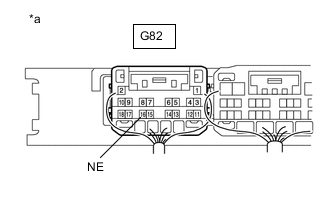
*a Component with harness connected
(Certification ECU (Smart Key ECU Assembly))
Reconnect the G82 certification ECU (smart key ECU assembly) connector.
-
Check the engine speed input signal waveform at the terminal of the certification ECU.
Standard Frequency Tester Connection Condition Specified Condition G82-16 (NE) - Body ground Engine stopped No pulse generated Engine running Pulse generated Result Proceed to OK NG (for 1AD-FTV) NG (for 2AD-FHV) NG (for 2AD-FTV (for DPF)) NG (for 2AD-FTV (for CCo)) NG (for 2AR-FE) NG (for 3ZR-FAE) NG (for 3ZR-FE)
OK
REPLACE CERTIFICATION ECU (SMART KEY ECU ASSEMBLY)
NG (for 1AD-FTV)
GO TO ECD SYSTEM (HOW TO PROCEED WITH TROUBLESHOOTING) Click here
NG (for 2AD-FHV)
GO TO ECD SYSTEM (HOW TO PROCEED WITH TROUBLESHOOTING) Click here
NG (for 2AD-FTV (for DPF))
GO TO ECD SYSTEM (HOW TO PROCEED WITH TROUBLESHOOTING) Click here
NG (for 2AD-FTV (for CCo))
GO TO ECD SYSTEM (HOW TO PROCEED WITH TROUBLESHOOTING) Click here
NG (for 2AR-FE)
GO TO SFI SYSTEM (HOW TO PROCEED WITH TROUBLESHOOTING) Click here
NG (for 3ZR-FAE)
GO TO SFI SYSTEM (HOW TO PROCEED WITH TROUBLESHOOTING) Click here
NG (for 3ZR-FE)
GO TO SFI SYSTEM (HOW TO PROCEED WITH TROUBLESHOOTING) Click here
-