CONTINUOUSLY VARIABLE TRANSAXLE SYSTEM DIAGNOSIS SYSTEM
-
DESCRIPTION

-
When troubleshooting Europe On-Board Diagnostic (Euro-OBD) vehicles, the vehicle must be connected to an OBD scan tool (complying with ISO 15765-4). Various data output from the vehicle ECM can then be read.
-
Euro-OBD regulations require that the vehicle on-board computer illuminate the Malfunction Indicator Lamp (MIL) on the instrument panel when the computer detects a malfunction in any of the following:
-
The emission control system/components
-
The powertrain control components (which affect vehicle emissions)
-
The computer
In addition, the applicable Diagnostic Trouble Codes (DTCs) prescribed by ISO 15765-4 are recorded in the ECM memory.
If the malfunction does not recur in 3 consecutive trips, the MIL goes off automatically but the DTCs remain recorded in the ECM memory.
-
-
To check DTCs, connect the GTS or OBD scan tool to the Data Link Connector 3 (DLC3) of the vehicle. The scan tool displays DTCs, freeze frame data and a variety of engine data.
The DTCs and freeze frame data can be cleared with the scan tool.
-
-
NORMAL MODE AND CHECK MODE
-
GTS only:
The diagnosis system operates in normal mode during normal vehicle use. In normal mode, 2 trip detection logic is used to ensure accurate detection of malfunctions. Check mode is also available as an option for technicians. In check mode, 1 trip detection logic is used for duplicating malfunction symptoms and increasing the system's ability to detect malfunctions, including intermittent problems.
-
-
2-TRIP DETECTION LOGIC
-
When a malfunction is first detected, the malfunction is temporarily stored in the ECM memory (1st trip). If the same malfunction is detected during the subsequent driving cycle, the MIL is illuminated (2nd trip).
-
-
FREEZE FRAME DATA
-
The ECM records vehicle and driving condition information as freeze frame data the moment a DTC is stored. When troubleshooting, freeze frame data can be helpful in determining whether the vehicle was moving or stationary, whether the engine was warmed up or not and whether the air-fuel ratio was lean or rich, as well as other data recorded at the time of a malfunction.
-
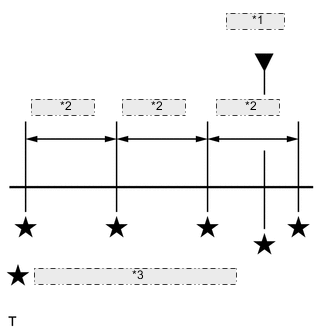
*1 DTC stored *2 0.5 seconds *3 Freeze frame data which can be read The GTS displays freeze frame data recorded at five different points: 1) 3 times before the DTC is stored, 2) once when the DTC is stored, and 3) once after the DTC is stored. The data can be used to reproduce the vehicle condition around the time of the malfunction. The data may be helpful in determining the cause of a malfunction. It may also be helpful in determining whether a DTC is being caused by a temporary malfunction.
-
-
LIST OF FREEZE FRAME DATA
Powertrain > Engine and ECTTester Display Vehicle Speed Engine Speed Calculate Load MAF Coolant Temp Throttle Motor DUTY N Range Status Starter Signal Neutral Position SW Signal Stop Light Switch A/C Signal Closed Throttle Position SW TC and TE1 SPD (NT) Shift SW Status (P Range) Kick Down Switch Status Pattern Switch (PWR/M) Shift SW Status (R Range) Shift SW Status (N Range) Shift SW Status (N,P Range) Supported Shift SW Status (N,P Range) Sports Shift Up SW Sports Shift Down SW Sports Mode Selection SW Shift SW Status (D Range) A/T Oil Temperature 1 ATF Thermal Degradation Estimate NT Sensor Voltage SPD (NIN) SPD (NOUT) NOUT Sensor Voltage A/T Oil Pressure G Sensor Lock Up Shift Status Solenoid (SLS) SLU Solenoid Status SL Solenoid Status Solenoid(SC) Solenoid(SLP) G Sensor Calibration G Sensor Learning Value CVT Oil Press Calibration Stop&Start of Eng State -
CHECK DATA LINK CONNECTOR 3 (DLC3)
-
Check the DLC3.
-
-
CHECK BATTERY VOLTAGE
If voltage is below 11 V, replace or recharge the battery before proceeding to the next step.
-
MIL (Malfunction Indicator Lamp)
-
Check that the MIL illuminates when the ignition switch is turned to ON.
If the MIL does not illuminate, there is a problem in the MIL circuit.
-
When the engine is started, the MIL goes off.
-