STOP AND START SYSTEM(for 3ZR-FAE), Diagnostic DTC:P0942
| DTC Code | DTC Name |
|---|---|
| P0942 | Hydraulic Pressure Unit |
DESCRIPTION
| DTC No. | Detection Item | DTC Detection Condition | Trouble Area | Warning Indicate | Memory |
|---|---|---|---|---|---|
| P0942 | Hydraulic Pressure Unit | 1. Diagnosis Condition 2. Malfunction Status 3. Malfunction Time 4. Other
|
|
Blinks | DTC stored |
CONFIRMATION DRIVING PATTERN
Tech Tips
DTCs for the stop and start system are not cleared even if the malfunction has been repaired. After repairing the malfunction, be sure to clear the DTCs.
-
CONFIRMATION AFTER TROUBLESHOOTING
Tech Tips
-
If the cable is disconnected from the negative (-) battery terminal, stop and start control is prohibited until refresh charge is completed. In this case, drive the vehicle approximately 5 to 60 minutes until refresh charge is completed and stop and start control operation is permitted.
-
Allow the engine to idle for 3 minutes after it is warmed up and check that the engine idle speed is within 50 rpm of the target idle speed.
-
Connect the GTS to the DLC3.
-
Turn the ignition switch to ON and turn the GTS on.
-
Clear the DTCs.
Powertrain > Stop and Start > Clear DTCs -
Start the engine and warm it up.
-
Drive the vehicle at 7 km/h (4.3 mph) or more.
CAUTION:
When performing Confirmation Driving Pattern, obey all speed limits and traffic laws.
-
Depress the brake pedal and stop the vehicle.
-
Keep the engine stopped by stop and start control. (Keep the shift lever in D.)
-
Release the brake pedal with the shift lever in D to start the engine.
-
Check that no DTCs are output.
Powertrain > Stop and Start > Trouble Codes
-
-
STOP AND START SYSTEM OPERATION CHECK
Tech Tips
If the cable is disconnected from the negative (-) battery terminal, stop and start control is prohibited until refresh charge is completed. In this case, drive the vehicle approximately 5 to 60 minutes until refresh charge is completed and stop and start control operation is permitted.
-
Start the engine and warm it up.
-
Turn the air conditioning system off.
-
Drive the vehicle at 7 km/h (4.3 mph) or more.
CAUTION:
When performing Confirmation Driving Pattern, obey all speed limits and traffic laws.
-
Depress the brake pedal and stop the vehicle.
-
Allow the engine to stop by stop and start control. (Keep the shift lever in D.)
-
Release the brake pedal with the shift lever in D to start the engine.
-
WIRING DIAGRAM
CAUTION / NOTICE / HINT
Note
-
When replacing the engine stop and start ECU with a new one, make sure to download the previous status (number of starter operations) of the old engine stop and start ECU. After replacing the engine stop and start ECU, turn the ignition switch to ON and wait 20 seconds, then confirm that "OK" is displayed for the Data List item "Oper Prohibition (O/P Air Bleeding)". Then upload the previous status (number of starter operations) to the engine stop and start ECU.
-
After replacing the engine stop and start ECU or air conditioning amplifier assembly, reset and perform learning of the air conditioning information in the engine stop and start ECU.
-
After replacing the engine stop and start ECU or airbag sensor assembly clear and calibrate the deceleration sensor zero point in the engine stop and start ECU.
-
Bleed the oil pump assembly with motor (continuously variable transaxle assembly) after removing and installing the continuously variable transaxle assembly or replacing the CVT fluid.
Tech Tips
Using the GTS, read the freeze frame data before troubleshooting. System condition information is recorded as freeze frame data the moment a DTC is stored. This information can be useful when troubleshooting.
PROCEDURE
-
CHECK ENGINE STOP AND START ECU (NOPM TERMINAL WAVEFORM)
-
Drive the vehicle to warm up the engine and CVT fluid.
Tech Tips
The oil pump assembly with motor (continuously variable transaxle assembly) may not operate properly if the CVT fluid temperature is low. Make sure to warm up the CVT fluid before performing the Active Test. (CVT fluid temperature: 25°C (77°F) or higher)
-
Connect the GTS to the DLC3.
-
Turn the ignition switch to ON.
Tech Tips
Do not start the engine.
-
Turn the GTS on.
-
Connect an oscilloscope to terminals A66-27 (NOPM) and A66-6 (DGND).
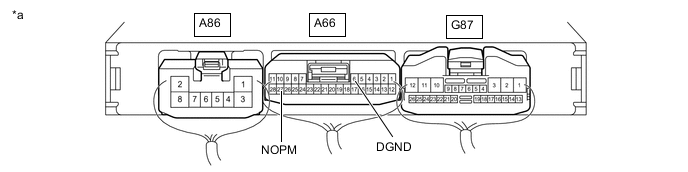
*a Component with harness connected
(Engine Stop and Start ECU)
- - -
Enter the following menus: Powertrain / Stop and Start / Active Test / AT Oil Pump (Lo).
Powertrain > Stop and Start > Active TestTester Display AT Oil Pump (Lo) -
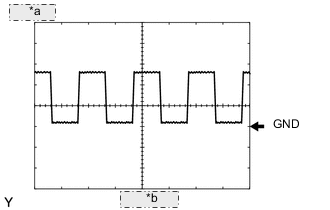
*a 5 V/DIV. *b 5 ms./DIV. Check the waveform while performing the Active Test.
Item Condition Tester Connection A66-27 (NOPM) - A66-6 (DGND) Tool Setting 5 V/DIV., 5 ms./DIV. Condition
-
Ignition switch ON (engine is stopped)
-
Active Test "AT Oil Pump (Lo)" being performed
Standard The waveform is similar to that shown in the illustration with no noise. Result Result Proceed to 17 to 200 Hz
(Normal Waveform)
A Except 17 to 200 Hz
(Abnormal Waveform)
B Tech Tips
-
17 Hz: Period is 59 ms (oil pump assembly with motor (continuously variable transaxle assembly) speed is approximately 510 rpm).
-
200 Hz: Period is 5 ms (oil pump assembly with motor (continuously variable transaxle assembly) speed is approximately 6000 rpm).
-
The higher the oil pump assembly with motor (continuously variable transaxle assembly) speed becomes, the shorter the wavelength.
-
B 
REPLACE CONTINUOUSLY VARIABLE TRANSAXLE ASSEMBLY Click here
A 
-
-
CLEAR DTC
-
Connect the GTS to the DLC3.
-
Turn the ignition switch to ON.
-
Turn the GTS on.
-
Enter the following menus: Powertrain / Stop and Start / Trouble Codes.
-
Clear the DTCs.
Powertrain > Stop and Start > Clear DTCsResult Proceed to NEXT
NEXT
-
-
CHECK DTC OUTPUT
-
Turn the ignition switch to ON.
-
Start the engine.
-
Perform a road test.
-
Enter the following menus: Powertrain / Stop and Start / Trouble Codes.
-
Read the DTCs.
Powertrain > Stop and Start > Trouble CodesResult Result Proceed to DTC P0942 is output A DTC P0942 is not output B
A
REPLACE ENGINE STOP AND START ECU Click here
B
USE SIMULATION METHOD TO CHECK Click here
-