SFI SYSTEM VC Output Circuit
DESCRIPTION
The ECM constantly generates a 5 V power source voltage from the battery voltage supplied to the +B (BATT) terminal to operate the microprocessor. The ECM also provides this power source voltage to the sensors through the VC output circuit.
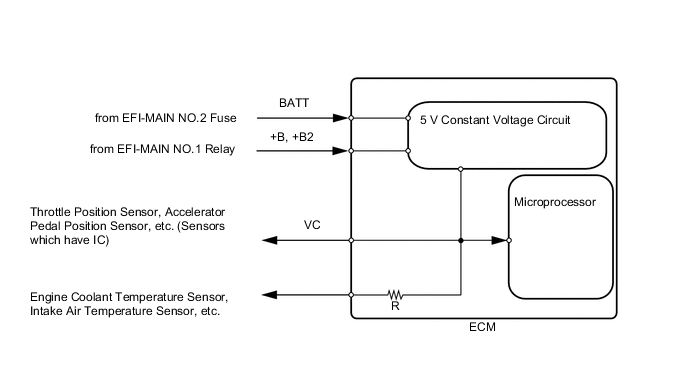
When the VC circuit is short-circuited, the microprocessor in the ECM and the sensors that are supplied with power through the VC circuit are inactivated because power is not supplied from the VC circuit. Under this condition, the system does not start up and the MIL does not illuminate even if the system malfunctions.
Tech Tips
Under normal conditions, the MIL is illuminated when the ignition switch is turned to ON. The MIL goes off when the engine is started.
WIRING DIAGRAM
PROCEDURE
-
CHECK MIL CONDITION
-
Check that the Malfunction Indicator Lamp (MIL) lights up when the ignition switch is turned to ON.
OK MIL lights up. Result Proceed to OK NG
OK 
PROCEED TO NEXT SUSPECTED AREA SHOWN IN PROBLEM SYMPTOMS TABLE Click here
NG 
-
-
CHECK CONNECTION BETWEEN GTS AND ECM
-
Connect the GTS to the DLC3.
-
Turn the ignition switch to ON.
-
Turn the GTS on.
-
Check for communication between the GTS and ECM.
Result Result Proceed to Communication is not possible A Communication is possible B
B
GO TO MIL CIRCUIT Click here
A
-
-
CHECK MIL (THROTTLE POSITION SENSOR)
-
Disconnect the throttle body assembly connector.
-
Turn the ignition switch to ON.
-
Check the MIL.
Result Result Proceed to MIL does not illuminate A MIL illuminates B Tech Tips
Perform "Inspection After Repair" after replacing the throttle body assembly Click here.
B
REPLACE THROTTLE BODY ASSEMBLY Click here
A
-
-
CHECK MIL (ACCELERATOR PEDAL SENSOR ASSEMBLY)
-
Disconnect the accelerator pedal sensor assembly connector.
-
Turn the ignition switch to ON.
-
Check the MIL.
Result Result Proceed to MIL does not illuminate A MIL illuminates B
B
REPLACE ACCELERATOR PEDAL SENSOR ASSEMBLY Click here
A
-
-
CHECK MIL (CAMSHAFT POSITION SENSOR (FOR INTAKE CAMSHAFT))
-
Disconnect the camshaft position sensor (for intake camshaft) connector.
-
Turn the ignition switch to ON.
-
Check the MIL.
Result Result Proceed to MIL does not illuminate A MIL illuminates B
B
REPLACE CAMSHAFT POSITION SENSOR (FOR INTAKE CAMSHAFT) Click here
A
-
-
CHECK MIL (CAMSHAFT POSITION SENSOR (FOR EXHAUST CAMSHAFT))
-
Disconnect the camshaft position sensor (for exhaust camshaft) connector.
-
Turn the ignition switch to ON.
-
Check the MIL.
Result Result Proceed to MIL does not illuminate (for CVT Models) A MIL does not illuminate (for Manual Transaxle Models) B MIL illuminates C
B 
GO TO STEP 8 Click here
C
REPLACE CAMSHAFT POSITION SENSOR (FOR EXHAUST CAMSHAFT) Click here
A
-
-
CHECK MIL (OIL PRESSURE SENSOR)
-
Disconnect the oil pressure sensor connector.
-
Turn the ignition switch to ON.
-
Check the MIL.
Result Result Proceed to MIL does not illuminate A MIL illuminates (for 2WD) B MIL illuminates (for 4WD/AWD) C
B
REPLACE OIL PRESSURE SENSOR Click here
C
REPLACE OIL PRESSURE SENSOR Click here
A
-
-
CHECK HARNESS AND CONNECTOR
-
Disconnect the throttle body assembly connector.
-
Disconnect the accelerator pedal sensor assembly connector.
-
Disconnect the camshaft position sensor (for intake camshaft) connector.
-
Disconnect the camshaft position sensor (for exhaust camshaft) connector.
-
Disconnect the oil pressure sensor connector (for CVT Models).
-
Disconnect the ECM connectors.
-
Measure the resistance according to the value(s) in the table below.
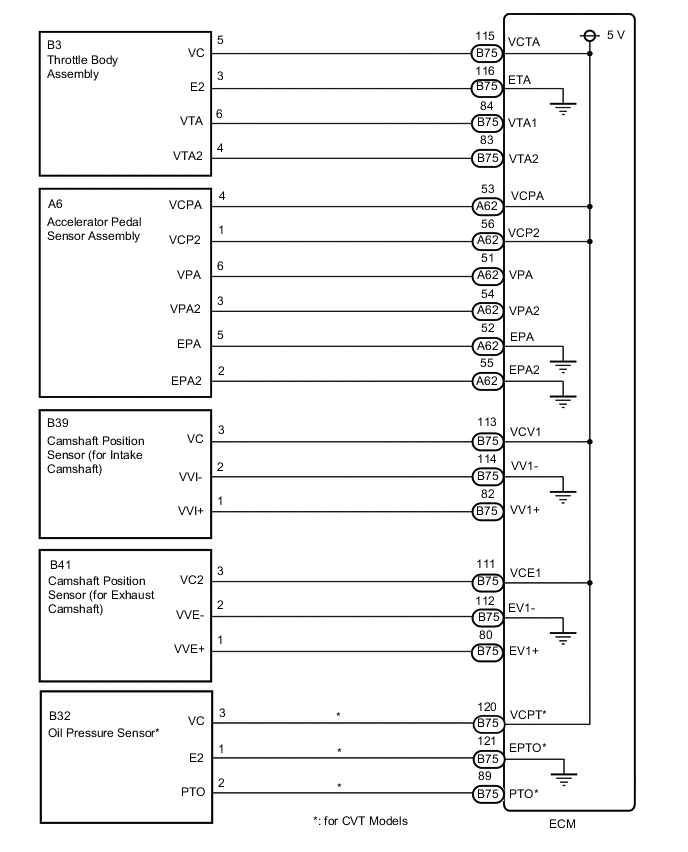
Standard Resistance Tester Connection Condition Specified Condition B75-115 (VCTA) - Body ground Always 10 kΩ or higher A62-53 (VCPA) - Body ground Always 10 kΩ or higher A62-56 (VCP2) - Body ground Always 10 kΩ or higher B75-113 (VCV1) - Body ground Always 10 kΩ or higher B75-111 (VCE1) - Body ground Always 10 kΩ or higher B75-120 (VCPT)* - Body ground Always 10 kΩ or higher *: for CVT Models
Result Proceed to OK NG
OK
REPLACE ECM Click here
NG
REPAIR OR REPLACE HARNESS OR CONNECTOR
-