ECD SYSTEM DATA LIST / ACTIVE TEST
-
DATA LIST
Tech Tips
Using the GTS to read the Data List allows the values or states of switches, sensors, actuators and other items to be read without removing any parts. This non-intrusive inspection can be very useful because intermittent conditions or signals may be discovered before parts or wiring is disturbed. Reading the Data List information early in troubleshooting is one way to save diagnostic time.
Note
In the table below, the values listed under "Normal Condition" are reference values. Do not depend solely on these reference values when deciding whether a part is faulty or not.
-
Warm up the engine.
-
Turn the ignition switch off.
-
Connect the GTS to the DLC3.
-
Turn the ignition switch to ON.
-
Start the engine.
-
Turn the GTS on.
-
Enter the following menus: Powertrain / Engine / Data List.
Tech Tips
-
To display the list box, press the pull down menu button next to "Primary". Then select a measurement group.
-
When you select a measurement group, the ECU data belonging to that group is displayed.
-
Measurement Group List / Description
-
All Data / All data
-
Primary / -
-
Engine Control / Engine control system related data
-
Diesel General / General data to analyze engine conditions for diesel engine
-
Common Rail / Fuel system related data
-
Common Rail (ALL) / Fuel system related detailed data
-
Diesel EGR / EGR system related data
-
Diesel Throttle / Diesel throttle system related data
-
VN Turbo / VN turbo related data
-
Diesel Exhaust / Exhaust system related data
-
Diesel Starting / "Difficult to start" related data
-
Diesel Rough Idle / "Rough idle" related data
-
Diesel Lack of Power / "Lack of power" related data
-
Diesel Knocking / "Knocking" related data
-
Diesel Black Smoke / "Black smoke" related data
-
Monitor Status / Monitor status related data
-
Charging Control / Charging control system related data
-
Compression / Data used during "Check the Cylinder Compression" Active Test
-
AT / Automatic transmission system related data
-
Vehicle Information / Vehicle information
-
-
Check the values by referring to the table below.
Tech Tips
"Result of real-vehicle check" is the assessment of one vehicle. Use it only for reference.
-
-
Engine Control
Powertrain > Engine > Data ListTester Display Measurement Item Type Range Normal Condition Diagnostic Note Vehicle Speed Vehicle speed Sensor output (speed sensor) Min.: 0 km/h, Max.: 255 km/h Actual vehicle speed Cause of Out of Range:
-
Speed sensor
-
Speed sensor circuit
Target Idle Engine Speed Target idling engine speed Target idling speed (ECM calculated value) Min.: 0 rpm, Max.: 10000 rpm - - Engine Speed Engine speed Sensor output (crankshaft position sensor) Min.: 0 rpm, Max.: 16383 rpm
-
50 to 400 rpm: Cranking
-
750 to 850 rpm: Idling with warm engine
When the crankshaft position sensor is malfunctioning, "Engine Speed" is approximately 0 or varies greatly from the actual engine speed.
Cause of Out of Range:
-
Crankshaft position sensor
-
Crankshaft position sensor circuit
Calculate Load Load calculated by ECM Calculated by ECM Min.: 0%, Max.: 100%
-
Idling: 7 to 26%
-
Running without load (2500 rpm): 10 to 20%
Calculated load = (Final injection volume / max. injection volume at current engine speed) x 100.
Cause of Out of Range:
Malfunction in which turbo pressure or Mass Air Flow decreases
MAF Air flow rate from mass air flow meter assembly/ Sensor output (mass air flow meter assembly) Min.: 0 gm/sec, Max.: 655.35 gm/sec
-
Idling: 3 to 12 gm/sec
-
Running without load (2000 rpm): 18 to 130 gm/sec
Tech Tips
Depends on EGR rate
-
Based on the MAF, the ECM controls the fuel injection volume, injection timing, EGR, etc.
-
If the value is always approximately 0 gm/sec:
-
Mass air flow meter assembly power source circuit is open.
-
VG circuit is open or shorted.
-
EVG circuit is open.
Cause of Out of Range:
-
Mass air flow meter assembly
-
Mass air flow meter assembly circuit
-
Intake related clog or leak
-
Exhaust related clog
-
Turbocharger sub-assembly
-
Leak or clog in passages for turbocharger
-
Malfunction in which EGR valve does not close
Symptoms when out of range:
Rough idling
Atmosphere Pressure Atmospheric pressure value Sensor output (atmospheric pressure sensor (built into ECM)) Min.: 0 kPa, Max.: 255 kPa Actual atmospheric pressure
-
With the ignition switch ON, when the difference between the atmospheric pressure sensor and intake manifold absolute pressure is 10 kPa or more, there is a malfunction in one of the sensors.
-
With the ignition switch ON, when the atmospheric pressure is 0 kPa or 140 kPa, there is a malfunction in the sensor circuit.
-
Standard atmospheric pressure: 101 kPa.
-
For every 100 m increase in elevation, pressure drops by 1 kPa.
This varies by weather (high atmospheric pressure, low atmospheric pressure).
Cause of Out of Range:
Atmospheric pressure sensor itself has failed (atmospheric pressure sensor is inside the ECM)
MAP Absolute pressure inside intake manifold Sensor output (manifold absolute pressure sensor) Min.: 0 kPa, Max.: 255 kPa
-
Idling: 90 to 103 kPa (depends on barometric pressure and amount of EGR)
-
Engine running at 3000 rpm: 125 to 150 kPa
-
When the ignition switch is ON or the vehicle is idling, the intake manifold absolute pressure and atmospheric pressure are approximately the same (standard atmospheric pressure = 101 kPa).
Above approximately 1500 rpm, the turbo becomes effective and the pressure becomes higher than atmospheric pressure.
-
Inspect while comparing with "Target Booster Pressure".
-
With the accelerator fully open, if the actual manifold absolute pressure (MAP) is low compared to the target booster pressure by at least 20 kPa for 5 seconds or more, a feeling of insufficient power will occur.
Cause of Out of Range:
-
Manifold absolute pressure sensor
-
Intake related clog or leak
-
Exhaust related clog
-
Turbocharger sub-assembly
-
Leak or clog in passages for turbocharger
-
EGR valve stuck open
-
Exhaust leak
-
Throttle valve stuck closed
Symptoms when out of range:
Lack of power
Coolant Temp Engine coolant temperature Sensor output (engine coolant temperature sensor) Min.: -40°C, Max.: 140°C After warming up engine: 60 to 90°C (140 to 194°F)
-
If the value is -40°C (-40°F) or 140°C (284°F), the sensor circuit is open or shorted.
-
After a long soak, the coolant temperature, intake air temperature and ambient temperature are approximately equal.
Cause of Out of Range:
-
Engine coolant temperature sensor
-
Thermostat
Symptoms when out of range:
Difficulty starting when engine is cold, rough idle, black smoke, lack of power
Intake Air Intake air temperature Sensor output (intake air temperature sensor (built into mass air flow meter assembly)) Min.: -40°C, Max.: 140°C Equivalent to temperature at location of mass air flow meter assembly
-
After a long soak, the engine coolant temperature, intake air temperature and ambient temperature are approximately equal.
-
If the value is -40°C (-40°F) or 140°C (284°F), the sensor circuit is open or shorted.
Cause of Out of Range:
Intake air temperature sensor
Intake Air Temp (Turbo) Intake air temperature after intercooler Sensor output (intake air temperature sensor after intercooler) Min.: -40°C, Max.: 190°C 70°C (158°F) or less
-
This is the intake air temperature at the intake manifold (after the intercooler).
-
During fail-safe operation, the value is set to 165°C (329°F). As the value is set to a high temperature, the turbo pressure may be suppressed and there may be a lack of power.
Cause of Out of Range:
Decreased cooling efficiency of intercooler (contamination, clogging)
Engine Run Time Engine run time Result of ECU calculations (using the engine speed) Min.: 0 sec., Max.: 65535 sec. Time after the ignition switch turned to ON Time passed since the ignition switch was turned to ON. Initial Engine Coolant Temp Initial engine coolant temperature Sensor output when engine started Min.: -40°C, Max.: 120°C Engine coolant temperature when engine started For freeze frame data, this tells whether the malfunction happened at a cold start or with a warm engine. Initial Intake Air Temp Initial intake air temperature Sensor output when engine started Min.: -40°C, Max.: 120°C Intake air temperature when engine started - Battery Voltage Battery voltage - Min.: 0 V, Max.: 65.15 V 11 to 14 V If 11 V or less, characteristics of some electrical components change.
Symptoms when out of range:
If 5 V or less, starting becomes difficult
Alternate Duty Ratio Alternator generation duty ratio Duty value from ALT terminal Min.: 0%, Max.: 100%
-
No electrical load at idling:
0 to 60%
-
High electrical load at idling:
100%
-
This is outputs the alternator generation duty and is used to determine the electrical load.
-
Can be used to determine whether a higher-than-normal injection volume at idle, etc. is due to electrical loading or from some other source. For example, when the duty is not high but the idling injection volume is high, there is injector volume degradation or high engine friction.
-
Can be used for judging whether or not a malfunctioning component in the electrical system is generating continual generation requests (e.g., battery deterioration is causing an unending full recharge request, etc.). Regardless of whether or not an auxiliary device like the A/C or heater is active, if the alternator duty is always at the maximum value, there is an electrical system abnormality, like battery deterioration.
Cause of Out of Range:
-
Battery deterioration
-
Alternator malfunction
-
Electric load, lights, etc.
Pre Glow Pre-glow operation Result of ECU calculations ON or OFF - This is the ECM command. After Glow After-glow operation Result of ECU calculations ON or OFF - This is the ECM command. Accel Position Accelerator position status
-
Accelerator pedal position sensor opening position
-
Engine coolant temperature requested opening position
-
Cruise requested opening position
-
VSC requested opening position
Min.: 0%, Max.: 99.6%
-
Accelerator pedal released:
0%
-
Accelerator pedal fully depressed:
100%
-
"Accel Position" is the accelerator opening amount (%) for engine control use.
-
When the accelerator pedal position sensor output itself (Accelerator Position 1, Accelerator Position 2) is in the normal voltage range, another actuator malfunction has caused the fail-safe function to restrict the accelerator.
-
Without cruise or VSC requests, and without accelerator restriction by the fail-safe function, this is adjusted in proportion to the amount the accelerator pedal is depressed by the driver.
-
Accelerator pedal released: 0%
-
Accelerator pedal fully depressed: 99.6%
Tech Tips
Accel Sens. No.1 Volt % and Accel Sens. No.2 Volt % express the value obtained by dividing the output voltage from the accelerator pedal position sensor by 5. This is used only for diagnosing malfunctions in the accelerator pedal position sensor. Under normal conditions, it is sufficient to only check the final accelerator opening angle value "Accel Position".
Accel Sens. No.1 Volt % Accelerator position No. 1 Sensor output (Accelerator pedal position sensor) Min.: 0%, Max.: 100%
-
Accelerator pedal released:
10 to 22%
-
Accelerator pedal fully depressed:
52 to 90%
Read value with ignition switch ON (do not start engine).
Tech Tips
Accel Sens. No.1 Volt % and Accel Sens. No.2 Volt % express the value obtained by dividing the output voltage from the accelerator pedal position sensor by 5. This is used only for diagnosing malfunctions in the accelerator pedal position sensor. Under normal conditions, it is sufficient to only check the final accelerator opening angle value "Accel Position".
Accel Sens. No.2 Volt % Accelerator position No. 2 Sensor output (Accelerator pedal position sensor) Min.: 0%, Max.: 100%
-
Accelerator pedal released:
24 to 40%
-
Accelerator pedal fully depressed:
68 to 95%
Same as Accel Sens. No.1 Volt %. Accel Sensor Out No.1 Accelerator position No. 1 voltage Sensor output (Accelerator pedal position sensor) Min.: 0 V, Max.: 5 V
-
Accelerator pedal released:
0.5 to 1.1 V
-
Accelerator pedal fully depressed:
2.6 to 4.5 V
Read value with ignition switch ON (do not start engine) Accel Sensor Out No.2 Accelerator position No. 2 voltage Sensor output (Accelerator pedal position sensor) Min.: 0 V, Max.: 5 V
-
Accelerator pedal released:
1.2 to 2.0 V
-
Accelerator pedal fully depressed:
3.4 to 4.75 V
Read value with ignition switch ON (do not start engine) Starter Signal Starter signal - ON or OFF ON: Cranking Ignition switch (STA) output:
-
ON: Starter is operating
-
OFF: Starter is not operating
Cause of Out of Range:
-
OFF malfunction (ignition switch (STA) is ON but the signal is OFF and the starter is operating): Wire harness is open or shorted to ground
-
ON malfunction (ignition switch (STA) is off but the signal is ON and the starter is not operating): Wire harness is shorted to +B
-
Operation malfunction: ignition switch malfunction, starter relay malfunction, starter malfunction, battery or battery cable is defective, or wire harness is open or shorted
Neutral Position SW Signal Neutral position switch status Switch output (neutral position switch) ON or OFF ON: Shift lever in neutral - Stop Light Switch Stop light switch assembly Switch output (stop light switch assembly) ON or OFF
-
ON: Brake pedal depressed
-
OFF: Brake pedal released
Stop light switch (STP) operation condition:
-
ON: Light is on (Brake pedal is depressed)
-
OFF: Light is off (Brake pedal is released)
Cause of Out of Range:
-
OFF malfunction: Wire harness (stop light switch to ECM, stop light switch to +B) open or shorted to ground
-
ON malfunction: Wire harness (stop light switch to ECM) shorted to +B
-
Stop light switch
Symptoms when out of range:
Stop light switch malfunction DTC P0504 is stored
A/C Signal A/C (Air Conditioner) signal A/C operation signal output from A/C amplifier
-
ON: Operating
-
OFF: Not operating
ON or OFF ON: A/C on Cause of Out of Range:
-
A/C switch
-
A/C amplifier
-
A/C system malfunction, wire harness between A/C amplifier and ECU open or shorted
Symptoms when out of range:
OFF malfunction (OFF even when A/C switch is turned on):
-
Engine speed decreases temporarily when the A/C is operating.
Immobiliser Communication Immobiliser communication - ON or OFF
-
ON: Normal
-
OFF: Engine cannot be started due to immobiliser communication malfunction
Cause of Out of Range:
-
Use of a non-registered key
-
Key battery is fully depleted
Check Mode Check mode - ON or OFF ON: Check mode on Check Mode: The mode in which certain DTCs can be detected more easily and with higher sensitivity. # Codes(Include History) Number of codes - Min.: 0, Max.: 255 - Number of DTCs appearing at least once during the last 40 times the vehicle was warmed up. MIL MIL status - ON or OFF OFF: MIL off - MIL ON Run Distance Distance traveled with MIL on Result of ECU calculations (using the vehicle speed) Min.: 0 km, Max.: 65535 km Distance traveled after DTC stored
-
Distance traveled after a DTC is stored.
-
Cleared when the cable is disconnected from the negative (-) battery terminal, or when the DTC is cleared using the GTS.
Running Time from MIL ON Running time after MIL turns on - Min.: 0 min., Max.: 65535 min. Running time after MIL turns on
-
Engine run time since the MIL illumination.
-
Cleared when the cable is disconnected from the negative (-) battery terminal, or when the DTC is cleared using the GTS.
Time after DTC Cleared Time after DTC cleared - Min.: 0 min., Max.: 65535 min. Time after DTCs cleared Time elapsed since the DTCs were cleared (or shipment from the factory). Distance from DTC Cleared Distance driven after DTC cleared - Min.: 0 km, Max.: 65535 km Distance driven after DTCs cleared
-
Distance driven since the DTCs were cleared.
-
(Data List "Distance from DTC clear") - (Freeze frame data "Distance from DTC cleared") = Distance driven since the abnormality occurred.
Warmup Cycle Cleared DTC Warmup cycles after DTC cleared - Min.: 0, Max.: 255 -
-
Number of engine warmup since DTCs were cleared.
-
(Data List "Warmup Cycle Cleared DTC") - (Freeze frame data "Warmup Cycle Cleared DTC") = Warmup cycles since the abnormality occurred.
Number of Emission DTC Number of emissions-related DTCs - - - - TC and TE1 TC and TE1 connection status for Active Test - ON or OFF - When the "Connect the TC and TE1" Active Test is performed, the system behaves as if TC and CG were connected. Engine Start Time Engine start time - Min.: 0 ms, Max.: 267000 ms - Time necessary for the engine to start. Electric Fan Motor Electric fan motor - ON or OFF ON: Electric fan motor operation - -
-
Compression
Powertrain > Engine > Data ListTester Display Measurement Item Type Range Normal Condition Diagnostic Note Engine Speed of Cyl #1 Engine speed for No. 1 cylinder - Min.: 0 rpm, Max.: 51199 rpm Engine speeds of all cylinders almost same
-
Output only when the "Check the Cylinder Compression" Active Test is performed.
-
Indicates the speed of each cylinder when cranking.
Example - Normal: Engine speeds of all cylinders are approximately equal.
When No. 1 cylinder compression is low, "Engine Speed of Cyl #1" is approximately 300 rpm, and "Engine Speed of Cyl #2 to #4" is approximately 200 rpm.
Cause of Out of Range:
Cyl #1 compression goes down
Symptoms when out of range:
When the engine speeds of all cylinders are not equal, idling will be rough.
Engine Speed of Cyl #2 Engine speed for No. 2 cylinder - Min.: 0 rpm, Max.: 51199 rpm - - Engine Speed of Cyl #3 Engine speed for No. 3 cylinder - Min.: 0 rpm, Max.: 51199 rpm - - Engine Speed of Cyl #4 Engine speed for No. 4 cylinder - Min.: 0 rpm, Max.: 51199 rpm - - Av Engine Speed of All Cyl Engine speed for all cylinders - Min.: 0 rpm, Max.: 51199 rpm -
-
Output only when the Active Test "Check the Cylinder Compression" is performed.
-
Indicates the average engine speed of all cylinders during cranking.
-
-
Vehicle Information
Powertrain > Engine > Data ListTester Display Measurement Item Type Range Normal Condition Diagnostic Note VN Turbo Type VN turbo type - Not Avl, Commo, Vacuum, CAN com, DC Vacuum Indicates the VN turbo vane actuation method.
-
DC motor system.
-
Negative-pressure diaphragm system.
-
Step motor system.
OBD Requirements OBD requirement - - EOBD (Euro OBD) - Model Code Model code - - - Identifying model code: ALA4# Engine Type Engine type - - - Identifying engine type: 2ADFHV Cylinder Number Cylinder number - Min.: 0, Max.: 255 - Identifying cylinder number: 4 Transmission Type Transaxle type - - - Identifying transaxle type: ECT 6th Destination Destination - - - Identifying destination: W Model Year Model year - Min.: 1900, Max.: 2155 - Identifying model year: 201# System Identification System identification - - - Identifying engine type: Diesel -
-
Common Rail (ALL)
Powertrain > Engine > Data ListTester Display Measurement Item Type Range Normal Condition Diagnostic Note Injection Volume Injection volume Calculated value Min.: 0 mm3/st, Max.: 1279.98 mm3/st
Idling: 4 to 12 mm3/st
-
Injection amount for each combustion.
-
If injector assemblies are clogged fuel quality is poor, the fuel filter element assembly is clogged, or engine friction increases, "Injection Volume" will increase.
-
If there is a malfunction due to low turbocharger pressure or a low intake air volume, the injection volume is limited and there is a lack of power.
Inj. FB Vol. for Idle Idle stability status integral control volume - Min.: -80 mm3/st, Max.: 79.99 mm3/st
-6 to 10 mm3/st
-
When the actual engine speed does not match the target idling speed, this corrects the injection volume.
If this item displays 10 mm3/st or more or -10 mm3/st or less even with the engine completely warmed up and the air conditioning and other electrical loads off, the internal parts of the engine may be damaged, or the fuel injection system or other auxiliary components may be malfunctioning.
-
Only calculated and reflected at idle.
Symptoms when out of range:
Engine friction problem, compression problem or injector breakdown
Inj Vol Feedback Learning Injection volume feedback learning value - Min.: -10 mm3/st, Max.: 9.9 mm3/st
- - Idle Signal Output Value Idle signal output value - Min.: 0, Max.: 255
-
Idling: 1
-
Not idling: 0
-
Piezo injector has big operation noise when idling. To reduce the noise level, this item lowers driving energy of when idling. This item displays the value for controlling driving energy
-
If the value is abnormal, DTC P1626 and P1627 will be stored.
-
If the injector is not Piezo injector, the value will be always "0".
Injection Feedback Val #1 Injection volume correction for No. 1 cylinder Learned value Min.: -10 mm3/st, Max.: 10 mm3/st
Idling: -3.0 to 3.0 mm3/st
-
When idling after warmup, the injection amount for each cylinder is corrected to optimize the difference between the engine speed of each cylinder.
Example: For cylinders that are slowing the engine speed compared to other cylinders, the injection volume is increased.
-
"Injection Feedback Val" more than 3.0 mm3/st: Injector breakdown is causing injection volume deviation, or insufficient compression is causing poor combustion.
-
Even if "Injection Feedback Val" for a cylinder is less than -3.0 mm3/st, the cylinder with this value does not necessarily have a problem.
Tech Tips
-
The ECM adjusts each cylinder so that the average "Injection Feedback Val" of the 4 cylinders is approximately 0 mm3/st.
-
If more than one cylinder has a positive correction value, a normal cylinder may have a value less than -3.0 mm3/st.
-
Cause of Out of Range:
-
Injector clogging
-
Injector deterioration
-
Decrease in cylinder compression
-
Injector compensation code is incorrectly set (forgot to input code after replacement or made mistake during setting of code after replacing ECM with one from another vehicle)
Symptoms when out of range:
Rough idling, black smoke, white smoke, poor driveability, lack of power, abnormal combustion noise, difficult to start
Injection Feedback Val #2 Injection volume correction for No. 2 cylinder Learned value Min.: -10 mm3/st, Max.: 10 mm3/st
Idling: -3.0 to 3.0 mm3/st
Same as Injection Feedback Val #1. Injection Feedback Val #3 Injection volume correction for No. 3 cylinder Learned value Min.: -10 mm3/st, Max.: 10 mm3/st
Idling: -3.0 to 3.0 mm3/st
Same as Injection Feedback Val #1. Injection Feedback Val #4 Injection volume correction for No. 4 cylinder Learned value Min.: -10 mm3/st, Max.: 10 mm3/st
Idling: -3.0 to 3.0 mm3/st
Same as Injection Feedback Val #1. Pilot 1 Injection Period Pilot 1 injection period Calculated value Min.: 0 μs, Max.: 65535 μs Idling: 140 to 260 μs Check to see if "Pilot 1 Injection Period" is not zero when symptoms occur.
Symptoms when out of range:
Combustion noise, poor driveability, white smoke
Pilot 2 Injection Period Pilot 2 injection period Calculated value Min.: 0 μs, Max.: 65535 μs Idling: 150 to 260 μs Check to see if "Pilot 2 Injection Period" is not zero when symptoms occur.
Symptoms when out of range:
Combustion noise, poor driveability, white smoke
Main Injection Period Main injection period Calculated value Min.: 0 μs, Max.: 65535 μs Idling: 110 to 310 μs
-
When the fuel pressure becomes 15000 kPa or less, "Main Injection Period" is set to 0.
-
When the engine will not start, confirm that injection is performed.
-
When P0093, P0627 or P062D is stored, there is an engine stall request. At that time, "Main Injection Period" equals 0.
Tech Tips
As the engine stalls 1 minute after the MIL illuminates, freeze frame data cannot be checked.
After Injection Period After injection period Calculated value Min.: 0 μs, Max.: 65535 μs - Check to see if "After Injection Period" is not zero when the following symptoms occur:
Black smoke, poor driveability.
Pilot 1 Injection Timing Pilot 1 injection timing Calculated value Min.: -70°CA, Max.: 20°CA Idling after engine warmed up and vehicle under normal atmospheric pressure: -12 to -8°CA - Pilot 2 Injection Timing Pilot 2 injection timing Calculated value Min.: -50°CA, Max.: 20°CA Idling after engine warmed up and vehicle under normal atmospheric pressure: -7 to -3°CA - Main Injection Timing Main injection timing Calculated value Min.: -90°CA, Max.: 90°CA Idling after engine warmed up and vehicle under normal atmospheric pressure: -5 to -1°CA Use "Main Injection Timing" to check poor drivability when the following symptoms are present: Bad injection timing, black smoke, and white smoke. After Injection Timing After injection timing Calculated Value Min.: -10°CA, Max.: 50°CA - - Injector Memory Error Injector memory error Calculated value No Error or Error No Error If the injector compensation codes are not input into the new ECM, or if an injector compensation code of a different injector model or a compensation code representing a value which exceeds the compensation setting range is input into the new ECM, DTC P062F is stored and "Injector Memory Error" displays "Error".
Symptoms when out of range:
Rough idling, poor driveability, black smoke, white smoke, combustion noise
Reju Pilot Quantity Learning Pilot quantity learning prohibition state Calculated value READY or NG - The status is only displayed while performing "Pilot Quantity Learning". Pilot Quantity Learning State of "Pilot Quantity Learning" Calculated value Standby, Wait, Learn, Stop, Comple -
-
The status is only displayed while performing "Pilot Quantity Learning".
-
If "Pilot Quantity Learning" is incomplete, the MIL illuminates and DTC P062F is stored.
Injection Pressure Correction Injection pressure feedback compensation volume Calculated value Min.: -500 mm3/st, Max.: 779.9 mm3/st
-20 to 20 mm3/st at standard temperature
-
When the (actual) fuel pressure is equal to the target fuel pressure, this value becomes 0.
-
This indicator can be used for diagnosing supply pump related malfunctions.
-
When this value (absolute value) is large, it indicates that the difference between the actual and target fuel pressure is also large.
A positive value indicates that the pressure feed is being increased due to insufficient pressure. A negative value indicates that pressure is being reduced due to excessive rail pressure.
When the suction control valve does not close properly, it causes rail overpressure, and this value and the "Pump SCV Learning Value" slip to the negative volume side.
Cause of Out of Range:
-
Suction control valve malfunction
-
Clogged fuel filter element assembly
Target Common Rail Pressure Target common rail pressure Target common rail pressure (ECU calculated value) Min.: 0 kPa, Max.: 250000 kPa 32000 to 200000 kPa when engine running
-
Inspect the (actual) fuel pressure, comparing it with the common rail target value.
-
Considered normal when the actual fuel pressure is within +/-5000 kPa of the target fuel pressure under stable conditions when idling after warm up the engine.
Fuel Press Fuel pressure Sensor output (fuel pressure sensor) Min.: 0 kPa, Max.: 250000 kPa Idling: 35000 to 45000 kPa
-
Fuel Press is the actual common rail fuel pressure.
-
Inspect by comparing the fuel pressure with the target fuel pressure.
-
When in a stable condition such as when idling after warm up the engine, the fuel pressure is within +/-5000 kPa of the target fuel pressure.
-
The ECM uses fuel pressure for feedback control of the target fuel pressure via the fuel supply pump assembly.
The injection amount is determined based on the injection timing and fuel pressure.
Also, the spray pattern is selected based on the fuel pressure.
-
For startup, at least 25000 kPa of fuel pressure is needed (take care as there is a response lag when the pressure rises).
-
When the fuel pressure is below 25000 kPa, it may cause rough idling.
-
When the fuel pressure has decreased by 20000 kPa from the target fuel pressure, there may be a lack of power.
-
If actual fuel pressure is 5000 kPa higher than the target fuel pressure, P1229 will be stored. When the actual fuel pressure is lower than the target fuel pressure, "P1608 Lack of Power" may be detected depending on the degree of deviation from the target pressure.
-
When the fuel pressure is higher than 220000 kPa, DTC P0088 will be stored.
Cause of Out of Range:
-
Fuel supply pump assembly
-
High pressure pipes
-
Fuel pressure sensor
-
Injector assembly
-
Feed pump (fuel supply pump assembly)
-
Fuel filter element assembly
-
Pressure discharge valve
-
Air in the fuel pipes
-
Lack of fuel
Symptoms when out of range:
Difficult to start, poor driveability, lack of power, abnormal combustion noise
Common Rail Pres Sens 2 Fuel pressure Sensor output (fuel pressure sensor) Min.: 0 kPa, Max.: 250000 kPa Idling: 35000 to 45000 kPa This is a backup output value from the fuel pressure sensor.
Cause of Out of Range:
-
Fuel supply pump assembly
-
High pressure pipes
-
Fuel pressure sensor
-
Injector assembly
-
Feed pump (fuel supply pump assembly)
-
Fuel filter element assembly
-
Pressure discharge valve
-
Air in the fuel pipes
-
Lack of fuel
Symptoms when out of range:
Poor driveability, lack of power, abnormal combustion noise.
Fuel Temperature Fuel temperature Sensor output (fuel temperature sensor) Min.: -40°C, Max.: 215°C Actual fuel temperature After fully cold soaking the engine, the fuel temperature is the same as the outside air temperature. Fuel Return Temp Fuel return temperature - Min.: -40°C, Max.: 215°C Idling after engine warmed-up: 35 to 85°C (95 to 185°F) If the "Fuel Return Temp" value is not between 35°C (95°F) and 110°C (230°F), "Pilot Quantity Learning" is prohibited. Target Pump SCV Current Final pump current target value Target value control (pump current) Min.: 0 mA, Max.: 8191.8 mA Idling: 923 to 1123 mA
-
ECU-calculated value for the suction control valve actuation target current.
-
Value is large when a high fuel pressure is desired.
-
Normally, the value is between 800 and 2500 mA.
-
If the value is stuck at 3000 mA or higher, it indicates that the operation is poor (poor movement due to deposits, etc.).
-
When this deviates from the standard value, it indicates that for some reason, even though the pump is running hard, the actual fuel pressure is inconsistent with the target fuel pressure.
Cause of Out of Range:
-
Suction control valve malfunction
-
Clogged fuel filter element assembly
Symptoms when out of range:
Difficulty starting, lack of power or rough idling
Pump SCV Learning Value Pump SCV learning value Learned value Min.: -4096 mA, Max.: 4095.8 mA
-
Min.: -100 mA
-
Max.: 100 mA
If the value is stuck at 200 mA or higher or -200 mA or less, it indicates that the operation is poor (poor movement due to deposits, etc.).
Cause of Out of Range:
-
Suction control valve malfunction
-
Clogged fuel filter element assembly
Symptoms when out of range:
Difficulty starting, lack of power or rough idling
Pressure Discharge Valve Pressure discharge valve operation - ON or OFF ON: Pressure discharge valve open This is the ECM command. Idle Injection Volume (Min) Idle minimum injection volume - Min.: 0 mm3/st, Max.: 39.8 mm3/st
- - -
-
Diesel EGR
Powertrain > Engine > Data ListTester Display Measurement Item Type Range Normal Condition Diagnostic Note Target EGR Position EGR valve target opening amount ECU-calculated value based on sensors (mass air flow meter assembly, manifold absolute pressure sensor, intake air temperature (built into mass air flow meter assembly), etc.) Min.: 0%, Max.: 100% Idling after engine warmed up: 0 to 80%
-
Fully open: 100%.
-
Fully closed: 0%.
-
Used for comparison to "Actual EGR Valve Pos.".
Symptoms when out of range:
-
When value is out of range and approaching 0%: mass air flow meter assembly degradation, intake or exhaust system blockage
-
When value is out of range and approaching 100%: EGR pipe blockage
Actual EGR Valve Pos. EGR valve position Calculated from EGR valve position sensor Min.: 0%, Max.: 100% Idling after engine warmed up: 0 to 80%
-
Fully open: 100%.
-
Fully closed: 0%.
-
Inspect while comparing to "Target EGR Position".
-
Check the valve movement via the Active Test.
-
Sometimes malfunctions only occur around a certain temperature, so refer to the engine coolant temperature and outside temperature at the time the malfunction occurred.
Symptoms when out of range:
-
EGR valve stuck open: Poor starts (engine does not stop), black smoke, white smoke, lack of power
-
EGR valve stuck closed: Increased turbo booster noise
EGR Motor Duty #1 EGR valve motor duty ratio - Min.: 0%, Max.: 127.5% 0 to 100% - EGR Close Lrn. Val. EGR fully closed position learned value EGR valve position sensor value when EGR valve fully closed Min.: 0 V, Max.: 4.99 V 0.34 to 0.70 V
-
This value is the EGR position sensor output voltage.
-
When the value is at the upper or lower limit of the normal range, it is possible that a foreign object is lodged in the EGR valve seat area.
-
As the lower and upper limits are 0 V and 1 V respectively, if the value becomes stuck at either of these values, there is a malfunction in the lift sensor or the valve position may be misaligned (foreign matter is present, etc.).
EGR Close Lrn. Status EGR valve fully closed position learning status - OK or NG OK
-
"OK" means the fully closed position learning has completed normally.
-
When NG, the learned fully closed position may be outside of the normal range.
When NG, there may be foreign matter stuck in the valve.
Tech Tips
After disconnecting and reconnecting the battery cable, if the ignition switch has not been turned off once, learning may not be completed.
EGR Operation Prohibit EGR operation prohibition - OK or NG OK: Possible to perform "Control the EGR Step Position" and "Activate the EGR Valve Close" Active Tests
-
OK: It is possible to perform the "Control the EGR Step Position" and "Activate the EGR Valve Close" Active Tests.
-
NG: It is not possible to perform the "Control the EGR Step Position" and "Activate the EGR Valve Close" Active Tests.
EGR Cooler Bypass VSV Status of the EGR Cooler Bypass VSV - ON or OFF
-
ON: Vacuum switching valve (for EGR bypass valve) is ON
-
OFF: Vacuum switching valve (for EGR bypass valve) is OFF
-
When EGR Cooler Bypass VSV is ON, the value for EGR Cooler Bypass Position is Cooler and, when EGR Cooler Bypass VSV is OFF, the value for EGR Cooler Bypass Position is Bypass.
-
The EGR cooler bypass VSV is controlled by the ECM and the vacuum switching valve (for EGR bypass valve) is opened and closed by the vacuum created by the vacuum pump.
Cause of Out of Range:
-
Vacuum switching valve (for EGR bypass valve)
-
Vacuum switching valve (for EGR bypass valve) circuit
EGR Cooler Bypass Position Status of the EGR Cooler Bypass Position - Cooler or Bypass
-
Cooler: EGR Cooler Bypass VSV is "ON"
-
Bypass: EGR Cooler Bypass VSV is "OFF"
-
When EGR Cooler Bypass VSV is ON, the value for EGR Cooler Bypass Position is Cooler and, when EGR Cooler Bypass VSV is OFF, the value for EGR Cooler Bypass Position is Bypass.
-
The EGR cooler bypass VSV is controlled by the ECM and the vacuum switching valve (for EGR bypass valve) is opened and closed by the vacuum created by the vacuum pump.
Cause of Out of Range:
-
Vacuum switching valve (for EGR bypass valve)
-
Vacuum switching valve (for EGR bypass valve) circuit
-
-
Diesel Throttle
Powertrain > Engine > Data ListTester Display Measurement Item Type Range Normal Condition Diagnostic Note Target Throttle Position Target throttle position Value calculated by ECM Min.: -128%, Max.: 127%
-
Throttle valve fully opened: 0%
-
Throttle valve fully closed: 100%
If there is a malfunction of the throttle actuator, compare the target and actual throttle position values for troubleshooting. Actual Throttle Position Actual diesel throttle position - Min.: -128%, Max.: 127% Idling after engine warmed-up: 0 to 94% Closing percentage of the throttle valve.
-
Fully closed: 100%.
-
Fully open: 0%.
Tech Tips
There is no connection with the accelerator. However, under full load, the throttle is usually fully open (0%).
Symptoms when out of range:
-
Stuck closed: Engine stall, difficult to start, lack of power, black smoke, rough idle
-
Stuck open: Loud turbocharging sound, bad vibration when engine is stopped
-
When ECM detects a malfunction of the diesel throttle (MIL on), engine power is restricted so that the vehicle can drive with a maximum speed of 80 to 100 km/h.
Throttle Close Learning Val. Throttle fully closed position learned value - Min.: 0 deg, Max.: 84 deg 14 to 21.25 deg
-
When the ignition switch is turned from ON to off and 5 seconds elapse, learning of "Throttle Close Learning Val." will be complete.
-
When "Throttle Close Learning Val." is outside of the normal range, a foreign object may be lodged in the throttle valve.
-
If the value is stuck at the upper limit of 21.25 deg, there is a chance that a malfunction is present.
However, as the initial value for the learned value is 21.25 deg, it is necessary to check the value after learning is completed.
Diesel Throttle Learn Status Diesel throttle learning history - OK or NG OK
-
If the system is functioning properly, learning will be performed when the ignition switch is turned from ON to off.
-
NG indicates that a foreign object may be lodged in the throttle valve or actuator components, or a disconnection/short exists in the signal wires.
Throttle Sensor Volt % Absolute throttle position sensor Sensor output (throttle position sensor) Min.: 0%, Max.: 100%
-
Ignition switch ON: 60 to 85%
-
Warmed-up and idling: 10 to 80%
-
Throttle position sensor output voltage is converted using 5 V = 100%.
-
When fully closed: 14%.
-
When fully open: 70%.
-
When the ignition switch is turned from off to ON, the throttle valve fully opens once.
-
When the ignition switch is turned from ON to off, the throttle valve fully closes once.
Symptoms when out of range:
-
Stuck closed: Engine stall, difficult to start, rough idling, lack of power, black smoke, white smoke
-
Stuck open: Loud turbocharging sound, bad vibration when engine is stopped
-
When the ECM detects a malfunction with the diesel throttle (MIL on), engine power is restricted but city driving is possible.
Throttle Motor DUTY Diesel throttle motor duty - Min.: 0%, Max.: 100% - When the moving force to open and close the diesel throttle valve increases, the value of the Throttle Motor Duty increases. -
-
VN Turbo
Powertrain > Engine > Data ListTester Display Measurement Item Type Range Normal Condition Diagnostic Note Target Booster Pressure Target booster pressure Value calculated by ECM Min.: -640 kPa, Max.: 639.98 kPa Idling and vehicle under normal atmospheric pressure: 80 to 144 kPa
-
Inspect while comparing with "MAP".
-
With the accelerator fully open, if the actual manifold absolute pressure (MAP) is low compared to the target booster pressure by at least 20 kPa for 5 sec. or more, a feeling of a lack of power will occur.
-
When the vehicle is driven with the engine speed at 3000 rpm or more and the accelerator pedal fully depressed, "MAP" is approximately equal to "Target Booster Pressure".
Boost Pressure Deviation Boost pressure deviation - Min.: -320 kPa, Max.: 320 kPa - Difference between target and actual boost pressure. VN Turbo Command VN turbo command value Controls the VN turbo vane opening position Min.: -128%, Max.: 127% 0 to 100%
-
"VN Turbo Command" is a command value.
-
0%: Vanes fully open (contraction of actuation rods)
-
90% or more: Vanes fully closed (extension of actuation rods)
-
When this value is large, the turbo works well.
-
There is no actual opening angle data to handle the VN turbo command value.
VN Turbo Max Angle VN turbo maximum opening amount - Min.: 0%, Max.: 99.6% -
-
The maximum vane opening amount is displayed in %.
-
The VN turbo is operated between VN Turbo Max Angle and VN Turbo Min Angle when the Test the Turbo Charger Step Motor Active Test is performed.
VN Turbo Min Angle VN turbo minimum opening amount - Min.: 0%, Max.: 99.6% -
-
The minimum vane opening amount is displayed in %.
-
The VN turbo is operated between VN Turbo Max Angle and VN Turbo Min Angle when the Test the Turbo Charger Step Motor Active Test is performed.
VN Turbo Operation Prohibit VN turbo operation prohibition - OK or NG OK: The "Test the Turbo Charger Step Motor" and "Activate the VN Turbo Open" Active Tests can be performed. When NG is displayed, the ECM does not permit "Test the Turbo Charger Step Motor" and "Activate the VN Turbo Open" Active Tests to be performed. -
-
Diesel Exhaust
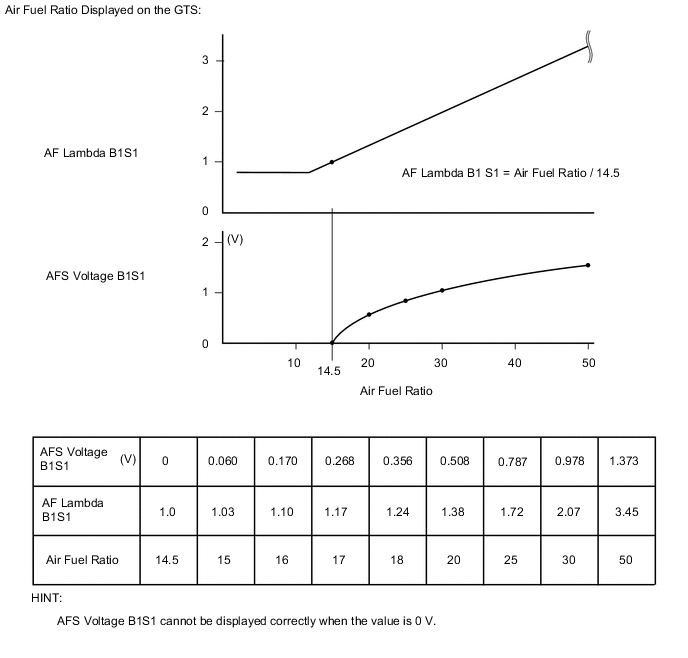
Powertrain > Engine > Data ListTester Display Measurement Item Type Range Normal Condition Diagnostic Note AF Lambda B1S1 Lambda equivalent ratio/ - Min.: 0, Max.: 255
-
AF Lambda B1S1 = air-fuel ratio / 14.5 (Stoichiometric A/F ratio)
-
Value less than 1 (0.000 to 0.999): Rich
-
Value more than 1 (1.001 to 255): Lean
-
Air-fuel ratio = intake air mass / (main fuel injection and exhaust fuel addition injection mass)
-
Check the air fuel ratio sensor output with the exhaust gas temperature (Exhaust Temperature B1S1) at 200°C (392°F) or higher (example: driving at speed of 50 km/h (31 mph) or more in 3rd gear).
-
If the exhaust fuel addition injector is clogged, the AF Lambda B1S1 value changes according to engine combustion, but large changes due to the addition of fuel are not seen even when PM forced regeneration is performed with the GTS.
-
Furthermore, if the main injectors become clogged, the AF Lambda B1S1 value will increase under all circumstances while the engine is running (the value increases regardless of whether the PM forced regeneration has been performed).
Cause of Out of Range:
-
Air fuel ratio sensor
-
Air fuel ratio sensor circuit
-
Fuel injector assembly clogged
AFS Voltage B1S1 Air fuel ratio sensor output voltage - Min.: 0 V, Max.: 7.99 V -
-
Check the air fuel ratio sensor output with the exhaust gas temperature (Exhaust Temperature B1S1) at 200°C (392°F) or higher (example: driving at speed of 50 km/h (31 mph) or more in 3rd gear).
-
If the exhaust fuel addition injector is clogged, the AFS voltage B1S1 value changes according to engine combustion, but large changes due to the addition of fuel are not seen even when PM forced regeneration is performed with the GTS.
Cause of Out of Range:
-
Air fuel ratio sensor
-
Air fuel ratio sensor circuit
-
Fuel injector assembly clogged
AFS Current B1S1 Air fuel ratio sensor current - Min.: -128 mA, Max.: 127.99 mA -
-
Check the air fuel ratio sensor output with the exhaust gas temperature (Exhaust Temperature B1S1) at 200°C (392°F) or higher (example: driving at speed of 50 km/h (31 mph) or more in 3rd gear).
-
If the exhaust fuel addition injector is clogged, even if PM forced regeneration is performed with the GTS, the AFS voltage B1S1 value will not change.
Cause of Out of Range:
-
Air fuel ratio sensor
-
Air fuel ratio sensor circuit
-
Fuel injector assembly clogged
AF Sensor Learning Value Air fuel ratio sensor learning value Value calculated by ECM Min.: 0 V, Max.: 5 V - Inspect the air fuel ratio sensor performance. Exhaust Temperature B1S1 Supported Status of exhaust gas temperature B1S1 Supported - Supp or Unsupp Supp If this item displays "Unsupp", a fixed value is displayed for "Exhaust Temperature", as exhaust gas temperature sensors are not equipped on the vehicle. Exhaust Temperature B1S1 Exhaust gas temperature of DPNR catalyst Sensor output (Exhaust gas temperature sensor B1S1) Min.: -40°C, Max.: 1000°C
-
Idling after engine warmed-up: 100 to 400°C (212 to 752°F)
-
During PM forced regeneration: 500 to 700°C (932 to 1292°F)
-
If an open occurs in an exhaust temperature sensor circuit, 0°C (32°F) is displayed on the GTS.
-
If a short occurs in an exhaust temperature sensor circuit, 1000°C (1832°F) or higher is displayed on the GTS.
Exhaust Temperature B1S2 Supported Status of exhaust gas temperature B1S2 Supported - Supp or Unsupp Supp If this item displays "Unsupp", a fixed value is displayed for "Exhaust Temperature", as exhaust gas temperature sensors are not equipped on the vehicle. Exhaust Temperature B1S2 Exhaust gas temperature of DPNR catalyst Sensor output (No. 2 exhaust gas temperature sensor B1S2) Min.: -40°C, Max.: 1000°C
-
Idling after engine warmed-up: 100 to 400°C (212 to 752°F)
-
During PM forced regeneration: 500 to 700°C (932 to 1292°F)
-
If an open occurs in an exhaust temperature sensor circuit, 0°C (32°F) is displayed on the GTS.
-
If a short occurs in an exhaust temperature sensor circuit, 1000°C (1832°F) or higher is displayed on the GTS.
Exhaust Temperature B1S3 Supported Status of exhaust gas temperature B1S3 Supported - Supp or Unsupp Unsupp If this item displays "Unsupp", a fixed value is displayed for "Exhaust Temperature", as exhaust gas temperature sensors are not equipped on the vehicle. Exhaust Temperature B1S3 - - Min.: -40°C, Max.: 1000°C - An open circuit condition fixed value is indicated, as exhaust gas temperature sensors are not equipped on the vehicle.
Tech Tips
Do not use the values for diagnosis as they are not related to the vehicle condition.
DPF Differential Pressure DPF differential pressure Sensor output (DPF differential pressure sensor) Min.: -5 kPa, Max.: 100 kPa Idling/ -3 to 3 kPa
-
When PM (Particulate Matter) builds up in the DPNR catalyst, the "DPF Differential Pressure" value increases.
-
At 3000 rpm (no load), if Catalyst Differential Press is 0.37 or more, the DPNR catalyst has become blocked.
Cause of Out of Range:
-
DPNR catalyst
-
DPF differential pressure sensor
-
Vacuum transmitting pipe clogged
-
Differential pressure sensor vacuum hose clogged
Catalyst Differential Press Amount of clogging in catalyst Calculated value Min.: -3.9998, Max.: 3.9998 0.2 or less
-
Diagnosis is possible when the MAF reading is between 30 and 140 gm/sec.
-
When the air intake volume is very low, such as when idling, due to excessive pressure fluctuation the correct values will not be displayed.
-
Catalyst Differential Press is the DPF Differential Pressure corrected in response to the MAF and other values.
-
If the filter in the DPNR catalyst is clogged, the "Catalyst Differential Press" value increases.
-
When the difference in pressure exceeds approximately 0.37, DTC P244B is stored and "DPF PM Block" displays "Blocked".
Symptoms when out of range:
-
If the difference in pressure increases, a decrease in engine power may be felt.
-
If an abnormal difference in pressure is detected, engine power is limited to protect the engine and catalyst.
Diff. Press. Sensor Corr. Differential pressure sensor 0 point learned value - Min.: -10 kPa, Max.: 245.9 kPa Ignition switch ON (engine stopped): - 1.5 to 1.5 kPa
-
This number indicates the correction value (0 point calibration) for compensation of variance in the differential pressure sensor.
-
If the value of DPF Differential Pressure does not approach 0 kPa when the ignition switch is ON (engine is stopped) and the Diff. Press. Sensor Corr. displays less than -1.5 kPa or more than 1.5 kPa, there may be a malfunction in the differential pressure sensor.
-
Note that the output of the differential pressure sensor fluctuates depending on the temperature.
Cause of Out of Range:
Differential pressure sensor
Exhaust Fuel Addition FB Exhaust fuel addition correction value Value calculated by ECM Min.: -256, Max.: 255.99 0.9 to 1.45
-
Usually Exhaust Fuel Addition FB is between 0.9 and 1.45.
-
Exhaust Fuel Addition FB is a correction value to increase the fuel volume injected from the exhaust fuel addition injector when the catalyst temperature does not rise to the target range during PM forced regeneration.
-
If the correction value is more than 1.45, a clog in the exhaust fuel addition injector assembly or fuel filter may be causing a reduction in injection volume or a problem with the engine (injectors, EGR, etc.) where the exhaust gas temperature decreases may be present. As a result, the catalyst temperature does not rise properly causing the catalyst to deteriorate.
Cause of Out of Range:
-
Exhaust fuel addition injector clogged
-
DPNR catalyst deteriorated
DPF Thermal Deteriorate DPNR catalyst thermal deteriorate Value calculated by ECM Normal or Deteriorated Normal Cause of Out of Range:
-
Exhaust fuel addition injector clogged
-
DPNR catalyst deteriorated
DPF No Activate DPF operation Value calculated by ECM Activate or No Activate During PM forced regeneration: Activate If the exhaust gas temperature does not rise enough when the PM forced regeneration is performed, "No Activate" appears on the GTS display. In this case, DPNR catalyst deterioration and clogging of the exhaust fuel addition injector are possible causes of the malfunction. Other possible causes include EGR valve malfunction, exhaust temperature sensor malfunction, and injector malfunction.
Cause of Out of Range:
-
DPNR catalyst
-
Exhaust fuel addition injector
-
Exhaust gas temperature sensor (B1S1)
-
Exhaust gas temperature sensor (B1S2)
-
Fuel injector assembly
DPF PM Block DPF PM Block Calculated value No Block or Blocked No Block
-
If PM (Particulate Matter) builds up in the DPNR catalyst, the pressure differential from front to rear of the DPNR catalyst gradually increases.
-
For example, at 3000 rpm (no load), if Catalyst Differential Press is 0.37 or more, "Blocked" appears on the GTS display. In this case, clogging of the DPNR catalyst, an injector system malfunction, differential pressure sensor system malfunction, exhaust leaks and a MAF meter malfunction are possible causes of the malfunction.
-
Clogging of the DPNR catalyst may be caused by the use of an oil that does not meet the specifications, such as using an engine oil that is not low-ash.
-
Clogging of the DPNR catalyst may also be caused by a high rate of engine oil consumption.
Cause of Out of Range:
-
DPNR catalyst clogged
-
DPF differential pressure sensor
-
Vacuum transmitting pipe clogged
-
Differential pressure sensor vacuum hose clogged
-
Fuel injector assembly
-
Exhaust gas leak
-
MAF meter
Catalyst Memory Error Catalyst memory error Calculated value No Error or Error No Error If the catalyst deterioration learning value from the old ECM is not input into the new ECM, or if a catalyst deterioration learning value that exceeds the setting range is input into the new ECM, DTC P062F is stored and "Catalyst Memory Error" displays "Error".
Symptoms when out of range:
Rough idling, poor driveability, black smoke, white smoke, combustion noise.
DPNR Status Reju (S) Sulfur poisoning regeneration status - Standby, Ready, Operate, Compl During sulfur poisoning regeneration: Operate The status is only displayed while performing "Activate the DPF Rejuvenate (S)".
-
Standby
-
Before entering the "Activate the DPF Rejuvenate (S)".
-
Ready
-
Enabling condition for "Activate the DPF Rejuvenate (S)" is not met.
-
Operate
-
Sulfur poisoning regeneration is being performed.
-
If "Activate the DPF Rejuvenate (S)" does not finish completely, the status turns to "Ready".
-
If "Activate the DPF Rejuvenate (S)" finishes completely, the status turns to "Compl".
-
Compl
-
Sulfur poisoning regeneration is completed.
DPNR/DPF Status Reju(PM) PM forced regeneration status - Standby, Ready, Operate, Compl During PM forced regeneration: Operate The status is only displayed while performing "Activate the DPF Rejuvenate (PM)".
-
Standby
-
Before entering the "Activate the DPF Rejuvenate (PM)".
-
Ready
-
Enabling condition for "Activate the DPF Rejuvenate (PM)" is not met.
-
Operate
-
PM forced regeneration is being performed.
-
If "Activate the DPF Rejuvenate (PM)" does not finish completely, the status turns to "Ready".
-
If "Activate the DPF Rejuvenate (PM)" finishes completely, the status turns to "Compl".
-
Compl
-
PM forced regeneration is completed.
Sulfur Accumulation Ratio Sulfur accumulation ratio - Min.: 0%, Max.: 510% - When sulfur poisoning regeneration is necessary, 100% is displayed for Sulfur Accumulation Ratio. PM Accumulation Ratio PM accumulation ratio - Min.: 0%, Max.: 510% -
-
When PM forced regeneration is necessary, 100% is displayed for PM Accumulation Ratio.
-
If the ratio exceeds 100%, PM forced regeneration will be performed automatically
-
-
Diesel starting
Powertrain > Engine > Data ListTester Display Measurement Item Type Range Normal Condition Diagnostic Note Glow Indicator Supported Status of the glow indicator supported - Unsupp or Supp Supp - Glow Indicator Status of the glow indicator - ON or OFF - - Engine Speed (Starter Off) Engine speed when starter off - Min.: 0 rpm, Max.: 1593 rpm - Engine speed immediately after starting the engine. Starter Count Starter on count - Min.: 0, Max.: 255 - Number of times the starter turned on from the time the ignition switch was turned to ON. Run Dist of Previous Trip Distance driven during previous trip - Min.: 0 km, Max.: 326.4 km - Before 5 seconds elapse after starting the engine, which is the DTC P1604 (Startability Malfunction) detection duration, this parameter indicates the distance driven during the previous trip. After 5 seconds elapse after starting the engine, this parameter indicates the distance driven during the current trip calculated from the vehicle speed signal.
Tech Tips
-
Run Dist of Previous Trip in the freeze frame data present when the startability malfunction occurred (DTC P1604 detected) indicates the distance driven during the previous trip, but in all other cases, such as for the snapshot data of the Data List (real-time measurements), or for freeze frame data present when DTCs other than P1604 were detected, the value indicates the distance driven during the current trip.
-
If DTCs indicating insufficient power or problems with the DPF system, diesel throttle or EGR valve are stored, confirm this item in the freeze frame data of the stored DTCs to determine the distance driven when the DTCs were stored. The distance driven can be used as a reference when troubleshooting.
Glow Request Lighting Time Glow Request Lighting Time - Min.: 0 ms, Max.: 33423 ms -
-
By comparing Glow Request Lighting Time to IG-ON Time, the operation state (whether the engine was started, etc.) can be determined.
-
If the malfunction occurred when starting a cold engine at 0°C (32°F) or less, this item is useful in determining whether the engine was started after the glow plug indicator lights turned off.
IG-ON Time IG-ON Time - Min.: 0 ms, Max.: 33423 ms -
-
By comparing Glow Request Lighting Time to IG-ON Time, the operation state (whether the engine was started, etc.) can be determined.
-
If the malfunction occurred when starting a cold engine at 0°C (32°F) or less, this item is useful in determining whether the engine was started after the glow plug indicator lights turned off.
Immobiliser Fuel Cut History Immobiliser fuel cut history - ON or OFF OFF If Immobiliser Fuel Cut History was "ON" when DTC P1604 (Startability Malfunction) was stored, the engine could not be started due to the immobiliser. -
-
Diesel Rough Idle
Powertrain > Engine > Data ListTester Display Measurement Item Type Range Normal Condition Diagnostic Note Rough Idle #1 Status of the Rough Idle #1 - ON or OFF OFF
-
This item indicates cylinders which had speeds lower than the other cylinders.
-
This item indicates cylinders which are likely to be the cause of rough idle.
Cause of Out of Range:
Injector assembly
Rough Idle #2 Status of the Rough Idle #2 - ON or OFF OFF
-
This item indicates cylinders which had speeds lower than the other cylinders.
-
This item indicates cylinders which are likely to be the cause of rough idle.
Cause of Out of Range:
Injector assembly
Rough Idle #3 Status of the Rough Idle #3 - ON or OFF OFF
-
This item indicates cylinders which had speeds lower than the other cylinders.
-
This item indicates cylinders which are likely to be the cause of rough idle.
Cause of Out of Range:
Injector assembly
Rough Idle #4 Status of the Rough Idle #4 - ON or OFF OFF
-
This item indicates cylinders which had speeds lower than the other cylinders.
-
This item indicates cylinders which are likely to be the cause of rough idle.
Cause of Out of Range:
Injector assembly
Electric Duty Feedback Value Electric load feedback value - Min.: 0 mm3/st, Max.: 39.8 mm3/st
0 to 3.9 mm3/st
Expected injection volume increase after the electrical load turns from off to on. A/C Duty Feedback Value A/C load feedback value - Min.: 0 mm3/st, Max.: 39.8 mm3/st
0 to 3.6 mm3/st
Expected injection volume increase after the A/C turns from off to on. PS Duty Feedback Value Power steering load feedback value - Min.: 0 mm3/st, Max.: 39.8 mm3/st
0 mm3/st
Expected injection volume increase after the power steering turns from off to on. -
-
Diesel Lack of Power
Powertrain > Engine > Data ListTester Display Measurement Item Type Range Normal Condition Diagnostic Note MAF Low Mass air flow Low - ON or OFF OFF
-
When DTC P1608 is output, this item indicates whether the cause of lack of power is related to the intake air amount.
-
This item indicates whether the intake air amount measured by the mass air flow meter assembly was insufficient, which would cause the fuel injection volume to be reduced for a certain period of time. If this is the case, this item displays "ON" and DTC P1608 (lack of engine power) is stored.
-
This item is "ON" when the intake air amount is low due to blockage in the intake system, disconnection of hoses or an excessive amount of EGR, and also when the intake air amount is measured to be low due to deterioration of the mass air flow meter assembly.
Cause of Out of Range:
-
Mass air flow meter assembly (value is out of range)
-
Intake system blockage
-
Disconnected air hoses (intake system)
-
EGR system (EGR valve closing malfunction)
-
Nozzle vane (turbo) movement problems
Symptoms when out of range:
Lack of power
Boost Pressure Low Status of the Boost Pressure Low - ON or OFF OFF
-
When DTC P1608 is output, this item indicates whether the cause of lack of power is due to the boost pressure.
-
This item indicates whether the actual boost pressure was insufficient compared to the target boost pressure, which would cause the fuel injection volume to be reduced for a certain period of time. If this is the case, this item displays "ON" and DTC P1608 (lack of engine power) is stored.
Cause of Out of Range:
-
Nozzle vane (turbo) stuck
-
Disconnected air hoses (intake system)
-
Manifold absolute pressure sensor
-
Atmospheric pressure sensor (built into ECM)
-
Difference between atmospheric pressure and intake pressure
Symptoms when out of range:
Lack of power
Common Rail Pressure Low Status of the Common Rail Pressure Low - ON or OFF OFF
-
When DTC P1608 is output, this item indicates whether the cause of lack of power is the common rail pressure.
-
This item indicates whether the actual common rail pressure was lower than the target pressure for a certain period of time. If this is the case, this item displays "ON" and DTC P1608 (lack of engine power) is stored.
Cause of Out of Range:
-
Suction control valve (movement problems)
-
Fuel leak
-
Fuel pressure sensor (built into common rail assembly)
Symptoms when out of range:
Lack of power
Engine Coolant Temp High Status of the Engine Coolant Temp High - ON or OFF OFF
-
When DTC P1608 is output, this item indicates whether the cause of lack of power is due to a high engine coolant temperature.
-
This item indicates whether the fuel injection volume was reduced for a certain period of time due to a high engine coolant temperature (overheating). If this is the case, this item displays "ON" and DTC P1608 (lack of engine power) is stored.
Cause of Out of Range:
-
Engine coolant temperature sensor
-
Engine coolant leak
-
Radiator clog
Symptoms when out of range:
Lack of power
MAF/Estimate MAF Ratio Ratio of intake air amount to estimated intake air amount - Min.: 0, Max.: 2.55 Engine speed 4000 rpm, EGR system off:
0.6 to 1.4
-
Even when the system is normal, the value may deviate from the range specified in Normal Condition for a short period of time (approximately 1 second).
-
This item indicates the ratio of the intake air amount to the estimated intake air amount. The estimated air amount is calculated using the intake manifold pressure and intake air temperature.
-
When DTC P1608 is stored, this item is useful in determining whether there is a problem in the turbocharger system or a disconnected or leaking pipe in the high pressure intake system when the boost pressure is insufficient.
-
When performing troubleshooting, this information is only valid when there is a high load (the diesel throttle is fully open) and the EGR system is off.
Cause of Out of Range:
-
Mass air flow meter assembly
-
Turbocharger sub-assembly
-
Pipes between turbocharger sub-assembly and intake manifold are disconnected or leaking
-
Pipes between mass air flow meter assembly and turbocharger sub-assembly are disconnected or leaking
Symptoms when out of range:
Lack of power
-
-
Monitor Status
Powertrain > Engine > Data ListTester Display Measurement Item Type Range Normal Condition Diagnostic Note Complete Parts Monitor Comprehensive component monitor - Not Avl or Avail - * Fuel System Monitor Fuel system monitor - Not Avl or Avail - * Misfire Monitor Misfire monitor - Not Avl or Avail - * EGR/VVT Monitor EGR/VVT monitor - Not Avl or Avail - * EGR/VVT Monitor EGR/VVT monitor - Compl or Incmpl - * O2S(A/FS) Heater Monitor O2S (A/FS) heater monitor - Not Avl or Avail - * O2S(A/FS) Heater Monitor O2S (A/FS) heater monitor - Compl or Incmpl - * O2S(A/FS) Monitor O2S (A/FS) monitor - Not Avl or Avail - * O2S(A/FS) Monitor O2S (A/FS) monitor - Compl or Incmpl - * A/C Monitor A/C monitor - Not Avl or Avail - * A/C Monitor A/C monitor - Compl or Incmpl - * 2nd Air Monitor 2nd air monitor - Not Avl or Avail - * 2nd Air Monitor 2nd air monitor - Compl or Incmpl - * EVAP Monitor EVAP monitor - Not Avl or Avail - * EVAP Monitor EVAP monitor - Compl or Incmpl - * Heated Catalyst Monitor Heated catalyst monitor - Not Avl or Avail - * Heated Catalyst Monitor Heated catalyst monitor - Compl or Incmpl - * Catalyst Monitor Catalyst monitor - Not Avl or Avail - * Catalyst Monitor Catalyst monitor - Compl or Incmpl - * *:
Avail: The monitor is available on the vehicle.
Not Avl: The monitor is not available on the vehicle.
Incmpl / Compl: The item changes from Incmpl to Compl if the monitor was completed at least once at some time in the past. This item does not change when the ignition switch is turned off. However, the item changes back to Incmpl when DTCs are cleared or the battery cable is disconnected.
-
AT
Powertrain > Engine > Data ListTester Display Measurement Item Type Range Normal Condition Diagnostic Note Received MIL from ECT MIL status from ECT - ON or OFF OFF - Shift Position Sig from ECT Shift position from ECT - 1st, 2nd, 3rd, 4th, 5th or 6th - - A/T Oil Temp from ECT ATF temperature from ECT - Min.: -40°C, Max.: 215°C With engine cold: Equal to ambient temperature - SPD (NO) Output shaft speed - Min.: 0 rpm, Max.: 12750 rpm - - ECT Lock Up ECT lock-up status - ON or OFF ON: Lock-up operating - Shift SW Status (P Range) Park/neutral position switch status - ON or OFF
-
ON: Shift lever in P
-
OFF: Shift lever not in P
When the shift lever position displayed on the GTS differs from the actual position, the adjustment of the park/neutral position switch or shift cable may be incorrect.
Tech Tips
When failure still occurs even after adjusting these parts, refer to DTC P0705.
Kick Down Switch Status Kick down switch status - ON or OFF
-
Accelerator pedal fully depressed: ON
-
Accelerator pedal released: OFF
- Pattern Switch (PWR/M) Pattern select switch (SPORT) status - ON or OFF Pattern select switch (SPORT) status is:
-
Pushed: ON
-
Not pushed: OFF
- Shift SW Status (R Range) Park/neutral position switch status - ON or OFF
-
ON: Shift lever in R
-
OFF: Shift lever not in R
When the shift lever position displayed on the GTS differs from the actual position, the adjustment of the park/neutral position switch or shift cable may be incorrect.
Tech Tips
When failure still occurs even after adjusting these parts, refer to DTC P0705.
Shift SW Status (N Range) Park/neutral position switch status - ON or OFF
-
ON: Shift lever in N
-
OFF: Shift lever not in N
When the shift lever position displayed on the GTS differs from the actual position, the adjustment of the park/neutral position switch or shift cable may be incorrect.
Tech Tips
When failure still occurs even after adjusting these parts, refer to DTC P0705.
Shift SW Status (N,P Range) Supported Status of shift switch supported - Supp or Unsupp Unsupp - Sports Shift Up SW Sports shift up switch status - ON or OFF
-
ON: Shift lever held in "+" (up-shift)
-
OFF: Shift lever not in "+" (up-shift)
- Sports Shift Down SW Sports shift down switch status - ON or OFF
-
ON: Shift lever held in "-" (down-shift)
-
OFF: Shift lever not in "-" (down-shift)
- Sports Mode Selection SW Sports mode select switch status - ON or OFF
-
ON: Shift lever in M, "+" or "-"
-
OFF: Shift lever not in M, "+" or "-"
- Shift SW Status (D Range) Park/neutral position switch status - ON or OFF
-
ON: Shift lever in D
-
OFF: Shift lever not in D
When the shift lever position displayed on the GTS differs from the actual position, the adjustment of the park/neutral position switch or shift cable may be incorrect.
Tech Tips
When failure still occurs even after adjusting these parts, refer to DTC P0705.
A/T Oil Temperature 1 ATF temperature sensor value - Min.: -40°C, Max.: 215°C With engine cold: Equal to ambient temperature If the value is -40°C (-40°F) or 150°C (302°F), the ATF temperature sensor circuit is open or shorted. MT Down Shift Indication Manual transmission shift down indication - ON or OFF - - MT Up Shift Indication Manual transmission shift down indication - ON or OFF - - -
-
ACTIVE TEST
Tech Tips
Using the GTS to perform Active Tests allows relays, VSVs, actuators and other items to be operated without removing any parts. This non-intrusive functional inspection can be very useful because intermittent operation may be discovered before parts or wiring is disturbed. Performing Active Tests early in troubleshooting is one way to save diagnostic time. Data List information can be displayed while performing Active Tests.
-
Connect the GTS to the DLC3.
-
Turn the ignition switch to ON.
-
Turn the GTS on.
-
Enter the following menus: Powertrain / Engine / Active Test.
-
Perform the Active Test.
Powertrain > Engine > Active TestTester Display Measurement Item Control Range Diagnostic Note Connect the TC and TE1 Turn on the TC and TE1 connection ON/OFF - Control the Electric Cooling Fan Control the electric cooling fan operation ON/OFF Test is possible when the following conditions are met:
-
Ignition switch ON.
-
Engine is stopped.
Control the EGR Step Position Control the electric EGR control valve assembly 1 to 100% Test is possible when the following conditions are met:
-
Ignition switch ON.
-
Engine is stopped.
Activate the DPF Rejuvenate (S) Sulfur poisoning regeneration Raise temperature of DPNR to more than 600°C (1112°F) by adding fuel intermittently using the exhaust fuel addition injector ON/OFF - Activate the DPF Rejuvenate (PM) PM forced regeneration Raise temperature of DPNR to more than 600°C (1112°F) by adding fuel intermittently using the exhaust fuel addition injector ON/OFF - Diesel Throttle Target Angle Control the diesel throttle valve 0 to 90% Test is possible when the following conditions are met:
-
Ignition switch ON.
-
Engine is stopped.
Test the Turbo Charger Step Motor Control the vacuum regulating valve assembly for turbocharger control 0 to 100% - Test the Fuel Leak Pressurize the common rail interior and check for fuel leaks Stop/Start
-
Fuel pressure inside common rail pressurized to specified value and engine speed increased to 2000 rpm when ON is selected
-
Above conditions preserved while test is ON
Tech Tips
If this Active Test is performed when the engine is cold, combustion may become unstable. However, this is not a malfunction. It is only necessary to confirm that the pressure rises to the target pressure and that there are no fuel leaks.
Activate the VN Turbo Open Control the vacuum regulating valve assembly for turbocharger control ON/OFF Confirm that the engine is running. Activate the EGR Valve Close Activate the electric EGR control valve assembly Close/OFF Confirm that the vehicle is stopped and the engine is idling Activate the VSV for EGR Cooler Bypass Activate the vacuum switching valve assembly (for EGR cooler) Bypass/Half Pos/Cooler Test is possible when the following conditions are met:
-
Engine warmed up
-
Engine is idling
-
Shift lever in neutral
If performing the Active Test continuously, it must be finished within 5 minutes.
Control the Voltage of Alternator Request output voltage of generator Between 12.5 and 14.8 V Test possible while vehicle stopped and engine idling. Control the Select Cylinder Fuel Cut Selected cylinder (cylinder #1 to #4) injector assembly fuel cut #1/#2/#3/#4
ON/OFF
Fuel injection is stopped while the test is ON.
-
Confirm that the vehicle is stopped and the engine is idling.
-
If the running condition of the engine does not worsen even though injection of the designated cylinder is stopped, the cylinder can be confirmed to be malfunctioning.
Check the Cylinder Compression Check the cylinder compression pressure ON/OFF Fuel injection stops in all cylinders. -
Tech Tips
When cranking the engine, the "Check the Cylinder Compression" measures the speed of each cylinder. In this "Check the Cylinder Compression", the fuel of all cylinders is cut when the engine is cranked for approximately 10 seconds.
At this time, the speed of each cylinder is measured. If the speed of one cylinder is higher than the other cylinders, the compression pressure of that cylinder is determined to be lower than the other cylinders.
-
Warm up the engine.
-
Turn the ignition switch off.
-
Connect the GTS to the DLC3.
-
Turn the ignition switch to ON.
-
Turn the GTS on.
-
Enter the following menus: Powertrain / Engine / Active Test / Check the Cylinder Compression.
Tech Tips
To display the entire Data List, press the pull down menu button next to Primary. Then select Compression.
-
Push the snapshot button to turn the snapshot function on.
Tech Tips
Using the snapshot function, data can be recorded during the Active Test.
-
While the engine is not running, press the ON button to change Check the Cylinder Compression to on.
Tech Tips
After performing the above procedure, Check the Cylinder Compression will start. Fuel injection for all cylinders is prohibited and each cylinder engine speed measurement enters standby mode.
-
Crank the engine for about 10 seconds.
Tech Tips
Continue to crank the engine until the values change from the default value (51199 rpm).
-
Monitor the engine speed (Engine Speed of Cyl #1 to #4) displayed on the GTS.
Tech Tips
At first, the GTS displays extremely high cylinder engine speed values. After approximately 10 seconds of engine cranking, each cylinder engine speed measurement will change to the actual engine speed.
Note
-
Do not crank the engine continuously for 20 seconds or more.
-
If it is necessary to crank the engine again after Check the Cylinder Compression has been changed to ON and the engine has been cranked once, press Exit to return to the Active Test menu screen. Then change Check the Cylinder Compression to ON and crank the engine.
-
Use a fully-charged battery.
-
-
Stop cranking the engine, and then change "Check the Cylinder Compression" to OFF after the engine stops.
Note
If the Active Test is changed to OFF while the engine is being cranked, the engine will start.
-
Push the snapshot button to turn the snapshot function off.
-
Select "Stored Data" on the GTS screen, select the recorded data and display the data as a graph.
Tech Tips
If the data is not displayed as a graph, the change of the values cannot be observed.
-
Check the change in engine speed values.
Tech Tips
As the data values of the Active Test return to their default values when cranking is stopped, the engine speed value of each cylinder cannot be observed. Therefore, it is necessary to use the data recorded with the snapshot function to check the engine speed values recorded during cranking.
-
-
SYSTEM CHECK
-
Activate the Pressure Discharge Valve Check
Tech Tips
-
This is the procedure for troubleshooting fuel pressure control malfunctions and combustion problems.
-
Malfunctions can be determined by checking the fuel pressure when performing a fuel cut and operating the pressure discharge valve with the GTS.
-
During "Pressure Discharge Valve Check", the GTS measures the fuel pressure while the engine is running, after the engine is stopped, and after the pressure discharge valve operates.
-
Connect the GTS to the DLC3.
-
Turn the ignition switch to ON.
-
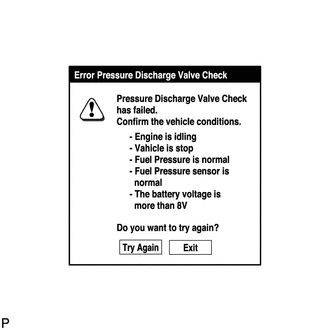
Turn the GTS on.
Note
Confirm the following conditions:
-
Engine is idling.
-
Vehicle is stopped.
-
Fuel pressure is not extremely high (less than 100000 kPa).
-
Fuel pressure is not extremely low (higher than 26000 kPa).
-
Fuel pressure sensor is normal.
-
Battery voltage is more than 8 V.
Tech Tips
When the common rail pressure is unstable, the fuel pressure may decrease to a level where the test cannot be performed. In this situation, wait until the common rail pressure meets the test condition, and then perform the test.
-
-
Enter the following menus: Powertrain / Engine / Utility / Pressure Discharge Valve Check.
-
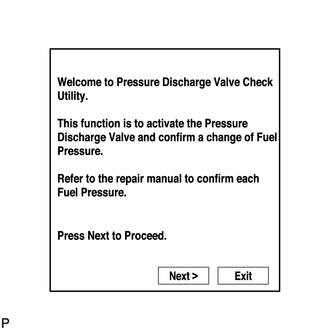
Press "Next".
-
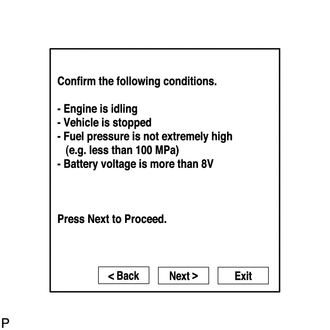
Press "Next" again to proceed.
-
Select the check type "Valve Check for Graph".
-
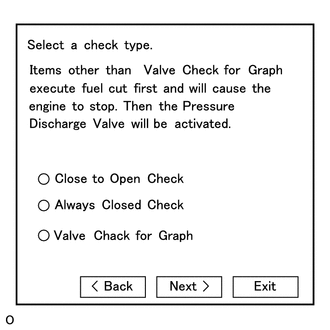
Press "Next" again to proceed.
-
Press "Start" again to proceed.
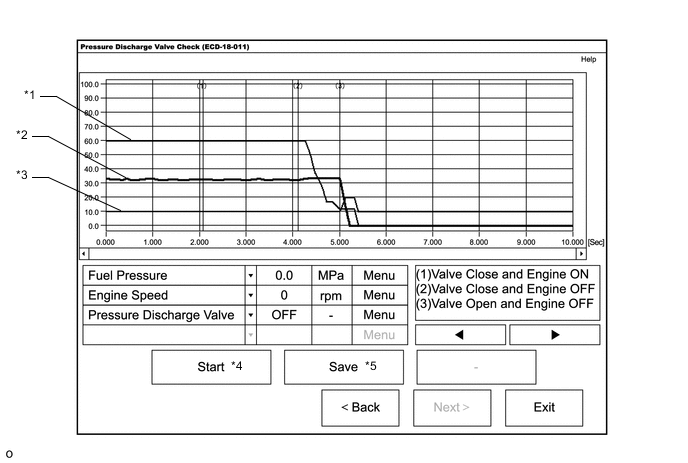
*1 Engine Speed *2 Fuel Pressure *3 Pressure Discharge Valve - -
*4: When "Start" is pressed, the pressure discharge valve check begins.
*5: If "Save" is pressed after the pressure discharge valve check, the data recorded during the valve check can be saved.
-
-
Select the check type "Close to Open Check" or "Always Closed Check".
Tech Tips
-
"Close to Open Check" opens the pressure discharge valve after the engine stops.
-
"Always Closed Check" holds the pressure discharge valve closed during the check.
-
Press "Next".
-
Perform troubleshooting based on the measurement results.
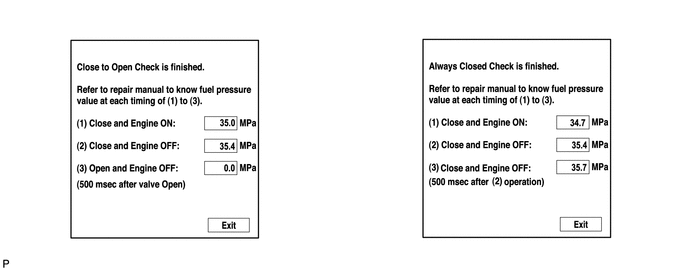
Tech Tips
-
During "Close to Open Check", if there is no large change in fuel pressure when the pressure discharge valve is closed while the engine is running and after the engine is stopped, and if the value is approximately 0 kPa when the pressure discharge valve is open, the system is normal.
-
Perform "Always Closed Check" if the value is not 0 kPa when the pressure discharge valve is open during "Close to Open Check". If the results are the same as during "Close to Open Check", there is a pressure discharge valve operation malfunction.
-
If the fuel temperature is high, perform "Pressure Discharge Valve Check" after the fuel has cooled to the outside air temperature.
-
If a large amount of fuel is leaking, the fuel pressure decreases when the engine is stopped. However, the condition of the pressure discharge valve can still be determined by comparing the measurement results of "Close to Open Check" and "Always Closed Check".
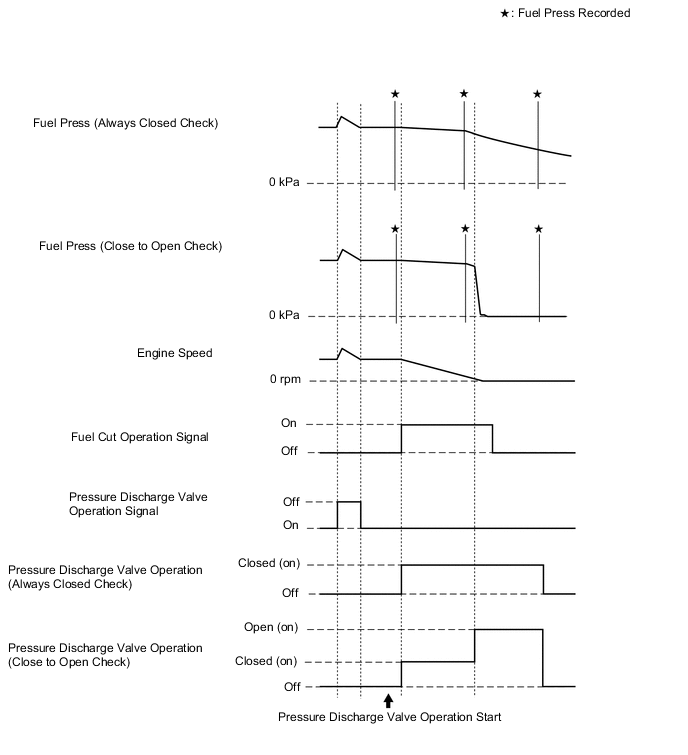
-
-
-
-