ENTRY AND START SYSTEM(for Entry Function) Room Oscillator does not Recognize Key
DESCRIPTION
If code verification cannot be performed in the vehicle interior, there may be problems with the communication between the vehicle (indoor electrical key antenna assembly (front floor), (rear floor) or (inside luggage)) and electrical key transmitter sub-assembly, or the certification ECU (smart key ECU assembly) may be malfunctioning. When the electrical key transmitter sub-assembly is brought into the vehicle, verification of the key ID code transmitted from the electrical key transmitter sub-assembly and the key ID code stored in the certification ECU (smart key ECU assembly) is performed. If verification cannot be performed or the codes do not match, the power switch cannot be turned on (IG) and the hybrid control system cannot be started.
When a door is unlocked and the electrical key transmitter sub-assembly is brought into the vehicle, the certification ECU (smart key ECU assembly) activates the indoor electrical key antenna assembly which transmits radio waves to detect the electrical key transmitter sub-assembly. If the electrical key transmitter sub-assembly recognizes that it is in the detection area, it responds with the key ID code. This information is received by the indoor electrical key antenna and then sent to the certification ECU (smart key ECU assembly).
WIRING DIAGRAM
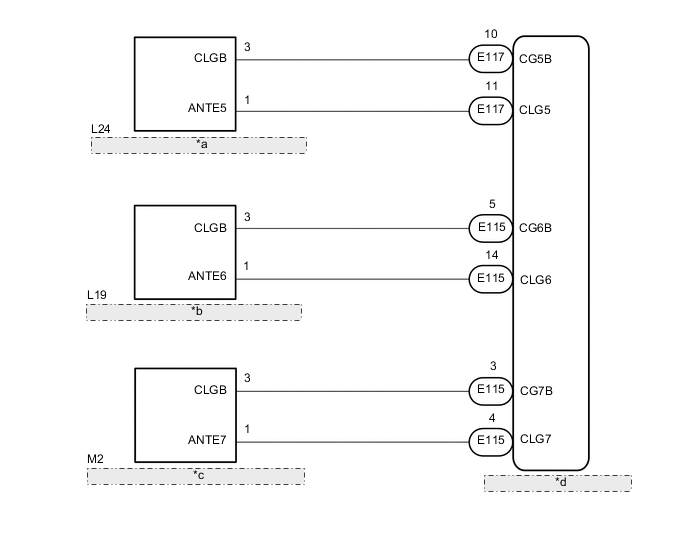
| *a | No. 1 Indoor Electrical Key Antenna Assembly (Front Floor) |
| *b | No. 2 Indoor Electrical Key Antenna Assembly (Rear Floor) |
| *c | No. 3 Indoor Electrical Key Antenna Assembly (Inside Luggage) |
| *d | Certification ECU (Smart Key ECU Assembly) |
CAUTION / NOTICE / HINT
Note
-
The entry and start system (for Entry Function) uses the LIN communication system and CAN communication system. Inspect the communication function by following How to Proceed with Troubleshooting Click here. Troubleshoot the entry and start system (for Entry Function) after confirming that the communication systems are functioning properly.
-
When using the GTS with the power switch off, connect the GTS to the DLC3 and turn a courtesy light switch on and off at intervals of 1.5 seconds or less until communication between the GTS and the vehicle begins. Then select Model Code "KEY REGIST" under manual mode and enter the following menus: Body Electrical / Entry&Start(CAN). While using the GTS, periodically turn a courtesy light switch on and off at intervals of 1.5 seconds or less to maintain communication between the GTS and the vehicle.
-
Before replacing the certification ECU (smart key ECU assembly), refer to the entry and start system (for Entry Function) precaution.
-
After repair, confirm that no DTCs are output by performing "DTC Output Confirmation Operation".
-
The indoor electrical key antenna assemblies each have an antenna coil between each two CLG terminals.
-
The door control receiver is also related to interior verification.
PROCEDURE
-
CHECK ENTRY DOOR LOCK OPERATION
-
Check that the entry lock and unlock functions operate for each door.
Tech Tips
If the door control receiver is defective, code verification does not begin in the cabin and the entry functions do not operate.
OK All door entry lock and unlock functions operate normally. Result Proceed to OK NG
NG 
GO TO OTHER PROBLEM (Proceed to Problem Symptoms Table) Click here
OK 
-
-
CHECK PUSH-BUTTON START FUNCTION
-
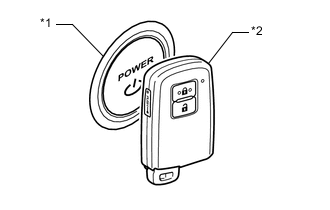
*1 Power switch *2 Electrical Key Transmitter Sub-assembly Remove the transmitter battery of the electrical key transmitter sub-assembly.
-
With the brake pedal depressed, face the logo side of the electrical key transmitter sub-assembly towards the power switch, hold the transmitter near the power switch and then press the power switch.
-
When operating the power switch, check whether the hybrid control system starts.
Tech Tips
-
When the electrical key transmitter sub-assembly cannot be verified even though it is inside the detection area, the hybrid control system start check can be performed by removing the transmitter battery from the electrical key transmitter sub-assembly and holding the electrical key transmitter sub-assembly near the power switch.
-
If the hybrid control system cannot be started when performing this inspection, the certification ECU (smart key ECU assembly), ID code box (immobiliser code ECU) may be malfunctioning.
OK Hybrid control system starts. Result Proceed to OK NG -
NG
GO TO ENTRY AND START SYSTEM (FOR START FUNCTION) Click here
OK
-
-
CHECK WAVE ENVIRONMENT
-
Install the transmitter battery to the electrical key transmitter sub-assembly.
-
Bring the electrical key transmitter sub-assembly near the No. 1 indoor electrical key antenna assembly (front floor) and perform a entry and start system check.
Note
Communication may not be possible if the electrical key transmitter sub-assembly is within 0.2 m (0.656 ft.) of the No. 1 indoor electrical key antenna assembly (front floor).
-
Bring the electrical key transmitter sub-assembly near the No. 2 indoor electrical key antenna assembly (rear floor) and perform a entry and start system check.
Tech Tips
Check that the customize status of the "Ignition Available Area" has been "All".
Note
Communication may not be possible if the electrical key transmitter sub-assembly is within 0.2 m (0.656 ft.) of the No. 2 indoor electrical key antenna assembly (rear floor).
-
Bring the electrical key transmitter sub-assembly near the No. 3 indoor electrical key antenna assembly (inside luggage) and perform a entry and start system check.
Tech Tips
Check that the customize status of the "Ignition Available Area" has been "All".
Note
Communication may not be possible if the electrical key transmitter sub-assembly is within 0.2 m (0.656 ft.) of the No. 3 indoor electrical key antenna assembly (inside luggage).
Tech Tips
-
As the effect of wave interference decreases by moving the electrical key transmitter sub-assembly close to each indoor electrical key antenna assembly, it may be possible to check whether wave interference is the cause of the problem.
-
If the inspection result is that the problem only occurs in certain locations or at certain times of day, the possibility of wave interference is high. Also, added vehicle components may cause wave interference. If installed, remove them and perform the operation check.
-
There may be wave interference if the vehicle is near broadcasting antennas, large video displays, wireless garage door opener systems, wireless security cameras, home security systems, etc. In this case, move the vehicle to a different location and check if there is any improvement.
-
If a tool for checking radio waves, such as a signal strength meter, is available, move around the area while observing both the LF band (used by the vehicle antenna to form the detection area) and RF band (used by the electrical key transmitter sub-assembly for transmission) to check for locations where there is wave interference.
Result Result Proceed to System cannot be operated A System can be operated B -
B
AFFECTED BY WAVE INTERFERENCE
A
-
-
CHECK KEY DIAGNOSTIC MODE
-
Check the following antennas in key diagnostic mode.
-
Select either channel 1 or channel 2 and perform key diagnostic mode inspection for each channel.
Tech Tips
If the buzzer sounds with [CH1] displayed but not with [CH2], the electrical key transmitter sub-assembly cannot be detected by channel 2 due to a malfunction, such as wave interference.
-
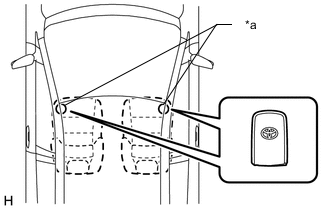
*a Inspection Point Check the No. 1 indoor electrical key antenna assembly (front floor).
When the electrical key transmitter sub-assembly is at either inspection point, check that the wireless door lock buzzer sounds.
Body Electrical > Entry&Start > UtilityTester Display Communication Check(Key Diag Mode) -
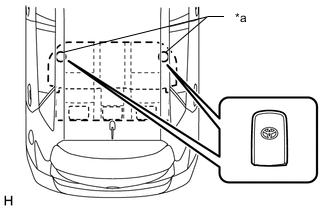
*a Inspection Point Check the No. 2 indoor electrical key antenna assembly (rear floor).
When the electrical key transmitter sub-assembly is at either inspection point, check that the wireless door lock buzzer sounds.
Body Electrical > Entry&Start > UtilityTester Display Communication Check(Key Diag Mode) -
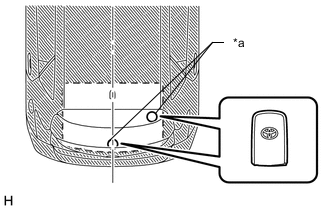
*a Inspection Point Check the No. 3 indoor electrical key antenna assembly (inside luggage):
When the electrical key transmitter sub-assembly is at either inspection point, check that the wireless door lock buzzer sounds.
Body Electrical > Entry&Start > UtilityTester Display Communication Check(Key Diag Mode) Tech Tips
-
If the buzzer sounds, it can be determined that the vehicle interior transmitters are operating normally.
-
It is possible to check which indoor electrical key antenna assembly (front floor, rear floor or inside luggage) is operating by the sounding of the buzzer.
-
If the buzzer does not sound for any indoor electrical key antenna assemblies, the certification ECU (smart key ECU assembly) circuit may be malfunctioning.
OK Wireless door lock buzzer sounds. -
Result Result Proceed to Front floor operation check fails A Rear floor operation check fails B Inside luggage operation check fails C All operation checks are normal D -
B 
CHECK HARNESS AND CONNECTOR (NO. 2 INDOOR ELECTRICAL KEY ANTENNA ASSEMBLY - CERTIFICATION ECU) Click here
C
CHECK HARNESS AND CONNECTOR (NO. 3 INDOOR ELECTRICAL KEY ANTENNA ASSEMBLY - CERTIFICATION ECU) Click here
D
REPLACE CERTIFICATION ECU (SMART KEY ECU ASSEMBLY)
A
-
-
CHECK HARNESS AND CONNECTOR (NO. 1 INDOOR ELECTRICAL KEY ANTENNA ASSEMBLY - CERTIFICATION ECU)
-
Disconnect the L24 No. 1 indoor electrical key antenna assembly (front floor) connector.
-
Disconnect the E117 certification ECU (smart key ECU assembly) connector.
-
Measure the resistance according to the value(s) in the table below.
Standard Resistance Tester Connection Condition Specified Condition L24-1 (ANTE5) - E117-11 (CLG5) Always Below 1 Ω L24-3 (CLGB) - E117-10 (CG5B) Always Below 1 Ω L24-1 (ANTE5) or E117-11 (CLG5) - Body ground Always 10 kΩ or higher L24-3 (CLGB) or E117-10 (CG5B) - Body ground Always 10 kΩ or higher Result Proceed to OK NG
NG
REPAIR OR REPLACE HARNESS OR CONNECTOR
OK
-
-
CHECK CERTIFICATION ECU (SMART KEY ECU ASSEMBLY) (OUTPUT TO NO. 1 INDOOR ELECTRICAL KEY ANTENNA)
-
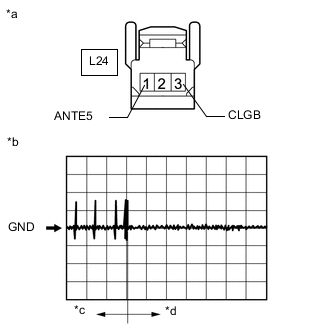
*a Front view of wire harness connector
(to No. 1 Indoor Electrical Key Antenna Assembly (Front Floor))
*b Waveform *c Within approximately 30 seconds from when the door is closed *d After approximately 30 seconds from when the door is closed Disconnect the L24 No. 1 indoor electrical key antenna assembly (front floor) connector.
-
Connect the E117 certification ECU (smart key ECU assembly) connector.
-
Using an oscilloscope, check the waveform.
OK Tester Connection Condition Tool Setting Specified Condition L24-1 (ANTE5) - L24-3 (CLGB) Procedure:
-
Power switch off
-
Electrical key transmitter sub-assembly not inside vehicle
-
Door is open
-
Door is closed
-
Within 30 seconds
2 V/DIV., 500 ms/DIV. Pulse generation
(See waveform)
Result Proceed to OK NG -
NG
REPLACE CERTIFICATION ECU (SMART KEY ECU ASSEMBLY)
OK
-
-
REPLACE NO. 1 INDOOR ELECTRICAL KEY ANTENNA ASSEMBLY (FRONT FLOOR)
-
Temporarily replace the No. 1 indoor electrical key antenna assembly (front floor) with a new or known good one.
Result Proceed to NEXT
NEXT
-
-
CHECK KEY DIAGNOSTIC MODE
-
Check the following antenna in key diagnostic mode.
-
*a Inspection Point Select either channel 1 or channel 2 and perform key diagnostic mode inspection for each channel.
Body Electrical > Entry&Start > UtilityTester Display Communication Check(Key Diag Mode) Tech Tips
If the buzzer sounds with [CH1] displayed but not with [CH2], the electrical key transmitter sub-assembly cannot be detected by channel 2 due to a malfunction, such as wave interference.
-
Check the No. 1 indoor electrical key antenna assembly (front floor). When the electrical key transmitter sub-assembly is at either inspection point, check that the wireless door lock buzzer sounds.
OK Wireless door lock buzzer sounds.
Result Proceed to OK NG -
OK
END (NO. 1 INDOOR ELECTRICAL KEY ANTENNA ASSEMBLY (FRONT FLOOR) WAS DEFECTIVE)
NG
REPLACE CERTIFICATION ECU (SMART KEY ECU ASSEMBLY)
-
-
CHECK HARNESS AND CONNECTOR (NO. 2 INDOOR ELECTRICAL KEY ANTENNA ASSEMBLY - CERTIFICATION ECU)
-
Disconnect the L19 No 2 indoor electrical key antenna assembly (rear floor) connector.
-
Disconnect the E115 certification ECU (smart key ECU assembly) connector.
-
Measure the resistance according to the value(s) in the table below.
Standard Resistance Tester Connection Condition Specified Condition L19-1 (ANTE6) - E115-14 (CLG6) Always Below 1 Ω L19-3 (CLGB) - E115-5 (CG6B) Always Below 1 Ω L19-1 (ANTE6) or E115-14 (CLG6) - Body ground Always 10 kΩ or higher L19-3 (CLGB) or E115-5 (CG6B) - Body ground Always 10 kΩ or higher Result Proceed to OK NG
NG
REPAIR OR REPLACE HARNESS OR CONNECTOR
OK
-
-
CHECK CERTIFICATION ECU (SMART KEY ECU ASSEMBLY) (OUTPUT TO NO. 2 INDOOR ELECTRICAL KEY ANTENNA)
-
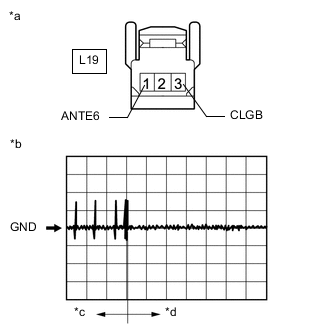
*a Front view of wire harness connector
(to No. 2 Indoor Electrical Key Antenna Assembly (Rear floor))
*b Waveform *c Within approximately 30 seconds from when the door is closed *d After approximately 30 seconds from when the door is closed Disconnect the L19 No. 2 indoor electrical key antenna assembly (rear floor) connector.
-
Connect the E115 certification ECU (smart key ECU assembly) connector.
-
Using an oscilloscope, check the waveform.
OK Tester Connection Condition Tool Setting Specified Condition L19-1 (ANTE6) - L19-3 (CLGB) Procedure:
-
Power switch off
-
Electrical key transmitter sub-assembly not inside vehicle
-
Door is open
-
Door is closed
-
Within 30 seconds
2 V/DIV., 500 ms/DIV. Pulse generation
(See waveform)
Result Proceed to OK NG -
NG
REPLACE CERTIFICATION ECU (SMART KEY ECU ASSEMBLY)
OK
-
-
REPLACE NO. 2 INDOOR ELECTRICAL KEY ANTENNA ASSEMBLY (REAR FLOOR)
-
Temporarily replace the No. 2 indoor electrical key antenna assembly (rear floor) with a new or known good one.
Result Proceed to NEXT
NEXT
-
-
CHECK KEY DIAGNOSTIC MODE
-
Check the following antenna in key diagnostic mode.
-
*a Inspection Point Select either channel 1 or channel 2 and perform key diagnostic mode inspection for each channel.
Body Electrical > Entry&Start > UtilityTester Display Communication Check(Key Diag Mode) Tech Tips
If the buzzer sounds with [CH1] displayed but not with [CH2], the electrical key transmitter sub-assembly cannot be detected by channel 2 due to a malfunction, such as wave interference.
-
Check the No. 2 indoor electrical key antenna assembly (rear floor). When the electrical key transmitter sub-assembly is at either inspection point, check that the wireless door lock buzzer sounds.
OK Wireless door lock buzzer sounds.
Result Proceed to OK NG -
OK
END (NO. 2 INDOOR ELECTRICAL KEY ANTENNA ASSEMBLY (REAR FLOOR) WAS DEFECTIVE)
NG
REPLACE CERTIFICATION ECU (SMART KEY ECU ASSEMBLY)
-
-
CHECK HARNESS AND CONNECTOR (NO. 3 INDOOR ELECTRICAL KEY ANTENNA ASSEMBLY - CERTIFICATION ECU)
-
Disconnect the M2 No. 3 indoor electrical key antenna assembly (inside luggage) connector.
-
Disconnect the E115 certification ECU (smart key ECU assembly) connector.
-
Measure the resistance according to the value(s) in the table below.
Standard Resistance Tester Connection Condition Specified Condition M2-1 (ANTE7) - E115-4 (CLG7) Always Below 1 Ω M2-3 (CLGB) - E115-3 (CG7B) Always Below 1 Ω M2-1 (ANTE7) or E115-4 (CLG7) - Body ground Always 10 kΩ or higher M2-3 (CLGB) or E115-3 (CG7B) - Body ground Always 10 kΩ or higher Result Proceed to OK NG
NG
REPAIR OR REPLACE HARNESS OR CONNECTOR
OK
-
-
CHECK CERTIFICATION ECU (SMART KEY ECU ASSEMBLY) (OUTPUT TO NO. 3 INDOOR ELECTRICAL KEY ANTENNA)
-
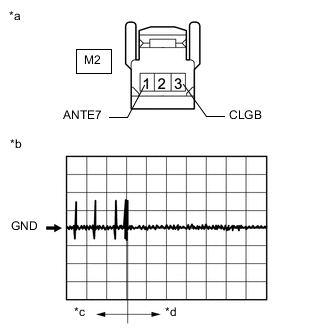
*a Front view of wire harness connector
(to No. 3 Indoor Electrical Key Antenna Assembly (Inside luggage))
*b Waveform *c Within approximately 30 seconds from when the door is closed *d After approximately 30 seconds from when the door is closed Disconnect the M2 No. 3 indoor electrical key antenna assembly (inside luggage) connector.
-
Connect the E115 certification ECU (smart key ECU assembly) connector.
-
Using an oscilloscope, check the waveform.
OK Tester Connection Condition Tool Setting Specified Condition M2-1 (ANTE7) - M2-3 (CLGB) Procedure:
-
Power switch off
-
Electrical key transmitter sub-assembly not inside vehicle
-
Door is open
-
Door is closed
-
Within 30 seconds
2 V/DIV., 500 ms/DIV. Pulse generation
(See waveform)
Result Proceed to OK NG -
NG
REPLACE CERTIFICATION ECU (SMART KEY ECU ASSEMBLY)
OK
-
-
REPLACE NO. 3 INDOOR ELECTRICAL KEY ANTENNA ASSEMBLY (INSIDE LUGGAGE)
-
Temporarily replace the No. 3 indoor electrical key antenna assembly (inside luggage) with a new or known good one.
Result Proceed to NEXT
NEXT
-
-
CHECK KEY DIAGNOSTIC MODE
-
Check the following antenna in key diagnostic mode.
-
*a Inspection Point Select either channel 1 or channel 2 and perform the key diagnostic mode inspection for each channel.
Body Electrical > Entry&Start > UtilityTester Display Communication Check(Key Diag Mode) Tech Tips
If the buzzer sounds with [CH1] displayed but not with [CH2], the electrical key transmitter sub-assembly cannot be detected by channel 2 due to a malfunction, such as wave interference.
-
Check the No. 3 indoor electrical key antenna assembly (inside luggage). When the electrical key transmitter sub-assembly is at either inspection point, check that the wireless door lock buzzer sounds.
OK Wireless door lock buzzer sounds.
Result Proceed to OK NG -
OK
END (NO. 3 INDOOR ELECTRICAL KEY ANTENNA ASSEMBLY (INSIDE LUGGAGE))
NG
REPLACE CERTIFICATION ECU (SMART KEY ECU ASSEMBLY)
-