AUTOMATIC HIGH BEAM SYSTEM PRECAUTION
-
Note
When disconnecting the cable from the negative (-) auxiliary battery terminal, initialize the following systems after the cable is reconnected.
System See Procedure Simple Intelligent Parking Assist System Power Door Lock Control System PRECAUTION FOR DISCONNECTING THE AUXILIARY BATTERY CABLE
-
PRECAUTION FOR AUTOMATIC HIGH BEAM SYSTEM
-
General Description
The automatic high beam system is a system that helps ensure visibility by automatically turning the high beam headlights on and off. Additionally, due to control limitations of the automatic high beam system, it may be necessary to manually turn the high beam headlights on and off. For safety reasons, make sure to turn the high beam headlights on and off manually according to the driving conditions.
-
Conditions Unsuitable for Using Automatic High Beam System
Under the following conditions, the automatic high beam system might not detect other vehicles or lights correctly, or the high beam headlights might cause glare or flash pedestrians or the occupants of other vehicles. Manual operation should be considered.
Factor Condition Weather/Climate When driving in bad weather (rain, snow, fog, sandstorms, etc.). Front windshield
-
When the windshield glass is not clear (ice, snow or frost on the glass).
-
When the windshield glass is dirty (sand, mud, water stains or bugs on the glass).
-
When the windshield glass is cracked.
-
When the windshield glass is fogged-up.
-
When the windshield glass has a film attached.
-
When an object on the instrument panel reflects off of the windshield glass.
-
When any other abnormal conditions exist with the windshield glass.
Pre-crash safety city sensor
-
When the pre-crash safety city sensor is deformed.
-
When the pre-crash safety city sensor is dirty.
-
When any other abnormal conditions exist with the pre-crash safety city sensor.
Nearby vehicles or lights
-
When lights similar to headlights or taillights are in the vicinity of the vehicle.
-
When a nearby vehicle has no lights or its lights are off.
-
When a vehicle in front has misaligned lights, or its lights are changing color.
-
When a vehicle in front has extremely dirty headlights or taillights.
Road conditions
-
When driving in areas where the conditions often change between bright and dark.
-
When driving on hilly roads.
-
When driving on winding roads or around sharp curves.
-
When driving on bumpy roads (cobblestone paving, gravel roads, rough unpaved roads, etc.).
-
When highly reflective objects are in front of the vehicle (mirrors, road signs, etc.).
Own vehicle
-
When the headlights are damaged, deformed or dirty.
-
When the vehicle posture is abnormal (posture has changed due to the vehicle being fully loaded, a trailer being towed, road conditions etc.).
-
When the vehicle has other malfunctions or it has been modified.
Automatic high beam system Malfunction:
When the automatic high beam indicator light on the combination meter assembly is off and "Headlight System Malfunction Visit Your Dealer" is displayed on the multi-information display.
Others:
-
When the automatic high beam system does not seem to be turning the high beam headlights on and off properly.
-
When the automatic high beam system is frequently turning the high beam headlights on and off.
-
When the glare from the high beam headlights would disturb pedestrians or the drivers of other vehicles.
-
-
Windshield Replacement Precautions
The timing of the high beam headlights turning on and off differs depending on the light transmission rate of the glass. For this reason, when replacing the windshield, replace it with an original equipment part.
-
Pre-crash Safety City Sensor Handling Precautions
Failure to observe the following precautions may result in a malfunction:
-
Do not touch the lens of the pre-crash safety city sensor with bare hands.
-
Do not allow anything to adhere to the pre-crash safety city sensor lens.
-
Do not apply strong impacts to the pre-crash safety city sensor.
-
Do not allow any liquid to contact the pre-crash safety city sensor.
-
Do not apply excessive force when installing or removing the pre-crash safety city sensor. Doing so may deform the pre-crash safety city sensor bracket.
-
Do not use a damaged pre-crash safety city sensor.
-
Replace the windshield glass if the pre-crash safety city sensor bracket is deformed or damaged.
-
Do not use a pre-crash safety city sensor that has been dropped.
-
Make sure to wear clean cotton gloves or equivalent when removing and installing the pre-crash safety city sensor as it will not function properly if oil adheres to a part.
-
Do not pull on the wire harness when disconnecting the pre-crash safety city sensor connector.
-
-
Precaution For Replacing Pre-crash Safety City Sensor
-
If the pre-crash safety city sensor has been replaced, or the windshield glass has been replaced or removed/installed, be sure to perform Recognition Camera/Target Position Memory and Recognition Camera Axis Adjust. If not performed, DTC will be stored when the system is turned on.
-
When replacing the pre-crash safety city sensor, replace it with a new one. If a pre-crash safety city sensor which was installed to another vehicle is used, the information stored in the pre-crash safety city sensor will not match the information from the vehicle and, as a result, a DTC may be stored.
-
-
-
PRECAUTION FOR REPLACING WINDSHIELD GLASS
-
When replacing the windshield glass of a vehicle equipped with a pre-crash safety city sensor, make sure to use a Toyota genuine part. If a non-Toyota genuine part is used, the pre-crash safety city sensor may not be able to be installed due to a missing bracket or the pre-crash safety system may not operate properly due to a difference in the transmissivity or black ceramic border.
-
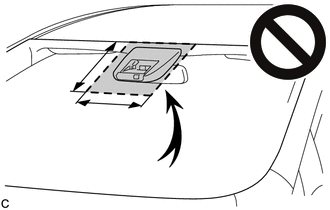
Do not attach stickers, including transparent stickers, or other items to the outer side of the windshield glass within the area shown in the illustration in front of the pre-crash safety city sensor.
-
Vertical range: from the top of the windshield glass to approximately 10 cm (3.94 in.) below the bottom of the pre-crash safety city sensor.
-
Horizontal range: approximately 10 cm (3.94 in.) to the left and right of the center of the pre-crash safety city sensor.
-
-
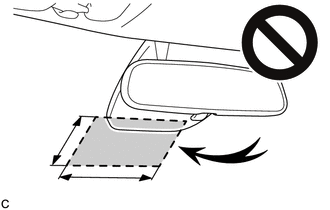
Do not install or attach anything to the inner side of the windshield glass within the area shown in the illustration below the pre-crash safety city sensor.
-
Vertical range: from the bottom of the pre-crash safety city sensor to approximately 10 cm (3.94 in.) below the pre-crash safety city sensor.
-
Horizontal range: approximately 10 cm (3.94 in.) to the left and right of the center of the pre-crash safety city sensor.
-
-
Do not attach window tint to the windshield glass.
-