ГОЛОВКА БЛОКА ЦИЛИНДРОВ РЕМОНТ

PROCEDURE
-
REPAIR INTAKE VALVE SEAT
Note
-
Repair the seat while checking the seating position.
-
Keep the lip free of foreign matter.
-
Take off the cutter gradually to make the intake valve seat smooth.
-
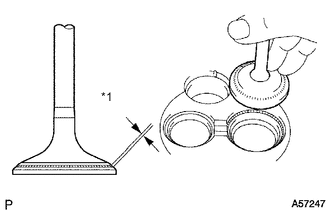
Text in Illustration *1 Width Check the valve seating position.
-
Apply a light coat of Prussian blue to the valve face.
-
Lightly press the valve against the seat. Do not rotate valve.
-
If blue appears 360° around the face, the valve is concentric. If not, replace the valve.
-
If blue appears 360° around the valve seat, the guide and face are concentric. If not, resurface the seat.
-
Check that the seat contact is the middle of the valve face with the width below.
Standard width 1.5 to 1.9 mm (0.0591 to 0.0748 in.)
-
-
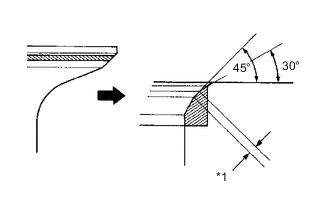
Text in Illustration *1 Width If the seating is too high on the valve face, use 30° and 45° cutters to correct the seat.
-
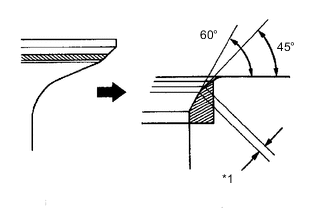
Text in Illustration *1 Width If the seating is too low on the valve face, use 60° and 45° cutters to correct the seat.
-
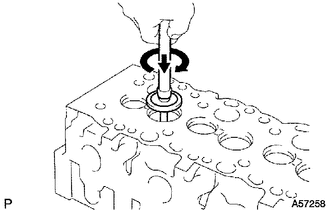
Hand-lap the valve and valve seat with an abrasive compound.
-
Clean the valve and valve seat.
-
-
REPAIR EXHAUST VALVE SEAT
Note
-
Repair the seat while checking the seating position.
-
Keep the lip free of foreign matter.
-
Take off the cutter gradually to make the exhaust valve seat smooth.
-
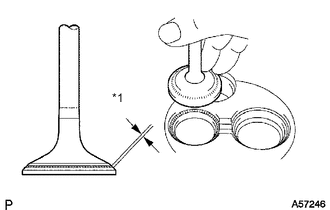
Text in Illustration *1 Width Check the valve seating position.
-
Apply a light coat of Prussian blue to the valve face.
-
Lightly press the valve against the seat. Do not rotate valve.
-
Prussian blue appears 360° around the face, the valve is concentric. If not, replace the valve.
-
Prussian blue appears 360° around the valve seat, the guide and face are concentric. If not, resurface the seat.
-
Check that the seat contact is the middle of the valve face with the width below.
Standard width 1.8 to 2.2 mm (0.0709 to 0.0866 in.)
-
-
Text in Illustration *1 Width If the seating is too high on the valve face, use 30° and 45° cutters to correct the seat.
-
Text in Illustration *1 Width If the seating is too low on the valve face, use 60° and 45° cutters to correct the seat.
-
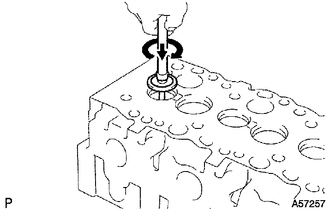
Hand-lap the valve and valve seat with an abrasive compound.
-
Clean the valve and valve seat.
-