OCCUPANT CLASSIFICATION SYSTEM (for TMMK Made) INITIALIZATION
Note
Make sure that the front passenger seat is not occupied before performing the operation.
Tech Tips
Perform zero point calibration and sensitivity check if any of the following conditions occur:
-
The occupant detection ECU is replaced.
-
Accessories (seatback tray and seat cover, etc.) are installed.
-
The front passenger seat is removed from the vehicle.
-
One of the bolts that install the front passenger seat is removed.
-
The passenger airbag ON/OFF indicator ("ON") comes on when the front passenger seat is not occupied.
-
The vehicle is brought to the workshop for repair due to an accident or a collision.
-
ZERO POINT CALIBRATION AND SENSITIVITY CHECK
-
Zero point calibration and sensitivity check procedure
-
Check that both of the following conditions are met:
-
The vehicle is parked on a level surface.
-
No objects are placed on the front passenger seat.
-
-
Adjust the seat position according to the table below.
Adjustment Item Position Slide Direction Rearmost position Headrest Height Lowest position Recline Angle Upright position -
Turn the engine switch off.
-
Connect the GTS to the DLC3.
-
Turn the engine switch on (IG).
-
Turn the GTS on.
-
Enter the following menus: Body Electrical / Occupant Detection / Utility / Zero Point Calibration & Sensitivity Check.
-
Perform zero point calibration and sensitivity check by following the prompts on the GTS screen.
Note
Place the weight in the area shown in the illustration.
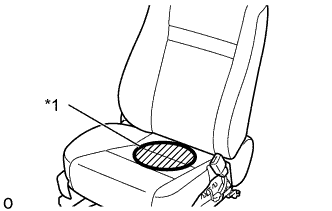
Text in Illustration *1 Weight Position Tech Tips
-
When performing sensitivity check, use a solid metal weight (the check result may not appear properly if a liquid weight is used).
-
Refer to the GTS operator's manual for further details.
-
If zero point calibration does not complete, replace the front seat frame with adjuster assembly RH.
-
When performing sensitivity check, place the weight on the seat cushion so that it contacts the seatback.
-
If sensitivity deviates from the specified range, retighten the bolts of the front passenger seat without deforming the seat rail. After performing this procedure, if sensitivity is not within the specified range, replace the front seat frame with adjuster assembly RH.
-
-
-